
Artificial Intelligence and Machine Learning aren’t just fancy jargon anymore—they’re tools sharp enough to slice right through old ways of doing business. But here’s the catch—not every so-called AI/ML “expert” can pull off what they promise.
Pick the wrong one, and your project could stall, your budget could vanish, and your data… well, let’s just say you won’t sleep easily. The right partner, though? They can flip the switch—open doors to fresh revenue, trim the fat off your processes, and hand you a lead your competitors won’t see coming.
Vetting your [AI/ML development company](https://appzoro.com/services/ai-and-ml-development-company-usa) isn’t some box you tick and move on. It’s a move that can make or break the whole game. And it starts with questions—the kind that dig deeper than code and algorithms. Questions that show if they can see your bigger picture, read between the lines of your industry quirks, and turn all that talk into results you can measure, not just imagine.
## Why Choosing the Right AI/ML Partner Matters
The success of any AI/ML initiative is tightly linked to who you trust to execute it. You’re not just buying code or algorithms—you’re investing in someone’s ability to translate complex data into practical, scalable solutions.
A provider’s domain knowledge dictates how quickly they can adapt to your industry’s unique challenges. Their data handling capabilities determine whether your project will remain compliant and secure. And their deployment experience decides if the end product will actually work in a real-world setting—or remain a nice demo on a presentation slide.
This is why companies turn to How an AI/ML Development Company Accelerates Business Automation for insights before making a choice.
## Questions About Business Understanding
### Have you worked with companies in our industry?
A provider who’s already navigated your industry’s landscape comes equipped with invaluable context—regulatory frameworks, customer behavior patterns, operational bottlenecks. That’s half the battle won.
If they can show you past projects with tangible results, that’s a sign they understand the market forces you’re up against. It also means they’re more likely to avoid rookie mistakes.
### How do you approach problem discovery and solution design?
AI is not magic. It doesn’t solve “everything” just because you apply a model to it. The real value comes from how a provider approaches problem discovery.
Do they spend time diagnosing root causes? Or do they jump straight into coding? Look for a partner who starts with strategic questioning, maps out the entire business process, and only then proposes a solution. This ensures the tech serves the business—not the other way around.
For perspective, review Choose the Right AI/ML Development Company for Your Business to understand this alignment.
## Questions About Technical Expertise
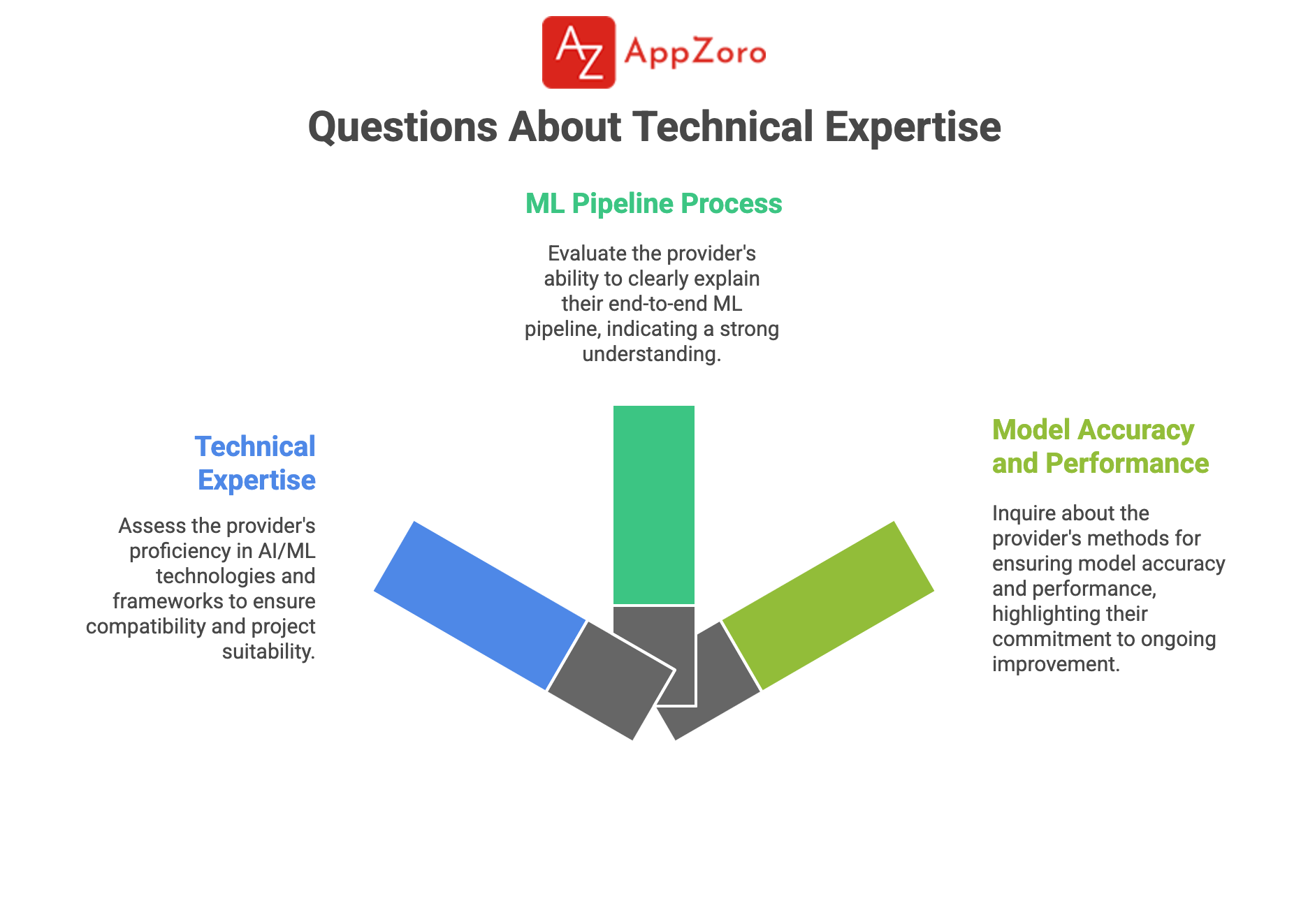
### What AI/ML technologies and frameworks do you specialize in?
Your tech stack shouldn’t be a mystery to your provider. Whether it’s TensorFlow, PyTorch, Scikit-learn, or more specialized frameworks, they should be fluent in the tools that best suit your project.
Compatibility matters. If their stack conflicts with your existing infrastructure, you’re looking at integration nightmares.
### Can you explain your end-to-end ML pipeline process?
A strong provider should be able to walk you through their process—data gathering, preprocessing, model selection, training, validation, and deployment.
Watch how they lay it out for you. Do they break it down clean, step by step—or does it melt into a messy puddle of jargon?
Because when someone can explain it simply, it’s a dead giveaway—they understand what they are up to.
### How do you ensure model accuracy and performance?
This is where you separate amateurs from seasoned experts. Accuracy is not a one-time achievement—it’s an ongoing responsibility.
Ask about their testing protocols, retraining cycles, and monitoring tools. Reliable partners will talk about precision, recall, F1-scores, and real-time performance tracking without hesitation.
## Questions About Data Handling
### How do you manage data privacy and compliance?
Regulations like GDPR, HIPAA, and industry-specific policies aren’t optional—they’re mandatory. A misstep here can cost millions in fines and damage your reputation.
Look for providers who have compliance baked into their development process. They should know exactly how they anonymize, encrypt, and store sensitive data.
You’ll find examples of these practices in [AI/ML Development Services](https://appzoro.com/blog/ai-ml-development-services-what-smart-businesses-need-to-know): What Businesses Should Watch For!.
### What is your approach to bias mitigation in AI models?
AI models inherit the biases in their training data. Left unchecked, they can produce skewed or even discriminatory outcomes.
A serious provider will have strategies—balanced datasets, fairness constraints, continuous bias testing—to address this. And they should be open to discussing them.
## Questions About Project Management and Delivery
### What is your typical project timeline and engagement model?
Be it agile sprints, waterfall milestones, or some messy hybrid in between—the approach shapes how fast things move and how easily they can bend without breaking.
Make sure their approach fits your organization’s workflow. A mismatch here can cause delays and misunderstandings.
### How do you handle changes in scope or requirements?
Business needs evolve. The model you thought you needed six months ago might not be the model you need now.
Find out how they handle shifting priorities—without spiraling into budget overruns. Clear change management protocols are a must.
### Can you provide documentation and model explainability?
AI models can become black boxes if they’re not documented well. If your internal team can’t understand how it works, you’ll struggle to maintain it.
Insist on full documentation, along with explainability reports that clarify model decisions. This is especially crucial in regulated industries.
## Questions About Support and Scaling
### Do you offer post-deployment support and maintenance?
AI models degrade over time if left unattended. Algorithms need tuning. Datasets need updating.
Ask whether they offer ongoing support—bug fixes, performance monitoring, and version upgrades.
### How do you handle model retraining as new data comes in?
A static model will eventually fail. Your provider should have a retraining pipeline that can adapt to fresh data without starting from scratch.
This is where scalability comes into play. Go with [AI/ML development solutions](https://appzoro.com/blog/ai-ml-development-solutions-that-drive-business-growth) that drive business growth—more users, more data, more complexity.
## Red Flags to Watch Out For
Some signs are hard to ignore:
Vague answers to technical or strategic questions.
Overpromising unrealistic results (“100% accuracy”).
No case studies or proof of past work.
Avoiding discussions on compliance or bias.
These are the providers who might impress you in the first meeting—but cost you dearly down the line.
## Final Thoughts
Asking the right questions is not about interrogation—it’s about building clarity and trust. The right AI/ML partner will see beyond the code. They will aim to solve your real business challenges, not just ship a model.
Keep this checklist close. Use it to evaluate every potential vendor. Because the future of your AI/ML initiative depends less on the technology itself—and more on the people who build it.