
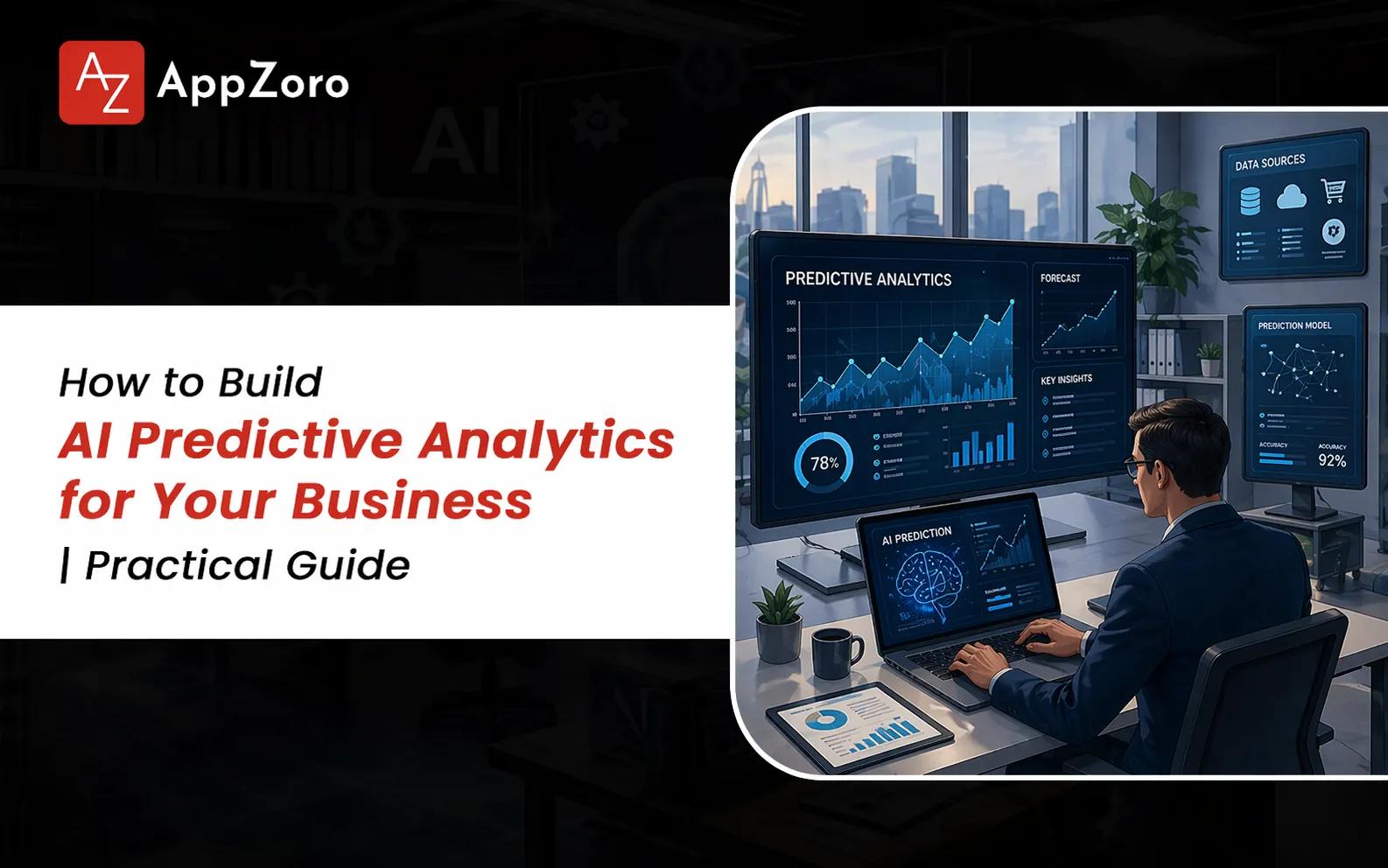
So you've heard about AI predictive analytics, you've seen the hype and now you're trying to figure out how to actually build it inside your own business without blowing up the budget or the timeline. Good news, this guide walks you through every step, with real cost estimates, real techniques and the specific decisions you'll face along the way. The practical walk-through you'd get from a senior ML engineer who has shipped production predictive systems before across multiple industries.
What Is AI Predictive Analytics in Simple Terms?
AI predictive analytics is the practice of using machine learning and deep learning to forecast what will happen next based on historical data, rather than just reporting on what already happened inside the business. Classical predictive analytics relied on statistical techniques like ARIMA and linear regression, which still work well for simple trend forecasting but struggle with nonlinear patterns and messy unstructured data sources today. AI predictive analytics extends that toolkit with gradient boosting, neural networks, transformer-based time-series models and large language models that parse unstructured text alongside tabular features for richer predictions across every workflow.
Think of it this way: your spreadsheet-based forecast tells you that sales went up last month, while an AI predictive analytics pipeline tells you which customers are likely to churn next month, which machines are likely to fail next week and which transactions are likely fraudulent in the next five minutes during live operation.
Why AI Predictive Analytics Matters More in 2026 Than Ever Before
Three shifts have turned AI predictive analytics from experimental capability into essential business infrastructure over the past twenty-four months across every major vertical worldwide today.
Compute Is Cheap Now: GPUs, managed model hosting and serverless inference have driven the cost of running production AI predictive analytics down by roughly seventy percent compared to 2021 baseline spending.
Models Are Mature: XGBoost, transformer-based time-series models and generative AI now produce production-ready accuracy on most tabular and sequential problems without requiring a dedicated research team.
Tooling Has Matured: Databricks, Snowflake, SageMaker and specialized vendors ship end-to-end AI predictive analytics platforms that let small teams ship production models faster than ever before today.
Gartner now estimates that over seventy-five percent of enterprises have moved at least one AI predictive analytics workload into production, up from roughly thirty percent just four years ago. The global predictive analytics market is projected to exceed sixty-seven billion dollars by 2030, which is exactly why data leaders across every category are investing now rather than waiting for the category to mature further. If you want a sense of what real AI budgets look like across categories, our AI development costs comprehensive breakdown walks through every price point across pilots, mid-market programs and enterprise platforms in real detail.
7 Step Process to Build AI Predictive Analytics With Real Cost Estimation
Here is the step-by-step process we walk our clients through at AppZoro when they want to build their first production AI predictive analytics capability from scratch across realistic twelve to twenty-week timelines in practice.
Step 1: Audit Your Data (Cost Estimate: $5,000 – $25,000)
Before you touch a single model, you need an honest audit of what data you have, where it lives and how clean it actually is across every relevant system in the business. Most teams discover that roughly forty to sixty percent of their historical data needs cleaning, deduplication or schema alignment before it can feed an AI predictive analytics pipeline reliably.
Inventory Every Source: Catalog every transactional database, data warehouse, log system and third-party data feed that could contribute features to the eventual predictive model inside the business.
Check Data Quality: Run profiling across missing values, duplicates, outliers and schema drift so you know exactly what engineering work is required before modeling starts inside the program.
Document Business Events: Map which real-world events produce which data rows so that feature engineering later accurately reflects the underlying business process being modeled across every table.
Step 2: Pick One Use Case That Actually Moves a Metric (Cost Estimate: $0 – $10,000)
The second step is scoping - and this is where most programs quietly fail before they even start because leaders pick vague "transformation" goals instead of one measurable business decision to target.
Choose a Decision, Not a Dashboard: Pick a use case where the AI predictive analytics output directly drives a specific business action, like routing a ticket, triggering a retention campaign or flagging a transaction.
Measure the Status Quo: Document current accuracy, error rates or manual-process time so you have a real baseline to measure the AI predictive analytics improvement against later during program reviews.
Estimate the Business Value: If a ten percent accuracy improvement on this use case produces less than six figures of annual value, pick a different use case where the economics actually justify investment instead.
Step 3: Choose Your AI Technique and Model Architecture (Cost Estimate: $5,000 – $20,000)
This is the step most people overweight, because in practice the right model usually emerges from a short bake-off rather than from a long architectural debate inside conference rooms every week.
Start With Gradient Boosting: XGBoost, LightGBM or CatBoost handle roughly seventy percent of tabular AI predictive analytics problems with excellent accuracy and strong interpretability across most business use cases consistently.
Layer In Deep Learning Only If Needed: LSTMs, Temporal Convolutional Networks and transformer-based time-series models shine for complex sequential data, high-dimensional inputs or problems with genuine nonlinearity across long histories.
Use LLMs for Unstructured Features: Large language models parse tickets, reviews, notes and documents into structured features that enhance traditional tabular models inside modern AI and predictive analytics pipelines today.
Step 4: Build the Data and Feature Pipeline (Cost Estimate: $25,000 – $150,000)
Feature engineering is where the real engineering effort lands and it is typically the biggest cost center across any serious AI predictive analytics build inside the first twelve months of program operation.
Set Up a Feature Store: Feast, Tecton or a managed feature store from Databricks or Vertex AI gives you reusable features across models and prevents training-serving skew between production and training systems.
Build Automated Pipelines: Use Airflow, Dagster or Databricks Workflows to schedule data ingestion, cleaning and feature computation without manual intervention across every training cycle consistently over time.
Handle Real-Time Features: If your AI predictive analytics use case needs real-time predictions, you also need streaming feature computation, which roughly doubles the pipeline cost compared to batch-only approaches.
Step 5: Train, Evaluate and Deploy Your First Model (Cost Estimate: $15,000 – $50,000)
With clean data and good features, actual training is surprisingly fast - usually a matter of weeks rather than months for a first production model across standard predictive analytics AI use cases today.
Hold Out a Real Test Set: Reserve the last few months of data as a temporal holdout so you can validate the AI predictive analytics model against genuinely unseen future data patterns reliably in production.
Run a Real Bake-Off: Compare three or four candidate models (XGBoost, a transformer and one baseline) on the same holdout set and pick based on accuracy plus operational constraints inside your stack.
Deploy Behind a Real Endpoint: Ship the model as a REST API using SageMaker, Vertex AI, BentoML or KServe so that downstream applications can actually call it inside production workflows reliably.
Step 6: Monitor, Detect Drift and Retrain ($5,000 – $25,000 per Month)
Models degrade silently, which is why monitoring determines whether your AI predictive analytics capability survives its first year in production or quietly starts producing garbage predictions that nobody catches inside the organization.
Track Every Prediction: Log inputs, outputs and model versions for every single prediction so you can investigate accuracy problems months later when business metrics start drifting without warning.
Automate Drift Detection: Evidently, Arize, WhyLabs or Fiddler continuously monitor input and output distributions and alert the team when the model starts behaving outside its original operating range.
Schedule Regular Retraining: Retrain on fresh data monthly or quarterly depending on how fast the underlying business changes and always backtest the new model before promoting it to production safely.
Step 7: Integrate Predictions Into Real Decisions (Cost Estimate: $10,000 – $40,000)
The final step is where most AI predictive analytics programs succeed or fail, because a prediction that lives on a dashboard is not a business capability; it is a research artifact inside the analytics team quietly.
Wire Into Operational Systems: Route predictions into CRM, ERP, ticketing, marketing automation or on-call tooling so that the AI output actually drives the action it was designed for consistently.
Design Human Workflows: Show the prediction alongside the supporting evidence so that human operators can act confidently or override the prediction when business context warrants it clearly every time.
Measure Business Outcomes: Track the real-world outcome (retention saved, revenue gained, outages avoided) for every action taken on an AI predictive analytics prediction across every single week reliably.
Want to talk through which use case fits your business best before you spin up a team? Our AI app development company and custom software development company in the USA teams have walked dozens of clients through exactly this framework from scratch across industries.
The 10 Most Impactful AI for Predictive Analytics Use Cases
Now that you've seen the process, let's look at the use cases where AI for predictive analytics delivers real measurable value across industries in 2026 across every mature operating environment.
Use Cases Every Business Should Evaluate First
Demand Forecasting: AI predictive analytics models forecast product and service demand with significantly better accuracy than classical seasonal decomposition across most retail and manufacturing categories consistently every planning cycle.
Churn Prediction: Classification models surface customers likely to leave so retention teams can act before the customer actually cancels their subscription or transfers their account elsewhere across industries.
Fraud Detection: Real-time AI predictive analytics stops suspicious transactions before losses occur, which saves financial institutions billions of dollars annually across every major market globally every year.
Predictive Maintenance: Sensor-driven AI predicts equipment failures before they happen, reducing unplanned downtime across manufacturing, transportation and utilities at meaningful scale every single year consistently.
AI for Preventing Outages: AI for preventing outages with predictive analytics uses observability data to flag emerging failures minutes or hours before traditional alerts fire inside production environments reliably.
Industry-Specific Applications Worth Knowing About
Credit Risk Scoring: AI predictive analytics improves credit decisions by capturing nonlinear patterns in alternative data while preserving the explainability that regulators require across every jurisdiction consistently worldwide.
Clinical Risk Stratification: Hospitals use AI predictive analytics to forecast readmissions, sepsis and deterioration, which measurably improves patient outcomes and reduces avoidable cost across care settings every day.
Marketing and Sales Forecasting: AI models predict conversion probability, customer lifetime value and campaign response rates across digital and offline channels every single quarter reliably for revenue teams.
Supply Chain Risk: AI predictive analytics flags delivery delays and supplier disruptions before they cascade through the supply chain into stockouts and missed customer commitments consistently across global markets.
Energy and Utilities Optimization: AI forecasts grid demand, renewable generation and equipment degradation across utility operations at scale across every major geography and operating environment consistently every hour.
Our guide on AI predictive analytics in healthcare goes deep on one of the highest-impact verticals, covering the clinical, operational and regulatory nuances specific to hospital and payer deployments across real production systems today.
How Does AI for Preventing Outages With Predictive Analytics Actually Work?
This is one of the most asked questions we get, so let's walk through exactly what AI for preventing outages with predictive analytics looks like when it actually works in production across modern IT operations teams.
Collect Everything: Logs, metrics and traces from every production system flow into a centralized observability platform where the AI predictive analytics models can train on historical incident patterns reliably.
Build a Baseline: Simple statistical thresholds and anomaly detectors catch the obvious signals and serve as a benchmark against which the deep learning models must actually beat accuracy meaningfully.
Train the AI Model: LSTMs, transformers and graph neural networks learn from labeled historical incidents to predict emerging failures minutes or hours before traditional alerts fire reliably inside production.
Act on Predictions: Predictions route into on-call tooling, automated remediation and incident response playbooks so that the AI prediction actually triggers a real response from SRE teams consistently.
Close the Feedback Loop: Every new incident retrains the model so that the AI predictive analytics capability improves each quarter as the system sees more labeled failure patterns across production.
The teams that succeed treat outage prediction as a closed-loop system (prediction plus action plus feedback) rather than a dashboard that engineers glance at occasionally when things feel unusually quiet inside production operations.
AI vs Predictive Analytics: The Clear Difference
Executives get confused on this point all the time, so here is the clearest possible explanation of AI vs predictive analytics without the vendor marketing spin attached to every piece of collateral.
Predictive Analytics Is the Discipline: Using historical data to forecast future outcomes, which covers everything from spreadsheet regressions to transformer-based forecasting models across every business use case in the enterprise.
AI Is the Technology Family: Machine learning, deep learning and generative AI, which you can apply to predictive analytics, natural language processing, computer vision and many other application areas across the enterprise.
AI Predictive Analytics Is the Intersection: Using AI techniques to power predictive analytics workloads, which is what most organizations actually mean when they talk about modernizing their analytics capability today inside the business.
Treat predictive analytics and AI as complementary rather than competing, because modern production stacks blend simple statistical models for easy problems with deep learning for hard ones across the same organization every day.
AI-Powered Predictive Analytics Techniques You Should Know
Here are the core techniques that power AI-powered predictive analytics across modern production systems, with guidance on when each technique is actually the right choice for a real business problem.
Workhorse Techniques for Most Business Problems
Gradient Boosted Trees: XGBoost, LightGBM and CatBoost dominate tabular AI predictive analytics work because they balance accuracy, interpretability and training efficiency better than most deep learning alternatives today consistently.
Classical Time-Series Methods: ARIMA, Prophet and exponential smoothing still outperform deep learning on small-sample forecasting problems and give you interpretable baselines for every production rollout reliably across teams.
Anomaly Detection: Isolation forests, autoencoders and contrastive learning surface unusual patterns across sensors, logs and transactions for downstream investigation inside predictive analytics AI pipelines consistently every day.
Advanced Techniques Worth Knowing
Deep Learning for Sequences: LSTMs, Temporal Convolutional Networks and transformer-based time-series models (Informer, PatchTST) outperform classical methods on complex forecasting problems with sufficient historical data consistently over time.
Graph Neural Networks: GNNs model relationships across entities (customers, products, networks) and unlock AI predictive analytics use cases that tabular models simply cannot express inside the same feature space meaningfully.
Causal Inference: DoWhy, EconML and modern causal methods extend AI predictive analytics from correlation into counterfactual reasoning, which matters inside marketing, pricing and policy decisions every single quarter consistently.
Large Language Models: LLMs parse unstructured text into features, generate narrative explanations and drive LLM-augmented AI and predictive analytics pipelines across customer support, operations and knowledge work consistently every week.
Typical Tech Stack for AI and Predictive Analytics in 2026
Here's the concrete tech stack most mature AI and predictive analytics teams run in production organized by layer so you can evaluate your current state against modern best practices quickly.
Layer | Typical Choice |
Data warehouse | Snowflake, Databricks, BigQuery, Redshift, Synapse |
Feature store | Feast, Tecton, Databricks Feature Store, Vertex AI Feature Store |
ML platform | Databricks MLflow, SageMaker, Vertex AI, Azure ML, Dataiku |
Classical ML | XGBoost, LightGBM, scikit-learn, statsmodels, Prophet |
Deep learning | PyTorch, TensorFlow, JAX with specialized time-series libraries |
Generative AI | OpenAI, Anthropic, Llama, Mistral, Cohere plus LangChain and LlamaIndex |
Orchestration | Airflow, Dagster, Prefect, Databricks Workflows |
Model serving | SageMaker endpoints, Vertex AI endpoints, BentoML, KServe, Triton |
Monitoring | Evidently, Arize, WhyLabs, Fiddler, custom dashboards |
BI and consumption | Looker, Tableau, Power BI, ThoughtSpot, custom apps |
You don't need every box filled on day one but you do need a feature store and a monitoring system before your AI predictive analytics program moves past its first production model into a real portfolio. For teams extending predictions into custom product surfaces, our guide on building generative AI powered apps covers the application architecture you'll need across the front-end and backend layers.
Total Cost Breakdown: What AI Predictive Analytics Programs Actually Cost
Let's tie the step-by-step numbers together into the real totals you can expect across different program sizes in 2026 across North American agency delivery standards.
Program Size | Scope | Total Cost Range | Timeline |
Pilot | One forecasting or classification model live in production | $75K – $250K | 12-20 weeks |
Multi-Model | 3-5 models across one business unit with shared pipeline | $250K – $750K | 24-40 weeks |
Enterprise Platform | Portfolio-wide AI predictive analytics with feature store and MLOps | $750K – $2.5M+ | 36-60 weeks |
Custom + Integrated | Proprietary models plus integrations across ERP, CRM, operations | $1M – $4M+ | 48-72 weeks |
Most businesses reach payback inside twelve to eighteen months on focused pilots, because a single strong AI predictive analytics model in production often saves more operating cost than the entire pilot required to build it in the first place. Enterprise-wide programs typically take twenty-four to thirty-six months to produce clear portfolio-level gains but those gains compound every year as more models ship on the shared platform consistently going forward.
How Can AppZoro Help You With AI Predictive Analytics?
Our team at AppZoro has built production AI predictive analytics systems across healthcare, fintech, retail and industrial operations and we know the specific pitfalls that slow down teams building their first production model from scratch today.
Discovery and Scoping: We help you pick the one use case that actually moves a metric, set a realistic baseline and scope the pilot so the economics justify the investment before you write any code.
Data and Pipeline Work: Our engineers handle the data quality audit, feature store setup and pipeline build that typically consume the bulk of any real AI predictive analytics program timeline inside the first year.
Model Development and Evaluation: We run disciplined bake-offs across classical and AI techniques, deploy the winner to production and document the architecture so your team can maintain it going forward reliably.
Monitoring and Operational Integration: We build the monitoring, drift detection and decision integration that actually turns your AI predictive analytics model into a durable business capability rather than a dashboard artifact.
If you're ready to walk through your specific use case, our AI-powered mobile app guide is a good starting point for anyone extending AI predictive analytics capability into field-facing mobile products across iOS and Android platforms.
Common Mistakes to Avoid in Predictive Analytics AI Programs
Even the best-funded predictive analytics AI programs run into the same patterns of friction, so here is the shortlist of mistakes worth avoiding before you start shipping your first model into production.
Technical Mistakes That Kill Programs Early
Skipping Data Quality: Your AI predictive analytics model is only as accurate as your training data, so investing in data engineering early pays back multiple times across the lifetime of the model consistently.
Chasing Novelty Too Soon: Teams that jump to transformers before baselining with XGBoost usually deliver worse accuracy at much higher operational cost across typical tabular prediction problems in practice today.
Ignoring Drift: Models degrade silently over time, which is why continuous monitoring and a scheduled retraining plan are non-negotiable for any serious AI predictive analytics system in production environments.
Organizational Mistakes That Kill Programs Later
Orphan Dashboards: Predictions that nobody acts on are analytics theater, so decision integration must live at the center of the program rather than as an afterthought at the end of rollout.
Underinvesting in MLOps: Feature stores, model registries, CI/CD for ML and observability are the infrastructure without which AI predictive analytics cannot scale beyond a handful of fragile production models.
Skipping Governance: Regulated industries need documented model cards, bias testing and audit trails and adding these after launch costs three to five times more than building them in originally consistently.

The Future of AI Predictive Analytics Across 2026 and Beyond
Five trends will reshape AI predictive analytics across the next three years and you should plan your roadmap with these shifts explicitly in view across every budget cycle going forward inside the business.
Foundation Models for Tabular Data: TabPFN, XTab and other pretrained tabular transformers now challenge gradient boosting on small-sample AI predictive analytics problems across specific domains consistently every release cycle.
LLM-Augmented Pipelines: Large language models now parse unstructured inputs, generate narrative explanations and enrich tabular features with text-derived signals across production predictive analytics AI pipelines reliably every day.
Causal Reasoning: AI predictive analytics is extending beyond correlation into causal estimation, which changes how marketing, pricing and policy decisions get made across modern organizations year over year meaningfully.
Privacy-Preserving ML: Federated learning, differential privacy and synthetic data unlock AI predictive analytics inside regulated environments where centralized training has historically been impossible at any meaningful scale.
Real-Time Streaming: Streaming feature stores and online learning let AI predictive analytics models update continuously rather than depending only on batch retraining cycles inside the production pipeline every week.
Data leaders building their 2026 roadmap should assume that foundation models, causal inference and streaming architectures will matter more than raw model scale across most production AI predictive analytics workloads across the enterprise portfolio consistently.
Leave a Comment