
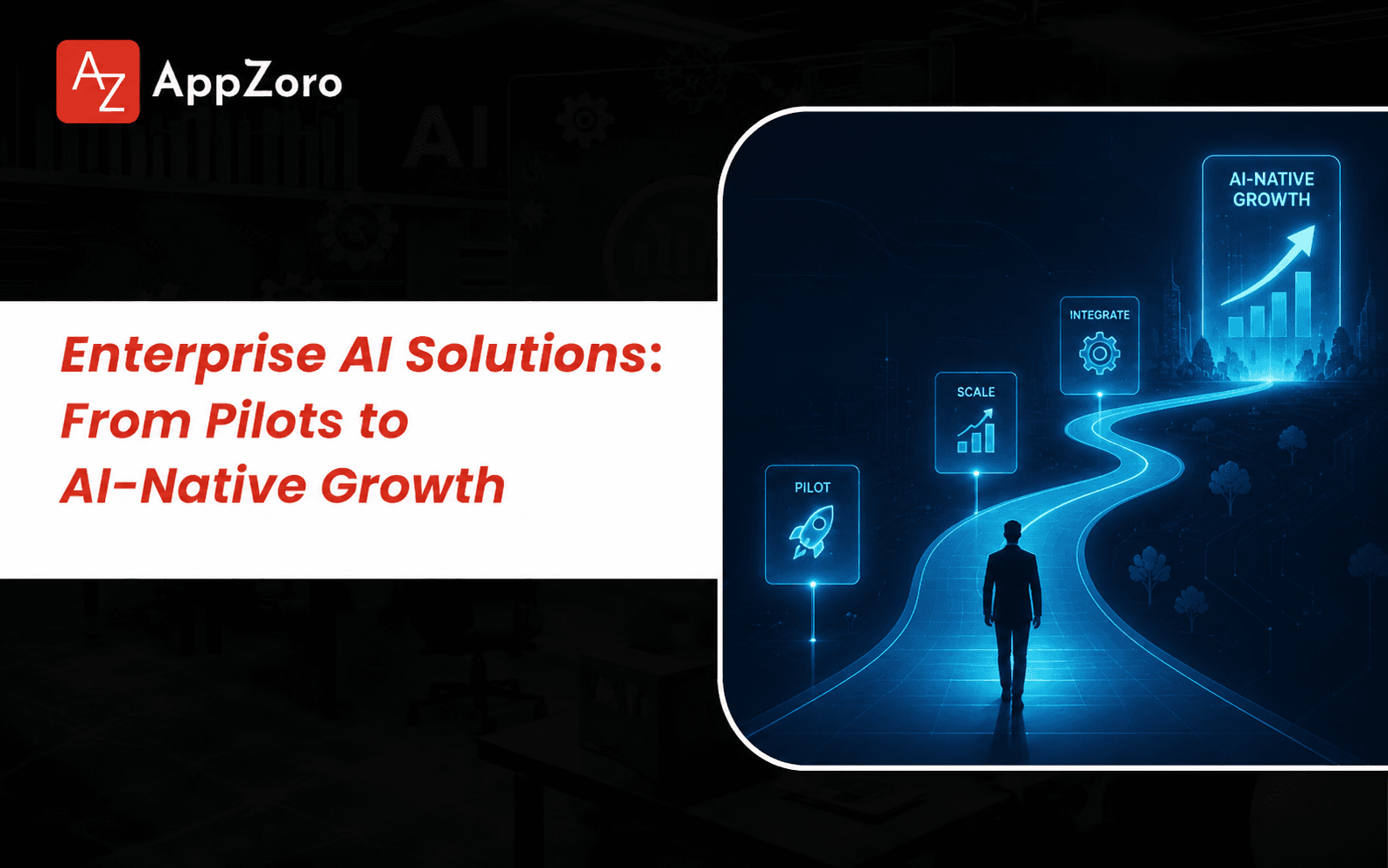
Quick Answer: AI solutions for enterprise are spanning six categories including productivity AI through Copilot and Workspace AI, customer service AI, sales and marketing AI, operations and supply chain AI, risk and compliance AI plus vertical-specific industry AI. Enterprises typically are adopting AI through four maturity stages from experimental pilots to AI-native operations across the lifecycle. Enterprise-ready generative AI is requiring SSO, data privacy controls, audit logs and governance frameworks across deployment. Total transformation investment is ranging from $500K to $50M+ depending on scope, while ROI is typically materialising within 12 to 36 months of the program starting.
Enterprise AI adoption shifted from "experimental side project" to "C-suite strategic priority" between 2023 and 2025 across nearly every major Fortune 500 company. Enterprise CIOs and CTOs leading AI transformation, IT directors evaluating vendors, business unit leaders advocating for specific solutions and AI transformation leaders building enterprise-wide programs are all running into the same set of decisions. By the end of this guide, the maturity stages, solution categories, enterprise-ready requirements, decision frameworks, transformation roadmap and ROI patterns for ai solutions for enterprise adoption at scale will be clear, let's take a look.
The Enterprise AI Solutions Market in 2026
Enterprise-ready generative AI is requiring SSO, data privacy controls, audit logs and governance frameworks across deployment. While the total cost to develop an AI app can vary based on complexity, transformation investment for enterprises is ranging from $500K to $50M+ depending on scope, while ROI is typically materialising within 12 to 36 months of the program starting.
Global Enterprise AI Market: USD 97 billion in 2024 and projected to exceed USD 396 billion by 2030 across major verticals globally.
Fortune 500 Adoption: 92% of Fortune 500 companies are reporting active enterprise AI deployment programs across multiple business units today.
Average Enterprise AI Spend: USD 13.2 million annually for organisations with $1B+ revenue, up 78% year over year across the segment.
Productivity AI Leads Adoption: Microsoft Copilot for Microsoft 365 was deployed at 60%+ of Fortune 500 within 18 months of general availability.
Generative AI Specific: Around 65% of enterprises now are having at least one generative AI solution in production across customer-facing or internal workflows.
The market signal is clear across the enterprise software industry today. Enterprise AI has moved from optional capability to operational necessity across most major segments and verticals. Companies that are delaying adoption are facing competitive disadvantages in cost structure, customer experience and operational efficiency across their core markets. The remaining sections are covering what enterprises actually buy, how they evaluate solutions and how to roll AI out at scale across the organisation.
The 4 Stages of Enterprise AI Maturity
Enterprises are not adopting AI in one move across the organisation, they are progressing through four predictable maturity stages over time. Knowing which stage your organisation is occupying is determining the right enterprise ai solution investments and enterprise ai transformation solutions roadmap across the program.
Stage 1 - Experimental (Year 1)
Organisations in this stage are having isolated AI experiments running in pockets across different teams. A marketing team is using ChatGPT Enterprise, an engineering team is piloting GitHub Copilot and a customer service team is testing a chatbot independently. There is no enterprise-wide strategy, no governance and no shared infrastructure across the organisation. Spend is typically $100K to $1M annually, mostly through individual SaaS subscriptions across teams. The characteristics of Stage 1 include:
Scattered Tool Adoption: Different teams are using different AI tools without coordination across the organisation.
No Governance Framework: Limited policies on data sharing, prompt logging or output validation across deployments.
Departmental Budget Authority: Individual teams are making AI purchasing decisions independently without central oversight.
Stage 2 - Departmental (Year 1–2)
Specific departments are deploying AI solutions strategically rather than experimentally across the organisation. HR might be deploying a hiring AI solution while finance might be deploying an AP automation tool across departments. Each department-level deployment is having a clear sponsor, defined success metrics and a budget allocated specifically to AI initiatives. Cross-departmental coordination is remaining limited across the organisation. Spend is growing to $1M to $10M annually across the company. The characteristics of Stage 2 include:
Department-Specific Solutions: AI deployed where ROI is clearest including customer service, marketing and engineering across teams.
Initial Governance Emerging: First policies on data privacy and acceptable AI use across the company.
Vendor Consolidation Beginning: Standardisation on 2 to 3 major AI providers per department across the organisation.
Stage 3 - Cross-Functional (Year 2–3)
AI solutions are spanning multiple departments and integrating with each other across the organisation. Customer data is flowing from sales AI to marketing AI to customer service AI across the customer journey. Productivity AI like Microsoft Copilot for Microsoft 365 is deploying enterprise-wide across the workforce. A central AI center of excellence (CoE) is setting standards across the organisation. Annual AI spend is reaching $5M to $50M+ across the company. This stage is representing the most common configuration for Fortune 500 companies in 2026. The characteristics include:
Enterprise AI Center Of Excellence: Dedicated team managing AI strategy, governance and vendor relationships across the organisation.
Integrated AI Workflows: Data and outputs are flowing between AI systems across departments and business units.
Centralised Governance: Enterprise-wide policies on data privacy, model risk and acceptable use across all deployments.
Stage 4 - AI-Native (Year 3+)
AI is embedded in every core business process across the organisation today. The organisation cannot operate effectively without AI across critical workflows. Decision-making is increasingly relying on AI augmentation across the leadership chain. Spend is reaching $25M+ annually but is generating measurable competitive advantage. Few enterprises are operating at full Stage 4 yet, leading examples are including digital-native companies and AI-first transformation winners across the market. The characteristics include:
AI Embedded In Core Operations: Critical workflows are depending on AI capabilities across the business.
Continuous AI Improvement Programs: Ongoing optimisation rather than discrete project deployment across the lifecycle.
AI-Driven Decision Making: Strategic decisions are augmented by AI analysis and recommendations across leadership.
6 Categories of AI Solutions for Enterprises
The ai solutions for enterprises market is organising into six distinct categories across the industry today. Each category is having different buyers, vendors and ROI patterns across the deployment lifecycle. Most enterprises are deploying solutions from multiple categories simultaneously across the organisation.
1. Productivity AI
AI tools are embedded in everyday work including email, documents, meetings and search across the workforce. Examples are including Microsoft Copilot for Microsoft 365, Google Workspace AI, Notion AI and Glean for enterprise search. Adoption is broadest because employees are experiencing direct value daily, and ROI is fastest at 3 to 6 month payback across the deployment. The required components include:
SSO Integration: Microsoft Entra ID, Okta or similar identity provider connection across the workforce.
Data Privacy Controls: Enterprise data is never being used for model training across the platform.
2. Customer Service AI
AI is handling customer queries through chat, email and voice channels across the customer base. Examples are including Intercom Fin, Ada, Decagon, Forethought and Salesforce Einstein Service across the customer service workflow. Many enterprises are also developing custom AI voice agents to handle complex telephonic support. This category is driving the largest measurable cost savings with 60 to 80% deflection rates on routine queries.
Knowledge Base Integration: Connections to help center content and product documentation across the platform.
Human Escalation Flows: Seamless handoff to human agents for complex issues across the customer journey.
3. Sales And Marketing AI
AI is assisting sales reps with research, outreach and forecasting plus marketing teams with content, campaigns and analytics. Examples are including Salesforce Einstein, HubSpot AI, Gong, Outreach AI, Jasper and Writer across the sales motion. This category is driving revenue lift with 15 to 30% conversion improvements common across enterprise deployments. The required components include:
CRM Integration: Native connections to Salesforce, HubSpot or similar platforms across the sales workflow.
Content Brand Voice Controls: AI-generated content matching brand guidelines across all marketing outputs.
4. Operations And Supply Chain AI
AI is optimising inventory, logistics, planning and operational decisions across the enterprise. Examples are including Blue Yonder, o9 Solutions, Coupa and SAP Joule across operations workflows. Modern research shows how AI is transforming logistics by reducing fuel consumption and optimizing delivery routes. This category is showing highest ROI for asset-heavy industries across manufacturing and distribution.
ERP Integration: Connections to SAP, Oracle and NetSuite for real-time data across the operational stack.
Forecasting And Optimization Models: Predictive analytics across multiple data sources across the supply chain.
5. Risk And Compliance AI
AI is handling fraud detection, AML monitoring, regulatory reporting and risk scoring across the enterprise. Examples are including Actimize, ComplyAdvantage, Hummingbird, NICE and Riskonnect across regulated workflows. This category is especially valuable in regulated industries including financial services, healthcare and defense across the market. The required components include:
Audit Trail Logging: Every AI decision is logged for regulatory review across the platform.
Explainability Features: Transparent reasoning for regulated decisions across the AI workflow.
6. Vertical-Specific Industry AI
AI solutions are purpose-built for specific industries across the enterprise market. Leading examples include the ways AI used in construction improves site safety, or how generative AI in education scales personalized learning. Examples are including Tempus for healthcare, Harvey for legal, C3 AI for industrial and Bloomberg for financial across the vertical AI category.
Industry-Specific Compliance: HIPAA for healthcare and attorney-client privilege for legal across the platform.
Domain-Trained Models: Models fine-tuned on industry-specific data across the use case.
Enterprise-Ready Generative AI Solutions - What "Enterprise-Ready" Actually Means
Enterprise generative ai solutions and enterprise-ready generative ai solutions are not marketing labels across the industry today. They are having specific technical and operational meanings that separate consumer AI from enterprise-grade products across the procurement decision. Eight requirements are distinguishing solutions truly ready for enterprise deployment from those that look ready in demos but fail in production.
Data Privacy Guarantees: Enterprise data is never used to train shared models, ChatGPT Enterprise versus consumer ChatGPT is the canonical example across the market.
Single Sign-On (SSO) Integration: Native support for SAML 2.0, OIDC, Microsoft Entra ID, Okta or other enterprise identity providers across the platform.
Role-Based Access Controls: Granular permissions controlling who can use which AI features and access which data across the organisation.
Audit Logging: Every prompt, output and user action is logged for compliance and forensic review across the platform.
Compliance Certifications: SOC 2 Type II, ISO 27001, HIPAA where applicable plus FedRAMP for government deployments across the market.
Data Residency Options: Geographic control over where data is processed and stored across EU, US and regional cloud regions.
SLA-Backed Availability: 99.9%+ uptime commitments with financial penalties for breaches across the platform agreement.
Governance Controls: Admin policies controlling content moderation, prompt logging and acceptable use enforcement across the deployment.
True enterprise-ready generative ai solutions are combining consumer-grade model capability with enterprise-grade infrastructure across the platform stack. Microsoft, Google, Anthropic and OpenAI are all offering enterprise tiers that are including these requirements, while their consumer products typically are not. Enterprise buyers evaluating generative AI must be verifying each requirement explicitly because vendor claims of "enterprise-ready" are meaning nothing without specific technical evidence. The cost premium for enterprise tiers is typically 2 to 4x consumer pricing but is representing real value through risk reduction and compliance enablement.
Enterprise AI Solution Decision Framework - Build vs Buy vs Partner
The most important enterprise ai solution decision is not which vendor to pick across the procurement process. It is whether to build, buy or partner for each use case across the AI portfolio. Most enterprises are ending up doing all three across their AI portfolio in 2026. The framework below is clarifying when each path is making sense across the enterprise.
Approach | When To Choose | Cost | Time To Value |
Buy (off-the-shelf SaaS) | Commoditised use cases (productivity AI, common customer service flows) | $50–$500/user/month | 1–3 months |
Partner (specialised vendor + customisation) | Specialised domain AI (vertical industry, complex workflows) | $100K–$5M/year + integration | 3–9 months |
Build (custom development) | Strategic differentiation requiring proprietary data + workflows | $500K–$10M+ build cost | 9–24 months |
Hybrid (Buy + Partner + Build combined) | Most enterprise AI portfolios | Variable | Ongoing |
The dominant pattern across Fortune 500 enterprises is hybrid across their AI portfolio in 2026. This decision-making process is fundamentally changing the role of AI in product development, as leaders must decide which proprietary features provide a "moat" versus which are commodities. Pure-build strategies are wasting capital on commoditised capabilities better served by SaaS across the market.
Enterprise AI Transformation Solutions Roadmap - From Pilot to Scale
Enterprise ai transformation solutions roadmaps are following six phases from initial pilots to enterprise-wide deployment across the program lifecycle.
Define The AI Strategy And Governance Framework: Document strategic priorities, governance policies, acceptable use, data privacy standards and vendor evaluation criteria across the organisation. Establish the AI Center of Excellence (CoE) early in the program. Skip this step and downstream chaos is guaranteeing expensive course corrections later in the lifecycle.
Run Targeted Pilots In 2 To 3 Departments: Choose departments with clear ROI potential and ready leadership sponsorship across the organisation. Productivity AI for knowledge workers, customer service AI for support teams and sales AI for revenue teams are typically piloting well. Measure quantitatively from day one with baseline metrics established before deployment is happening.
Evaluate Pilot Results And Refine Selection: After 90 days, measure adoption rates, productivity gains and user satisfaction across the pilots. Discontinue pilots that did not meet thresholds and expand pilots that did across the organisation. The discipline to kill non-performing pilots is determining transformation success across the enterprise.
Scale Winning Solutions Enterprise-Wide: Deploy successful pilots beyond initial departments across the organisation. Negotiate enterprise-tier pricing with proven vendors across the procurement function. Establish standardised deployment, training and support processes across the workforce. Most enterprises are stalling at this phase due to organisational resistance from leadership and middle management.
Integrate AI Solutions With Existing Enterprise Systems: Connect AI tools to CRM, ERP, and identity providers across the technology stack. Build data pipelines so AI systems are working with current data. This is where AI agent workflow automation becomes critical, ensuring that agents can autonomously trigger actions across different software silos without manual intervention.
Operate Continuous Improvement And Optimisation: Monitor adoption, quality, cost and ROI continuously across the AI portfolio. Iterate on prompt designs, model selections and integration patterns across the platform. Expand into new use cases as the organisation is maturing across the curve. Enterprise ai transformation solutions are not one-time deployments because they are requiring ongoing investment to deliver compounding value over 3 to 5 year horizons.
ROI and Cost Considerations for AI Solutions for Enterprise
Enterprise AI ROI is varying significantly by solution category across the portfolio. Productivity AI is delivering fastest payback while transformation initiatives are taking longest but producing largest cumulative returns over time. The numbers below are reflecting typical enterprise ranges based on published case studies and industry research across the market.
Productivity AI Payback: 3 to 6 months at $30 to $50 per user per month with measurable productivity gains of 20 to 40% on knowledge work.
Customer Service AI Payback: 6 to 12 months with deflection rates of 60 to 80% on routine queries translating to direct cost savings.
Sales AI Payback: 9 to 15 months through conversion lift, faster sales cycles and reduced manual research time across teams.
Operations AI Payback: 12 to 24 months due to longer implementation but largest absolute dollar savings across the supply chain.
Risk And Compliance AI Payback: 12 to 18 months through false positive reduction, fraud prevention and audit cost reduction across the platform.
Transformation Program ROI: 24 to 36 months for full enterprise transformation programs spanning multiple solution categories across the organisation.
Total enterprise AI spend at scale is typically representing 1 to 3% of revenue for mature programs across the market. This is generating 10 to 25% effective cost savings or productivity gains across the affected business processes over the lifecycle.
Conclusion
AI solutions for enterprise in 2026 are representing the most consequential technology shift since cloud computing across the industry. The enterprises that are moving from experimental to AI-native ahead of competitors are capturing significant operational and strategic advantages across markets. If your organization is ready to scale, partnering with an experienced AI app development company can ensure your infrastructure is production-ready.
Leave a Comment