

The wrong tech stack can kill a project before it breathes. The right one? It can turn an idea into a product that runs like it’s been alive for years.
In 2025, AI and ML aren’t experiments anymore. They’re the engines running supply chains, hospitals, finance systems, and even the phone in your pocket. Businesses that choose the right ai/ml development company and win faster. Those that don’t, burn budget and time.
This isn’t a generic “tools list.” It’s a map of the current terrain. What’s working. What’s fading? And what’s about to change.
Understanding the AI/ML Development Lifecycle
AI/ML isn’t magic. It’s a grind. A loop you run until things work.
Data Collection You start here. Hunting for data like a miner with dirt under his nails. Logs, sensors, forms, scraped text—whatever you can get. Quantity matters, but quality keeps the model sane.
Data Preprocessing Raw data’s ugly. Missing values, weird outliers, formats that make no sense. You clean, normalize, and split it until it starts to look like something a model might actually learn from.
Model Development This is the sketching phase. You choose algorithms, architectures, loss functions. Maybe a deep net. Maybe something leaner.
Model Training and Evaluation Hours or days of GPU heat and fan noise. Tweaks. More tweaks. Validation scores are crawling higher.
Deployment and Monitoring You push it live. And then? You watch it. Like a hawk. Models drift, data changes, and the job’s never really done.
Key Considerations Before Choosing a Tech Stack
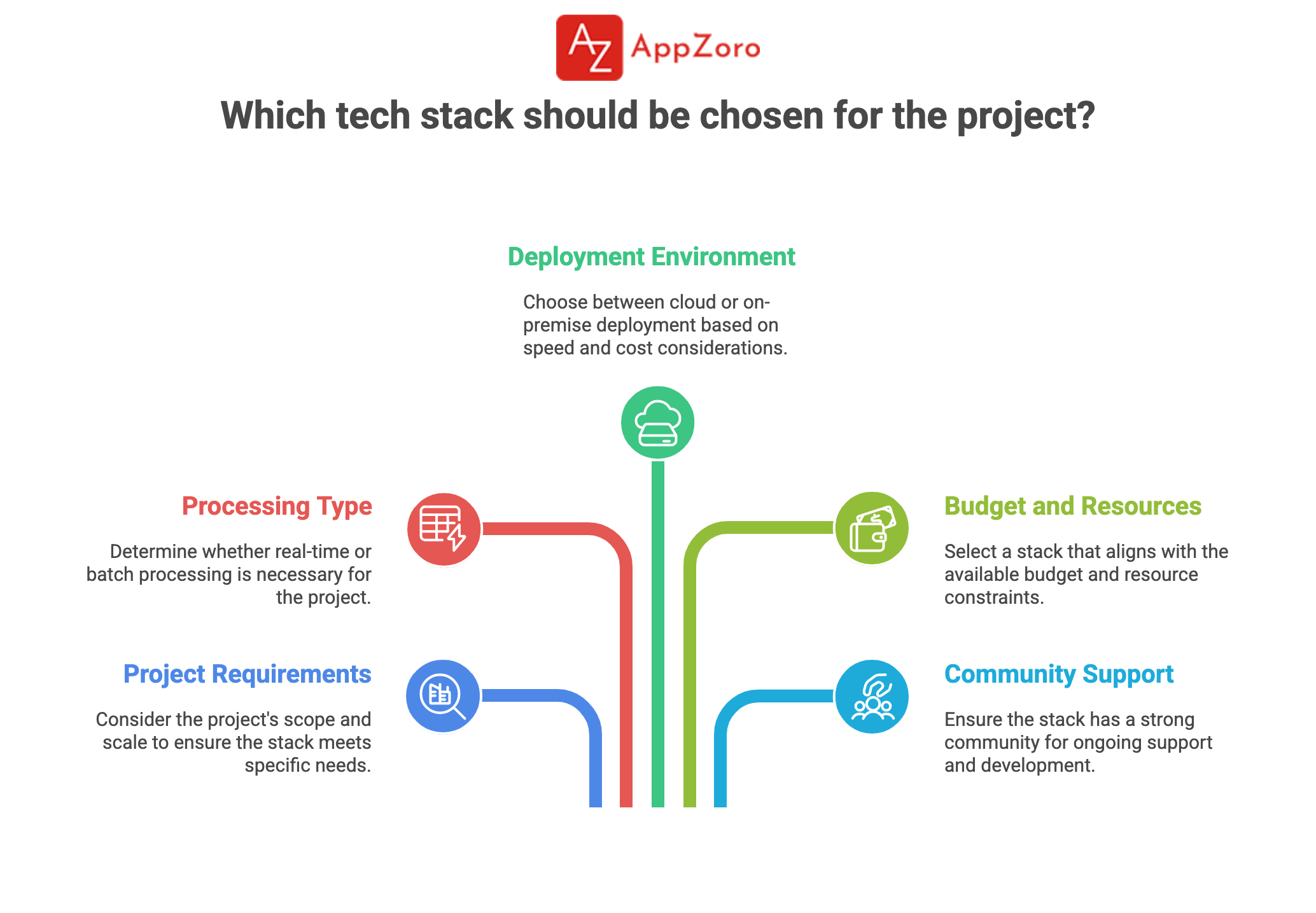
Project Requirements and Scale: A healthcare chatbot isn’t the same beast as a high-frequency trading engine. Scope matters.
Real-Time vs. Batch Processing: Milliseconds can be life or death in some systems. In others, you can wait till tomorrow morning.
Cloud vs. On-Premise: Cloud is faster to spin up. On-prem can be cheaper at scale. Pick wrong, and you’ll regret it.
Budget and Resource Availability: Some stacks bleed money. Others play nice with a lean wallet.
Compatibility and Community Support: A lonely stack with no dev community is a slow death.
For context, AI/ML Development Solutions That Drive Business Growth often hinge on getting these choices right—before a single line of code is written.
Programming Languages for AI/ML in 2025
Python – Still the Undisputed Leader
It’s not flashy. But it works. TensorFlow, PyTorch, scikit-learn—it’s all here. The syntax feels like speaking plain English. Works for MVPs, production models, and everything between.
R – For Statistical Modeling & Research
Sharp tools for statisticians. Data visualization so clean it feels surgical. Not the best for production apps, but unbeatable for analysis.
Julia – Gaining Momentum for High-Performance ML
Fast. Really fast. Built for numerical computing. Gaining converts among teams tired of Python’s slower runtime.
Other Contenders: JavaScript, Scala, C++
C++ for speed demons. Scala for big data pipelines. JavaScript if you’re tying ML into web apps.
Top Frameworks & Libraries for AI/ML
- TensorFlow 3.x (Google): Polished. Built for scaling models to production. Strong community, better tooling than before.
- PyTorch 3.x (Meta): Still the darling of research. Flexible, intuitive, with lightning-fast prototyping.
- Hugging Face Transformers: If it’s NLP, this is your stop. Pre-trained models, APIs, and a community obsessed with language AI.
- Scikit-learn: The old reliable. Decision trees, SVMs, regressions—classics done right.
- XGBoost & LightGBM: Tabular data powerhouses. Still winning Kaggle competitions for a reason.
Best Tools for Data Engineering and Preprocessing
- Apache Spark: Handles terabytes like they’re nothing. Distributed, fault-tolerant, and battle-tested.
- Pandas and Dask: For smaller jobs, Pandas feels like home. For bigger ones, Dask scales the same syntax across clusters.
- Apache Airflow: The conductor of your data orchestra. Scheduling, dependencies, and monitoring handled.
Model Training & Experimentation Platforms
- MLflow: Keeps track of experiments so you don’t lose yourself in a forest of model versions.
- Weights & Biases: Dashboards, visualizations, and collaboration features that make debugging less painful.
- Google Vertex AI / AWS SageMaker / Azure ML: Full-stack, cloud-native environments. Spin up GPUs, deploy models, manage pipelines—all under one roof.
Deployment & Serving Technologies
- Docker + Kubernetes: Containerized models that scale like crazy. Deployment becomes predictable.
- ONNX: Run the same model across frameworks without rewriting.
- FastAPI / Flask / gRPC: Expose your model through APIs—fast, lightweight, and production-friendly.
Best Databases for AI/ML Workloads
- PostgreSQL + TimescaleDB: Structured, time-series-friendly. Great for IoT and analytics-heavy apps.
- MongoDB: Flexible schemas for messy, unstructured data.
- Snowflake / BigQuery: Data warehouses that eat petabytes for breakfast.
Cloud & Infrastructure Options
- AWS, Google Cloud, Azure: The big three. AWS for variety. GCP for AI-first services. Azure for enterprise integration.
- NVIDIA DGX / Edge AI Devices: If you need raw GPU muscle or on-device AI, this is where you look.
Trends to Watch in 2025 AI/ML Tech Stack
Rise of AutoML & Generative AI APIs: OpenAI, Anthropic, Google Gemini—auto-tuning models without the grunt work. LLM Ops and Foundation Model Tooling: LangChain, LlamaIndex, vector databases—they’re the scaffolding for large language models. Sustainability in AI Workloads: Green compute. Energy-efficient architectures. Lower carbon footprints in training pipelines. The Future of AI/ML Development Services: Trends to Watch and Invest In is already being shaped by these shifts.
Conclusion
There’s no perfect stack. Just the one that fits your job, your budget, your team. Stay flexible. Keep learning. The ground moves fast.
Choose the Right AI/ML Development Company for Your Business, and your stack won’t just work—it’ll grow with you.
FAQs
Can I build AI/ML projects using only Python?
Yes. Many do. But other tools may suit specific needs better.
Is it necessary to use cloud platforms for training models?
No. But cloud saves setup time and scales easily.
What is the best stack for a startup with limited budget?
Open-source tools, cloud credits, and lean infrastructure.
How often should I update my stack?
At least once a year—or when core tools release major updates.
What tech stack is ideal for LLM applications?
Python, PyTorch, Hugging Face, vector databases, and scalable cloud infra.
Leave a Comment