
OTT stands for “Over-the-Top.” Strange phrase, but what it means is pretty straightforward—content coming directly to you through the internet, no permission required from your cable company or those old-school satellite providers. No need for TV boxes, wires draped along walls, or heavy roof dishes. If you’ve got a stable internet connection, a device you can actually watch on, and the app that delivers the content—you’re already connected.
This whole shift is not small. It’s a huge disruption. People around the world are actively moving away from rigid bundles—the kind cable companies tied viewers into for years—and chasing freedom by choosing exactly what to watch, when, and how long. The entire media business has changed because of it, with entertainment app development playing a central role in delivering flexible, on-demand experiences. Numbers tell the story too: the OTT market in 2024 was already crossing a $200 billion valuation, and projections put it soaring past $400 billion by 2028. That speed of growth speaks volumes. Internet penetration is no longer city-limited, smartphones are far more affordable than before, and the craving for flexible, on-demand content is relentless.
To put it stripped down: OTT is not tomorrow’s trend. It is already today’s reality, defining entertainment everywhere.
The Business Machine Behind OTT: Monetization at Play
Here’s where it gets interesting—OTT is not simply an artistic revolution where streaming suddenly appeared as a gift to the masses. Behind those films, shows, and documentaries is a deep ecosystem and a carefully wired financial model. The entire space is sustained by monetization strategies that vary yet often overlap.
Subscription Video on Demand (SVOD).
You pay a fee monthly or annually. In return you dive freely into the full library of whatever service you choose. Netflix turned into a cultural verb under this model, Amazon Prime glued extras into it, Disney+ came swinging with blockbuster catalogs. Stability is where SVOD wins. It gives platforms predictable monthly cash flow. And retention chances jump when people already automated payments without noticing.
Transactional Video on Demand (TVOD).
Pay per title. No contract. You want that shiny movie? Rent or buy it. Google Play Movies or Apple iTunes built strong presence this way. It works best for high-value blockbuster releases or niche categories—not every user pays each week, but when they pay, margins feel justified.
Advertising Supported Video on Demand (AVOD).
This flips the table: no cost to the viewer, the revenue comes through advertising. YouTube runs almost entirely on this fuel, along with platforms like Pluto TV. It’s mass reach first, collect viewership, then sell those eyeballs to brands. More impressions, more ad spend, more profits.
Hybrid Models.
A mix-and-match approach. Hulu lets users choose between cheaper, ad-supported tiers or premium ad-free. Disney+ Hotstar in India added another layer where subscriptions themselves combine with ads sprinkled through content. Hybrids appeal to wider audiences. If someone doesn’t want to pay much—they can tolerate ads. Someone wanting smooth viewing—pays extra. Everyone is included.
This balance of monetization methods is why OTT became a sustainable business rather than just an entertainment fad.
Understanding the Investment: OTT App Development Costs
Building your own OTT app? Costs are the first reality check. And unlike traditional assumptions, pricing swings heavily depending on scope, features, and ambition of your plan.
Basic OTT App (MVP). Cost: $25,000 – $50,000.
MVP (Minimum Viable Product) is the bare-bones version. User registration, logins, a functional video player, streaming pipeline, and maybe one payment method. Perfect if your aim is just testing market interest before burning large cash.
Mid-Range OTT App. Cost: $50,000 – $100,000.
This category lives in the comfort zone for many scaling startups. Multi-device support, recommendation engines, integrated payment gateways, subscription handling beyond just basic. It feels professional, competes fairly with mainstream services without excessive bloat.
High-End OTT App. Cost: $100,000 to $300,000 plus.
Enterprise ambition lives here. The kind of apps designed for millions of users. You’ll likely want AI personalization, offline downloads, live streaming sports/events, analytics dashboards, complete scalability ready to burst open. Costs climb but so do your chances of being industry-level.
Feature-Wise Breakdown of Costs
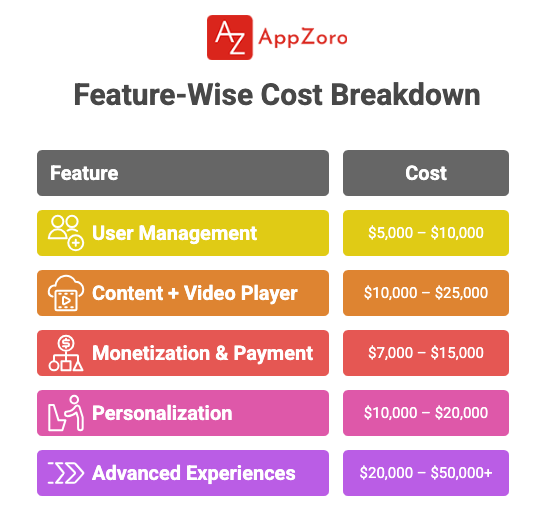
App budgets break apart further once specific features join the list. Here’s the usual segmentation:
-
User Management (Registration/Login/Profile): around $5,000 – $10,000.
-
Content + Video Player (Library, Search, Modern Video Player): usually $10,000 – $25,000.
-
Monetization & Payment Integrations: subscription handling, seamless gateways, costing $7,000 – $15,000.
-
Personalization Features (Watchlists, Recommendations, Profiles): $10,000 – $20,000.
-
Advanced Experiences (AI suggestions, Live streaming, Offline support, Voice Search): $20,000 – $50,000+.
The Shadow Costs Developers Don’t Tell You Early
What many businesses discover too late: the visible price tag is only half the picture. OTT revolves around ongoing, recurring spends that show up once the app is live.
-
Content Licensing/Production. Without eye-catching, quality content, even beautifully coded apps fail. Licensing rights eat a huge portion of budgets, often shadows the technical spend itself.
-
CDN (Content Delivery Networks). If you want global reach without endless buffering, you’ll engage CDN services like Cloudflare or Akamai. These renew recurrently, not one-time spend.
-
Backend and Server Maintenance. Each user streaming means bandwidth costs, storage allocation, and cloud hosting charges. Continuous budget drains.
-
Marketing, Promotion, Acquisition. It is not enough to build. People have to know. Paid campaigns, influencers, banners—all real costs.
-
Maintenance, Patching, Upgrades. New phones, updated operating systems, bugs that flare after 6 months—unless your app actively harmonizes with tech evolution, you fall behind.
Why Final OTT Development Costs Differ
Several additional layers influence how much you eventually spend:
Device and Platform Diversity.
The base trio—iOS, Android, and web—are mandatory. Expand to Smart TVs, like Samsung or LG platforms? That’s additional dev effort. Push into Apple TV, Fire TV sticks, Xbox, or PlayStation? Costs multiply, since each comes with unique frameworks.
UI/UX Design Importance.
You could cheap out and go with a generic template UI—it might work in the short term, but churn, meaning users dropping your app after a week, skyrockets. The opposite scenario—investing in ui/ux design and development services that focus on custom UI/UX design, where navigation is fluid, visuals are immersive, and dashboards adapt through personalization—significantly increases retention. Spending wisely on design now saves far more time, cost, and lost users later.
Development Resources.
-
Hire freelancers: budget friendly, but usually no reliability if you want to scale later.
-
Build in-house: more control, long-term vision intact, but fixed salaries, infrastructure, and overhead weigh heavy.
-
Work with specialized agencies: They provide faster market entry, managed workflows, diverse experts under one roof. Usually best for businesses aiming serious launch. But agency pricing is linked to geography—so hiring a US dev agency costs far beyond outsourcing into Asia/Eastern Europe.
Smarter Budget Management Approaches
Building OTT requires strategy. Otherwise, uncontrolled expenses can sink the vision.
-
MVP-first approach. Release only essential features—video listings, user login, play/pause, subscription payments. Validate. If users engage strongly, then double down.
-
Technology stack caution. Choices at this stage define scalability. The wrong API or framework can lead to major rebuilds down the line, draining pockets.
-
Phased build instead of all-at-once. Add modules step by step: streaming core first, social sharing later, AI recommendations last. Manage cash flow and apply real user insight into iterative design.
Step-by-Step Development Journey
The pipeline of turning idea into actual launch:
-
Discovery + Planning. Competition review, requirement gathering, studying trends.
-
UI/UX Design. From prototype sketches into functional visual solutions.
-
Backend + Frontend Build. Streaming core development, APIs, user interface implementations.
-
Testing & QA. Stress checks, security gaps, performance analytics.
-
Deployment. Uploading and publishing on platforms, followed by marketing wave.
Timelines vary by scale:
-
MVP: approx. 3–6 months.
-
Mid-Range: 6–9 months.
-
High-level complex app: ranges from 9 all the way to 18 months.
Why Businesses Partner with Appzoro
Appzoro positions itself in the OTT app space as not just coders, but as builders who mix technical precision with awareness of business endgames. As a custom mobile app development company, they bring case histories across multiple industries, each demonstrating adaptability, strategic thinking, and skilled workflows that drive real results.
What sets them apart is the promise of combining development speed with clarity. With Appzoro, projects stay transparent—clients understand where budgets go, what stage is ongoing, and how launch will align with commercial goals. Their team offers expertise in creating apps not only rich in features but fine-tuned for scalability, ensuring your platform never stalls under scaling load.
For any company or entrepreneur ready to jump in, Appzoro lays options: personalized consultation, idea evaluation, roadmap planning, and detailed project quote. The goal isn’t delivering just another OTT app. It’s about launching sustainable platforms that actually compete long-term.
Conclusion
OTT has undeniably shifted the shape of entertainment globally. From Netflix queues to niche local streaming startups, consumers now dictate rather than being dictated to. The costs are heavy, yes. But the rewards for businesses that design well, budget cleverly, and launch strategically are bigger than ever. And whether you’re looking to build a modest MVP or a flagship platform scaled for millions, success comes down to structured building.
At some point it becomes less about whether OTT is worth it, and more about how soon you’ll join the competition. The market is already embedded in users’ daily patterns. The window is open now.