Cross Platform App Development vs Native: A Decision Framework

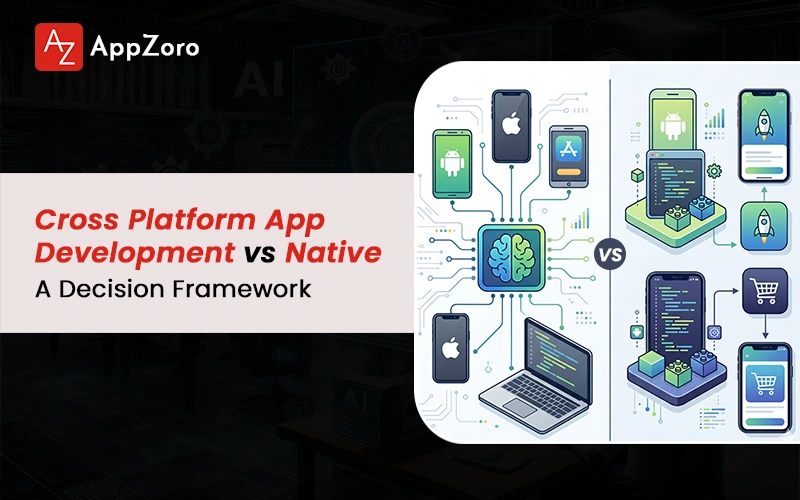
Choosing between cross-platform and native can be stressful, dealing with framework benchmarks, conflicting community opinions, and budget pressure giving founders genuine analysis paralysis. While this comprehensive cross-platform mobile app development guide provides the foundational context for the shift, this specific breakdown compares native versus cross-platform across 8 decision dimensions to show where each path is winning in 2026.
Cross Platform App Development vs Native — The Core Trade-Off
So, what is the cross platform app development vs native decision actually about at the core? Well, it is a trade-off between two distinct mobile build approaches that each carry their own set of compounding consequences.
-
Native: Separate iOS (Swift, SwiftUI) and Android (Kotlin, Jetpack Compose) codebases. Maximum platform integration combined with doubled engineering effort across the project.
-
Cross-Platform: One codebase using a variety of modern cross-platform app development frameworks including Flutter, React Native, and Kotlin Multiplatform -targeting both iOS and Android. This allows for a shared engineering effort through a framework abstraction layer, reducing the need for dual-specialist teams.
The core trade-off is breaking down into four specific dimensions that every team should be aware of.
-
Cost And Time For Performance And Platform Depth: Cross-platform is trading full native capability for 35 to 50% lower cost and faster ship time.
-
Single Codebase For Maintenance Simplicity: One bug fix is updating both platforms, however until platform-specific issues need native code to resolve them.
-
Talent Pool Differs Sharply: Cross-platform is leveraging JavaScript or Dart developers, while native is needing specialist Swift or Kotlin engineers.
-
Reversibility Is Expensive: Switching mid-project from one to the other is typically costing 30 to 50% of the original build figure.
The cross platform app development vs native decision is rarely binary in practice. The right answer for many products is one approach for most screens and the other approach for the screens that genuinely demand it.
Decision by Dimension – 8 Ways Native vs Cross-Platform Differ
The native vs cross platform app development choice is not really one single decision. It is eight smaller decisions that are combining into one path forward.
|
Dimension |
Native |
Cross-Platform |
Practical Notes |
|
Build cost |
1.7 to 1.9x baseline |
1.0x baseline |
Engineering line is dominating savings |
|
Time to ship |
Longer (parallel teams) |
20 to 35% faster |
Both platforms are shipping together |
|
Performance ceiling |
Maximum |
Sub-50ms interaction limits |
Matters for games, AR, complex animation |
|
UI/UX polish |
Maximum native feel |
Near-native |
Cross-platform UX gap is narrowing in 2026 |
|
Platform-specific feature access |
Day-1 |
6 to 18 month lag |
Critical for new OS feature launches |
|
Talent availability |
Specialist (Swift, Kotlin) |
Broad (JavaScript, Dart) |
Geography matters |
|
3-year maintenance |
Higher (2 codebases) |
Lower (1 codebase) |
Compounds over product lifetime |
|
Hardware integration depth |
Direct |
Through wrappers |
BLE, AR, sensors all easier native |
Four of these eight dimensions are usually the most decisive ones when teams are working through the trade-off honestly across a real project.
-
Performance Ceiling: Native is winning meaningfully for apps requiring sub-50ms frame interactions, complex animations at 120Hz or AR and camera-heavy workloads at scale.
-
Platform-Specific Feature Access: If your roadmap is depending on shipping a new iOS or Android capability the same week it launches, native is the only viable path. Cross-platform frameworks are routinely lagging by 6 to 18 months.
Build And Maintenance Cost: Cross-platform’s 35 to 50% savings on the initial build are a primary driver for many startups. By significantly reducing cross-platform mobile app development cost, companies can allocate more budget toward marketing and user acquisition, while also enjoying 30 to 35% lower 3-year TCO.
-
Talent Availability: This dimension is often deciding the choice in practice. If your hiring market has scarce Swift or Kotlin talent or abundant JS and Dart talent, this dimension is overriding theoretical performance preferences.
Weighting these 8 dimensions against your specific product profile is typically pointing toward one approach within 30 minutes of honest analysis.
Where Native App vs Cross-Platform — Native Wins (4 Scenarios)
The native app vs cross platform decision is still favoring native in four specific scenarios across the modern app landscape and each one is worth understanding before any framework decision is being made.
Scenario 1: Performance-Critical Apps
Games, AR experiences, real-time camera filters and complex drawing apps in the Procreate class. The frame budget is too tight for cross-platform overhead to be acceptable. Examples include most iOS games (Genshin Impact, Monument Valley), Procreate and Snapchat (which stayed native for the camera-first UX).
Scenario 2: Day-1 Platform Feature Access
Apps that need to ship the latest iOS or Android capability the moment it launches, including Apple Intelligence integrations, new ARKit features, App Clips and Live Activities. Cross-platform frameworks are typically lagging 6 to 18 months. Examples include Apple-first feature showcases and OS launch partner apps.
Scenario 3: Deep Platform Integration
Widgets, watchOS apps, complications, CarPlay android Auto, App Intents and Siri Shortcuts. Cross-platform is supporting some of these but rarely as first-class citizens. Examples include weather apps with widget primacy, fitness apps with deep Apple Watch integration like Strava (partially native) and automotive HUD apps.
Scenario 4: Existing Native Codebase With No Migration Reason
Mature native apps with multi-year codebases. Adding cross-platform mid-life is rarely paying off, unless via Kotlin Multiplatform for incremental adoption. Examples include Lyft (mostly native), Robinhood (native iOS and Android) and Tinder.
In any of these four scenarios, the native app vs cross platform math is favoring native as the cheaper choice over the product’s lifetime, even though it costs more upfront. Cross-platform’s cost advantage is assuming the product’s needs fit cross-platform’s capability ceiling.
Where Cross-Platform App Development vs Native — Cross-Platform Wins (5 Scenarios)
The cross platform app development vs native decision is favoring cross-platform in five specific scenarios that are covering the bulk of new mobile builds shipping today.
Scenario 1: Standard Consumer Apps
E-commerce, social, content, productivity and fitness tracking apps that are the bulk of the App Store. Cross-platform is delivering near-native UX at 35 to 50% lower cost. Examples include Shopify, Walmart, Pinterest, Discord, Coinbase and Reflectly, all on React Native or Flutter.
Scenario 2: Cross-Platform Marketplace And On-Demand Apps
Two-sided marketplaces where both consumer and provider need apps. The doubled native cost is compounding, while cross-platform is halving the engineering bill. Examples include many on-demand startups, DoorDash (RN for parts) and Instacart shopper apps.
Scenario 3: Enterprise And B2B Apps
Field service, sales enablement and internal tools where users care more about reliability and feature coverage than pixel-perfect platform feel. Examples include Microsoft Office Mobile (Word and Excel use RN for shared chrome), Salesforce Mobile and various enterprise dashboards across industries.
Scenario 4: MVPs And Early-Stage Startups
Pre-product-market-fit, where founders need to ship and learn fast. The latest cross-platform app development trends suggest that the speed advantage of a single codebase is often the difference between catching a market window and missing it entirely, as 30%+ time savings translate directly into faster validation cycles.
Scenario 5: Multi-Surface Products
Apps that are targeting mobile plus desktop plus web from one codebase. Flutter or Kotlin Multiplatform with Compose Multiplatform is serving all surfaces. Examples include the BMW connected car app (Flutter), Google Pay (Flutter parts) and various enterprise SaaS mobile surfaces.
When the product profile fits any of these scenarios, the native vs cross platform apps decision is overwhelmingly favoring cross-platform. The 35 to 50% cost savings and the faster time-to-market are compounding into a meaningful business advantage across the product’s lifetime.

The Hybrid Option – Native + Cross-Platform in the Same App
The cross platform app development vs native question is often assuming a binary choice, however in practice many large apps are using native for some screens and cross-platform for others. This hybrid approach is trading some shared-code benefit for the right tool per screen.
How Hybrid Builds Work
A native shell is hosting the app. Performance-critical screens (camera, AR, complex drawing) are built native. Standard screens (forms, lists, content) are built in React Native or Flutter modules embedded into the native app. Shared business logic via Kotlin Multiplatform is increasingly common across hybrid builds.
Real-World Examples
-
Instagram: React Native for some shared features and tooling, with native for camera, feed and stories where performance matters most to the user.
-
Microsoft Office Mobile: React Native for the shared chrome and cross-Office consistency, with native handling document rendering and editing performance.
-
Shopify: React Native for most consumer-facing screens, with native modules handling camera, payments and platform-specific features.
-
Cash App (Square): Kotlin Multiplatform is sharing business logic across iOS and Android, with native UI being built per platform.
When Hybrid Makes Sense
-
Multi-Team Engineering Org: One team can own native screens while another owns cross-platform and the coordination overhead is workable.
-
Specific Performance Bottlenecks: 80% of the app is fitting cross-platform and the 20% that does not gets built native.
-
Existing Native App Extending With Cross-Platform Modules: Significantly less risk than a full rewrite from scratch.
The hybrid approach is underrated in native vs cross platform app development discussions because it is adding operational complexity. However, for large apps it is often delivering the best of both paths simultaneously.
The Numbers — Cost, Timeline and Performance Side-by-Side
The native apps vs cross platform comparison sits on top of concrete data points across cost, timeline and performance. Below is the side-by-side view for a typical $200K validated product equivalent being scoped.
Cost Comparison (Validated Product Scope):
|
Approach |
Initial Build |
3-Year TCO |
Maintenance Per Year |
|
Dual-Native |
$280K |
$840K |
$140K/year |
|
Cross-Platform (Flutter/RN) |
$150K |
$582K |
~$100K/year |
|
Hybrid (50/50 split) |
$210K |
$700K |
~$120K/year |
Timeline Comparison:
-
Native Dual-Track: 6 to 10 months running with parallel teams across both platforms.
-
Cross-Platform: 4 to 7 months running with a single shared team.
-
Hybrid: 5 to 8 months depending on the split between native and cross-platform screens.
Performance Comparison (Typical Consumer App):
|
Metric |
Native |
Modern Cross-Platform (2026) |
|
Cold start time |
<1.5s |
1.5 to 2.5s |
|
Scroll frame rate |
60 to 120fps |
60 to 120fps (within close range) |
|
Memory footprint |
Lower |
10 to 25% higher typically |
|
Binary size |
Smaller |
15 to 40% larger |
The cost numbers are tilting cross-platform, while the performance gap has narrowed sharply since 2020 but is still favoring native at the edges of the use case. For a typical consumer app, users genuinely cannot reliably tell the difference between the two. For performance-critical apps the gap is remaining meaningful in real-world testing.
Real-World Examples — Apps That Picked Each Path
The native vs cross platform app development decisions made by large successful apps in market are useful reference points. Below is what real teams chose and where they are sitting today.
Built Native (iOS Swift + Android Kotlin):
-
Snapchat: Camera-first and performance-critical, so it stayed native throughout its history.
-
Lyft And Uber (Mostly): Both have small RN experiments, however the mainline apps remain native.
-
Robinhood: Native iOS and Android for trading reliability and execution speed.
-
Tinder: Native on both platforms across the product surface.
-
Most Mobile Games: Native or game engines like Unity or Unreal, not React Native or Flutter.
Built Cross-Platform:
-
Meta Apps (Facebook shared code, Instagram shared code, WhatsApp messaging): React Native heavily across the family.
-
Shopify, Walmart, Discord, Microsoft Office Mobile: React Native for the dominant surfaces.
-
Google Pay, Alibaba, BMW: Flutter as the framework of choice.
Built Hybrid:
-
Instagram: RN plus native (with camera and feed performance staying native).
-
Microsoft Office Mobile: RN shell plus native for document engines and rendering.
-
Cash App: Kotlin Multiplatform sharing business logic with native UI per platform.
Built Native, Tried Cross-Platform, Returned Native:
-
Airbnb: The famous 2018 RN sunset, returning to native after a public reflection.
-
Udacity Mobile: Tried React Native and returned to native for parts of the app.
The pattern across the native vs cross platform apps landscape is showing that large successful apps are using both paths thoughtfully and are changing direction when the original choice does not fit the product’s evolving needs.
A 4-Question Decision Framework
Most cross platform vs native app development decisions are resolving cleanly through four specific questions that every team should be walking through honestly before committing.
-
Question 1: Does The App Need Sub-50ms Interaction Performance Or Heavy AR/Camera Use? If yes, native (or hybrid with native for those specific screens). If no, cross-platform is a strong candidate.
-
Question 2: Will The Roadmap Require Day-1 Platform Feature Access? If yes, native is required. If no, cross-platform remains a strong candidate.
-
Question 3: What Talent Is Available In Your Hiring Market? If JavaScript or Dart talent is abundant, React Native or Flutter is the natural answer. However, the execution depends on choosing a cross-platform app development company that understands your specific region’s talent landscape and can staff your project with senior-level engineers.
-
Question 4: Is There An Existing Native Codebase? If yes, adding cross-platform mid-life is rarely paying off. Consider Kotlin Multiplatform for incremental shared-logic adoption instead. If no, cross-platform fits naturally for new builds.
Most teams that are walking through these 4 questions honestly are arriving at the same answer that most teams should be arriving at. That is cross-platform for new builds in roughly 80% of cases and native for the specific performance, platform or legacy scenarios that genuinely demand it.
Conclusion
The cross-platform app development vs native decision resolves around 8 dimensions, with cross-platform winning for roughly 80% of new apps. Teams scoping a new mobile build should walk through the 4-question decision framework before committing to either path. If you are ready to begin your development journey, partnering with a specialized cross-platform app development company in the USA can ensure your architecture is built for both near-term performance and long-term scalability.
Frequently Asked Questions
Which Should I Choose Between Cross Platform App Development Vs Native?
Cross platform app development vs native: choose cross-platform for roughly 80% of new apps and choose native for performance-critical, AR-heavy or platform-feature-dependent products specifically.
What Is The Native Vs Cross Platform App Development Decision Based On?
Native vs cross platform app development is depending on 8 dimensions including cost, time, performance, platform features, UX polish, talent, maintenance and roadmap requirements.
Is Native App Vs Cross Platform Better For Performance?
Native app vs cross platform: native is winning for sub-50ms interactions, complex animations and AR or camera-heavy use, while modern cross-platform is handling most consumer apps near-natively.
Native Vs Cross Platform App — Which Costs Less?
Native vs cross platform app: cross-platform is saving 35 to 50% on initial build and roughly 30% on 3-year TCO, while native costs more but performs at the ceiling.
What About Cross Platform Vs Native App Development For Startups?
For startups, cross platform vs native app development is favoring cross-platform, because speed to validated learning and lower burn matter more than ceiling performance pre-PMF.
Are Native Apps Vs Cross Platform More Reliable?
Native apps vs cross platform: reliability is comparable for typical apps, however cross-platform apps can hit edge-case bugs in framework upgrades that native is avoiding entirely.
What Are The Hybrid Options For Native Vs Cross Platform Apps?
Hybrid native vs cross platform apps are building native shells with cross-platform modules. Instagram, Microsoft Office Mobile and Shopify are all using this pattern.
Can I Switch From Cross Platform To Native Later?
Switching from cross platform to native (or vice versa) mid-product is typically costing 30 to 50% of the original build, so it is reversible but expensive.