
Health habits have moved to the phone. Not because people suddenly love tracking everything, but because they want clarity. They want to know what they are eating, how it affects their body, and whether small changes actually make a difference.
By 2027, it is projected that over 70 percent of smartphone users will regularly use nutrition or wellness apps, making diet and nutrition apps one of the most widely adopted categories in healthcare technology. What started as a simple calorie tracker has evolved into a full ecosystem for managing diet, nutrition, and overall wellness.
For businesses developing Nutrition Apps, this represents a very significant opportunity within the intersection of wellness, healthcare, and daily behaviours. The Nutrition App will provide a frequent use-case and build long-lasting relationships with users, while providing valuable data through user analytics, assuming the app has been built correctly.
That's why diet and nutrition apps are becoming one of the most active segments within wellness and healthcare app development.
Market Overview: The Rapid Growth of Diet and Nutrition Apps
Diet and nutrition app development is at the center of the global health and wellness app market, and their growth has been steady for a reason. People are paying closer attention to preventive health. Lifestyle-related conditions are rising. And using mobile health tools now feels normal, not experimental.
Nutrition apps work because they fit real life. Food decisions happen every day, multiple times a day. Unlike fitness apps that see interest spike in January and fade by March, nutrition tracking stays relevant year-round. When logging food is easy and the feedback makes sense, users keep coming back.
User expectations have also changed. Basic food logs are no longer enough. People want insight. They want recommendations that reflect how they actually eat, not generic charts that sit untouched. This shift is reshaping how diet and nutrition tracking mobile app development is approached, from feature planning to long-term product strategy.
Healthcare systems are following the same logic. Nutrition plays a major role in managing chronic conditions like diabetes, heart disease, and obesity. That is why healthcare app development increasingly treats nutrition tracking as a foundation of preventive care, not an optional add-on.
For businesses, this creates a clear opportunity. Apps that are easy to use, medically responsible, and respectful of user privacy stand out quickly. Accuracy matters. Trust matters. And products that get both right earn long-term users in a crowded market.
Types of Diet and Nutrition Apps: Choosing the Right Development Approach
Not every nutrition app should try to do everything. The strongest products start with a clear purpose. Choosing the right app type early shapes the feature set, development effort, and how users stay engaged over time.
Calorie and Macro Tracking Apps
For successful diet and nutrition app development, companies can give users a more comprehensive view of their food intake through tracking of calories consumed, carbohydrate consumption, protein consumption, fat consumption, and so forth. This gives users more options in their choice of how to consume food, to control what foods they eat, to maintain a balanced and healthy diet, and to make better-informed decisions regarding their eating patterns and what they choose to consume.
Personalized Meal Planning and Diet Recommendation Apps
The primary challenge to creating a successful diet and nutrition app for users is not in creating additional features for the user to enjoy, but in providing a fast, accurate, and seamless method for users to log their daily food intake. Users will have more incentive to continue using a meal planning app when that app becomes an integral part of the user's daily decision-making process.
Meal planning apps allow users to plan meals ahead of time to help mitigate the impulse to eat when hungry. When correctly executed, users will have a trusted resource to rely on for guidance in determining their food choices, which in turn will help them develop better eating habits and retain their use of that app longer.
Condition-Specific Nutrition Apps
Nutrition apps that are specific to a certain condition or health issue cater to people with specific nutritional needs. Diabetes management apps, keto meal planning apps, vegan diet completion apps, and allergy-based meal planning apps are all included in this category of nutrition apps.
Because nutrition apps for specific conditions or health issues are designed to support healthy lifestyles, they generally adhere to medical guidelines for nutrition and are generally developed as a supplementary component to more comprehensive healthcare application development.
Fitness-Integrated Diet Tracking Apps
There are correlations between diet, activity, and exercise; nutrition tracking apps that pull together information pertaining to nutrition and physical activity will allow users to better comprehend their overall health status as well as how they're progressing.
Essential Features for Diet and Nutrition Tracking App Development
An application to track nutrition only works when the individual using it remains committed. In most cases, individuals who stop using a dietary application do so for the reason that it feels more like work than enjoyment; therefore, successful design of any nutritional or dietary application means removing any barriers to use while maintaining an accurate record of what is being tracked by users.
Each key element of a nutrition application should answer the same three fundamental queries posed by users. What am I to eat? What did I eat? Am I tracking what I've consumed properly?
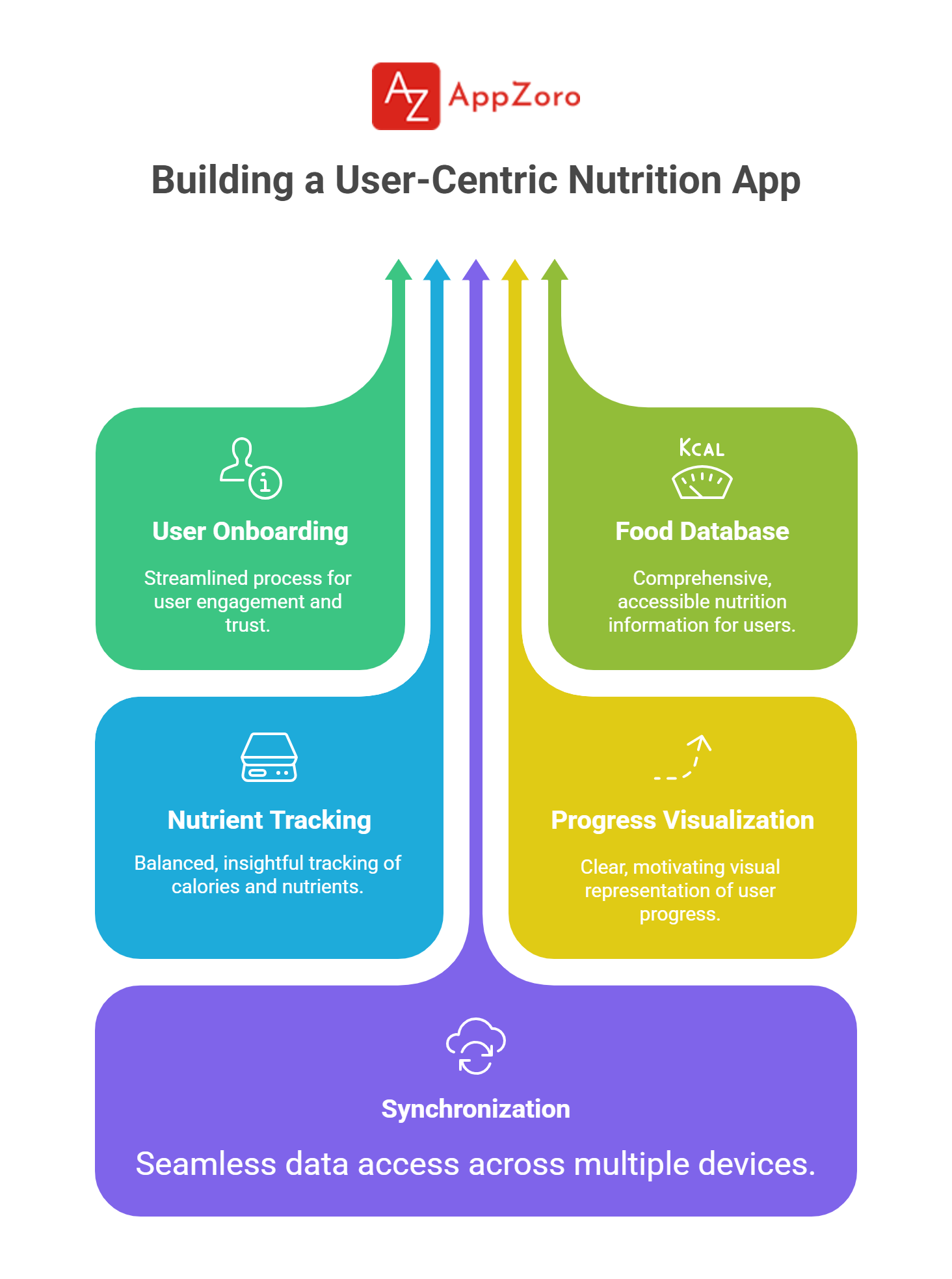
User Onboarding and Profile Creation
The first few minutes of interaction with the application will establish basis for the individual's perception of the application moving forward. Therefore, if the onboarding process appears burdensome to users, they will be reluctant to continue utilizing it.
Profiles should collect only what's necessary. Age, goals, dietary preferences, and basic health context. Nothing more. The app can learn over time. Asking for everything upfront slows adoption and reduces trust. In diet and nutrition app development, onboarding is where health awareness meets user comfort. Clarity matters more than completeness.
Food Database and Nutrition Breakdown
The food database represents the heart of every nutritional tracking application. The food database should be inclusive, detailed, easily accessible and display detailed information pertaining to both the nutrition breakdown of each food item in addition to any long-term effects or findings culled from research regarding specific foods that may benefit or hinder a user from achieving his/her personal health goal.
Users expect clear nutrition breakdowns without having to decode labels. Calories, macros, and serving sizes should be visible at a glance. Advanced users may want deeper data, but that information should never overwhelm first-time users. Accuracy here directly impacts credibility, especially in apps aligned with healthcare app development standards.
Calorie, Macro, and Micronutrient Tracking
Tracking should not come across as too sterile; rather, it should provide value-added knowledge. The focus of calorie and macro tracking is to teach balance rather than limit what people can consume. Tracking micronutrients provides insight into long-term health goals, particularly for those looking to address deficiencies or dietary restrictions/requirements. A tracking application that has been developed effectively allows users to make better decisions without making a mathematical challenge.
Visualizing and Reporting Progress
Trends are just as important as numbers. Visual representations such as charts or graphs with summaries will assist users in viewing their progress over time. Weekly views, monthly comparisons, and milestone recognitions can aid in maintaining motivation. Reporting assists businesses in identifying patterns of user engagement/products being actively used or benefiting the user's experience.
Synchronization and Cross-Platform Compatibility
Users often have a number of devices available in their daily lives. They frequently upgrade phones. They may record their meals from multiple types of devices. To keep things consistent for users, your application needs synchronization capabilities through the cloud. A user's progress, preferences, and historical data should remain attached to the individual regardless of what device the user connects to the application from, making it an extremely important characteristic of any commercially developed application designed within the health or wellness community.
Advanced Features That Differentiate High-Performing Nutrition Apps
Once the essentials are in place, advanced features create differentiation. These are the elements that turn useful apps into daily companions.
Barcode Scanning and Food Image Recognition
Manual logging is one of the biggest drop-off points. Barcode scanning speeds things up. Image recognition takes it further by identifying foods from photos. These tools reduce friction and encourage consistent use, especially for busy users. They also improve data accuracy when implemented thoughtfully.
Smart Meal Planning and Grocery List Automation
Meal planning removes daily decision fatigue. Smart planning tools suggest meals based on goals, preferences, and past behavior. Grocery lists update automatically, saving time and reducing guesswork.
This feature bridges tracking and action, which is why it's becoming common in advanced diet and nutrition app development projects.
Wearable and IoT Integration
Nutrition doesn't exist in isolation. Activity, sleep, and recovery all influence dietary needs. Integration with wearables allows nutrition recommendations to adjust based on real activity data. This is where nutrition apps align closely with custom fitness app development, offering users a more complete health picture.
Community, Challenges, and Social Sharing
Motivation improves when users feel connected. Challenges, progress sharing, and community features create accountability without pressure. These tools work best when optional and supportive, not competitive by default. Social features help retention without distracting from the core purpose of the app.
Push Notifications and Habit-Forming Reminders
Reminders should feel helpful, not intrusive. Timely prompts encourage meal logging, hydration, and reflection. Overuse drives churn. Underuse reduces engagement. The balance lies in context and timing. When notifications align with habits, users respond.
AI-Driven Personalization in Diet and Nutrition Tracking Mobile App Development
Personalization is the line between an app people try and an app people rely on. Most users don't want more data. They want better guidance. This is where AI earns its place in diet and nutrition app development.
Used correctly, AI does not replace nutrition science or human judgment. It supports both by spotting patterns that are difficult to track manually.
AI-Powered Dietary Recommendations
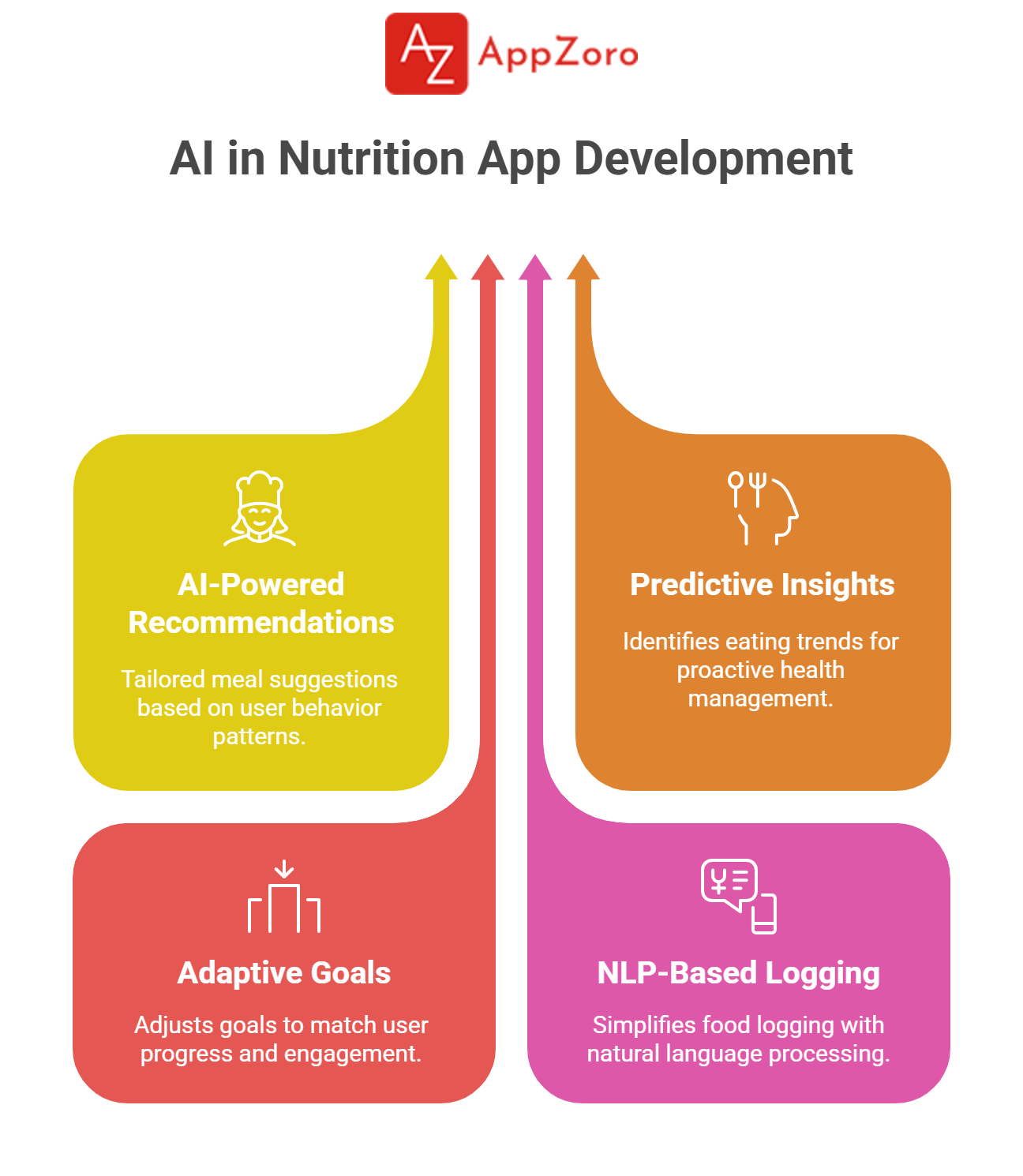
Generic advice rarely works. AI allows nutrition apps to suggest meals and adjustments based on real user behavior, not static profiles.
As users log meals, skip entries, or adjust portion sizes, the system learns. Recommendations become more relevant over time. This makes diet and nutrition tracking app development more effective because guidance improves with use instead of staying fixed.
Predictive Insights Based on Eating Patterns
AI models can identify trends before users notice them. Late-night snacking patterns. Weekend calorie spikes. Long gaps between meals.
This approach is especially valuable in apps aligned with broader healthcare app development goals, where prevention matters more than correction.
Adaptive Goals and Automated Nutrition Coaching
Static goals often fail because life changes. AI-driven systems adjust goals based on progress, consistency, and engagement.
When users struggle, goals soften. When users succeed, challenges increase. Automated coaching messages reflect real performance rather than ideal scenarios.
This adaptability keeps users engaged longer and reduces drop-off, which is a key metric for any wellness app development initiative.
NLP-Based Food Logging and Voice Input
Logging food should not feel like work. Natural language processing allows users to describe meals in their own words. Voice input removes friction entirely in some contexts. These tools lower the barrier to consistent tracking.
Technology Stack for Scalable Diet and Nutrition App Development
A nutrition app's success depends as much on technology choices as on features. Scalability, performance, and security must be baked in from day one.
Frontend: Native vs Cross-Platform Frameworks
Native development provides the fastest performance, better device integration, and consistent user experience—especially important for advanced features like biometric tracking and AI-powered recommendations.
Cross-platform frameworks can reduce initial costs and time-to-market. For smaller pilots or proof-of-concept apps, they are a viable option. Long-term, however, native builds usually provide better scalability and reliability.
Backend Architecture and Cloud Infrastructure
The backend handles user data, analytics, AI processing, and integrations. Choosing a scalable cloud infrastructure ensures the app can support thousands or even millions of users without performance issues.
Modular backend design allows features like meal logging, progress tracking, and community tools to evolve independently, which is essential for apps built as part of custom fitness app development ecosystems.
APIs for Food Databases and Wearables
Accessing accurate nutrition data is non-negotiable. Integrating with reliable food databases and wearable devices provides users with precise insights. APIs allow this data to flow seamlessly, improving recommendations and tracking without adding manual work.
This connectivity is a key differentiator in modern diet and nutrition tracking app development projects.
Security, Compliance, and Data Encryption
Nutrition apps handle sensitive health information. Compliance with HIPAA, GDPR, and other regulations is mandatory. Data encryption, secure authentication, and safe storage practices protect both users and businesses from legal and reputational risk.
Collaboration with a Custom Android App Development Company
Partnering with a mobile app development company USA ensures your technology choices align with both user expectations and business goals. Experienced developers guide decisions on architecture, scalability, integrations, and ongoing maintenance, which are crucial for long-term success.
Cost Breakdown: How Much Does Diet and Nutrition App Development Cost?
Budgeting for a nutrition app can feel like guessing, but understanding the key cost drivers makes planning realistic. Diet and nutrition app development costs vary widely depending on features, integrations, and long-term goals.
MVP vs Advanced Nutrition App Pricing
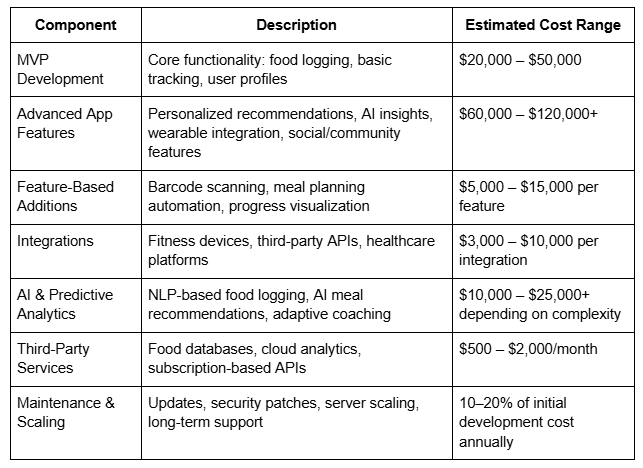
If your goal is to test the market, an MVP (minimum viable product) can cost significantly less. These apps focus on core functionality—food logging, basic tracking, and user profiles. For most projects, this falls in the $20,000 to $50,000 range.
Advanced apps with personalized recommendations, AI-driven insights, and wearable integration can reach $60,000 to $120,000 or more, depending on complexity. The difference lies in feature depth, scalability, and data management.
Feature-Based Cost Estimation
Each functionality adds cost. Barcode scanning, meal planning automation, AI recommendations, progress visualizations, and social/community features all require additional development time.
Integrations with fitness devices, third-party APIs, or healthcare platforms add both initial development and ongoing support costs. Choosing which features to prioritize early is key for managing budgets effectively in diet and nutrition tracking mobile app development.
AI, Integrations, and Third-Party Service Costs
AI-powered recommendations, predictive insights, or NLP-based logging increase both development and maintenance costs. Similarly, third-party services such as food databases or cloud analytics may require subscription fees.
Working with a custom android app development company ensures these integrations are efficient, reducing unexpected expenses and technical debt.
Maintenance and Scaling Considerations
Cost doesn't stop at launch. Regular updates, security patches, server scaling, and new feature additions are essential for app longevity. Apps that fail to maintain performance risk losing users and credibility, especially in health-focused contexts where reliability is critical.
Monetization Models for Diet and Nutrition Apps
Building an app is only half the equation. Monetization ensures sustainability while continuing to deliver value to users.
Subscription-Based Plans
Monthly or yearly subscriptions are common for premium nutrition apps. Users pay for access to personalized meal plans, progress tracking, and AI-driven insights. Recurring revenue makes this a stable model for scaling.
Freemium and In-App Purchases
Offering a free basic version with optional upgrades is effective for user acquisition. Users can try logging meals and tracking progress before purchasing premium features like detailed analytics, recipe libraries, or advanced meal plans.
Coaching and Nutritionist Consultations
Some apps provide in-app access to professional guidance. Users pay for one-on-one consultations, personalized coaching, or structured programs. This adds high-value offerings without relying solely on subscriptions.
Brand Partnerships and Affiliate Revenue
Partnerships with supplement brands, healthy food companies, or kitchen appliance providers create additional revenue streams. Affiliate links or sponsored content can monetize while keeping the core app free for users.
Why Partner with AppZoro for Diet and Nutrition App Development?
Building a diet or wellness app is more than creating a platform to log meals or count calories. The real challenge and opportunity is creating an app that people trust, actually use, and rely on as part of their daily routine. That is where AppZoro makes a difference. Our mobile app development company USA combine technical skill, healthcare knowledge, and design expertise to deliver apps that work for both users and businesses.
Here is why AppZoro is the right partner for your diet and nutrition tracking mobile app development project:
-
Healthcare Expertise You Can Trust: Nutrition and wellness apps handle sensitive personal information. We ensure your app complies with HIPAA, GDPR, and other regulations. Secure storage, encrypted data, and safe integrations give users confidence, and you do not have to worry about compliance issues.
-
Custom Solutions That Fit Your Goals: Off-the-shelf templates only go so far. We build fully custom fitness app development solutions that match your brand, your users, and your business objectives. Every feature, from personalized meal plans to wearable integration, is tailored to your specific needs.
-
Scalable and Flexible Architecture: Whether your app targets a local audience or scales nationally, our apps are designed to grow. You can add new features, integrate additional devices, and support thousands of users without affecting performance. This ensures your investment in diet and nutrition app development pays off long-term.
-
Proven Success in Wellness and Fitness: We have helped clients build nutrition trackers, holistic wellness platforms, and connected fitness solutions. This experience allows us to design apps that drive engagement and keep users returning.
-
User-Centric Design for Daily Engagement: Logging meals, tracking progress, and accessing insights should be effortless. We focus on intuitive interfaces, visual dashboards, and simple interactions that encourage daily use. The goal is for your app to become a trusted companion, not just another app on a phone.
-
Advanced Integrations and Technology: Modern wellness apps connect to wearables, IoT devices, and fitness trackers. These integrations provide users with a complete view of their health and make your app part of a larger wellness ecosystem.
-
Ongoing Support and Optimization: Launch is just the beginning. We provide analytics, performance monitoring, and updates to keep your app relevant. This ensures your platform evolves alongside your users' needs.
-
Focus on Business Impact: Beyond features, our approach is results-driven. We design apps that increase engagement, retention, and revenue potential. Your app becomes not just a tool for users, but a valuable asset for your business.
AppZoro's Proven Process for Diet and Nutrition App Development
Working with a local mobile app development company USA means direct collaboration, clear communication, and faster response times. AppZoro combines local market insight with technical expertise to create apps that resonate with users and meet your business objectives. We follow a tested process designed to minimize risk and maximize impact.
Discovery and Healthcare Compliance Planning
Every project starts with understanding your audience, business goals, and regulatory requirements. We plan for HIPAA compliance and secure data handling from day one, so you don't face issues after launch.
UX/UI Prototyping and Validation
User experience drives engagement. We create interactive prototypes, test them with real users, and refine every flow. From food logging to progress tracking, every interaction is intuitive, friction-free, and designed to boost retention.
Agile Development and QA Testing
Our development is iterative. Features evolve based on feedback and testing. Continuous QA ensures reliability, smooth integrations, and high performance across devices, including Android and iOS platforms.
Deployment, Analytics, and Long-Term Optimization
Launch is just the beginning. AppZoro implements analytics, performance tracking, and ongoing optimization strategies. Your diet and nutrition tracking mobile app development project grows smarter with every user interaction, ensuring continued engagement and ROI.
Final Note
Everyone wants to eat healthier, manage their weight, or stick to wellness routines, but most people struggle to stay consistent. Logging meals, tracking calories, and following a plan can quickly feel overwhelming. The challenge is not motivation. It is having a tool that is simple, intelligent, and personalized to each user's needs. That is where a well-designed diet and nutrition app makes all the difference, and where partnering with the right development team becomes critical.
A modern app understands user habits, adapts recommendations, and delivers actionable insights that make healthy living achievable. Personalized meal suggestions, progress tracking, and seamless integration with fitness devices turn your app into a daily companion users rely on.
For businesses, this is a major opportunity. Diet and nutrition app development is not just about building software. It is about creating a platform that users trust and return to every day, while also generating measurable business results. Partnering with AppZoro ensures your app is built with strategy, technical expertise, and a deep understanding of wellness and healthcare ecosystems. Our mobile app development company USA bring the experience to design apps that are scalable, secure, and personalized, giving your brand a competitive edge from the start.
Partnering with AppZoro means your vision becomes a fully functional, engaging, and results-driven nutrition or wellness app that stands out in a crowded market.
Leave a Comment