
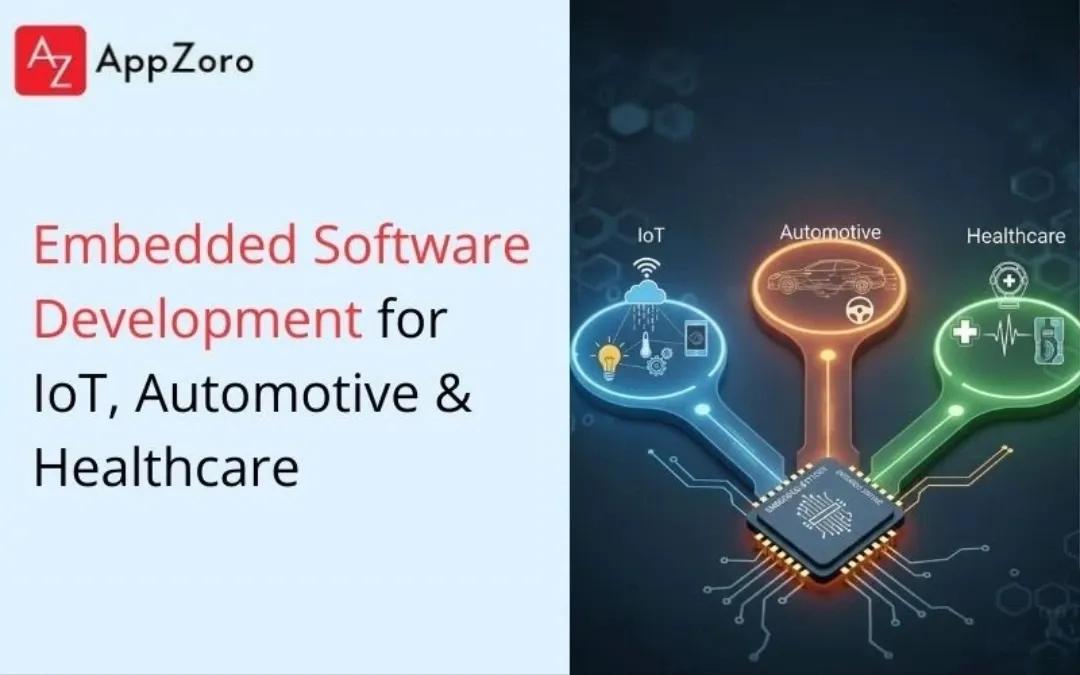
For many years, embedded software was treated as plumbing. Essential, yes, but rarely discussed unless something went wrong. That mindset no longer holds. As devices become smarter and more connected, embedded software has quietly taken on a much larger role. It now determines how products behave in the real world, often in situations where there is no room for hesitation or recovery.
What has changed most is the level of trust placed in these systems. Cars respond to software decisions at highway speeds. Medical devices monitor and react to patient data continuously. Industrial and connected systems run for months or years with minimal human intervention.
This shift has exposed a truth many teams learn only after deployment. Embedded software development services are treated as a late-stage implementation detail. The choices made early, how hardware and software interact, how failures are handled, how updates are planned, shape a product’s behavior long after it leaves development. Poor decisions tend to surface slowly, often when systems are hardest to change.
Teams that recognize this early tend to build products that age well. Those that do not often spend years managing limitations that could have been avoided. Embedded software, at this point, is no longer a background concern. It is a defining factor in whether modern products earn long-term trust.
Fundamentals of Embedded Software Development
At its core, embedded software development is about responsibility as much as control. The software does not simply tell hardware what to do. It defines how that hardware behaves when conditions are less than ideal, when timing matters, and when there is no opportunity to retry. Unlike general software, embedded systems live inside strict boundaries. Memory is limited. Processing power is finite. Time itself becomes a constraint that cannot be ignored.
Embedded systems software development is different from conventional application development because the software and hardware are one in the same, rather than loosely coupled layers. A small change in code can have drastic effects on power consumption, timing, and stability that may only surface under certain conditions. There is no room for inefficiencies and far less tolerance for behaviors that cannot be predicted.
In many cases, real-time responses become the "hard line." For example, in the automotive world, the embedded software must respond to a sensor's output within a defined time frame, regardless of what else is going on in the vehicle's system. In healthcare, time and/or accuracy delays are not technical issues, but rather can negatively impact patient outcomes. An embedded software solution is expected to continually run without interruption, sometimes for years on end, without any opportunity for regular system reboots or upgrades.
Because of these factors, embedded systems software development company requires a fundamental shift in thinking. It rewards a methodical approach rather than a quick approach to solving problems, and it rewards restraint rather than excess (e.g., adding extra features to gain speed). Embedded software developers focus on developing systems that maintain consistent levels of performance despite suboptimal conditions or extreme levels of stress.
Core Components in Embedded Systems Software Development
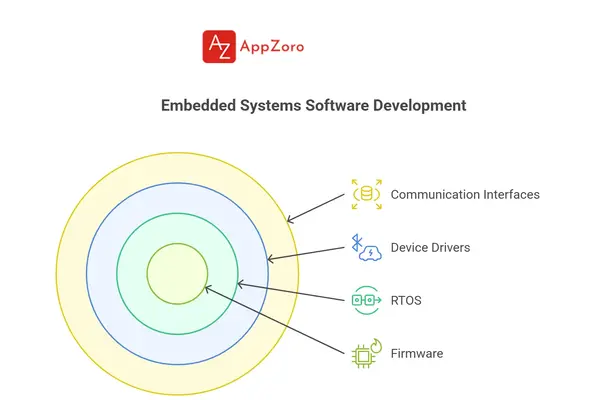
Firmware and Low-Level Software
Firmware is the source of everything. The firmware defines how to execute the start sequence, how to initialize the hardware, how to transition from being powered on to being fully functional. When developing firmware for a custom embedded software development project, the developer needs to develop it with great care so that he/she can balance maximum performance with a limited amount of memory and processing power.
Weaknesses in firmware often do not show up during normal development cycles, but will typically be discovered later during testing, often during edge conditions. Most times, these types of issues can take a considerable amount of time and effort to diagnose and resolve. When firmware is properly designed, it is often unnoticed because it is doing its job properly.
Real-Time Operating Systems.
As systems begin to grow in complexity and beyond simple tasks, an RTOS becomes less of an option and more of a necessity. An RTOS will ensure that critical tasks have the highest priority in the system by managing the timing of tasks, managing access to resources, and managing the flow of execution of tasks within the RTOS.
This level of predictability is what allows embedded systems to operate consistently and reliably in safety-critical environments. Without predictability, the level of complexity increases faster than it can be controlled, increasing the difficulty of verifying behaviour as additional functionality is added.
Device Drivers and Hardware Abstraction Layers
Device drivers act as translators between software and hardware, enabling communication with sensors, actuators, displays, and communication modules. A hardware abstraction layer introduces separation, allowing application logic to remain stable even when hardware components change.
This separation becomes increasingly valuable over time. Products evolve. Components are replaced. Supply chains shift. Embedded software development services account for this early are far easier to maintain than those that hard-code assumptions about hardware.
Communication Interfaces and Protocols
Few embedded systems operate in isolation anymore. Data flows between devices, cloud platforms, and enterprise systems continuously. Communication interfaces and protocols define how that exchange happens, and how reliably and securely it does so.
This layer often connects embedded products with broader ecosystems built by a an artificial intelligence app development company. When designed thoughtfully, communication turns individual devices into coordinated systems rather than isolated endpoints.
Exploring Types of Software Development Embedded Systems
The architecture you choose early in an embedded project tends to linger far longer than anyone expects. The best decisions are usually less about what is possible today and more about what the system will be asked to handle a few years from now.
Bare-Metal Embedded Software
Bare-metal development is the purest form of embedded work. The embedded software development talks directly to the hardware, with no operating system in between. This simplicity can be appealing. There is very little overhead, and when done well, the system behaves in a highly predictable way.
That predictability comes at a cost. Every responsibility sits squarely with the development team. For devices with a narrow, well-defined purpose, bare-metal software can be an elegant solution. Problems tend to arise when requirements evolve. What once felt clean and efficient can become difficult to extend without introducing risk.
RTOS-Based Systems
The moment a device needs to juggle multiple responsibilities, a real-time operating system often enters the conversation. An RTOS introduces structure. Tasks are scheduled, priorities are enforced, and timing becomes more manageable without sacrificing determinism.
This approach has proven itself in environments where timing matters and resources are still constrained. Automotive systems, industrial controllers, and many healthcare devices rely on RTOS-based designs because they strike a workable balance. They offer more flexibility than bare-metal systems while preserving the predictability that embedded environments demand.
Embedded Linux Systems
Embedded Linux is typically used when a device should operate more like a mini-computer than a single purpose machine. Embedded Linux supports various functionalities including heavy graphics user interfaces, networking, and regular & simple updating via the vast selection of tools and libraries within the Linux ecosystem.
Embedded Linux does however present a greater complexity. With rather advanced hardware requirements and significant design expertise needed to keep them stable and secure, Once developed to meet these requirements, Embedded software development services connect points for advanced medical equipment or connected platforms that interact closely with the cloud of enterprise systems.
Edge Computing and Connected Embedded Systems
Connected embedded systems and edge computing are more than a temporary trend; they are evolving into an absolute necessity for many industries. There are a variety of reasons for developing connected embedded systems with the advantages of edge computing — reduced latency for processing data, as well as avoidance of overwhelming networks with loads of raw data not required to move far for interpretation.
In particular, connected systems with local edge computing significantly benefit from the combination of timely and reliable decision-making at the local level with selective Cloud communication. Now, when remote data is being collected for providing critical decisions, it is not only the collection of the data that is going to be used; it is also the ability to interpret that data to maximize value at the local level.
Choosing the Right Approach Based on Use Case
Context matters more than preference. A simple sensor does not need the weight of embedded Linux, just as a connected healthcare device will quickly outgrow a bare-metal foundation. The challenge is recognizing those boundaries early.
This is where experienced embedded software development services tend to earn their value. They help teams think beyond the first release and weigh trade-offs honestly.
Step-by-Step Process in Embedded Software Development Services
Every embedded system project should begin with establishing what the project will actually achieve and does not achieve. This will cover both what the device is supposed to do and all of the things that cannot be accomplished with that device.
Requirement Analysis And Hardware Selection
Factors such as expected timing, environmental factors, safety considerations, and regulatory requirements must all be taken into consideration early on in the embedded hardware selection process. Hardware selection is probably more critical than many embedded development teams realize.
A poorly selected microcontroller or other embedded hardware will create a series of challenges throughout the design, development, and production of embedded hardware. The custom embedded software development company has been successful have learned to spend the typical amount of time necessary to select embedded hardware, since a poor choice of embedded hardware is one of the most difficult changes to correct during development.
System Architecture and Software Design
Architecture will be the unchanging, silent foundation of the system once requirements have been established. The interactions between components, the hierarchical prioritisation of tasks, and the pathways of data through the system will define how resilient the software will be when faced with stress.
Strong architecture is usually not characterised by being overly complex. Strong architecture will normally allow for continuous growth. Even simple initial versions will be better when their designs consider future features. This is typically the chief distinction between software that can continue to evolve without having to go through a labour-intensive reworking to keep up to date.
Coding and Firmware Development
Discipline is necessary for writing software development embedded; it must be efficient, predictable, and logical to understand even months or years after being written. The level of difficulty with writing firmware is especially high because firmware has virtually zero tolerance for errors. The programmer must ensure they are using memory correctly, that their timing will be accurate during operation and that they have interacted directly with hardware as desired.
Generally, the team has utilised embedded software development services in order to manage building, debugging, and version control at this stage of the development process. Small mistakes can lead to serious issues, but they will usually only be revealed in rare instances that can be difficult to diagnose once systems are up and running.
Testing, Validation, and Debugging
Testing in embedded systems does not represent the end of a process; rather, it represents only one piece of a large puzzle. Embedded system testing is a continuous process that requires multiple forms of testing such as unit testing, integration testing and hardware in the loop to fulfill specific requirements at particular stages of development. Skipping any type of testing will lead to unknown risk.
Testing under actual operating conditions differs from controlled/ lab environments. Embedded systems can face real-life situations where power is unstable, connectivity is lost and many unplanned scenarios can occur. The added layer of validation provides extra confidence for Healthcare and Wellness Devices because users rely on these devices for their health and well being.
Long Term Maintenance and Deployment
Once an embedded system is deployed, it does not mean that the project is finished; it is only the beginning of another phase of the embedded system lifecycle. An embedded system may have to function for decades after deployment, which will still require updates, monitoring and modifications to preserve operations.
Early decisions regarding the design and architecture of embedded systems have a big influence on how good a job will be accomplished during the maintenance phase of a system. Embedded systems that were built with a well thought out structure and with foresight tend to be easier to maintain and modify compared to embedded systems that were built on a deadline and without thought. If appropriate design principles are followed from the start of a project, the result will be a robust project that will be able to last a long time.
Addressing Challenges in Software Development in Embedded Systems
Embedded systems tend to look straightforward from the outside. A device performs a specific function, often with no visible interface, and does it repeatedly. The reality behind that simplicity is usually far more complex. Most challenges in software development for embedded systems do not come from a single issue, but from how multiple constraints interact over time.
Hardware Constraints and Performance Limits
Every embedded project begins with limits. Processing power is finite. Memory is tight. Power consumption matters, sometimes more than anything else. Unlike general software, embedded systems cannot rely on scaling hardware resources when performance dips.
This forces difficult trade-offs. Features must justify their cost in cycles and memory. Code must be efficient, not just correct. In automotive embedded software development company, these constraints are even stricter, as systems must respond in real time while operating under safety requirements. Experienced teams learn to treat constraints as design inputs, not obstacles, and that mindset often separates stable systems from fragile ones.
Security Vulnerabilities in Embedded Devices
Security is one of the most underestimated challenges in embedded systems software development. Many devices are deployed with the assumption that they will operate in controlled environments. Over time, that assumption breaks down.
Connected devices expose new attack surfaces, from communication interfaces to firmware update mechanisms. Once deployed, embedded systems are often difficult to patch quickly. This makes early security decisions critical. A reliable embedded software development service treats security as part of system architecture, not something added near the end. Authentication, secure boot, encrypted communication, and access control must be planned from the beginning.
Scalability and Update Management
Embedded systems are increasingly expected to evolve after deployment. Features change. Bugs surface. Regulations shift. Managing updates across large device fleets introduces both technical and operational complexity.
Poor update strategies can turn routine maintenance into a risk. Failed updates can disable devices or introduce inconsistencies across versions. This is where custom embedded software design matters. Systems built with modular architectures and reliable update paths scale more gracefully. Those built without future updates in mind often struggle once they move beyond small deployments.
Regulatory and Compliance Challenges
In sectors like automotive and healthcare, compliance is not optional. Regulations influence how software is written, tested, documented, and maintained. These requirements can slow development, but ignoring them creates far greater risk later.
Teams without prior experience often underestimate the effort involved. Working with an embedded software development company that understands regulatory expectations helps avoid costly redesigns. Compliance shapes not just the final product, but the development process itself.
Real-World Applications of Embedded Software Development Services
Embedded software rarely exists in isolation. Its value becomes clear when it is applied to real products, operating in real environments, under real constraints. Across industries, embedded systems form the foundation of reliability and intelligence.
Embedded Systems in IoT Devices and Smart Infrastructure
IoT devices depend heavily on efficient embedded software to function reliably in the field. Sensors, gateways, and edge devices must collect data, process it locally, and communicate with larger systems without interruption.
In smart infrastructure projects, scale adds complexity. Thousands of devices may operate simultaneously, often in uncontrolled environments. Collaboration with an IoT application development company helps ensure embedded software integrates cleanly with cloud platforms and enterprise systems, turning individual devices into coordinated networks.
Healthcare Devices and Medical Equipment
Healthcare embedded systems demand accuracy, consistency, and trust. Devices such as monitors, diagnostic equipment, and wearable medical tools rely on embedded software to process data correctly and respond within strict time constraints.
In this space, failure is not measured in downtime alone. It affects patient safety. This is why healthcare devices often combine embedded expertise with support from a custom enterprise software development company to enable analytics, decision support, and long-term data management without compromising reliability.
Industrial Automation and Manufacturing
Manufacturing environments rely on embedded systems for control, monitoring, and optimization. Embedded software manages machinery, coordinates workflows, and ensures consistent production output.
These systems often operate continuously for years. Stability matters more than novelty. Embedded systems software development in industrial settings prioritizes predictability, fault tolerance, and maintainability over frequent change.
Consumer Electronics and Wearables
Consumer devices and wearables place a different set of demands on embedded software. Power efficiency, responsiveness, and user experience all compete for priority. Devices must feel instant while conserving battery life.
Custom embedded software allows manufacturers to fine-tune this balance. When combined with intelligent features or connectivity, embedded systems enable products that feel responsive without sacrificing reliability.
Innovations and Trends in Automotive Embedded Software Development
Automotive embedded software development services has changed more in the last decade than it did in the previous three. Vehicles are no longer defined primarily by mechanical components. Increasingly, they are defined by software decisions made long before the first prototype reaches the road.
Software-Defined Vehicles
The idea of the software-defined vehicle reflects a deeper shift in how cars are built and maintained. Instead of tying functionality tightly to hardware, manufacturers are designing vehicles where features evolve through software updates. This approach depends heavily on reliable embedded development software that can support change without compromising safety or performance.
For embedded teams, this changes priorities. Software must be modular, updateable, and resilient over long lifecycles. It also means closer alignment with custom software development solutions that connect in-vehicle systems with cloud platforms and enterprise environments.
ADAS and Autonomous Driving Systems
Advanced driver assistance systems have become a baseline expectation rather than a premium feature. Lane assistance, adaptive cruise control, and collision avoidance all rely on embedded systems processing sensor data in real time.
What makes this challenging is not just complexity, but responsibility. Software development in embedded system environments for ADAS must meet strict timing and safety requirements. Decisions happen in milliseconds, often with no margin for error. As autonomy increases, embedded software must coordinate cameras, radar, and AI-driven perception systems reliably under unpredictable conditions.
Electric Vehicle Software Architecture
Electric vehicles introduce an entirely different software landscape. Battery management, energy optimization, and charging behavior all depend on embedded logic. Unlike traditional vehicles, software plays a central role in performance, range, and user experience.
This has pushed embedded software development company to evolve. Teams must design systems that balance efficiency with responsiveness, often integrating analytics or intelligence developed in collaboration with an artificial intelligence app development company. EV software is less about isolated control units and more about coordinated systems working together.
Functional Safety and Automotive Standards
As vehicles become more software-driven, safety standards become more influential. Functional safety frameworks shape how embedded software is designed, tested, and documented. Compliance is not just a checkbox. It affects architecture, development workflows, and long-term maintenance strategies.
Automotive software development embedded increasingly requires teams that understand both engineering constraints and regulatory expectations. This combination is difficult to build without experience, which is why many manufacturers rely on established network rather than building everything internally.
Why Partner with AppZoro for Embedded Software Development Services?
Choosing a development partner for embedded systems is rarely about filling a short-term gap. It is about finding a team that understands how software behaves over years of use, not just during initial deployment.
AppZoro brings experience across IoT, automotive, and healthcare, domains where embedded software is expected to operate reliably under real-world constraints. That cross-domain perspective matters because many embedded products now sit at the intersection of hardware, connectivity, and enterprise systems.
As a provider of embedded software development services, AppZoro focuses on end-to-end delivery. From early architecture decisions to long-term maintenance, teams work with a clear understanding of how embedded systems integrate into larger ecosystems. This includes collaboration with a wellness app development company when embedded devices connect to user-facing or clinical platforms.
The emphasis on custom embedded software development allows solutions to be shaped around actual use cases rather than generic assumptions. Systems are designed to scale, adapt, and remain maintainable as requirements evolve. This approach aligns closely with how modern products grow in the field.
Long-term support is another consideration that often gets overlooked early. Embedded systems live longer than most software. AppZoro’s focus on scalable architecture and sustained support helps ensure that systems remain reliable, updateable, and aligned with business needs well beyond initial release.

Conclusion
Embedded software rarely makes headlines, but it increasingly determines whether modern products succeed or struggle. Across IoT, automotive, and healthcare, it is the layer that translates hardware potential into real-world performance. As devices become more connected and intelligent, embedded systems software development is no longer just an engineering task. It is a long-term business decision.
What we see repeatedly is that outcomes depend less on tools and more on approach. Teams that treat software development for embedded systems as a one-time effort often run into limitations when products scale, regulations tighten, or updates become necessary. Those that invest early in thoughtful architecture, testing discipline, and maintainability tend to move forward with fewer disruptions.
Choosing the right healthcare app development company USA plays a big role here. Embedded systems live longer than most software.
If you are evaluating embedded software development services for a new product or looking to stabilize and modernize an existing system, a technical assessment or early consultation can bring clarity. Connect with us today!