
A few years ago, most enterprise blockchain projects never left the whiteboard. They sat inside innovation teams, ran as pilots, and quietly stopped when the business case fell apart. That phase is done. In 2026, blockchain runs real operations. It tracks shipments, settles transactions, protects medical records, and enforces contracts without handoffs or manual checks.
The change happened for a simple reason. When data moves between vendors, regions, and regulators, centralized databases slow everything down. Errors multiply. Disputes become routine. Blockchain solved that by changing how records are shared. Instead of one system owning the truth, every approved participant works from the same record.
Enterprise blockchain platforms are expected to move USD 1,431.54 billion by 2030. Smart contracts already handle large parts of finance, logistics, insurance, and manufacturing operations. What makes blockchain different now is maturity. The platforms are stable. Governance is clearer. Integration with ERP and internal systems is no longer a blocker.
Many enterprises now treat blockchain the same way they treat databases or messaging systems. If you are assessing an enterprise blockchain development company, planning a custom build, or strengthening in-house capabilities, this guide focuses on what works, what fails, and why.
Enterprise Blockchain Development Explained: What It Is and Why It Matters
Before going further, it helps to be clear about what enterprise blockchain development is. Enterprise blockchain development means designing and running permissioned blockchain networks that support real business processes. Access is controlled. Rules are enforced by the system. Performance, security, and governance are part of the foundation.
Public blockchains value openness. Enterprise blockchains value reliability and control.
This also sets them apart from traditional enterprise software. Most enterprise applications rely on a central database owned by one organization. Scalability matters just as much. Enterprise systems must perform under pressure. Transaction volume fluctuates. Latency affects operations. This is where experienced teams earn their value. They understand how technology behaves inside real organizations, under legal and operational pressure.
When built well, enterprise blockchain reduces friction, shortens settlement cycles, improves visibility, and lowers risk. When built poorly, it becomes an expensive system that no one owns.
The difference is not the technology. It is how it is planned and executed.
Why Enterprises Are Rapidly Adopting Blockchain Development Today
Enterprises do not adopt technology because it sounds promising. They adopt it when existing systems start costing more than they return. That tipping point has already passed.
Blockchain is no longer a niche capability parked inside innovation teams. It is now being used to fix problems that traditional enterprise systems struggle to solve at scale. The shift is happening for practical reasons, not curiosity.
Here are the seven forces pushing enterprises toward blockchain development today.
1. Transparency That Holds Up When It Matters
Most enterprise platforms claim to offer visibility. That promise usually breaks the moment more than one organization is involved.
Blockchain changes this by giving every approved participant access to the same record, at the same time, with the same history. There are no competing versions and no quiet edits. That is why many blockchain development for enterprises initiatives begin with cross-company workflows rather than internal processes.
2. Traceability That Ends Arguments Instead of Starting Them
Tracing a transaction across disconnected systems is slow, expensive, and unreliable.
Blockchain records every step in sequence. Nothing is overwritten. Nothing disappears. When questions arise, answers are immediate.
In supply chains, healthcare, and financial settlements, this traceability cuts investigation time from weeks to minutes. Enterprises turn to enterprise blockchain development solutions because accountability becomes automatic, not enforced.
3. Security Without a Single Point of Collapse
Centralized systems concentrate risk. When they fail, everything downstream is affected.
Blockchain spreads trust across the network. Data is linked cryptographically, and changes require agreement. That does not eliminate risk, but it makes unauthorized activity difficult to hide and easy to trace.
This shift in security posture is a major reason enterprises choose blockchain enterprise development services instead of extending aging platforms.
4. Cost Reduction Through Automation That Actually Works
Manual reconciliation drains time and budget. Delays add more cost. Disputes add even more.
Smart contracts remove much of this overhead. Payments trigger automatically. Approvals follow predefined rules. Exceptions surface clearly instead of getting lost in email chains.
This is where enterprise blockchain development services move from theory to measurable return.
5. Compliance Built Into the System
Compliance is often treated as a reporting task. That approach does not scale.
Blockchain treats compliance as a design requirement. Every transaction is time-stamped, traceable, and auditable by default. Enterprises operating across borders increasingly rely on an enterprise blockchain app development company that understands compliance at the architectural level, not as an afterthought.
6. Data Sovereignty Without Breaking Collaboration
Data regulations continue to tighten, and enterprises are expected to know exactly where data lives and who can access it.
Blockchain supports precise permissioning. Sensitive data can stay off-chain, while verifiable references are shared across participants. This allows global collaboration without violating local rules.
Achieving this balance with traditional systems is difficult and often fragile.
7. Enterprise Adoption Is Now the Standard
Blockchain adoption started in finance, driven by settlement speed and risk control. Healthcare followed with a focus on record integrity and consent. These are not pilot programs. They are production systems built by enterprise application development company teams that understand uptime, scale, and integration pressure.
Blockchain adoption today is enterprise-led because enterprise problems finally have a system designed to handle them.
AI Meets Blockchain: Practical Automation for Enterprise Systems
Blockchain establishes trust. Advanced analytics help teams make better decisions.
Each plays a different role. Together, they solve problems that traditional enterprise systems still struggle to manage at scale.
Blockchain brings order to data. Records remain consistent, traceable, and difficult to change without approval. Decision systems depend on this consistency to function reliably. When analytical models work on blockchain-backed data, outcomes become easier to explain. This approach has become a standard part of enterprise blockchain development solutions designed for real operations, not demos.
Smart Contracts That Reflect Real Conditions
Basic smart contracts follow fixed instructions. They work well until conditions change.
More advanced implementations allow contracts to respond to updated inputs such as risk levels, usage patterns, or historical behavior. Approvals adjust based on context instead of rigid thresholds. It is one reason many organizations plan blockchain initiatives alongside AI development services instead of treating them as separate efforts.
From Cleanup to Prevention
Blockchain records what already happened. Predictive systems help identify what may happen next.
In financial operations, this means identifying suspicious patterns early. In supply chains, it means spotting delays or quality risks before they disrupt production. In healthcare, it means flagging inconsistencies before they affect patient care.
The focus shifts from fixing problems late to preventing them early.
Ongoing Monitoring Without Manual Overhead
When transactions are recorded on a blockchain, monitoring does not need to rely on periodic reviews.
Activity can be observed continuously. Unusual behavior stands out sooner. Trends emerge faster. Response times improve.
This level of oversight is difficult to achieve with fragmented systems and manual controls. That is why blockchain enterprise development services increasingly include advanced monitoring from the start.
How Enterprises Are Using This Today
Banks use verified transaction data to streamline compliance checks and reduce unnecessary alerts. Manufacturers track supplier performance and anticipate disruptions before schedules are affected. Logistics providers improve routing decisions using reliable shipment records. Healthcare organizations protect patient data while supporting data-driven diagnostics.
These systems are not accidental. They are built by teams that understand enterprise software, strong UI/UX design and development services, and how large organizations actually function.
When blockchain-backed systems support better decisions, automation becomes accountable. Outcomes become easier to explain. That shift changes how enterprises operate.
Must-Have Features of Enterprise-Grade Blockchain Development Solutions
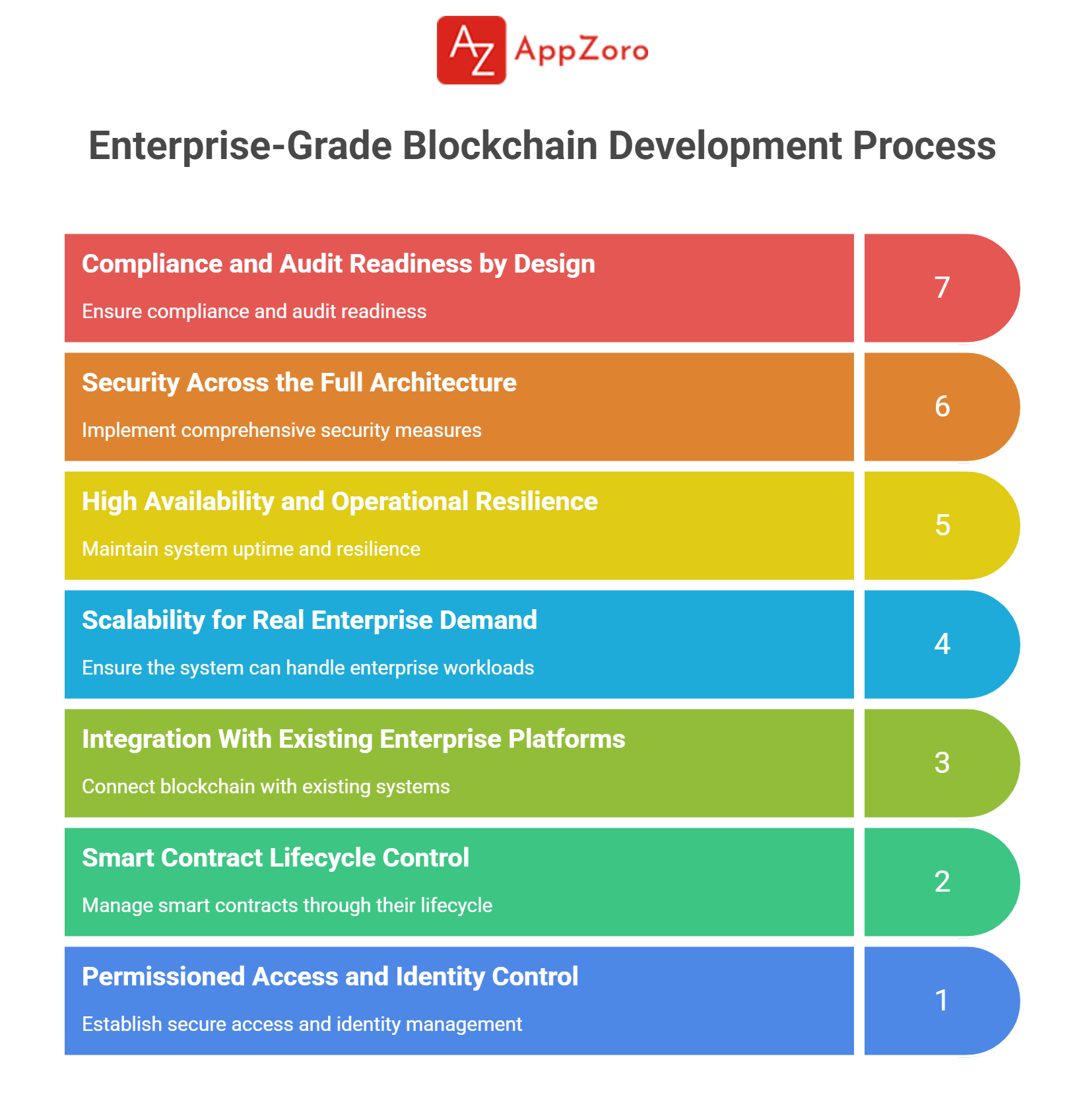
1. Permissioned Access and Identity Control
Enterprises must know who can view data, who can update it, and who can approve transactions.
Permissioned access allows control at the role level. Identity management should connect with existing enterprise IAM systems rather than replace them. This supports governance, accountability, and compliance.
Any enterprise blockchain development company that treats access control as optional is creating future risk.
2. Smart Contract Lifecycle Control
Smart contracts do not end at deployment.
Enterprises need testing environments, version tracking, rollback options, and controlled upgrades. A single flaw can halt operations or lock assets.
Managing the full contract lifecycle is a key part of enterprise blockchain development expertise that separates experienced teams from first-time builders.
3. Integration With Existing Enterprise Platforms
No enterprise starts from scratch.
Blockchain systems must connect with ERP tools, CRM platforms, data warehouses, and internal applications. APIs and middleware matter more than the blockchain framework itself.
Effective custom enterprise blockchain development starts with integration planning, not technology selection.
4. Scalability for Real Enterprise Demand
Enterprise workloads change quickly.
Systems must scale without slowing down or becoming unstable. This includes transaction throughput, response times, and data access under pressure.
Blockchain development experts for enterprise environments design for peak conditions, not average usage.
5. High Availability and Operational Resilience
Downtime is not acceptable.
Enterprise blockchain networks must support redundancy, failover, and recovery planning. Nodes should continue operating even if parts of the network are unavailable.
Availability is a baseline expectation, not a premium feature.
6. Security Across the Full Architecture
Security extends beyond encryption.
Enterprises need strong key management, network separation, role-based permissions, and continuous oversight. Blockchain reduces some risks but introduces others if poorly designed. Experience matters more than tools in this area.
7. Compliance and Audit Readiness by Design
Auditors care about records, access, and controls.
Enterprise blockchain platforms must generate audit-ready data automatically. Compliance cannot be added later without disruption.
Understanding enterprise blockchain development means understanding regulatory pressure as much as technical design.
Enterprise Blockchain Architectures: Choosing the Right Model for Your Business
Architecture decisions determine whether a blockchain initiative scales or stalls. There is no universal best model. The right choice depends on trust boundaries, performance needs, and regulatory constraints.
Public vs Private vs Consortium Blockchains
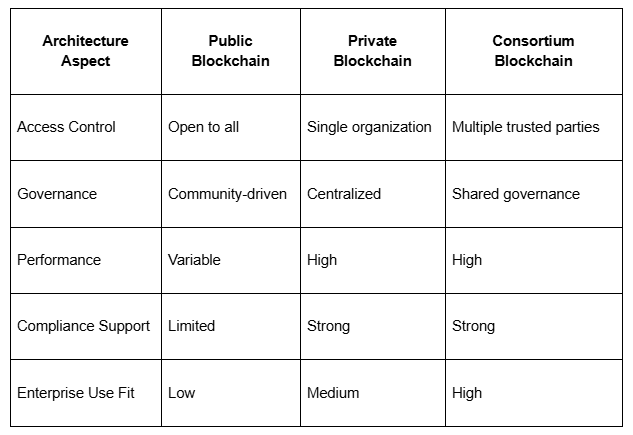
Public blockchains prioritize openness. Enterprises rarely need that.
Private blockchains offer full control but limited collaboration. Consortium blockchains strike a balance by allowing multiple organizations to share governance while maintaining permissions.
Most enterprise use cases fall into private or consortium models. Public chains are used selectively, often for settlement or asset anchoring.
Permissioned Blockchain Architecture for Enterprises
Permissioned architectures define who can validate transactions, deploy contracts, and access data.
This structure supports compliance and performance while maintaining shared trust. It also aligns better with enterprise accountability models where ownership and responsibility are clearly defined.
On-Chain vs Off-Chain Data Strategies
Not all data belongs on the blockchain.
Sensitive or high-volume data is often stored off-chain, with cryptographic references recorded on-chain. This approach balances transparency with privacy and performance.
Enterprises that skip this strategy usually run into scalability or compliance issues later.
Cloud-Based vs Hybrid Blockchain Deployments
Cloud-based deployments offer speed and flexibility. Hybrid models offer control.
Many enterprises choose hybrid architectures that run critical components on private infrastructure while leveraging cloud scalability for non-sensitive workloads.
The choice depends on regulatory exposure, latency needs, and internal IT strategy.
Business-Ready Benefits: How Blockchain Delivers Real Value for Enterprises
Enterprises do not invest in blockchain because it sounds advanced.
They invest when it reduces friction, lowers cost, or removes risk from critical operations.
When implemented correctly, blockchain delivers value in measurable ways. Here is how that value shows up in real enterprise environments.
Improved Operational Efficiency and Cost Savings
Most enterprise processes still rely on manual checks, reconciliation, and approval chains that exist only because systems do not trust each other.
Blockchain removes that friction.
In financial services, settlement cycles that once took two to three days are now completed in minutes. Supply chain leaders report significant reductions in manual paperwork and dispute resolution time. These are not marginal improvements. They translate into fewer staff hours, lower operational overhead, and faster cash flow.
This is why enterprises increasingly invest in enterprise blockchain development services that focus on automation, not experimentation.
End-to-End Data Transparency That Builds Trust
When multiple parties rely on the same process, transparency becomes a competitive advantage.
Blockchain provides a shared record where every participant sees the same transaction history. No data silos. No conflicting reports. This level of visibility builds trust not just internally, but across partners and regulators.
Many enterprises turn to an enterprise blockchain app development company specifically to address trust gaps in multi-party workflows.
Faster Transactions and Fewer Intermediaries
Traditional enterprise transactions often pass through several intermediaries. Each adds time, cost, and risk.
Blockchain reduces the need for third-party verification by embedding trust into the system itself. Payments, approvals, and validations happen directly between authorized parties.
In logistics and trade finance, enterprises have cut processing time by more than half by removing unnecessary intermediaries. That speed directly impacts customer satisfaction and revenue velocity.
Enhanced Security and Tamper-Proof Records
Data integrity matters more than data volume. Blockchain records cannot be altered without consensus. Every change is traceable. This makes fraud harder to hide and errors easier to identify.
Enterprises in healthcare and manufacturing rely on this immutability to protect sensitive records and ensure compliance. It is one of the strongest arguments for enterprise blockchain development solutions in regulated industries.
Long-Term ROI and Sustainable Competitive Advantage
The real return on blockchain investment compounds over time.
As more processes move onto shared ledgers, enterprises reduce dependency on manual oversight and fragmented systems. This creates operational leverage that competitors struggle to replicate.
When blockchain is built by experienced blockchain enterprise development services teams and integrated properly, it becomes part of the enterprise backbone, not a standalone tool.
Building a Custom Enterprise Blockchain Solution: A Strategic Development Approach
Successful blockchain initiatives are rarely driven by excitement.
They are driven by structure, restraint, and clear thinking.
Enterprises that skip steps often end up with costly platforms that look impressive but solve very little. The following seven-step approach reflects how high-performing organizations build blockchain systems that last.
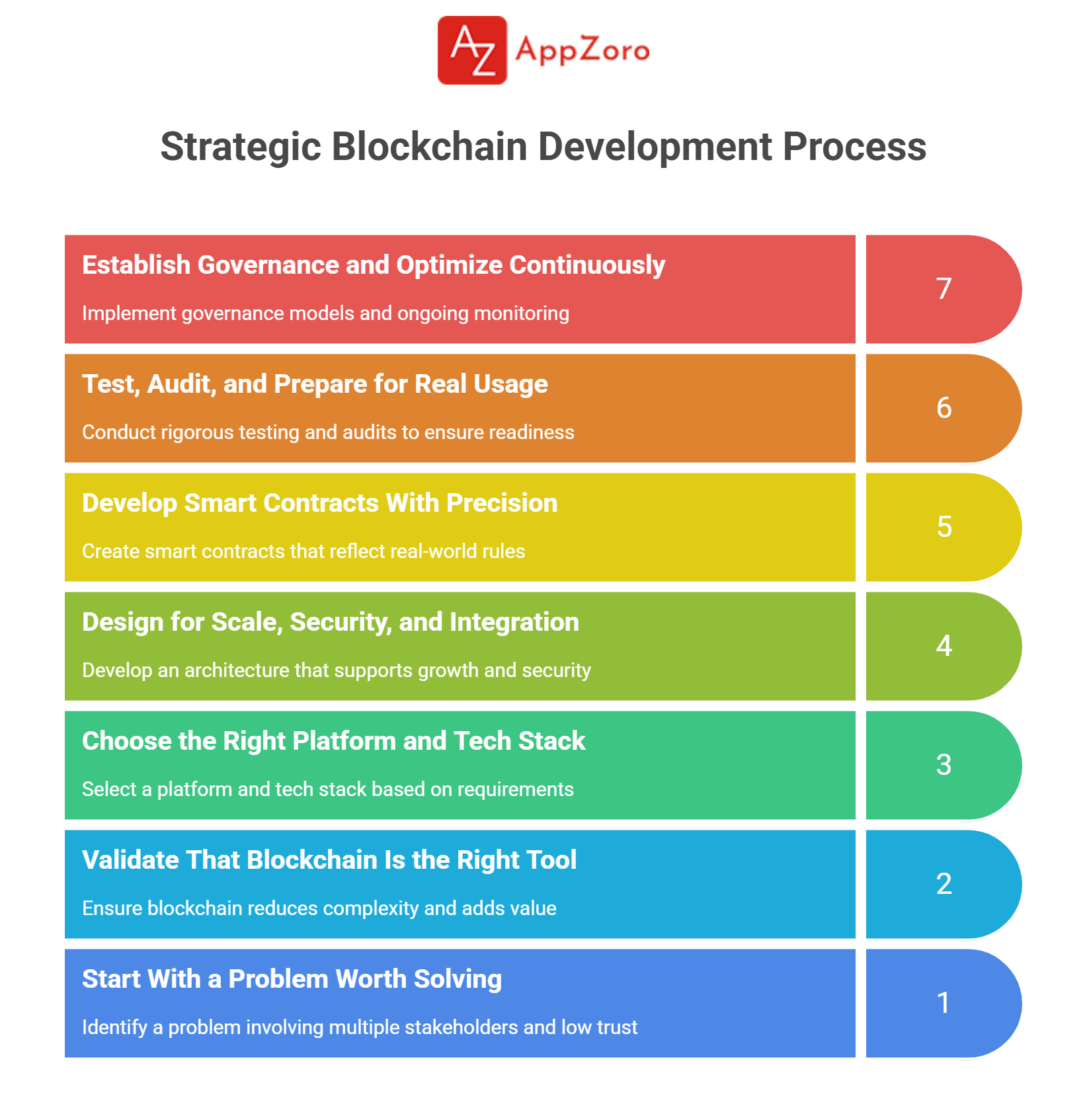
Step 1: Start With a Problem Worth Solving
Not every business process needs a blockchain. The right starting point is a problem that involves multiple stakeholders, shared data, and low trust between parties. If a process works perfectly with a centralized system, blockchain will likely introduce friction instead of value.
This is where an experienced enterprise application development company brings clarity by challenging assumptions early.
Step 2: Validate That Blockchain Is the Right Tool
Once a candidate use case is identified, it needs validation.
Key questions include how many parties are involved, how data flows between them, and where disputes or delays occur today. Blockchain should reduce complexity, not add another layer. This step often prevents unnecessary investment and refines the scope before development begins.
Step 3: Choose the Right Platform and Tech Stack
Platform selection should follow requirements, not trends.
Transaction volume, privacy expectations, governance structure, and system integrations all influence this decision. Enterprises also need to think ahead. The tech stack should support future enhancements, including AI development services and analytics.
This is one of the most critical decisions in blockchain development for enterprises and should be approached deliberately.
Step 4: Design for Scale, Security, and Integration
Architecture determines whether a system grows or stalls. This includes node distribution, permissioned access, data storage strategy, and integration with existing enterprise systems. Security and performance must be built in from day one.
Custom enterprise software development company teams with blockchain experience recognize these trade-offs early and design accordingly.
Step 5: Develop Smart Contracts With Precision
Smart contracts are business logic, not just code. They must reflect real-world rules, exceptions, and compliance requirements. Every contract should be tested against edge cases and failure scenarios.
Mistakes at this stage are expensive to fix later, which is why experienced development oversight matters.
Step 6: Test, Audit, and Prepare for Real Usage
Enterprise blockchain systems demand rigorous testing.
Performance tests should simulate peak load, not average conditions. Security audits are mandatory. Integration testing ensures the system behaves correctly within the broader enterprise ecosystem.
User experience also plays a major role. Clear interfaces drive adoption, making strong UI/UX design and development services a practical necessity, not a nice-to-have.
Step 7: Establish Governance and Optimize Continuously
Deployment is not the end of the journey.
Enterprises need governance models for onboarding participants, upgrading smart contracts, and adjusting rules as the business evolves. Ongoing monitoring helps identify performance issues, security risks, and optimization opportunities.
Blockchain platforms that evolve with the organization deliver far more value than those treated as static infrastructure.
Challenges in Enterprise Blockchain Development and How to Overcome Them
Scalability and Performance Limitations
Early blockchain platforms struggled with throughput and latency. That reputation still lingers.
Enterprise systems must handle consistent transaction volumes without delays. Poor architectural decisions lead to bottlenecks that surface only after go-live.
The solution lies in platform selection, network design, and data strategy. Experienced blockchain development experts for enterprise environments design for peak demand and future growth, not pilot-scale usage.
Integration With Legacy Enterprise Systems
Most enterprises operate on complex technology stacks built over years. Blockchain does not replace ERP, CRM, or data platforms. It connects to them. Integration challenges often arise when blockchain is treated as a standalone system rather than part of a broader architecture.
An enterprise blockchain development company with integration experience plans these connections early and avoids fragile workarounds.
Regulatory and Compliance Complexities
Enterprises must comply with data privacy laws, financial reporting standards, and industry-specific requirements. Blockchain adds transparency, but without careful design, it can expose sensitive information or create compliance gaps.
Understanding what is enterprise blockchain development means understanding how governance, permissioning, and auditability work together from day one.
Talent Gaps and Technical Expertise Shortages
Blockchain talent is still unevenly distributed. Enterprises often struggle to find teams that understand both distributed systems and enterprise constraints. This gap slows development and increases risk.
Partnering with teams that bring proven enterprise blockchain development expertise reduces dependency on scarce internal resources.
Change Management and Organizational Adoption
Technology is only half the challenge. Employees must trust and understand the system. Processes change. Ownership models shift. Without clear communication and training, adoption stalls.
This is where leadership matters. Successful initiatives treat blockchain as an operational change, not just a technical upgrade.
The Future of Enterprise Blockchain Development Services: Trends to Watch Beyond 2026
Enterprise blockchain is entering a more disciplined phase. The focus is shifting from experimentation to scale, interoperability, and intelligence. Here are the trends shaping what comes next.
Blockchain-as-a-Service Becomes Enterprise Infrastructure
BaaS platforms are maturing. Enterprises increasingly prefer managed blockchain environments that reduce operational overhead while maintaining control. This approach accelerates deployment and standardizes governance without sacrificing flexibility.
Cross-Chain Interoperability Gains Real Momentum
Enterprises do not operate on a single network. As adoption grows, the ability to exchange data and assets across different blockchains becomes essential. Standards and interoperability layers are evolving to support this reality.
Tokenization of Enterprise Assets Expands
Tokenization is moving beyond financial instruments. Enterprises are tokenizing real-world assets like inventory, licenses, and usage rights. This improves liquidity, tracking, and transferability while reducing administrative overhead.
Privacy-First Blockchain Designs Take Center Stage
Transparency must coexist with confidentiality. Zero-knowledge proofs and privacy-preserving techniques allow enterprises to validate transactions without exposing sensitive data. This is especially important in regulated industries.
AI-Driven Autonomous Enterprise Workflows
The next wave combines intelligence with trust. Blockchain ensures data integrity. AI acts on that data. Together, they enable workflows that adapt, predict, and self-correct.
Enterprises are increasingly working with an AI & ML development company or a Generative AI app development company to build systems that make decisions, not just record them.
Developing Enterprise-Ready Blockchain Expertise: How AppZoro Leads the Way
Most enterprise blockchain failures come down to one thing. The team building it did not understand enterprise reality.
At AppZoro, blockchain is not treated as a standalone initiative. It is treated as part of a larger enterprise system that already has users, regulations, vendors, and pressure to perform. That mindset shapes everything.
AppZoro delivers enterprise blockchain development services with discipline. Every project starts by questioning whether blockchain is truly needed and where it creates leverage.
The focus stays on business outcomes. Reduced reconciliation. Faster settlements. Clear accountability. If blockchain does not move one of those needles, it does not belong in the solution.
Proven Expertise in Scalable, Secure, and Compliant Solutions
AppZoro designs enterprise blockchain development solutions to handle real transaction volume, strict access control, and regulatory scrutiny. Architecture decisions are guided by performance testing, audit requirements, and integration complexity. This level of enterprise blockchain development expertise is earned through delivery, not theory.
Industry-Focused Blockchain Frameworks That Reduce Risk
Generic blockchain templates do not survive industry regulations. AppZoro builds frameworks tailored to finance, healthcare, logistics, and manufacturing. These frameworks account for data sensitivity, compliance expectations, and operational workflows from day one.
Teams Built for Enterprise Execution, Not Just Development
Enterprise blockchain projects fail when technical teams work in isolation. AppZoro assigns blockchain architects, AI engineers, enterprise consultants, and designers as a single unit. This ensures alignment between technology, operations, and usability.
UI/UX design and development services are embedded early to ensure the system works for real users, not just technical stakeholders.
Why Enterprises Stay With AppZoro Long After Launch
Enterprises continue working with AppZoro because delivery does not end at deployment.
Governance, optimization, and expansion are part of the engagement. Many clients extend into AI development services as their blockchain platforms mature. Long-term value matters more than short-term delivery.
Case Study: How AppZoro Delivered a Scalable Enterprise Blockchain Solution
The Client and the Real Problem
A multinational supply chain organization struggled with inconsistent data, delayed settlements, and frequent disputes across partners. Each participant trusted their own system. No one trusted the full process.
The Blockchain Architecture That Solved It
AppZoro designed a permissioned blockchain connecting suppliers, logistics partners, and internal teams. Sensitive data remained off-chain. Transaction proofs and workflow states were shared securely. The platform supported high transaction volume without compromising access control. Platform selection prioritized stability and enterprise integration, not novelty.
Measured Outcomes That Moved the Business
Within the first six months of deployment, the enterprise saw measurable improvements across operations, finance, and compliance. Reconciliation time was reduced by 68%, cutting multi-day settlement cycles down to same-day confirmation in most cases. What once required manual cross-checking across systems became an automated process governed by smart contracts.
Transaction-related disputes dropped by 54%. Shared visibility and immutable records eliminated version conflicts between suppliers, logistics partners, and internal teams. Automation removes repetitive tasks without disrupting existing workflows.
The system reached full ROI in under 9 months, driven primarily by cost reduction and faster settlement cycles. By the end of year one, the platform was generating sustained operational savings across the network.
Why Did This Project Succeed While Others Stall
The success of this initiative came down to discipline. The scope was defined around business outcomes, not technology experimentation. Every feature tied back to a measurable operational goal.
Governance was established before development began. Participant roles, access rules, and upgrade processes were clear from day one. Most importantly, blockchain was treated as infrastructure, not a pilot. It was built to support daily operations at scale.
AI was introduced with restraint. Models were applied only where they improved decision-making and risk visibility. No features existed for novelty alone.
Conclusion
Enterprises that delay blockchain adoption often assume they are being cautious. In reality, they are falling behind. Early adopters are already building operational advantages that compound over time. They reduce friction. They automate trust. They gain visibility others cannot match.
The difference lies in execution and partnership.
Choosing the right development partner matters more than choosing the right platform. A custom enterprise software development company with enterprise blockchain experience will help you avoid expensive missteps and build systems that last.
If your organization is ready to move beyond pilots and into production, AppZoro is ready to help. Start your enterprise blockchain journey with a partner that values clarity, discipline, and long-term success.
Leave a Comment