
The fintech revolution has completely altered the way money moves. Payments, lending, trading, investments—nearly everything in finance today lives inside sleek mobile apps and digital platforms. They give the appearance of instant speed and seamless convenience. Yet behind every “tap to pay” or “swipe to invest” interface, a battleground exists—where hackers, fraudsters, and insider threats constantly search for openings.
Data proves the scale of this risk. IBM’s 2024 Cost of a Data Breach Report revealed that financial services remain one of the most expensive and most targeted industries—breaches in this sector averaging $5.9 million per incident. That number speaks for itself.
For fintech companies, this isn’t a side issue. Security is not a checkbox—it’s the foundation on which trust, adoption, and survival lie. Without it, even the most innovative payments platform or trading product can collapse in days, losing customers and attracting regulators with heavy penalties. That’s why custom fintech software development, built with security embedded from the ground up, is crucial for creating resilient systems that protect data, ensure compliance, and sustain long-term growth.
As the industry expands into trillions, so does the sophistication of attacks. Which means embedding robust, forward-looking security layers into custom fintech systems isn’t just necessary. It’s existential.
What Exactly is Fintech Software Security?
Fintech security is the set of principles, tools, and practices engineered to protect digital finance applications against unauthorized access, fraud, and cybercrime.
While every software system needs some level of security, fintech takes it to another level. Why? Because instead of just emails or profile info, fintech platforms protect:
-
Banking credentials
-
Credit/debit card details
-
Customer IDs, biometrics, digital footprints
-
Trading algorithms and transaction histories
A single weakness here can trigger catastrophic consequences. People don’t just lose privacy—they lose money. And institutions lose trust, reputation, and compliance licenses.
How Fintech Security Differs from General App Security
-
Higher regulatory load – Frameworks like PCI DSS, GDPR, PSD2, AML/KYC create strict checklists.
-
Data integrity requirements – Transaction accuracy is non-negotiable. Records must remain consistent and tamper-proof.
-
Audit trails & transparency – Regulators demand clear logs whenever financial systems are reviewed.
So fintech cyber protection isn’t just about walls and firewalls—it’s about embedding resilience, traceability, and legality into the core codebase, whether you're considering custom fintech software or SaaS solutions.
Common Security Risks in Fintech
Even the most polished digital finance apps face constant risks. Some of the most damaging include:
Data Breaches & Fraud
Financial data is a goldmine. Theft of card numbers, SSNs, account records often leads to direct monetary damage. In 2023, fintech accounted for roughly 19% of all recorded global breaches.
Insider Threats
Not all attackers are outsiders. Employees or contractors with system access can misuse or leak sensitive data. Studies show nearly 30% of fraud incidents in finance originate from insider threats.
Phishing & Identity Theft
Still among the most used attack vectors. Fake SMS messages, cloned banking portals, “urgent” phishing emails trick users into giving credentials. Once stolen, funds can vanish instantly.
Cloud Vulnerabilities
Yes, the cloud is fantastic for scale. But misconfigured storage buckets, weak encryption, or poor identity controls open fintech apps to exploitation.
Regulatory Non-Compliance
Security risk is not only about hackers—it’s also about failing audits. PCI DSS, GDPR, PSD2 violations can lead to multi-million-dollar fines. British Airways, for example, was fined £20M in 2020 for a data breach exposing over 400,000 customers.
Essential Security Features Every Custom Fintech App Needs
End-to-End Data Encryption
Encryption—both at rest and in transit—acts as the bedrock. Standards like AES-256 combined with TLS (SSL’s successor) ensure that intercepted data is meaningless to attackers.
Multi-Factor Authentication (MFA)
Passwords are obsolete as standalone security. MFA combines factors like passwords, OTPs, and biometrics. Microsoft reports MFA reduces unauthorized access by 99%+.
Biometric Verification
Face scans, fingerprints, retina or voice patterns. Biometrics allow smooth yet hardened authentication integrated right into the experience (Apple Pay, Google Pay lead this).
Role-Based Access Control (RBAC)
Every employee doesn’t need the same access. RBAC ensures users see only what their roles require, cutting insider risks substantially.
-
Secure APIs: APIs are fintech’s lifeblood but also a growing attack vector. Securing them via OAuth 2.0, API gateways, and rate throttling is mandatory to stop unauthorized access. This is a critical part of the overall fintech software development process, which must also consider the key technologies and frameworks.
-
Fraud Detection Systems: Machine learning models track user behaviors and flag anomalies—like sudden high-value transfers or suspicious regions. Done in real time, fraud can be stopped instantly rather than after-the-fact.
-
Regular Penetration Testing & Audits: The best fintechs hire ethical hackers to simulate attacks, uncovering vulnerabilities before criminals do. Quarter-on-quarter testing is now industry standard.
Best Practices in Secure Fintech Development
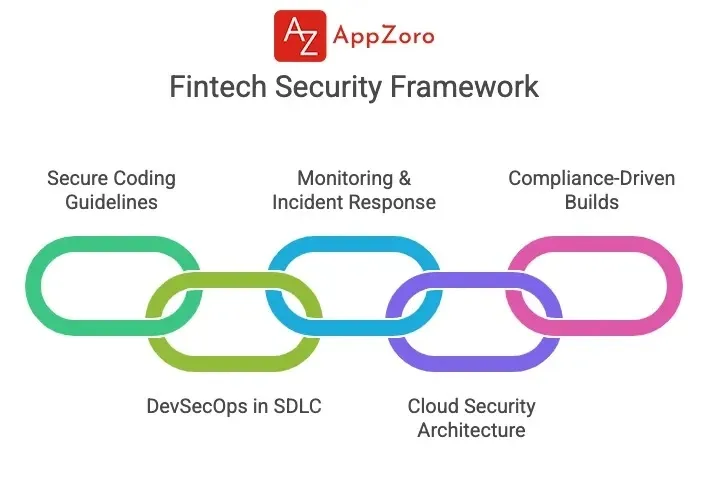
Secure Coding Guidelines
Developers must code defensively. OWASP best practices cover SQL injections, XSS, buffer overflows—all relevant in fintech where even minor injections could leak customer balances.
DevSecOps in SDLC
Security can’t be an afterthought. DevSecOps integrates it from day one—with vulnerability scanning, automated compliance checks, and CI/CD security gates. The choice between development methodologies, such as exploring Agile vs. Waterfall for fintech projects, can also impact how security is integrated.
Monitoring & Incident Response
Modern fintech platforms maintain real-time SIEM (security information and event management) systems, alerting the second abnormal activity occurs. Rapid response prevents escalations.
Cloud Security Architecture
Zero-trust access models, key management systems, and identity federation are vital in fintech. Cloud-native setups must be hardened with least-privilege principles and encryption by default.
Compliance-Driven Builds
Every fintech product must be aligned right inside the SDLC with AML, GDPR, PSD2, CCPA, PCI DSS compliance frameworks, ensuring audits don’t catch you scrambling.
Emerging Trends Redefining Fintech Security
Blockchain for Secure Transactions
Immutable, decentralized ledgers eliminate single points of failure. Beyond crypto, now used in cross-border wire transfers, clearing, settlement systems, even identity verification.
AI-Driven Fraud Analysis
AI models scan billions of data points daily. They flag unusual login patterns, new device anomalies, or geographic irregularities—and defeat fraud before money leaves accounts.
Zero-Trust Architectures
This principle assumes nobody is trusted by default. Every user and device must verify repeatedly before getting any access. A rising standard in financial app security.
Behavioral Biometrics
Goes beyond static traits. Systems now analyze typing speed, swipe habits, tilt of the phone. Nearly impossible for an attacker to replicate.
Cost Considerations: Security vs Budget
Factors That Influence Cost
-
Level of compliance frameworks adopted (PCI DSS, GDPR, regional regulations)
-
AI fraud systems integrated or not
-
Audit + penetration cycles
-
Cloud-native architecture complexity
Why Strong Security Saves Costs
The upfront burden seems heavy, but Ponemon Institute reports proactive security saves $1.5M on average per breach. Prevention costs a fraction of a failure.
Balance Between Growth & Compliance
Startups often hesitate, but penalties or breach fallout can bankrupt them far faster than investment in protection. Eventually, compliance-heavy security becomes not optional, but cheaper long-term, a crucial consideration in the fintech software development process.
The Future of Fintech Security
New Regulations Coming
The EU’s DORA (Digital Operational Resilience Act) and similar laws globally will further heighten uptime and resilience requirements.
Next-Gen Defenses
Expect hybrid models: AI + blockchain + future-ready quantum-safe encryption. This combo may become the gold standard for banking-grade fintech apps.
A Security-First Growth Mindset
Ultimately, treating security as a growth enabler, not a cost center, will separate winners from also-rans. Customers stick only to fintech apps they deeply trust.
Conclusion
Fintech thrives on innovation. But innovation without robust security is a gamble that no company can afford. From advanced encryption to zero-trust, from biometrics to AI-driven fraud analysis, it’s the built-in security stack that determines whether a platform survives.
Custom fintech products that invest in security-first development aren’t just protecting data—they’re creating long-term trust. And in finance, no asset has higher value than that trust.
Leave a Comment