
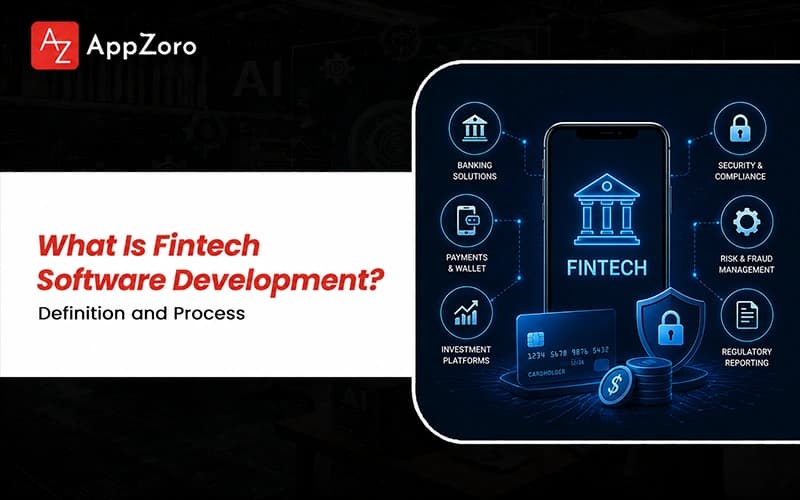
Quick Answer: Fintech software development is the design and engineering of applications that are delivering financial services to end users or businesses across markets. This is including payments, banking, lending, investing, insurance and cryptocurrency products built on top of regulated financial systems and infrastructure. It is differing from standard software through heavy regulatory requirements like PCI DSS, SOC 2 and GLBA, plus deep banking system integrations and security standards that are exceeding most consumer software categories today.
Most of the what is fintech software development articles are drifting into vague claims that are not really helping anyone make a real decision. This post is replacing that with a concrete definition and the specific ways fintech software is differing from standard software development today. The audience are anyone who are new to the category and are looking for clarity, let's take a look.
What Is Fintech Software Development? A Clear Definition
Fintech software development is the building of mobile, web or API-based applications that are delivering financial services directly to users or businesses. The category is including consumer products like Chime and Venmo, B2B infrastructure like Stripe and Plaid, and crypto products like Coinbase and MetaMask. Regulated services like Robinhood and Affirm are also part of this same category since they are interacting with regulated financial systems daily. The defining characteristic is not the technology stack, it is that the software is interacting with regulated financial systems or moving money.
The fintech software development meaning is extending well beyond writing code into the entire compliance and infrastructure layer of the project lifecycle. It is encompassing compliance design, banking partnership integration, identity verification flows, fraud detection systems, audit logging and regulatory reporting at every step. A team building fintech software is writing engineering specs alongside compliance documentation rather than treating them as separate workstreams. Many organizations choose to partner with specialized firms for fintech app development to ensure that every feature decision correctly addresses regulated processes like KYC, AML, and PCI DSS from day one.
How Fintech Software Development Differs from Standard Software Development
While it may look like standard engineering on the surface, navigating these unique requirements represents a collection of significant fintech app development challenges, ranging from banking API inconsistencies to immediate fraud threats upon launch. These differences affect cost, timeline, and risk meaningfully, and they are crucial to understand before any project is scoped fully.
Regulatory burden is heavy, PCI DSS, SOC 2, GLBA and KYC/AML are all mandatory, while standard software is typically only facing GDPR or SOC 2.
Banking integrations through Plaid, Stripe or chartered banks are adding 4 to 8 weeks per integration, which is unique to the fintech category.
Security standards including encryption, audit logging and incident response must be production-grade from day one, not bolted on as a post-launch enhancement.
Compliance is a design input from the start, since features must be designed for auditability rather than added or retrofitted after launch is live.
Fraud and adversarial users are arriving on launch day in fintech, while in standard software they are typically arriving gradually with user growth.
These structural requirements lead to longer timelines of 12 to 24 months compared to standard applications. Furthermore, the specialized nature of these builds typically results in a higher fintech app development cost, driven by the need for banking-grade security and continuous compliance audits. They are also creating deeper moats around successful fintech products, which is why specialised fintech development is treated as its own discipline today.
Types of Fintech Software You'll Encounter
The fintech software category is spanning seven distinct types, each with different regulatory profiles and architectural patterns across consumer and enterprise markets. Knowing the type is mattering significantly before discussing development cost, timeline or tech stack for any specific fintech project being scoped today.
Payment software is processing transactions between users, merchants or businesses, examples are Stripe, Adyen, Square, Venmo and Cash App across markets.
Banking software provides full-service digital accounts and savings products, exemplified by platforms like Chime and Mercury. Many entrepreneurs seeking to enter this space analyze how to develop apps like Revolut to understand how to bundle multi-currency features and trading into a single 'super-app' architecture.
Lending software is credit decisions, loan origination and BNPL products, examples are Affirm, Klarna, Upstart and SoFi across consumer and student markets.
Investment and wealth software is covering robo-advisors, trading apps and portfolio management, examples are Robinhood, Wealthfront and Betterment across mass-market and affluent segments.
Insurance software, also called insurtech, is handling quoting, underwriting and claims management, examples are Lemonade, Hippo and Root across multiple insurance product lines.
Crypto and Web3 software is including exchanges, wallets and on-chain protocols, examples are Coinbase, MetaMask and Kraken across both centralised and decentralised products.
Fintech infrastructure for B2B is APIs and platforms that other fintechs are building on, examples are Plaid, Stripe Treasury, Synapse and Marqeta directly.
These types of fintech software are often combining together, Cash App is handling payments, banking and crypto inside one single app for millions of users. Understanding each category is helping clarify exactly what is being built and which regulatory rules are applying to the project from day one onwards.
How Fintech Software Development Works — The Process
The fintech software development process is following six predictable steps that are holding across category and team size in nearly every project today.
Compliance and use case mapping is the first step, defining the financial mechanism and identifying regulatory requirements like PCI DSS, SOC 2 and state licensing across jurisdictions.
Banking partnership and infrastructure decisions are the second step, engaging banking partners or BaaS providers like Synapse, Unit or Stripe Treasury early on. The choice between direct bank integration and BaaS is shaping timeline, cost and compliance burden significantly across the rest of the build.
The third step involves selecting the architecture and tech stack, including mobile frameworks and backend languages. For a complete step-by-step roadmap of this lifecycle, you can explore our pillar guide on how to develop a fintech app, which covers everything from initial discovery to post-launch scaling, since mid-project changes are exceptionally costly in fintech compared to other categories.
Security-first development with continuous compliance is the fourth step, building the application with encryption, audit logging and authentication all baked in from day one. Static and dynamic security testing is run in CI/CD pipelines, while KYC and AML flows are implemented from the very start of the build. The fintech software development process is differing from standard development primarily here, since security and compliance are continuous rather than pre-launch checkpoints to address later.
Testing, audits and certifications are the fifth step, scheduling SOC 2 readiness assessment 60 days before launch and running comprehensive penetration testing across systems. PCI DSS scope is verified, and compliance automation tools like Drata or Vanta are used to cut audit prep time from months to weeks.
Launch, monitoring and iteration is the final step, with a soft-launch through closed beta and full transaction monitoring from day one of public release. Iteration is happening weekly based on real-world telemetry, the first 30 days are revealing patterns that no test environment is ever surfacing earlier.
Real Examples of Fintech Software in Production
Concrete examples are grounding abstract definitions in production reality and helping readers understand exactly what fintech software is in the wild today across markets. The fintech software products below are representing the major categories at scale, each one illustrating different aspects of the discipline being practised by teams.
Stripe is payment processing infrastructure that is handling trillions in annual volume across millions of merchants and businesses operating globally across every major economy.
Plaid is the banking API connecting thousands of US financial institutions to fintech apps, powering account aggregation and identity verification across consumer fintech products.
Affirm is buy-now-pay-later with ML-driven credit underwriting in under 30 seconds, covering millions of users across e-commerce checkouts and physical retail locations daily.
Wealthfront is a robo-advisor that is managing over $30 billion through algorithmic portfolio construction, automated rebalancing and tax-loss harvesting across mass-affluent customer segments.
Coinbase is a regulated crypto exchange operating across 100+ countries with public listings, KYC compliance and direct integration with traditional banking infrastructure today.
Conclusion
These products are sharing characteristics that are defining fintech software, heavy compliance investment, deep banking integration, real-time transaction processing and strong security architectures. Each of these market leaders is defensible because regulatory and integration moats are difficult for competitors to cross. As you plan your own project, learning how to choose fintech app development company with proven experience in these regulated environments is the most critical step toward long-term success..
Leave a Comment