
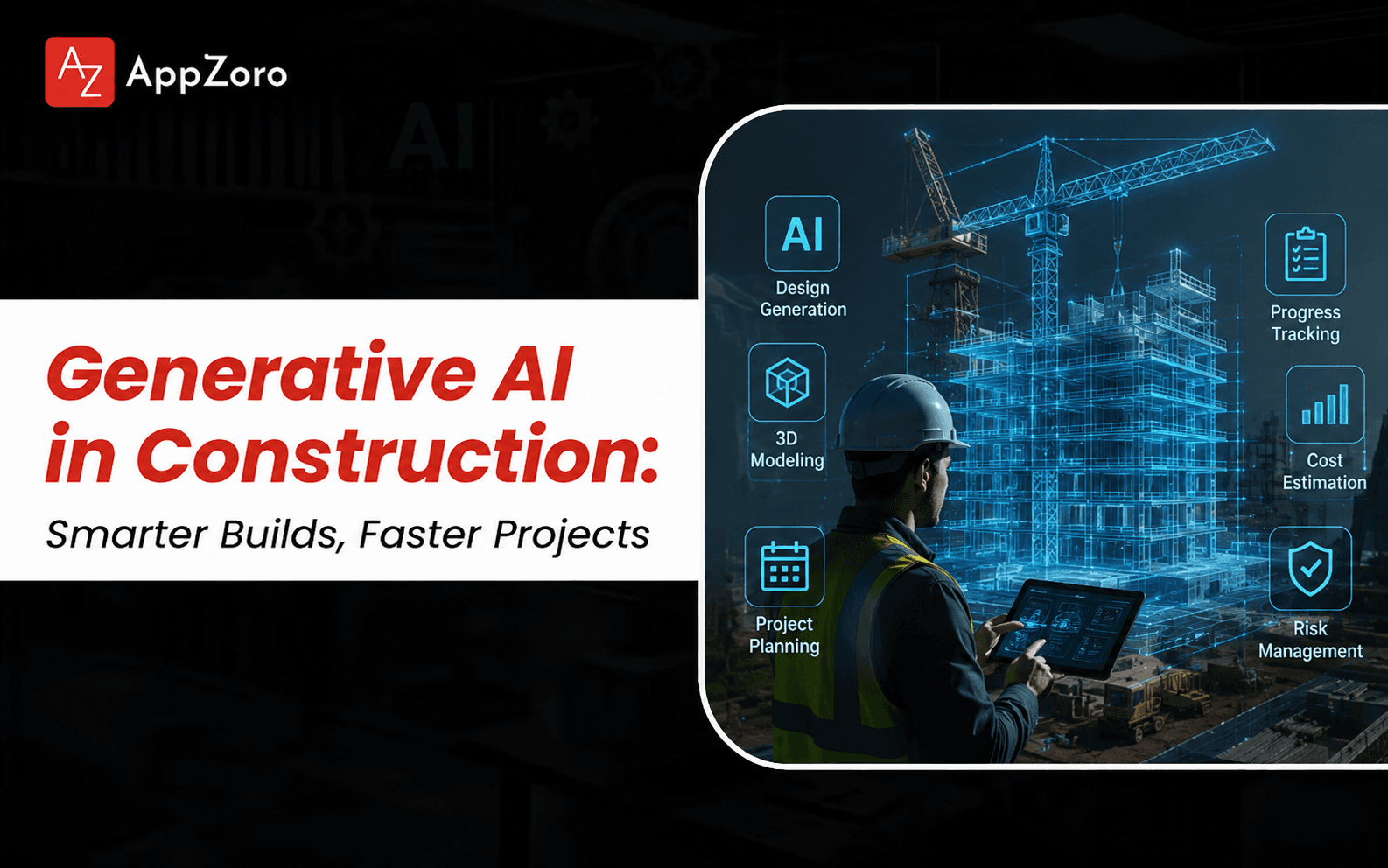
Quick Answer: Generative AI in construction now is powering automated design generation through Autodesk Forma, schedule optimisation, document analysis, safety monitoring through computer vision and predictive cost forecasting across major contractors. The industry is using AI across four project phases including preconstruction estimating, design and planning, construction execution and post-construction operations. Real applications are including site progress tracking through Buildots and OpenSpace, automated takeoff through Togal.AI plus AI-driven scheduling through ALICE Technologies. Adoption is accelerating because AI is addressing construction's three biggest pain points including cost overruns, labour shortages and safety incidents.
Construction has been one of the slowest industries to adopt digital technology across the global economy, however AI is changing that faster than any prior tech wave. General contractor executives evaluating AI investments, project managers exploring AI tools, and technical leaders learning how to develop an AI app for specific site needs are all running into the same set of decisions today. By the end of this guide, how generative ai in construction is being applied today, real use cases, benefits and what is coming next will be clear across every project phase, let's take a look.
Why AI Adoption Is Accelerating in Construction Now
Construction's AI moment arrived in 2024 to 2025 after years of slow buildup across the industry. Four converging factors are creating the conditions for accelerating adoption today including generative AI breakthroughs, mature computer vision, mounting labour shortages and intense pressure on project economics from rising material costs.
Global Construction AI Market: USD 4.2 billion in 2024 and projected to exceed USD 22 billion by 2030 across major construction segments globally.
Productivity Stagnation: Construction productivity has grown only 1% annually for 20 years versus 3.6% for manufacturing across the same period.
Cost Overruns: 80%+ of construction projects are exceeding budget, AI forecasting models are reducing overruns by 15 to 25% in early deployments today.
Labour Shortage: The US construction industry is facing a 500,000+ worker gap as of 2024 across both skilled and unskilled trades.
Safety Costs: Workplace incidents are costing the industry $13 billion+ annually, AI safety monitoring is reducing incident rates significantly across deployed sites.
The combination of mature tech, painful problems and clear ROI has made construction one of the fastest-growing AI verticals despite the industry's traditional pace of adoption. The remaining sections are covering where AI is actually being applied today, what generative AI specifically is doing across project phases and how to evaluate adoption for your construction projects in 2026.
How Is AI Used in Construction Across the Project Lifecycle
How is ai used in construction is depending entirely on where in the project lifecycle the application is happening. The four phases below are covering the full spectrum of AI applications shipping today across the construction industry.
1. Preconstruction Phase - Estimating, Bidding, Planning
AI is accelerating the most data-intensive preconstruction activities across estimators and bid teams. Automated quantity takeoff tools including Togal.AI and Bluebeam Revu AI are extracting measurements from drawings in minutes instead of days. Bid analysis AI is scoring opportunities against historical win rates across the portfolio. Predictive cost models are estimating project costs using historical data from thousands of completed projects. Risk scoring is identifying projects with high overrun probability before bidding is happening. The key applications in this phase include:
Automated Quantity Takeoff: AI is extracting dimensions and material counts from PDF drawings instantly across estimator workflows.
Bid Analysis And Scoring: ML models are predicting win probability against historical project data across the bid portfolio.
Conceptual Cost Estimating: AI is generating rough order-of-magnitude estimates from project descriptions across early-stage opportunities.
2. Design And Planning Phase - Generative Design And BIM Optimisation
The design phase is where generative AI is having the most disruptive impact across the industry today. Autodesk Forma is generating building designs that are meeting specified constraints including height, energy efficiency and sun exposure across the project. Generative BIM tools are proposing alternate structural systems and MEP routing across design teams. Schedule optimisation AI through ALICE Technologies is generating millions of possible construction sequences to identify the optimal one. The key ai applications in construction design include:
Generative Building Design: Algorithm-generated floor plans, massing studies and site layouts across architectural projects.
Energy Performance Optimisation: AI models are predicting energy use and suggesting envelope improvements across building designs.
Automated Clash Detection: Identifying conflicts between architectural, structural and MEP systems before construction is starting on-site.
3. Construction Execution Phase - Field AI Applications
Field-deployed AI is covering safety, progress and quality across active construction sites today. Computer vision platforms including Buildots, OpenSpace and Doxel are using cameras and 360-degree imagery to track construction progress automatically. Safety monitoring AI is detecting unsafe behaviours in real time, often leveraging advanced computer vision principles found in facial recognition software to identify workers and verify PPE compliance.
Construction Progress Tracking: 360-degree imagery is analysed by AI to compare reality against BIM models across the project.
Safety Hazard Detection: Computer vision is identifying PPE violations and unsafe conditions in real time across active sites.
Equipment Telematics And Maintenance: AI is predicting equipment failures before they are causing schedule delays across operations.
4. Post-Construction And Operations Phase - Building Intelligence
After project handover, AI is continuing to deliver value in building operations across the asset lifecycle. Digital twin platforms are tracking building performance against design predictions across years of operation. Many of these platforms are now integrating spatial interfaces; teams can refer to our guide to make an AR app to understand how augmented reality is used to visualize hidden MEP systems behind finished walls during maintenance.
Digital Twin Performance Monitoring: AI is tracking real-world building performance versus design assumptions across operations.
Predictive Building Maintenance: ML is detecting equipment degradation before failure is happening across HVAC and electrical systems.
Energy Use Optimisation: AI is continuously adjusting HVAC and lighting based on occupancy and weather patterns across the building.
Generative AI in Construction - The Specific Revolution
Generative AI in construction is deserving separate treatment because it is representing a fundamentally different capability than traditional construction AI. It is creating new content like designs, schedules and documents rather than analysing existing data across the workflow.
1. Generative Design For Buildings And Sites
Tools like Autodesk Forma are generating building designs from constraints including floor area requirements, height limits, energy targets and view corridors. The AI is proposing options that humans can refine, dramatically expanding the design exploration space across projects. Generative site planning is optimising parking, landscaping and utility routing based on parameters across the site. Spacemaker, now part of Autodesk Forma, pioneered generative urban design that is considering wind, sun, noise and views simultaneously. Architects are using generative design as a creative co-pilot rather than a replacement for design judgment.
2. AI-Assisted Construction Documentation
Generative AI is accelerating document creation across the project lifecycle dramatically. Specifications writing tools are generating spec sections from project descriptions across construction documents. RFI response drafting is helping project teams answer questions faster across the workflow. Change order documentation is generating supporting narratives across the project. Submittal review AI is comparing submittals against project specs and flagging discrepancies automatically. The time savings are compounding, what previously consumed full days of project engineer time now is happening in minutes. Key documentation applications include automated meeting minutes, drawing markups and progress report generation across the team.
3. Generative Scheduling And Resource Optimisation
ALICE Technologies and similar platforms are using generative AI to create construction schedules from scratch across project portfolios. The system is generating millions of possible construction sequences and identifying the optimal one for cost, duration or resource utilisation. Schedule optimisation AI is continuously updating as project conditions are changing across the active site. Resource levelling generative AI is assigning crews and equipment optimally across activities. The shift is from manual schedule creation taking weeks to AI generation taking hours with human review across the planning workflow.
4. Generative AI For Field Communications And Knowledge
Construction project teams are generating massive amounts of documentation, communications and knowledge across every project. Generative AI tools are indexing this corpus and enabling natural language queries across teams. Workers can be asking questions like "What's the spec for the lobby flooring?" and getting instant answers grounded in project documents. Procore Copilot, Autodesk Construction Cloud AI features and specialty tools like Buildots Copilot are representing this category. The benefit is that field knowledge is no longer locked in documents nobody reads, it is becoming accessible through conversation.
Top AI Use Cases in Construction Today
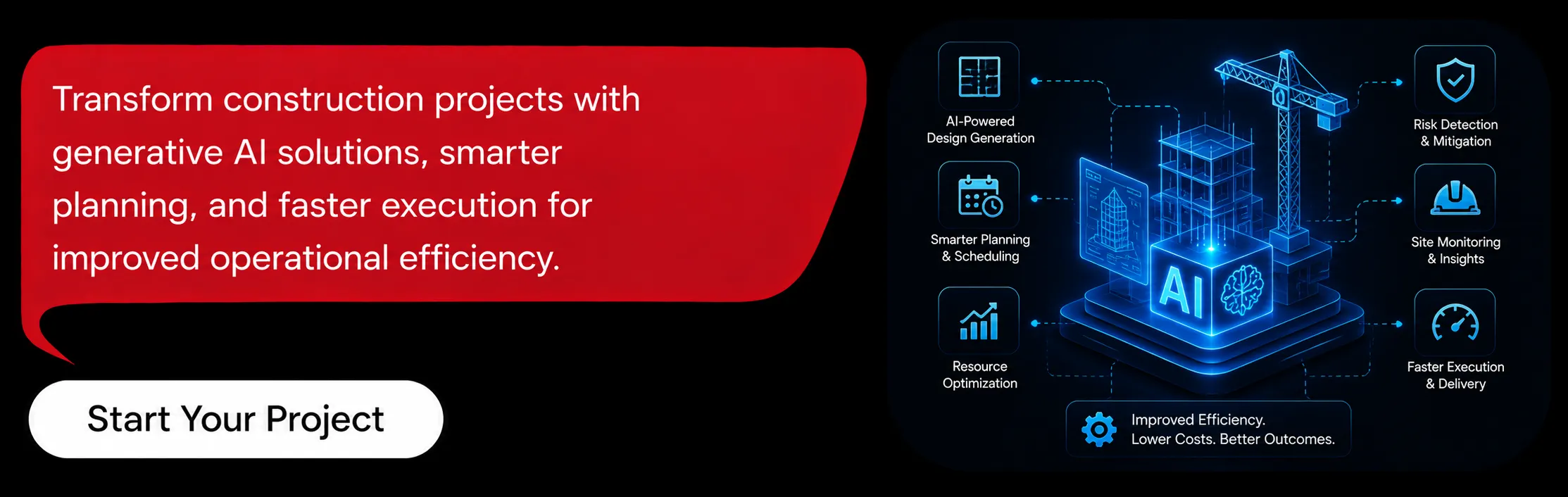
The seven ai use cases in construction below are representing the highest-adoption applications shipping in 2026 across the industry. Each one is mapping to a real productivity, safety or cost outcome that contractors have measured in production deployments across major projects.
Construction Progress Tracking Via Computer Vision: Buildots, OpenSpace and Doxel are using site imagery to compare actual construction to BIM models, automatically detecting delays and deviations across the project.
Automated Quantity Takeoff And Estimating: Togal.AI, Bluebeam Revu AI and STACK are extracting quantities from drawings using computer vision, cutting takeoff time from days to hours.
AI-Powered Safety Monitoring: Smartvid.io and similar platforms are detecting PPE violations, fall risks and unsafe behaviours from site cameras in real time across active sites.
Predictive Scheduling Optimisation: ALICE Technologies is generating and optimising construction schedules, reducing project durations 10 to 20% versus traditional sequencing approaches.
Generative Design For Buildings: Autodesk Forma is generating building options from constraints, expanding the design exploration space dramatically across architectural practices.
AI-Powered Document Analysis And Search: Project teams are querying construction documents through natural language interfaces, accessing knowledge previously locked in PDFs.
Predictive Maintenance For Construction Equipment: IoT-connected equipment data is analysed by AI to predict failures before they are causing schedule delays across operations.
These seven ai applications in construction are representing the highest-ROI starting points for contractors and developers evaluating AI investments in 2026. Each one is having measurable case studies and proven vendor solutions available today across the market.
Benefits of AI in Construction - Real Outcomes
The benefits of ai in construction are increasingly measurable across the industry, not aspirational claims anymore. The list below is reflecting outcomes published in case studies from major contractors and industry research rather than marketing claims from AI vendors.
Cost Overrun Reduction: AI-augmented projects are showing 15 to 25% lower overrun rates versus baseline projects across major contractors today.
Schedule Optimisation: AI scheduling tools are cutting project durations 10 to 20% by identifying parallel work opportunities humans are missing.
Productivity Gains: 20 to 40% time savings on knowledge work like takeoff, estimating and documentation across project teams.
Safety Improvement: Computer vision safety monitoring is reducing incident rates 30%+ in deployed sites across the construction industry.
Quality Defect Reduction: AI quality inspection is catching 50%+ more deviations than manual inspection across active construction sites.
Faster Project Closeout: AI document analysis is cutting punch list completion time by 40 to 60% across project teams.
Equipment Uptime Improvement: Predictive maintenance is increasing equipment availability 15 to 25% across construction fleets.
The aggregate impact of these benefits of ai in construction is compounding across the project lifecycle in measurable ways. A single AI tool is delivering incremental improvement while coordinated AI adoption across estimating, design, execution and operations is producing transformative results. Contractors that have measured five-year impact are reporting margin improvements of 200 to 400 basis points on AI-augmented projects.
Challenges to AI Adoption in Construction
AI adoption in construction is facing real barriers that the technology alone is not going to solve across the industry. Six challenges are consistently slowing adoption across firms of all sizes today. Recognising these challenges upfront is helping construction leaders plan realistic adoption roadmaps for their organisations.
Cultural Resistance To Change: Construction's deep operational traditions are creating skepticism about technology promising productivity gains across the workforce.
Fragmented Tech Stacks: Most contractors are using 10+ disconnected software systems, AI tools are struggling to integrate cleanly across the ecosystem.
Project-Based Workforce Dynamics: Subcontractors are changing project-to-project, consistent AI tool adoption is harder than in unified workforces across the industry.
Data Quality Gaps: AI is needing structured data, however construction is generating massive unstructured data in PDFs, emails and field notes.
Limited In-House AI Expertise: Few construction firms are having data scientists, vendor relationships are mattering more than internal capability across the industry.
Privacy And Liability Concerns: AI-generated designs, decisions and recommendations are raising unresolved liability questions across the construction legal landscape.
These challenges are surmountable but they are requiring deliberate change management across the firm. The contractors winning at AI adoption are investing equally in technology and organisational readiness across their AI programs.
The Future of AI in Construction - 5 Trends to Watch
The future of ai in construction through 2030 will be shaped by five trends that are already emerging across the industry today. Each one is representing an extension of current capabilities into more transformative applications across the project lifecycle.
Agentic AI For Project Management: Autonomous AI agents will be handling routine project management tasks including RFI responses, change order processing and submittal review. This shift toward AI agent workflow automation is freeing project managers to focus on relationships and complex decisions across the workflow.
Construction Robotics Driven By AI: Built Robotics autonomous earthmoving equipment, Boston Dynamics Spot for site inspection and bricklaying robots will scale from pilots to production across job sites. AI is the brain making these systems viable, pure hardware automation has been around for decades without breakthrough adoption.
AI-Native Project Delivery Models: New project delivery approaches built around AI capabilities, not retrofit onto traditional workflows across the industry. Firms designing processes assuming AI is handling 60% of routine work will be outcompeting those treating AI as a side tool. However, teams must carefully calculate the total cost of an AI application before overhauling their entire delivery model. This transition highlights the evolving role of AI in product development within the built environment.
Generative AI For Permitting And Code Compliance: Building codes are complex enough that AI assistance for permit applications and code compliance reviews will dramatically accelerate the most painful preconstruction bottleneck. Several startups are building in this space across major jurisdictions globally.
Industry-Specific Foundation Models: Domain-trained AI models for construction specifically, versus general-purpose LLMs, will be delivering superior accuracy on construction tasks across the industry. Expect Bloomberg-GPT-style construction-specific models within 2 to 3 years across the major construction software vendors.
Conclusion
Generative AI in construction is representing the largest technology shift the industry has experienced across its modern history. Successful adoption is combining clear use case prioritisation, vendor selection, and change management. For deeper reads, explore our AI in fintech post for cross-industry comparison, the LLM application development guide and the AI solutions for enterprise content across our cluster. If you are ready to build a custom solution, consulting with an experienced AI app development company can help bridge the gap from pilot to production.
Leave a Comment