
If your food delivery app is slow, unreliable, or difficult to maneuver, your customers will immediately switch to a competition. The food market is crowded, and exceeding customer expectations is getting higher. Your app is the public face of your business and can be one of your most valuable solutions to revenue generation.
Finding the perfect on-demand food delivery app development company is going to be one of the most important business decisions you will make. The right partner brings proven restaurant food delivery app development expertise, helping you formulate your strategy, optimize operations, and ensure your customers come back over and over again.
In this guide, we will show you exactly how to hire the best on-demand app development company. You will learn about current trends that will approach in 2026, the technical framework for a successful app, the business implications of your decisions, and practical steps. By the end, you will have a roadmap to take your app idea to the next level.
Understanding the Food Delivery App Landscape
While a food delivery app may appear simple on the surface to you as a customer, a complicated ecosystem is working hard behind every app tap that keeps your business with finesse. Understanding this ecosystem as a food delivery operator will allow you to better gauge whether or not a development partner can fulfill your immediate needs and to grow with your needs.
The market is evolving rapidly, however, successful apps are all similar in that they contain versions of one or more of the following traits:
-
Hyper-local delivery – by targeting smaller neighborhoods or districts with higher demand, delivery will help medium to large orders get to each customer faster, and costs cut down on routing costs. Smart routing and progress toward ecological sustainability keeps them coming back.
-
Contactless and digital payments – the average user expects relatively fast and secure contactless payments. Failure to provide or increase these as a payment method is a guaranteed way to lose that customer in seconds.
-
Augmented reality menu visualizations – allowing customers to visualize their meals before ordering increases the average order value and cuts down on cancellations when the order is delivered.
-
Eco-friendly or ecological delivery models – cutting down what it costs to fuel drivers and routing each order away from various negative environmental aspects that drive consumers to NOT order.
According to McKinsey, application of at least two of these traits are correlated with repeat orders increasing by 20-30% six months after operational deployment. Now, being ahead of the trends is no longer discretionary, it is a prerequisite to competition and growth.
How a Well-Built App Can Make or Break Your Business?
A food delivery app is much more than software. It is your brand, your revenue driver, and the first interaction with your customers. If the app is slow, buggy, or confusing, users will not wait. They will change to another choice. Just look at Uber Eats, which has indicated that over 60 percent of revenue is attributed to app performance in terms of commission.
Behind the scenes, a successful app is actually a collection of multiple interconnected systems. The customer-facing app allows customers to view menus, place orders, and track orders in real-time. Restaurants use a dashboard to manage orders, change menus, and review sales. Delivery partners have their own app that determines optimal route guidance and real-time updates. Finally, the admin panel allows owners to have full oversight and control over the entire operation.
If any component of the app does not operate seamlessly for the user experience, it can lead to delayed orders, no updates, and errors, as well as customer frustration and loss of loyalty. This is precisely why it is crucial to select the right on-demand food delivery app development company. Experienced developers understand how to seamlessly connect all of the components in a manner that is reliable and scalable.
A professional on-demand food delivery app development company ensures your app delivers:
-
Accurate order processing and faster deliveries
-
Happy, returning customers who recommend your app
-
Data-driven insights to optimize menus, pricing, and marketing
-
A platform that scales effortlessly as your business grows
Proven Roadmap to Hiring the Best On-Demand Food Delivery App Development Company
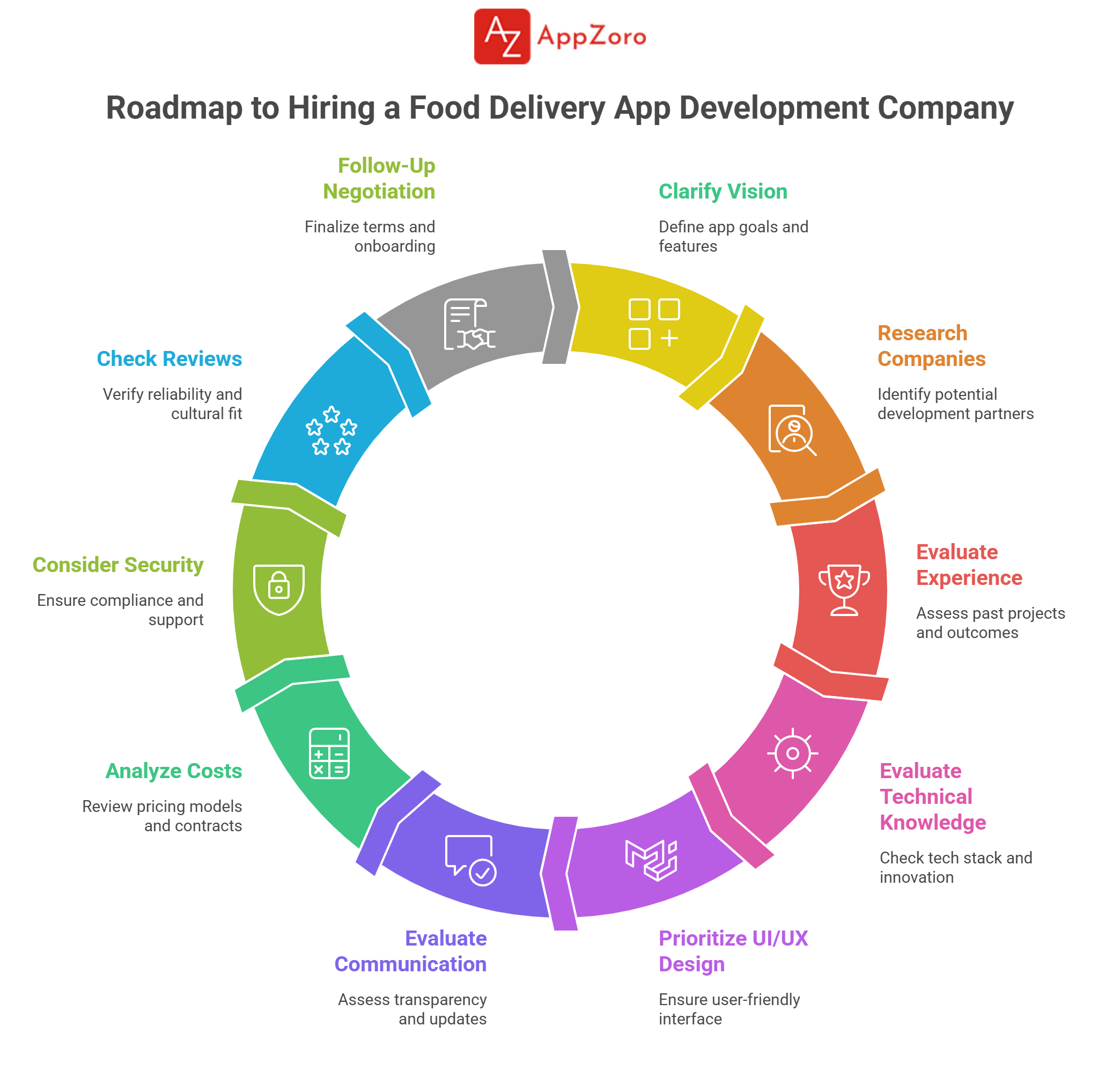
Step 1: Clarify Your Vision and Requirements
Vision is the foundation of every successful app. The biggest decisions are if your platform will contract or partner with a single restaurant, multiple restaurants, or a hybrid marketplace, as well as the features that are most important: real-time order tracking, multiple payment gateways, loyalty programs, and push notifications. Once you've established a plan, the next step is to benchmark your budget range and timeline. Most projects are anywhere from $20,000 to $150,000 and take three to six months.
Appzoro Insight: During a consultation with a regional cloud kitchen, we helped them prioritize their most important features and align the app with a commission-based revenue model. They doubled their order volume within just four months of launching the app. The benefit of properly planning is ensuring that your app goals are distilled to actionable requirements to achieve results.
Step 2: Research Development Companies and Make a Shortlist
It is very important to pick an on-demand food delivery app development company that has an understanding of food delivery. Look at sites like Clutch, GoodFirms, or LinkedIn. Ideally, you will want to find a team that has experience in your space of food-tech. Make sure to avoid companies that are using generic templates or viable success data/evidence.
Appzoro Insight: Appzoro has completed more than 50 food delivery web and mobile apps. One multi-unit regional restaurant chain effectively doubled its order volume after the launch of our app. This proven track record highlights Appzoro’s strength as a custom mobile app development company, demonstrating the ability to deliver measurable gains in usability, scalability, and revenue when businesses outsource to a top on-demand app development partner.
Step 3: Evaluate Experience and Portfolio
Having experience encompasses much more than just a number of years of someone being in business. Ask an agency or consultant about the measurable outcomes of their work; i.e., uptime, performance during peak hours, and integrations with POS or inventory systems. Be able to understand what resources the team has in place to accommodate the potential traffic during business ups and downs, and bless the quality of the system to maintain steady performance.
Appzoro Insight: Most of our apps can be integrated with POS systems such as Toast or Square, which means you can get your systems up and running with 40% less setup time, while keeping orders and inventory synced. Real metrics from previous projects establish that we are capable of handling peak demand scenarios.
Step 4: Evaluate Technical Knowledge and Innovation
The specific tech stack you choose to build becomes vital to the performance and scalability of your app. There are cloud services on Amazon Web Services or Google Cloud. Cross-platform frameworks (i.e., Flutter can provide time and cost savings. Node.js is a flexible option for a backend solution. Applying A.I. technologies can forecast demand and improve peak demand planning, while blockchain technologies can increase transparency within the supply chain.
Appzoro Insight: Our A.I. algorithms forecast demand which allow us to improve delivery time up to 20%. Using web socket technology allows real-time updates to flow into the hands of customers, delivery personnel, or restaurants. These measures ensure your constantly-functioning technology is equipped and ready to grow and constantly innovate.
Step 5: Prioritize UI and UX Design
User experience is a critical aspect of app adoption. App adoption fails with a complex user experience, no matter how many features the app contains. Offering an easy to use design, accessibility, and rigorous testing on all devices helps users fulfill each function and enables them to order food, track their delivery, or interact with your platform seamlessly. Mapping out the journey of each user role; customer, delivery partner or restaurant creates a natural flow of use ensuring the user will use your functionality repeatedly.
Appzoro Insight: Our structure of user journey mapping paired with A/B testing has led to increased retention rates of 25 percent for multiple clients of Appzoro. Backed by expert ui/ux design and development services, all interactions are crafted to stay simple, engaging, and conversion-focused—eliminating friction instead of creating frustration.
Step 6: Evaluate Communication and Transparency
Development is a collaborative process. Effective communication will ensure the project stays on schedule and within budget. Regular weekly updates using either agile or scrum models will keep you appraised of development progress and timeline; so you can review and provide feedback. Lastly, regular demos will help sort out questions and misalignment of expectations along the way.
Appzoro Insight: Each client is assigned a dedicated project manager who provides daily or weekly status updates and timelines for sustains. The feedback we get from clients is that this transparency, consistency, and status reporting has made collaborating with Appzoro smooth and predictable.
Step 7: Analyze Costs, Contracts, and Value
Recognizing the actual cost of development does not end once you have received a quote. Consider the additional cost of ongoing maintenance, updates, and feature requests in the future. Pricing can vary widely; look for fixed-price, based on established milestones, or hourly pricing models to figure out what will work best for you and will keep your costs predictable. Contracts that exhibit full transparency in costs will ensure there are not hidden fees and help to measure ROI.
Appzoro Insight: At Appzoro, we utilize clear, transparent pricing with no hidden fees in our contracts, and we provide an ROI model so that clients can discuss the impact their requested features will have on their business before they invest and make functional changes to their app.
Step 8: Consider Security, Compliance, and Post Launch Support
Apps often manage sensitive customer information and payment details. Security and compliance with personal information laws (GDPR) and payment processing standards (PCI-DSS), along with two-factor authentications are key to security considerations. Post-launch support is equally important to ensure your app has continued security measures, proliferates issues related to crash reports, and releases updates in a timely manner.
Appzoro Insight: At Appzoro, we offer lifetime support for bug fixes, server monitoring, and store optimization. We audit for security to ensure your app continues to be compliant and we monitor for proactive updates.
Step 9: Check Reviews, References, and Cultural Fit
Technical know-how isn't everything. Equally important is how a firm operates, communicates, and thinks when confronted with a challenge. Make sure to verify reviews on websites such as Clutch or GoodFirms, and speak with prior clients to judge the reliability and responsiveness of the group. Likewise, cultural fit can help the overall partnership run smoother.
Appzoro Insight: As one of the few development firms with over 200 client testimonials, we receive repeated accolades for our professionalism, responsiveness, as well as ability to deliver projects on time and on budget.
Step 10: Follow-Up Negotiation & Onboarding
Before signing the contract, confirm everything regarding intellectual property rights, NDAs, responsibilities, etc. Finally, before going "all in," consider starting with a pilot or MVP to test the water before a full launch. An onboarding process that everyone can refer to from the start will help every stakeholder get on the same page from day 1.
Appzoro Insight: As you may now guess, Appzoro creates a personalized onboarding roadmap for each client. From kickoff meetings to milestone planning - everything is personalized. By creating a structured process we mitigate risk and provide a shortcut to success.
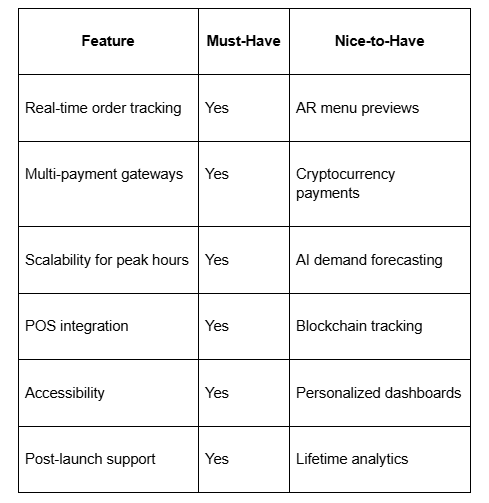
Must-Have vs. Nice-to-Have Features Comparison
Common Mistakes to Avoid When Selecting a Developer
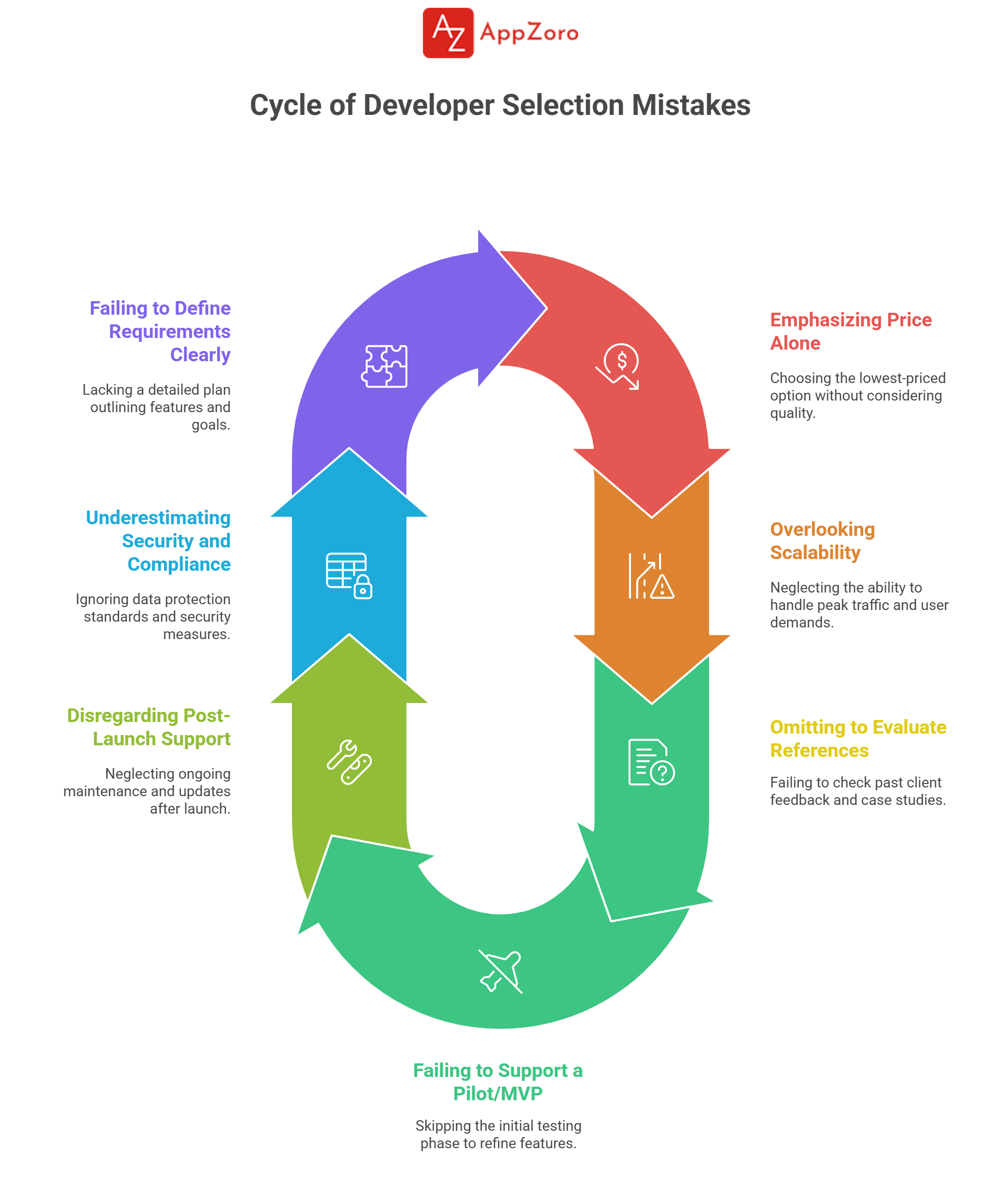
Choosing the wrong on-demand food delivery app development company can cost you time, money, and future growth. Here are the most frequent mistakes businesses make and how to avoid them:
Emphasizing price alone: Choosing the lowest-priced option may initially look smart, but this often generates hidden costs, delays, and reworks that can add up to 50% of your total project budget. Instead, focus on long-term value and quality over short-term savings.
Overlooking scalability: Applications that cannot handle traffic during peak hours or higher user demands often fail fast. Scalability must be built into the platform from the start to ensure smooth operations as your business continues to grow.
Omitting to evaluate references: It isn't easy to gauge a company's reliability without speaking with previous clients. Reviews, case studies, and/or references support verification of their performance, communication, and quality of delivery.
Failing to support a pilot/MVP: Jumping into full build mode without a pilot/MVP is risky - a minimum viable product will allow you to test the concept, gather feedback, and refine a few key features before your full investment.
Disregarding post-launch support: Many issues arise after the launch, from bugs, to server down times to updates. Having clear agreements on ongoing support after the maintenance and availability would provide peace of mind while minimizing disruptions and keeping your users satisfied.
Underestimating security and compliance: Handling sensitive, secure data without the proper safeguards can lead to legal problems and damage your reputation. Compliance with GDPR and PCI-DSS standards, and having appropriate security in place, must be part of the plan.
Failing to define requirements clearly: Vague or incomplete requirements lead to delays, scope creep, and misaligned features. A detailed plan outlining features, functionality, and business goals is essential before development begins.
How Appzoro Delivers Results: A Real-World Case Study
Seeing how the best on-demand app development company executes a real project gives you a clearer picture of their capabilities. Here’s an example of how Appzoro delivers measurable results.
The Challenge
A startup wanted to launch a multi-vendor food delivery platform that could scale quickly and handle high order volumes. They needed seamless integration of multiple restaurants, efficient management of delivery partners, real-time order tracking, and reliable payment systems—all while keeping costs and timelines under control.
The Solution
Appzoro built the platform with a modular architecture that made releasing new features fast and simple. AI-powered chatbots were added to manage customer queries and order updates, improving engagement. The system was designed to scale effortlessly, ensuring smooth operations even during peak hours. Real-time tracking, optimized payment gateways, and delivery partner coordination made the app reliable and efficient from day one.
The Results
Within six months, the platform was processing 10,000 orders per day. Modular design reduced development time by 30%, and AI-assisted support boosted customer satisfaction by 15%. The client could customize branding using white-label solutions without rebuilding the platform, saving both time and money.
Lessons Learned
This project highlighted key factors that make the difference when choosing the best on-demand app development company:
-
A clear project vision and detailed requirements are essential.
-
Experience with on-demand food delivery apps ensures scalability and operational efficiency.
-
Modular architecture and innovation allow faster rollout of features and adaptability to market needs.
-
Post-launch support and monitoring are crucial for reliability and customer satisfaction.
Conclusion
Building a food delivery app is a strategic decision that can shape your business growth. Success comes from partnering with the best on-demand app development company that understands your goals, delivers technical expertise, and prioritizes user experience.
The future of food delivery is moving fast. AI-powered personalization, AR menu previews, and even early metaverse ordering are starting to reshape customer expectations. Your app needs to meet today’s demands while being ready for tomorrow’s innovations.
A skilled on-demand food delivery app development company anticipates challenges, suggests smarter solutions, and helps your business scale efficiently. Appzoro turns concepts into high-performing food delivery platforms, mapping app ideas, creating technical roadmaps, and optimizing monetization strategies for growth and customer satisfaction.
Take the first step now. Book a free audit with Appzoro to receive a personalized roadmap for launching your on-demand food delivery app successfully.