
The global app economy is no longer a young frontier. It has matured into a formidable economic ecosystem, one that minted thousands of new creators, entrepreneurs, and full-scale digital businesses over the last decade. And the numbers reveal the magnitude of this upward surge. In 2023 alone, worldwide app revenue touched a jaw-dropping $143 billion, and analysts expect this figure to expand beyond $270 billion by 2027, powered largely by subscription ecosystems, microtransactions, and omnipresent in-app purchases. The scale is colossal. Yet the opportunity remains wide open—especially for beginners.
The biggest myth? That you need to be a programming virtuoso sitting in front of six monitors, typing spell-like code at lightning speed. You don’t. Modern no-code ecosystems, intuitive development frameworks, and accessible professional services have dissolved the barrier-to-entry. Today, a motivated beginner can transform a mere concept into a fully functioning revenue-generating application—without a sophisticated budget. Without elaborate technical literacy. Without the typical entrepreneurial red tape.
Another persistent misconception is that mobile apps require multiplied thousands of dollars to even begin. Not anymore. A simplified MVP (minimum viable product) can be created for the same price as a mid-range laptop. And scaled later. In other words, the dream is much closer than it appears.
At Appzoro, we’ve seen this firsthand. A wellness startup approached us with a raw idea—an app offering mood tracking, breathing modules, and short guided relaxation routines. Nothing too complex. We refined their core concept, built a clean freemium version, and launched it strategically. Within months, it crossed 500,000 downloads, expanded into multiple languages, and eventually created a thriving subscription funnel. Simple foundation. Huge outcome. A testament to what a validated idea, a clean design, and a smart monetization model can accomplish.
This guide is the blueprint.
You will learn how to make a money-making app, evaluate real monetization options, validate ideas, understand user behavior, and avoid pitfalls that sink most beginner projects. Whether you aim to create a casual game, an e-commerce extension, a finance tool, or a wellness companion, the methodology remains universal.
By the end, you’ll understand exactly how to transform an idea into a predictable, revenue-generating mobile application. And here’s the teaser—no matter how you choose to move forward (DIY development or partnering with Appzoro’s expert team), the first step remains the same: validate your idea thoroughly to ensure profitability.
Understanding the Mobile App Landscape
Before you craft your digital masterpiece, you must understand the environment you're entering. Mobile apps in 2026 are shaped by swift technological accelerations—especially AI. Artificial intelligence is no longer an add-on. It’s at the very center. Apps integrate smart recommendations, adaptive user interfaces, predictive analytics, emotion-aware engines, and automated content generation. AI is influencing every category—from fitness logs and therapy assistants to e-commerce product recommendations.
Another monumental shift is the fusion of short-form content with app development. Platforms like TikTok and YouTube Shorts have conditioned global audiences to crave quick, entertaining bursts of interaction. App creators now integrate micro-content loops inside their own ecosystems to prolong engagement and reduce early drop-offs.
Cross-platform compatibility is another essential trend. Flutter now dominates the development conversation because it allows teams to build one codebase and deploy on both Android and iOS—a major advantage any cross platform app development company leverages to deliver faster results. This efficiency is indispensable when budgets are tight and deadlines are unforgiving.
Yet there is a harsh reality: over 50% of users uninstall an app within 30 days. Retention is the war you must win—not installation. To survive, your app must deliver immediate value, frictionless onboarding, and consistent utility. If the user can't understand your app within the first 10–15 seconds, they will depart. Brutal, but true.
Platform differences also matter. iOS users typically spend twice as much money inside apps compared to Android users. However, Android holds massive global market share. To capture 99% of the world, you need both ecosystems.
Appzoro’s own market-analysis tools help new creators locate niches with disproportionate opportunity—such as health-tech, micro-learning, AI productivity tools, and e-commerce enablement. In many of these categories, we’ve recorded 3x ROI for client projects within their first growth quarter.

Step 1: Validate Your App Idea
Every profitable app begins in the same place: validation. Not coding. Not design. Validation.
Start by identifying pain points. The simplest way? Ask people. Tools like Google Forms, Typeform, and SurveyMonkey help you gather 100+ responses within days. Ask users direct questions about daily frustrations, missing features in existing apps, and what they’d pay for. Look for recurring patterns. If 20 or 30 responses echo the same pain point, you’ve found a potential gold mine.
Next comes competitor analysis. Apps don’t need to be completely original; they need to be better, leaner, or more specialized. Platforms like App Annie, Sensor Tower, and Mobile Action allow you to examine top competitors, revenue projections, traffic sources, download curves, and user complaints. Focus on the 1-star and 2-star reviews—they reveal the gaps you can exploit.
Now craft your MVP idea. A minimum viable product isn't a stripped-down version of your dream. It’s a laser-focused prototype containing only the essential features that solve the core problem. Nothing extra. If your app is a budgeting tool, the MVP might only include expense tracking and categorization—not bank syncs, goal tracking, or investments.
Use this quick checklist:
-
Problem-solution fit: Does the app solve a real issue?
-
Target audience clarity: Who exactly is this for?
-
Demographic specificity: What age group? What income? What habits?
-
Unique Value Proposition: What makes your app different?
-
Revenue potential: What monetization model blends with user behavior?
Appzoro’s discovery workshops compress this entire process into two weeks, where we help creators validate ideas scientifically. According to our client data, this reduces failure risk by 70%—a dramatic advantage, especially for beginners.
Step 2: Planning and Designing Your App
Once the idea is validated, you step into structural planning. Here is where your app takes shape.
Begin by defining your features. Separate them into two categories:
-
Core Features: Mandatory, foundational, value-creating capabilities.
-
Nice-to-Have Features: Enhancements, expansions, future add-ons.
The danger lies in bloating the initial build. Feature creep is the silent killer of app budgets. Prioritize the user’s journey. Map the pathways—from login to outcome. Every tap should feel intentional. Every screen should serve purpose.
Now move to UI/UX design. Tools like Figma and Adobe XD make designing intuitive, interactive prototypes easy. A polished UI isn’t cosmetic; it’s strategic. A clean, intuitive interface can reduce cart abandonment by 30% or more. Avoid clutter. Focus on clarity. Design for thumbs, not cursors.
Branding integration is vital. Humans trust consistency. Your logo, typography, color palette, tone, and micro-animations must feel cohesive. A user should recognize your brand instantly—even outside the app.
Don’t forget accessibility and compliance. ADA accessibility can be a decisive factor for long-term success. Make sure your fonts are readable, your color contrast is compliant, and your navigation supports disability-focused features. GDPR readiness is now obligatory, especially if handling European traffic.
This is where Appzoro’s design sprints shine. In one week, we deliver pixel-perfect UI prototypes as part of our ui/ux design and development services, optimized for monetization—think seamless checkouts, frictionless onboarding, and conversion-first layout design.
Step 3: Choosing Your Development Path
With your prototype in place, you face the biggest crossroads—how to develop the app.
Option 1: No-Code/Low-Code Development
Tools like Adalo, Glide, and Bubble allow you to create an MVP quickly and inexpensively. No coding. No technical hurdles. Perfect for validating ideas or launching early-stage products.
Pros:
-
Budget-friendly ($3K–$5K range)
-
Rapid development cycles (3–4 weeks)
-
Easy prototyping
Cons:
-
Limited scalability
-
Restricted customization
-
Performance issues for high traffic
These platforms are perfect for testing traction, gathering users, and presenting early versions to investors.
Option 2: Custom Development
This is the gold standard for scalability, performance, and long-term monetization.
Languages and frameworks:
-
Swift for iOS
-
Kotlin for Android
-
Flutter or React Native for cross-platform builds
Choose custom development when your app:
-
Needs complex features
-
Must scale to thousands of users
-
Handles sensitive data (e-commerce, fintech, health-tech)
-
Requires advanced integrations
Cost ranges from $50,000–$150,000 depending on feature depth, backend requirements, and UI complexity.
Option 3: Hybrid Approach
Start no-code. Validate traction. Then migrate to a custom architecture. Appzoro frequently executes these transitions, ensuring seamless data migration and scalable backend foundations.
Appzoro’s Development Advantage
Our end-to-end development covers:
-
Agile workflows
-
Backend integrations
-
Real-time databases (Firebase)
-
Cloud hosting
-
Security compliance
Your idea becomes a production-grade application without technical chaos.
Step 4: Implementing Monetization Strategies
Now the heart of the matter—how to make a money-making app. This section is pivotal. Monetization is not a post-launch decision. It’s embedded into your architecture from day one.
Data shows that 62% of app revenue comes from ads, while 34% comes from subscriptions. The rest emerges from hybrid models, commerce integrations, and partnerships.
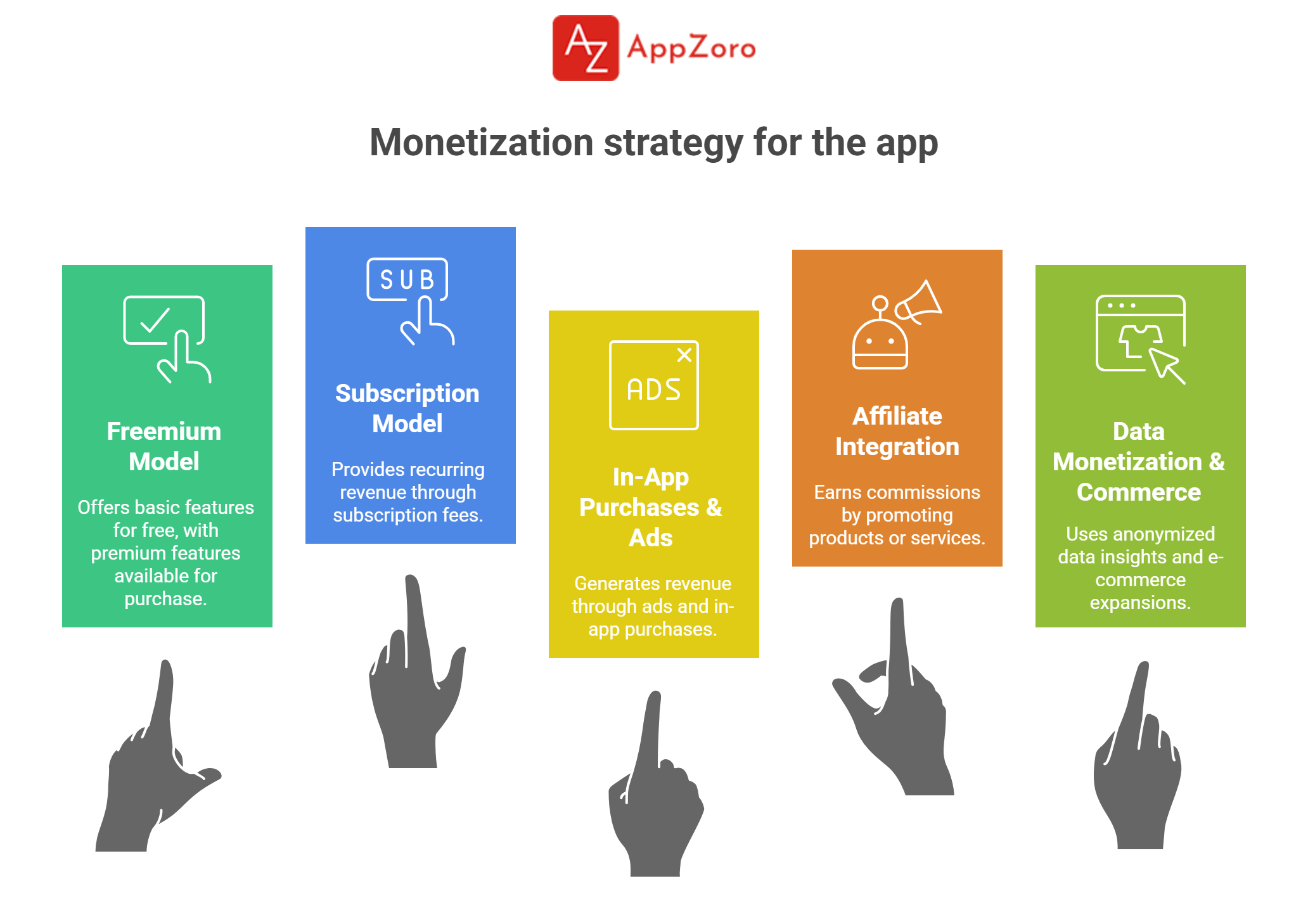
Freemium Model
The most popular model for beginners. Users get basic features at no cost. Premium features unlock advanced tools, ad removal, extra content, or exclusive perks.
Apps like Tinder use this brilliantly. Free to use. But supercharging the experience requires paid boosts. This model drives 90% of global downloads.
Subscriptions
Subscription models are recurring engines. Calm, for example, charges $69.99 per year and generated tremendous growth. Subscription revenue grew 34% in a single year across categories.
In-App Purchases & Ads
Google AdMob offers banners, video ads, interstitials, and reward ads. Perfect for games, utility tools, and micro-entertainment apps.
Affiliate Integration
You can promote products or services inside your app and earn commissions. Stripe, Digistore, and Amazon Associates integrate smoothly.
Data Monetization & Commerce
Ethical data monetization involves using anonymized insights—not personal data—and selling aggregated market patterns. E-commerce expansions turn apps into mini-stores.
Appzoro builds monetization-optimized flows during the wireframing phase, boosting client conversion rates by 20–50%.
Step 5: Testing, Launching, and Publishing
Your app must undergo rigorous testing before launch.
Testing Phases:
-
Alpha Testing: Internal team tests core functionality.
-
Beta Testing: External users explore the app for bugs, friction points, and UI problems. Tools like TestFlight simplify the workflow.
Store Submissions:
-
Apple Developer Fee: $99/year
-
Google Play Fee: $25 one-time
Prepare App Store Optimization (ASO) assets:
-
High-converting screenshots
-
Compelling app description
-
Target keywords
-
A powerful tagline
Legal Compliance
You must include:
-
Privacy policy
-
Terms of service
-
Cookie policy
Tools like iubenda automate this for beginners.
Appzoro handles submissions end-to-end, boasting a 95% first-pass approval rate, saving creators weeks of back-and-forth.
Step 6: Marketing, Growth, and Scaling
Launching an app is only half the battle. Growth is the real arena.
ASO and Paid Ads
Optimize for high-traffic keywords in your niche. With Google and Facebook ads, beginners can maintain a cost-per-install (CPI) under $2 with the right targeting.
Organic Growth
-
Instagram teaser videos
-
YouTube Shorts walkthroughs
-
Reddit threads
-
TikTok demos
-
Influencer collaborations
-
Email list promotions
Analytics
Track everything using Google Analytics for Firebase:
-
Lifetime Value (LTV)
-
Cost Acquisition (CAC)
-
Session duration
-
Retention cohorts
Scaling Strategies
-
Add web app versions
-
Release feature updates
-
Introduce loyalty rewards
-
Expand to international markets
Appzoro’s post-launch campaigns have lifted DAUs (Daily Active Users) by 40% in the first 90 days.
Measuring Success and Common Pitfalls
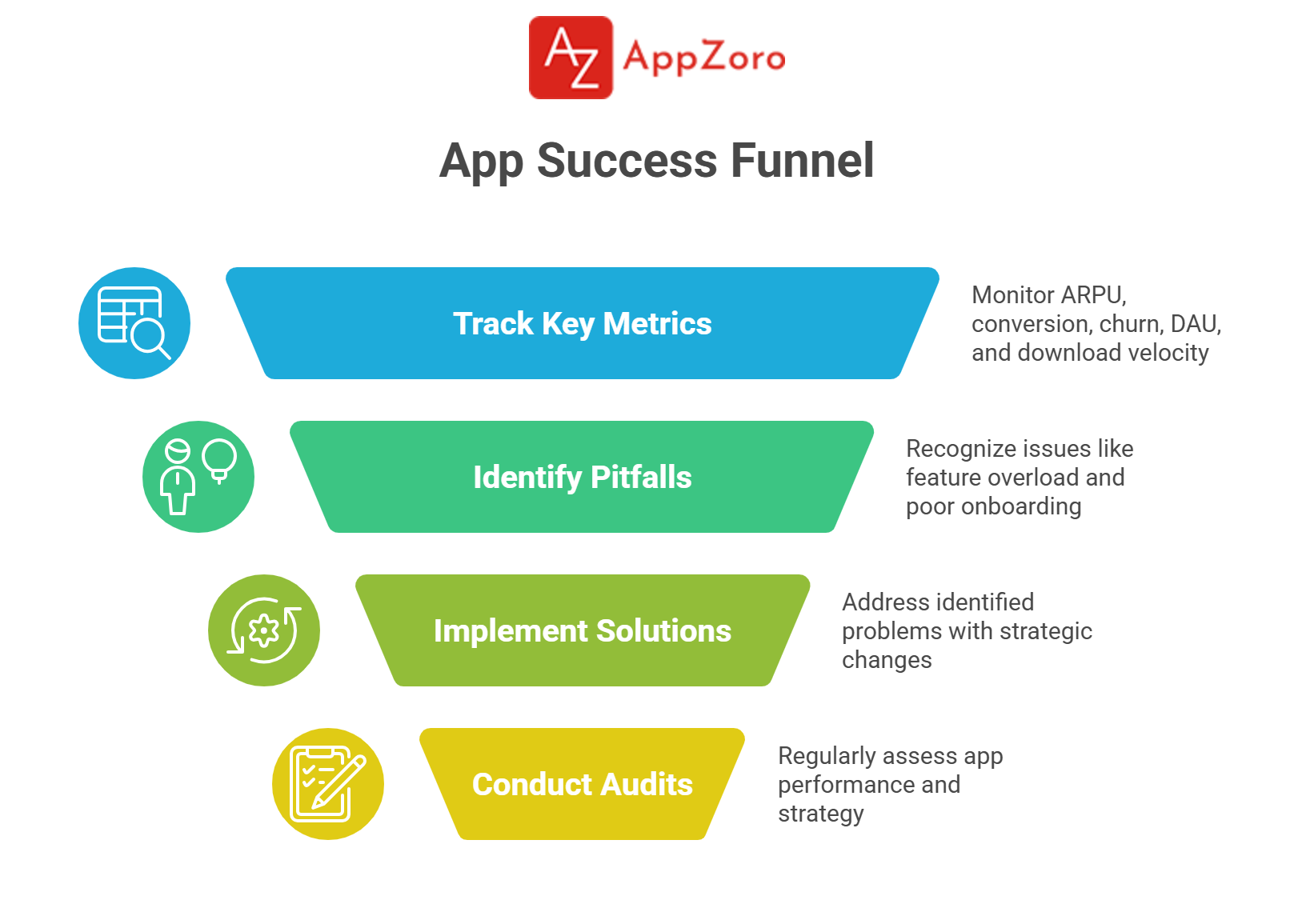
Success isn’t measured by downloads alone. Track:
-
Revenue per user (ARPU)
-
Conversion rates
-
Churn rate
-
Daily active users (DAU)
-
Download velocity
Common pitfalls include:
-
Overloading with unnecessary features
-
Neglecting updates
-
Poor onboarding
-
Ignoring user reviews
-
Slow performance
Appzoro offers quarterly audits to identify issues and reroute strategies for sustained profitability.
Real-World Case Studies from Appzoro Clients
Case 1: E-Commerce Affiliate App
A client created an affiliate-powered shopping aggregator. Appzoro built their custom platform with automated product syncing. The result?
-
$1 million in revenue in the first year
-
Average session length doubled
-
Monthly downloads climbed rapidly
Case 2: Fitness Subscription App
A beginner with no coding experience approached us with a fitness-tracking idea. We validated the concept, developed the app, and optimized the subscription funnel.
The results:
-
300,000 active users within months
-
Monthly recurring revenue became stable and predictable
-
A loyal fitness community formed around the app
The pattern is simple: Validation + strong design + custom development = accelerated ROI.
Conclusion
The journey from idea to income-generating application isn’t a mystery. It’s a structured process. Validate deeply. Design intentionally. Build smartly. Test obsessively. Market strategically. Refine continuously.
The opportunity is alive in 2026. The tools are accessible. And the revenue potential is enormous.
If you want expert help, Appzoro is here to turn your idea into a profitable mobile application.
Contact Appzoro today for a free consultation and start building your money-making app.