
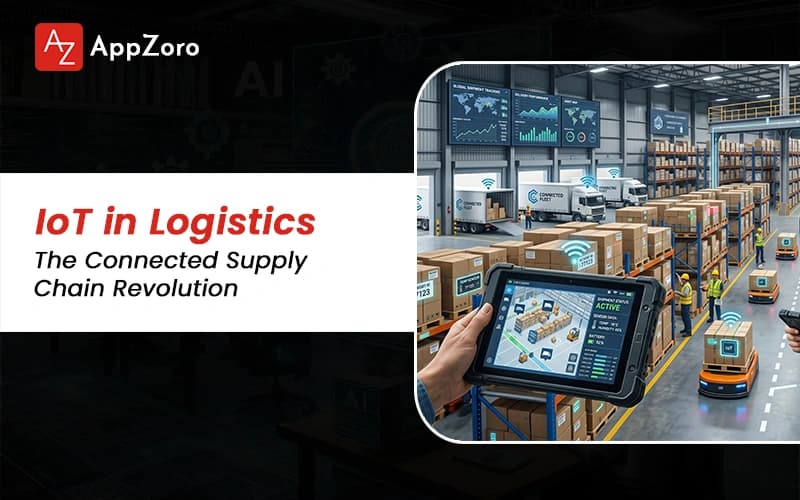
Quick Answer: IoT in logistics is the use of connected sensors and trackers across a shipment's full journey, from origin pickup through linehaul, hub handoff, warehouse receipt, last-mile delivery and proof of delivery. It is capturing five data types covering location, condition, identity, status and behavior and it is being deployed differently across road, ocean, air and rail modes. Major platforms include Samsara, project44, FourKites, Sensitech and Maersk Remote Container Management. The market sits at $40 billion and is projected to reach $120 billion+ by 2030.
Tracking a single shipment can be stressful, dealing with disconnected handoffs, missing condition data, and blind spots between carriers giving operators headaches before any pallet is moved. This is not suitable for any modern operator and to tackle that, smart teams are now equipping themselves with specialized IoT development services that are making every touchpoint visible and integrated across the supply chain.
What Is IoT in Logistics?
So, what is IoT in logistics actually covering in 2026? Well, it is the deployment of connected sensors, trackers, telematics and edge devices across the people, vehicles, assets and infrastructure that are moving goods, combined with the platforms and integrations that are turning raw sensor data into operational decisions.
But what is the actual scope of IoT in logistics as it is being practiced today? Let's break it down.
It's More Than GPS Tracking: This is including temperature, humidity, vibration, tilt, light, shock, fuel, driver behavior and RFID-based identity tagging across the fleet.
It Crosses Organizational Boundaries: Shippers, carriers, 3PLs, warehouses and end customers are all seeing slices of the same shared data.
It Spans Modes And Borders: One single shipment may be crossing road, ocean, air, customs and rail inside one continuous move.
The Value Sits In Integration: Sensor data is only genuinely useful when it is flowing into TMS, WMS, ERP and customer-facing systems.
How IoT Works in Logistics - The Connected Shipment Journey
To understand how IoT works in logistics in practice, the cleanest way is to follow a single shipment all the way from its origin through to delivery. Let's walk through the 7 touchpoints where IoT is capturing data and is triggering operational decisions.
Touchpoint 1: Origin Tagging (Warehouse Or Manufacturer)
An RFID tag, barcode or QR is being applied at pack-out and smart pallet sensors are being activated. Data captured includes identity origin, weight, lot or batch and departure timestamp.
Touchpoint 2: Pickup And Loading
The driver is scanning the manifest via mobile telematics platforms like Samsara or Motive and the trailer-mounted tracker is starting to ping. Data captured includes pickup confirmation, photos and condition baseline.
Touchpoint 3: Linehaul Transit
Vehicle telematics plus the asset tracker are streaming location, speed, fuel and driver behavior continuously, while cold chain sensors are streaming temperature in real time. Data captured includes continuous location, condition and behavior signals.
Touchpoint 4: Hub, Port or Border Crossing
The asset is being re-scanned at the hub or container yard, customs IoT seals are being verified and yard management systems like PINC and FourKites Yard are tracking dwell time. Data captured includes handoff timestamp, integrity status and dwell duration.
Touchpoint 5: Warehouse Receipt
RFID gate scan, dock door sensor activation and the WMS receipt are happening together, with smart shelf systems updating the inventory record in real time. Data captured includes arrival confirmation, condition exception check and inventory update.
Touchpoint 6: Last-Mile Routing And Delivery
The driver app like Bringg, Onfleet or DispatchTrack is routing the run and the customer is receiving real-time ETA pings. The technical complexity behind building custom IoT applications for the last mile involves route optimization signals, customer notification logs and live ETA updates that must be synchronized with the central TMS.
Touchpoint 7: Proof Of Delivery (POD)
The photo, signature, geofence confirmation and any condition seal are all being captured at handover and the cold chain log is being uploaded for compliance. Data captured includes delivery confirmation, chain-of-custody close and the compliance documentation.
Each one of these touchpoints exists with or without IoT, however IoT is what is making them visible, timestamped and integrated across the operation. That visibility is what is compounding into real operational savings.
The 5 Types of IoT Data in Logistics
IoT in logistics is not generating one single kind of data, it is generating five distinct types of data and the value of any deployment is depending on which types you are capturing and how you are integrating them into the broader operation.
Location Data: GPS coordinates, geofence entries and exits and dwell time measurements. Unlocks real-time tracking, ETA prediction, route optimization, theft prevention and yard management workflows.
Condition Data: Temperature, humidity, vibration, tilt, light and shock readings on the asset itself. Unlocks cold chain compliance, damage attribution, pharma and food safety and high-value goods protection.
Identity Data: RFID tags, barcodes, container numbers (ISO 6346) and lot or batch identifiers. Unlocks chain of custody, inventory accuracy, recall management and anti-counterfeit protection.
Status Data: Vehicle diagnostics, fuel level, engine hours, battery state and door open or close events. Unlocks predictive maintenance, fuel optimization, cargo security and asset utilization tracking.
Behavior Data: Driver speeding, harsh braking, idle time, hours of service and dwell time at customer sites. Unlocks safety coaching, ELD compliance, accessorial charge accuracy and broader performance management.
Most logistics operators are starting by capturing location data first, then layering condition data for cold chain applications and behavior data for fleet management. Identity and status data are typically requiring deeper warehouse and vehicle system integration, so they tend to follow later in the maturity curve once the foundation is properly in place.
IoT in Logistics by Transportation Mode
Each transportation mode is operating with its own IoT stack, its own preferred connectivity layer and its own dominant platform vendors across the industry today.
Road Freight
Vehicle telematics platforms including Samsara, Motive, Geotab and Verizon Connect are dominating this mode today. ELD compliance is the baseline, with 4G LTE-M cellular as the standard connectivity—a key overlap with the broader evolution of IoT in the telecommunications sector. Sensors cover GPS, fuel, engine diagnostics, and trailer trackers to ensure full fleet visibility.
Ocean Freight
Smart containers are now leading this mode, with Maersk Remote Container Management instrumenting 380,000+ reefers and Hapag-Lloyd Live Position covering roughly 100,000 containers. Connectivity is satellite for open ocean plus cellular at the ports and sensors include location, temperature, humidity, door open or close and shock.
Air Cargo
Unit Load Device (ULD) tracking via providers like Unilode and CHEP is becoming standard. Connectivity is cellular plus BLE handoff at airport infrastructure and the IATA ONE Record initiative is pushing IoT data standardization across the industry.
Rail
Wabtec, Trinity Industries and Hapag rail equipment are increasingly being instrumented with sensors covering location, brake performance, wheel temperature and bearing health. Predictive maintenance is the leading use case here, with cellular at stops and satellite in remote stretches.
Intermodal (Multi-Mode)
This is genuinely the hardest case, because a single shipment is moving across truck, ocean, rail and truck again in one continuous journey. Visibility platforms like project44 and FourKites are aggregating carrier data across modes, with sensor data either transferring with the container or resetting at the handoffs between operators.
Choosing IoT for a logistics operation is starting with the mode mix, because single-mode operators are facing far simpler stack decisions than intermodal carriers running across multiple modes.
IoT in Logistics by Stakeholder Perspective
The same IoT in logistics industry deployment is serving very different stakeholders with very different priorities and value definitions, so the platform choice and the integration approach are depending heavily on which stakeholder is primarily funding the rollout.
Shippers (Manufacturers, Retailers, Pharma): Priority is end-to-end visibility, supplier accountability and exception management across the supply chain. Platforms include project44, FourKites and Shippeo. Value is SLA enforcement, better customer experience and lower inventory buffer.
Carriers (Trucking, Ocean, Air): Priority is asset utilization, fuel and driver efficiency, predictive maintenance and accessorial billing accuracy. Platforms include Samsara, Motive and Geotab. Value is margin improvement, safety and regulatory compliance.
3PLs And Forwarders: Priority is differentiation through visibility, multi-carrier aggregation and shipper-facing dashboards. Platforms include project44 (often white-labeled), FourKites and in-house customer portals. Value is customer retention and premium pricing.
Last-Mile And Delivery Operators: Priority is route optimization, customer notifications, proof of delivery and gig driver management. Platforms include Bringg, Onfleet, DispatchTrack and Routific. Value is density, on-time performance and customer experience.
End Consumers: Priority is real-time ETA, delivery transparency and package security across the experience. The touchpoint is SMS, app notifications and branded tracking pages.
Most IoT deployments are serving one primary stakeholder while generating spillover value for others in the chain. Mapping which stakeholder is the primary buyer is what is determining the platform choice and the integration footprint required.
IoT Use Cases, Applications and Examples in Logistics
The iot use cases in logistics span every single touchpoint of the shipment journey from origin to delivery. Below are 8 concrete iot applications in logistics with real-world named examples from the operators who are running them today.
End-To-End Shipment Visibility: project44 is aggregating carrier data for Walmart, P&G and Unilever multi-mode tracking across modes.
Fleet Telematics: Samsara is serving DHL and Sysco with vehicle diagnostics, ELD compliance and driver coaching across the fleet.
Cold Chain Monitoring: Sensitech and Tive sensors are traveling with Pfizer and Moderna pharma shipments, flagging temperature excursions in real time.
Smart Containers: Maersk Remote Container Management is instrumenting 380,000+ reefer containers globally with cellular IoT.
Yard Management: PINC and FourKites Yard are cutting trailer dwell time at distribution centers by 30%+ across larger operators.
Warehouse RFID: Decathlon, Zara and Walmart are using RFID at unit level for real-time inventory accuracy across all retail locations.
Last-Mile Notifications: Bringg and DispatchTrack are powering on-time delivery alerts for grocery, parcel and restaurant operators.
Predictive Maintenance For Fleet: Geotab and Motive are using vehicle telemetry data to predict component failure days in advance.
These examples of iot in logistics span from $1 billion+ smart container programs at global carriers down to sub-$50K cold chain deployments at regional pharma distributors. The unit economics are working at both ends of that spectrum, because the value of avoided loss is compounding with shipment volume across every operator running these use cases inside the iot in logistics industry today.
Benefits of IoT in Logistics
The benefits of iot in logistics are clustering into three distinct categories that operators should be evaluating separately when scoping any new deployment investment.
Operational Benefits
15 To 30% Improvement In On-Time Performance: Real-time visibility is enabling proactive intervention before delays compound across the network.
20 To 40% Reduction In Trailer And Yard Dwell: Better coordination at the hubs is freeing up significant capacity across the operation.
30 To 60% Reduction In Cold Chain Spoilage: Real-time excursion alerts and rerouting are protecting product before damage occurs.
Financial Benefits
8 To 15% Fuel Savings: Driver coaching and route optimization are delivering measurable savings across the fleet.
15 To 25% Reduction In Cargo Loss And Theft: Tamper detection and geofence alerts are protecting in-transit value continuously.
25 To 40% Lower Unscheduled Maintenance: Predictive diagnostics are catching issues before they become breakdowns in the field.
Customer And Compliance Benefits
Real-Time ETA For Consumers: Last-mile notifications are now a standard expectation across consumer-facing delivery.
Automated Compliance Documentation: GDP for pharma, FSMA for food and customs for cross-border are all being automated through IoT data feeds.
Stronger SLA Performance: Visibility is supporting tighter contractual commitments across the operation.
The benefits of iot in logistics are typically arriving in 6 to 18 months for well-scoped deployments and the most common failure mode is pilots that never reach steady-state operation.
IoT in Logistics Market - Size and Growth
The IOT in logistics market is one of the largest vertical IoT segments globally, driven by sustained pressure on supply chain efficiency, customer experience expectations and cold chain compliance requirements across regulated industries.
Segment | 2024 Size | 2030 Forecast | CAGR |
Total iot in logistics market | $40 to $50B | $110 to $140B | ~16 to 20% |
Fleet telematics | $25B | $55B | ~14% |
Supply chain visibility platforms | $5B | $20B | ~25% |
Cold chain monitoring | $4B | $12B | ~20% |
Warehouse IoT | $6B | $18B | ~20% |
These figures are synthesized from IoT Analytics, Berg Insight, MarketsandMarkets and Grand View Research reporting. Operators should always verify the current primary figures before citing them inside any commercial decision materials.
The Future of IoT in Logistics
The future of iot in logistics through 2030 is being shaped by six distinct trends that are moving fast across the industry and operators planning long-term investment should be tracking each of them carefully.
Autonomous Freight Corridors: Aurora, Kodiak and TuSimple are operating sensor-heavy autonomous trucks on fixed-route freight corridors across the US.
AI Layered On IoT Data: Anomaly detection, predictive ETA and demand forecasting are moving from analytics dashboards into autonomous operational decisions.
Drone And Robot Delivery Scaling Past Pilots: Zipline, Wing and Nuro are expanding deployment footprints from pilot zones into broader regional service.
Private 5G And Network Slicing For Industrial Logistics: Ports, large distribution centers and rail yards are adopting dedicated cellular as primary connectivity.
Digital Freight Matching With Embedded IoT: Convoy, Uber Freight and Loadsmart are integrating IoT data to verify capacity and shipment status in real time.
Sub-$1 Smart Packaging: Wiliot and Tive are enabling unit-level visibility at the parcel and even item level, opening up entirely new commercial models.
The future of iot in logistics through 2030 is hinging less on individual sensor breakthroughs and more on the integration with AI-driven decision systems that are triggering action autonomously across the operation.
The 4-Phase IoT Maturity Roadmap for Logistics Operators
Most logistics enterprises are sitting between Phase 1 and Phase 2 of IoT maturity today and the path forward is genuinely sequential. Skipping phases is producing deployments that never reach steady state inside the iot in logistics rollout.
Phase 1 - Visibility (6 To 12 Months): Deploy fleet telematics and shipment tracking using tools like Samsara, project44 and FourKites. The outcome here is simply knowing where things are at any given moment.
Phase 2 - Optimization (12 To 24 Months): Integrate IoT data into TMS, WMS and ERP and use the data for routing, scheduling and exception management. The outcome is acting on what you already know.
Phase 3 - Automation (24 To 48 Months): Trigger operational workflows automatically including auto-reroute, auto-replenish and auto-notify across stakeholders. The outcome is reduced manual intervention across the operation.
Phase 4 - Autonomous (4+ Years): AI-driven decisions, autonomous vehicles wherever viable and self-healing supply chains across modes. The outcome is human-in-the-loop only for genuine exception handling.
Most failed IoT programs are over-scoping Phase 1, trying to do visibility plus optimization plus automation all at once and are stalling at the integration layer before any phase is producing measurable value.
Conclusion
IoT in logistics is no longer just a sensor experiment tucked away inside an innovation budget, it has become an operational baseline for any shipper, carrier or 3PL serious about delivering on cost, speed and customer experience. Logistics operators scoping IoT should follow a structured IoT product development process to map their shipment journey first, decide which data types matter most, and then sequence investment across the 4-phase maturity roadmap.
Leave a Comment