

Here’s a statistic that should prompt every business to pause. 88 percent of users dump an app in 10 seconds if it feels confusing or poorly designed. Ten seconds. Less time than unlocking your phone. Now picture a large enterprise pouring millions into a digital project—only to watch users bounce because layouts didn’t make sense. That kind of UX/UI mistake costs real money. Yet countless companies still repeat it.
For enterprises, mobile app creation means more than just coding. It’s building a digital pathway people actually trust—employees, clients, or partners alike. The process, though, rarely flows smoothly. Teams stay divided. Designers chase visuals, developers chase logic, and project leads try holding it together somehow. Native builds eat budgets, delay schedules. Compliance gets messy, especially inside the healthcare or banking worlds. And scaling? Usually breaks once the business starts growing faster than the tech ever planned.
That’s where Appzoro steps ahead. A top mobile app development services usa, they combine human-centered design with enterprise-level systems. The outcome—apps that perform flawlessly and make a measurable business impact. Their framework has already pushed clients toward 40 percent quicker releases and roughly 30 percent higher retention rates.
This guide tears open every layer—why UX/UI runs the show, why cross-platform tech matters more than ever, how Appzoro’s agile model works, and what ROI looks like when all the moving pieces align.
The Weight of UX/UI in Enterprise App Building
Most mobile platforms fail not because they crash but because they miss the purpose—designed that works. In enterprise systems, design equals productivity. A single interface might serve a warehouse manager, an accountant, and a director together. It can’t afford confusion.
Understanding the Enterprise UX Equation
Looking good isn’t enough. Design should support workflow. A field officer needs quick offline access; a CFO wants live dashboards. Different roles, same system. Interfaces clearly mapped to these behaviors make enterprise apps usable.
Accessibility ranks next. Big organizations can’t exclude. WCAG standards matter—not just ethics, it’s law in many regions. Compliance ensures apps stay safe, functional, and open for everyone.
Then comes large-scale personalization. Using AI-driven dashboards, design shifts for roles dynamically. Employees get only the information relevant to them, with no clutter. This is where thoughtful ui/ux design and development services ensure the balance stays personal yet consistent—keeping users engaged without ever feeling lost.
The Cost of Ignoring UX/UI Integration
Even strong technology fails without a polished design. Results show fast. Poor workflows mean slow adoption. Productivity dips 20 to 25 percent. Extra steps waste time. Confused workers flood support lines.
Then integration pain hits. Without a unified design strategy, links between systems break, and users toggle across multiple tools. Efficiency falls apart again. Security too—fields or buttons coded wrong sometimes leak sensitive data out. That’s an expensive brand mistake.
Measuring User Experience the Right Way
UX impact isn’t a gut feeling. It’s numeric.
-
A System Usability Score above 80 links directly to higher financial growth.
-
Simplified flows slash help tickets by nearly half.
-
Proper A/B design cycles push conversions upward 30 percent on average.
Small tweaks done right can shift major business numbers.
Why Cross-Platform is Now Non‑negotiable for Enterprises
Employees don’t all use one phone type anymore, so enterprises must think universally. Partnering with a cross platform app development company makes this easier, as cross-platform frameworks enable faster deployment, consistent design across devices, and significant cost savings.
Core Differences, Real Advantages
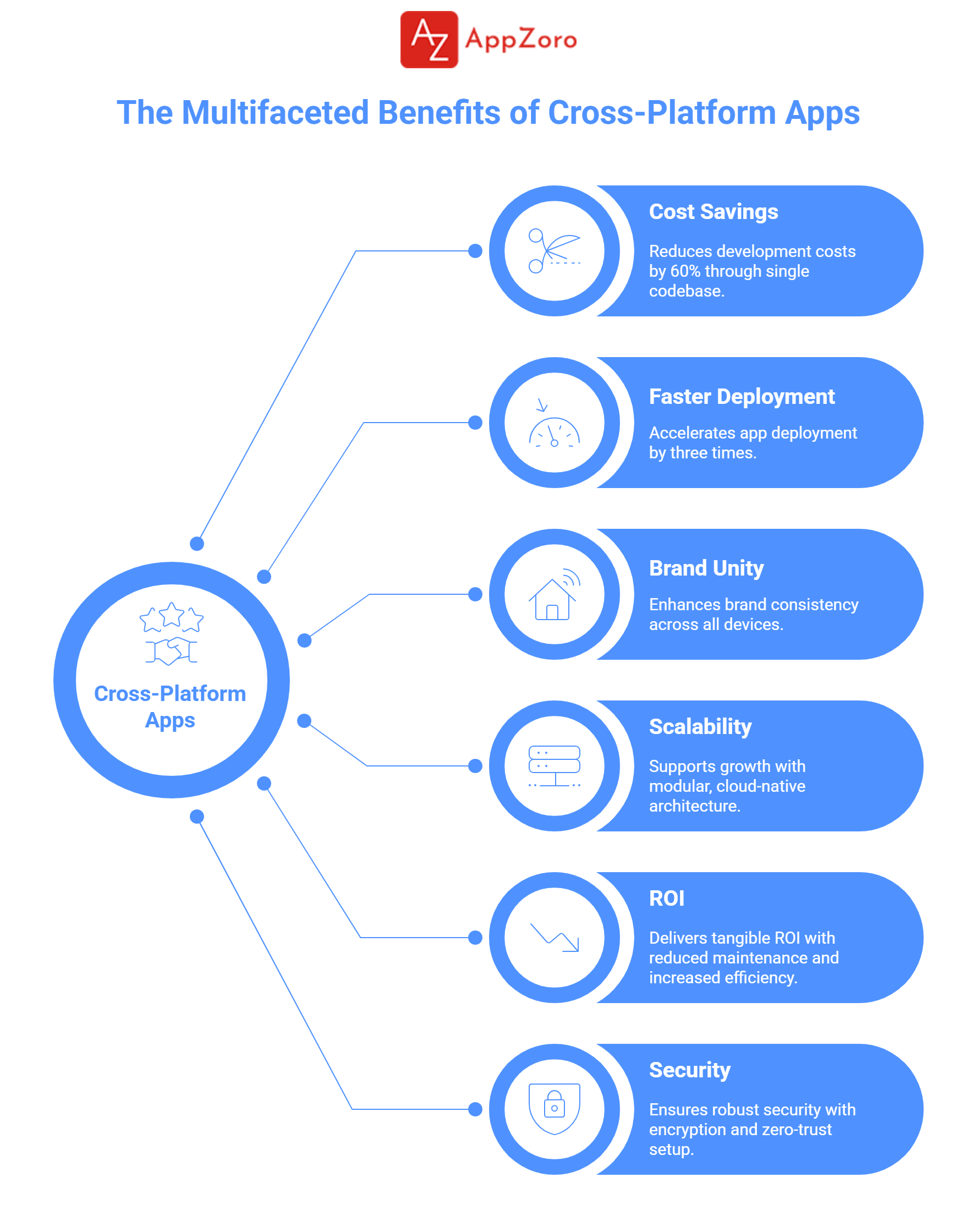
Using tools like Flutter or React Native lets you run one codebase for all devices. That cuts costs nearly 60 percent versus building twice. More budget is free to innovate instead.
Deployment quickens dramatically—apps for both iOS and Android are released side by side, often three times sooner. That speed shortens feedback loops and gives immediate returns.
The same goes for brand unity. One interface that feels across devices builds trust, reduces training time, and supports a familiar experience anywhere.
Scaling and Running Long‑Term
Growth never stops for enterprises. Their technology shouldn’t slow down, either. Modular setups allow adding new services without rewriting the base. Cloud-native design on AWS or Azure lets performance stretch easily for millions of sessions. Apps developed under this approach typically load in under two seconds, even under heavy waves of users.
Security Where It Counts
From the blueprint itself, security lives in each layer. Encryption applies end-to-end. Logins use biometrics or OAuth‑based identity control. Zero-trust setup limits even internal misuse. Every prototype must show audit records—vital for healthcare, fintech, or government-grade systems.
ROI That Feels Tangible
Cross-platform apps bring measurable benefit:
-
Maintenance needs drop to 15 percent of total cost versus 40 percent for native versions.
-
Efficiency rises by roughly a quarter through smoother integration.
-
Long-term ownership cost falls 40 percent in five years thanks to predictive updates and less technical debt.
How Appzoro Builds Enterprise Applications Properly
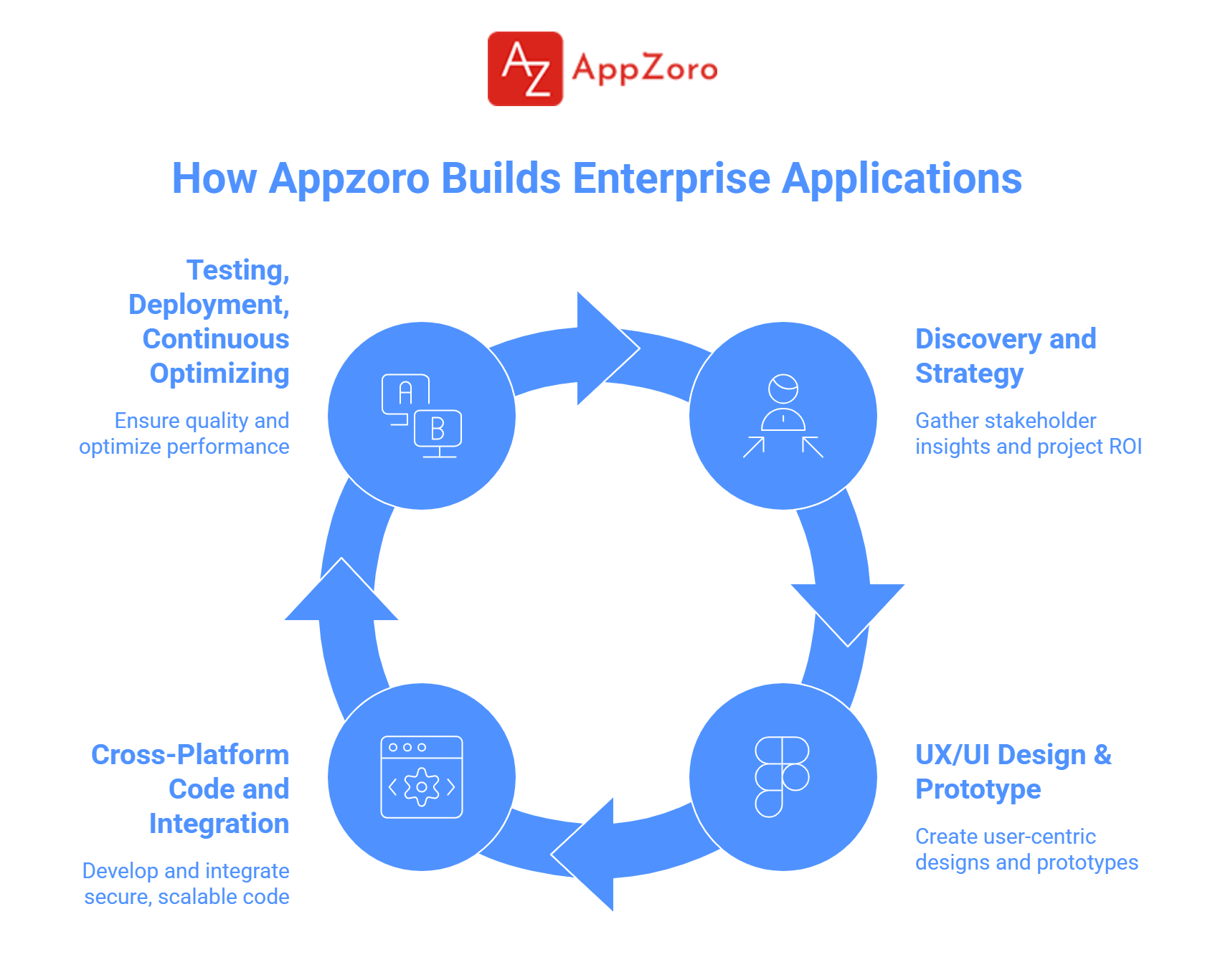
Behind every app performing right lies a precise routine. Appzoro follows a tested agile flow, keeping vision transparent and goals measurable.
Phase 1: Discovery and Strategy
Everything starts with listening. Workshops bring together stakeholders—IT, field ops, and finance. UX audits surface what others miss. ROI projection models show expected value before any design file is made.
Phase 2: UX/UI Design & Prototype
This is where form meets usability. Personas revolve around job roles. Designers use Figma or Sketch to draft wireframes, each going through accessibility and task tests. Prototypes hit near 90 percent satisfaction ahead of development itself. That saves huge correction time later.
Phase 3: Cross-Platform Code and Integration
Once visuals are approved, engineers enter. The selection between Flutter and React Native happens based on scaling needs. APIs bind the app into corporate systems—CRMs, ERPs, or analytics stacks. Security integrates from the start, including authentication, compliance logic, and encrypted storage.
Phase 4: Testing, Deployment, Continuous Optimizing
Every code commit gets checked under real conditions. QA runs on multiple devices, ensuring uptime is near perfect. Stress tests simulate tenfold traffic bursts. After launch, analytics panels monitor session times, drop rates, and adoption, keeping improvement constant.
Agile Flow Designed for Business
Appzoro modifies standard Agile for enterprise rhythm. Bi‑weekly sprints add executive reviews. MVP approaches reduce risk early. Continuous delivery pipelines deliver updates live with zero downtime.
Cases That Prove the System Works
Case 1: Refining logistics for a global carrier The problem—native apps failed to sync across regions, causing shipment delays. Appzoro rebuilt the stack using cross-platform logic with AI route optimization. Delivery speeds rose by 45 percent, annual savings hit $2.5M, and adoption touched 95 percent in months.
Case 2: Lifting patient involvement for a healthcare group Their app looked secure, but it confused users. Appzoro redesigned it using HIPAA-guided layers with intuitive layouts. Patient engagement jumped 60 percent, breaking even in half a year.
Case 3: Supporting seasonal retail surges A Fortune 500 retailer faced lag under peak loads. The rebuilt app worked offline with real-time sync. Inventory accuracy improved 30 percent, reclaiming $1.8M lost revenue that year.
Common Results Noted
Average return quadruples through UX‑focused rebuilds. Apps handle a million concurrent users smoothly. And partnerships remain active years later—features scaling over time, growing 25 percent portfolio expansion yearly.

Why Appzoro Repeats Wins Consistently
Ten years deep in enterprise app design means experience has structure. Over 200 deployed products, 50 core specialists across UX and mobile tech, all focused on blending creativity with reliability.
Key Differentiators
Security sits at the top—risk lowered by 70 percent across projects. ROI planners estimate potential financial gain before contract signing. Framework scalability ensures clients expand to full suites without locking into a rigid vendor cage.
Trust Earned Through Real Delivery
A ninety-eight percent retention rate says enough. Client base includes Fortune 100 alliances. Appzoro’s UX excellence even led it to be a finalist in the global design awards. Transparent pricing and punctual launch schedules maintain that trust.
Focused on Actual Business Gains
Once apps go live, assistance stays. Their post-launch division keeps uptime above 99 percent. Data analytics fuel next updates, ensuring apps grow in capability continuously. Choosing Appzoro means extending your tech team with a partner who speaks compliance, growth, and usability all at once.
Conclusion
The marketplace moves fast, and fragmentation kills growth. If your enterprise tech stack feels disconnected or underperforming, that’s friction costing you growth each day. Appzoro bridges those gaps—fusing thoughtful UX with dependable cross-platform engineering.
Schedule a free half‑hour consultation now to review your product ecosystem. Whether your issue is dated systems or dull engagement, they’ll map a route to modern, seamless mobility. Your next scale moment might only need one good rebuild.
Leave a Comment