
In the last ten years, oil and gas work has changed quietly. What started as basic automation and simple reports is now full of software that touches almost every part of operations. Today, software is at the center. It helps teams run daily work, manage risk, and make quick decisions.
This change did not happen by chance. Margins are tight. Rules and regulations are stricter. Many assets are old. Equipment failures or accidents can cost a lot. In this setting, oil and gas software development services are not just useful. They are tools companies depend on to keep operations running well.
Decision-making is different now. Teams no longer rely on occasional reports or manual checks. Software also saves money. It helps plan drilling, prevents unexpected shutdowns, and improves maintenance. Even small improvements can save millions over time.
Operations are connected. Exploration choices affect transportation. Transportation choices affect refining. Without software, it is hard to see the full picture. Modern platforms show these connections clearly and make decisions easier.
Many energy companies work with enterprise application development companies to improve their software. They connect old systems to new platforms and build tools that fit real operations, not generic templates.
What Oil and Gas Software Development Means
Oil and gas software development is more than coding. It is building systems for exploration, production, transport, refining, and delivery. These systems run in complex and risky environments where reliability and security are very important.
The software covers many areas. Field data platforms, production dashboards, ERP systems, and analytics tools all help. These systems often link to industrial controls, sensors, and other platforms while following strict rules and security standards.
Companies often choose between ready-made software and custom software development solutions. Ready-made software is fast to use and works for standard processes. But it can force teams to change how they work. Integrating it with old systems can be hard.
Custom software is different. It is made to fit real operations. It matches how teams work in the field and in offices. For example, a production monitoring system can follow a company's assets and reports exactly. It costs more upfront but usually gives bigger long-term benefits, especially for large operations.
Software in Different Parts of the Industry
Upstream is exploration and production. Software helps with seismic data, reservoir modeling, drilling, and well performance. Accuracy is very important because mistakes can cost a lot.
Midstream is transport and storage. Pipeline monitoring, leak detection, and logistics software keep work safe and smooth. Real-time data is critical. Delays here cause problems later.
Downstream is refining and distribution. Software helps optimize production, track quality, manage energy, and coordinate supply chains. It also links to finance, procurement, and compliance systems.
Intelligent Software in Oil and Gas
AI is becoming central. Many companies work with artificial intelligence app development companies. Machine learning and predictive analytics help teams see problems before they happen. Equipment failures can be predicted. Production can adjust in real time. Decisions move from reacting to problems to preventing them.
Oil and gas software development is more than technology. It is about building tools that fit operations, long-term goals, and the people who use them. Companies that do this well gain a strong advantage in a fast and high-risk industry.
Evolution from Legacy Systems to Modern Digital Platforms
For a long time, oil and gas companies relied on old systems. SCADA platforms and on-premise applications did the job, but they were rigid. Updates were slow. Connecting with new technology was hard. Expanding to multiple sites costs a lot. Many teams still used manual processes or separate databases. This made decisions slower and it was hard to see the full picture.
Moving to modern digital platforms has changed the game. Cloud-based systems let software run across many environments. Teams can access real-time data from a rig, a control room, or an office.
APIs are very important. They allow different software to talk to each other. Production monitoring tools can send data to predictive maintenance software or ERP systems. This reduces manual work, improves accuracy, and helps teams act quickly when problems come up.
Some companies show how powerful this change can be. One multinational energy company replaced several SCADA systems offshore with a single cloud platform. The results were faster response times and less unplanned downtime. Updating systems is not just about technology. It directly improves efficiency and saves money.
Working with an oil and gas software development company makes this easier. They know how to connect old systems with new platforms. They help companies keep operations running while using new digital tools.
Core Parts of Oil and Gas Software Development Services
Making software for oil and gas is more than just coding. You need to know how the operations work, follow safety rules, and meet regulations. Good oil and gas software development services focus on solving real problems and helping teams work better.
Data Collection and Integration
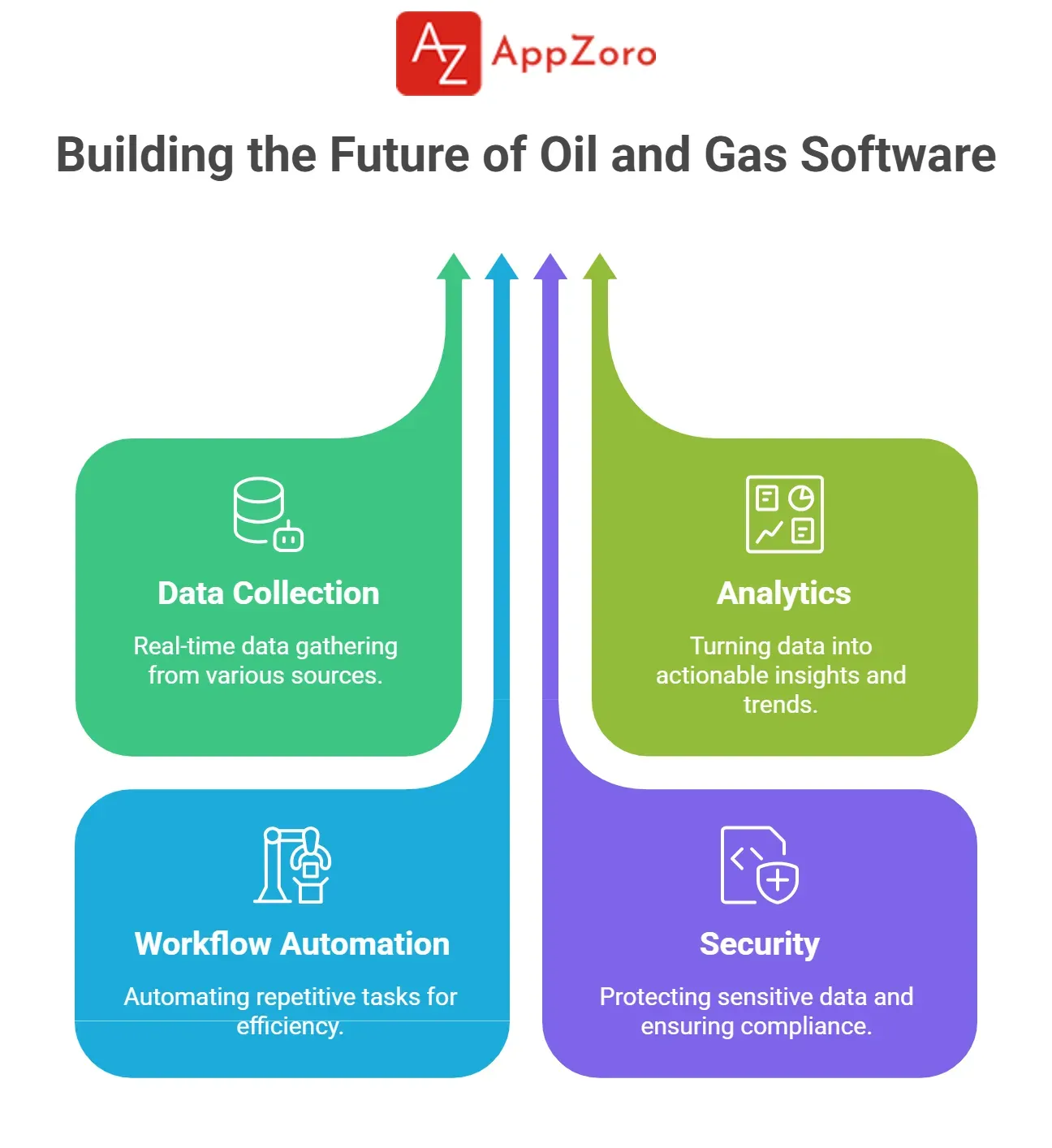
Data is the starting point for all decisions. Sensors on rigs, pipelines, and refineries create a lot of information every second. Collecting this data in real time is very important. The next step is putting it all together. The best software combines data from SCADA, IoT, and ERP systems into one dashboard.
This lets teams see trends, find problems early, and make faster decisions. Custom software development solutions help connect all systems in a way that fits each company.
Analytics and Dashboards
Data alone does not help. Software must turn it into insights. Dashboards show this information in a clear way. Teams can track performance, pipeline pressure, or energy use. Some dashboards can even warn teams about problems before they happen.
Using oil and gas software development company solutions means companies can get dashboards and reports that match their operations. This makes decisions faster and more accurate.
Workflow Automation
Many tasks in oil and gas are repetitive. Automation can handle these tasks automatically. It can create reports, send alerts, or schedule maintenance.
When combined with custom software development for the oil and gas industry, automation fits each company's needs. It saves time, reduces mistakes, and lets staff focus on more important work.
Security and Compliance
Oil and gas companies handle sensitive data and follow strict rules. Software must keep data safe. It needs strong access controls, secure storage, and compliance tracking.
Working with an enterprise application development company helps make sure software protects data and meets regulations. Teams can work confidently and make quick decisions.
Benefits of Custom Software Development for Oil and Gas Operations
One-size-fits-all software does not work well in oil and gas. Upstream, midstream, and downstream all have different needs. Each part also follows strict rules. Custom software development for oil and gas industry operations can match software to how each company works.
Better Efficiency and Less Downtime
Even one equipment problem can stop work for days. Standard maintenance schedules are often too slow. Custom software helps predict problems before they happen. By looking at sensor data and past performance, the software can warn teams early.
For example, a big energy company built software for offshore rigs. It tracked vibration, pressure, and temperature. Downtime dropped by 15 percent. Maintenance became easier to plan and costs went down.
Save Money with Predictive Maintenance
Custom software also helps reduce costs. Predictive tools tell teams when maintenance is needed. Companies can order parts at the right time, not in an emergency. Small changes like this save a lot over time, especially for large operations.
Better Safety and Compliance
Safety is very important. Custom software can track dangerous areas, follow safety rules, and monitor compliance. It can log inspections, track worker safety, and warn about risks. This prevents accidents and keeps companies in line with regulations.
Works Across Sites and Locations
Oil and gas companies work in many places. Custom platforms bring data from different sites into one dashboard. Teams can compare performance and share insights quickly. Working with an enterprise application development company ensures the software can grow and work in new locations.
Easy to Use
Even good software fails if people cannot use it. UI/UX design and development services make software simple and easy for operators, engineers, and managers. Clear dashboards and easy navigation help teams adopt the software faster.
Key Technologies Powering Oil and Gas Software Solutions
Custom software is only as strong as the technologies behind it. Today's oil and gas companies use several innovations to improve efficiency, safety, and profits.
Cloud Computing and Edge Processing
Cloud platforms store and analyze huge amounts of data. Teams can access dashboards and reports from anywhere. Edge computing keeps critical decisions local, right at the equipment, so there is no delay. This combination of cloud and edge balances speed and scalability. It is vital for real-time monitoring, especially in remote locations.
Industrial IoT and Sensor Networks
Sensors are the eyes and ears of modern operations. From pipelines to refineries, sensors generate constant data. Industrial IoT platforms collect and process this information. Operators get a detailed view of operations. For instance, sensor networks combined with custom dashboards can detect a pipeline leak within seconds, reducing environmental damage and losses.
Big Data Platforms and Real-Time Analytics
Oil and gas operations create massive amounts of data. Big data platforms help store, manage, and analyze it efficiently. Real-time analytics turn numbers into insights. For example, comparing historical drilling data with live performance can optimize drilling speed, reduce equipment wear, and increase output.
Digital Twins and Simulation Tools
Digital twins create virtual copies of real assets. Teams can test changes or scenarios without touching actual equipment. For example, a refinery can simulate process changes to improve efficiency or spot safety risks. Many artificial intelligence app development companies now use AI in digital twins. This adds predictive insights and smarter decision-making.
Practical Uses of Software Solutions in the Oil and Gas Sector
Software in oil and gas does more than digitize processes. It shapes decisions, affects safety, and drives profits. From exploration to refining, technology now touches almost every part of the value chain.
Exploration and Seismic Data Interpretation
Exploration has always been high-risk and high-investment. Geologists and engineers sift through huge datasets from seismic surveys, satellites, and sensors to find drilling sites. A modern oil and gas software development company can make this process faster and smarter. Advanced software can process seismic waves automatically, highlight anomalies, and even predict resource density. This reduces time and uncertainty.
For example, a mid-sized energy firm used a custom seismic interpretation tool. It cut initial survey analysis by 40 percent. Geologists could focus on strategy rather than crunching data manually.
Drilling Optimization and Well Performance Monitoring
Selecting an appropriate site for drilling is an important step in the drilling process. Once the site has been chosen, drilling can commence, and optimizing drilling operations is essential for cost effectiveness and safety. Custom software development solutions can be developed to combine drilling-related sensor data (from drill bits and pumps), along with mud-type system data for each rig.
For example, one operator operating offshore effectively tracked the torque and vibration associated with various rigs, which resulted in a drilling efficiency improvement of 12 percent and a marked decrease in the number of mechanical failures experienced by the rigs.
Pipeline Monitoring and Leak Detection
Pipelines play an important role in the transfer of oil and natural gas over long distances, and any type of failure during this process could have disastrous consequences. Monitoring software currently in use today to monitor pipelines utilizes pressure sensors, flow meters, and environmental sensors to detect leaks and irregular flow patterns.
In North America, one pipeline operator implemented a predictive analytical platform for monitoring pipeline conditions in real-time, and in the first year's operation, the number of unplanned shut-downs dropped by 20%.
Refinery Process Optimization and Energy Management
Refineries are complex. Small inefficiencies can cost millions. Software lets operators simulate processes, test adjustments, and optimize energy use. Dashboards display live metrics, making it easy to see where heat, energy, or feedstock can be saved.
A European refinery used a platform with UI/UX design and development services so operators could navigate data easily. Energy use dropped 7 percent, and throughput quality improved.
Advancements in Artificial Intelligence Software Development for Oil and Gas
AI is no longer a nice-to-have. Artificial intelligence software development for oil and gas is changing how companies monitor equipment, predict production, and manage risk. AI turns huge datasets into usable insights.
AI-Driven Predictive Maintenance and Anomaly Detection
Maintenance has moved past simple alerts. AI looks at patterns in sensor data to spot subtle problems humans might miss. Teams can fix issues before they grow costly. A Gulf Coast refinery used an AI predictive maintenance tool for pumps and compressors. Unscheduled maintenance dropped 18 percent, and uptime improved.
Machine Learning for Reservoir Modeling and Production Forecasting
Machine learning finds patterns in historical and live production data. This improves reservoir models and helps plan drilling schedules and resource allocation. Companies can simulate scenarios and forecast production more confidently, reducing financial risk.
Computer Vision for Safety Monitoring and Inspections
Inspections often happen in dangerous areas. AI-powered computer vision lets teams monitor equipment remotely. Drones and cameras detect corrosion, leaks, or unsafe conditions. A Middle Eastern operator reported drone inspections cut man-hours in high-risk areas by 60 percent.
Natural Language Processing for Operational Intelligence
Operational data hides in reports, logs, and incident files. NLP can extract insights from this text. It can flag repeated safety issues, identify maintenance trends, or suggest improvements. This helps managers act faster, even when handling massive amounts of documentation.
Technical Steps Involved in Effective Oil and Gas Software Development
Building software for oil and gas isn't just about writing code. It's about understanding how operations work, predicting challenges, and creating tools that really deliver value. A clear, step-by-step approach ensures the solution meets needs today and can grow for tomorrow.
Requirements Discovery and Operational Assessment
It starts with understanding the operation itself. Software developers, engineers, and operations managers work together to identify what matters most. Questions like "Which data drives decisions?" or "Where are bottlenecks slowing things down?" guide the process.
For example, an offshore operator might find that production data from several rigs sits in separate systems. Maintenance teams have to wait for reports. With custom software development for oil and gas industry, developers can target exactly where improvements are needed.
Architecture Design and Technology Selection
Once requirements are clear, the architecture comes next. Teams decide whether to use cloud or on-premise solutions, how systems will integrate via APIs, and which databases to use. The right technology choices affect scalability, security, and future updates. Many companies work with an enterprise application development company to align architecture with both short-term and long-term goals.
Agile Development and Iterative Deployment
Agile works well in oil and gas projects. Teams build in small steps, test components, gather feedback, and adjust. For example, a predictive maintenance tool might first run on one rig. If it works well, it expands across the company. Iterative deployment reduces risk and ensures the software truly supports operations.
Testing, Validation, and Field Readiness
Simulated testing is useful, but nothing beats field trials. Sensors, dashboards, and workflows must work in real conditions. Often, software integrates with industrial equipment or SCADA systems. Testing ensures safety, efficiency, and reliability before full deployment.
Continuous Monitoring and Optimization
Software is never truly finished. Monitoring keeps it running smoothly and allows updates as needs change. AI components improve as they process more data. Regular updates and tuning keep the system secure and effective. Companies that focus on ongoing optimization get better results and smoother adoption.
Addressing Key Challenges in Oil and Gas Software Development Projects
Even with careful planning, oil and gas software projects face challenges. Remote locations, harsh conditions, and high stakes make mistakes costly.
Cybersecurity and Infrastructure Risks
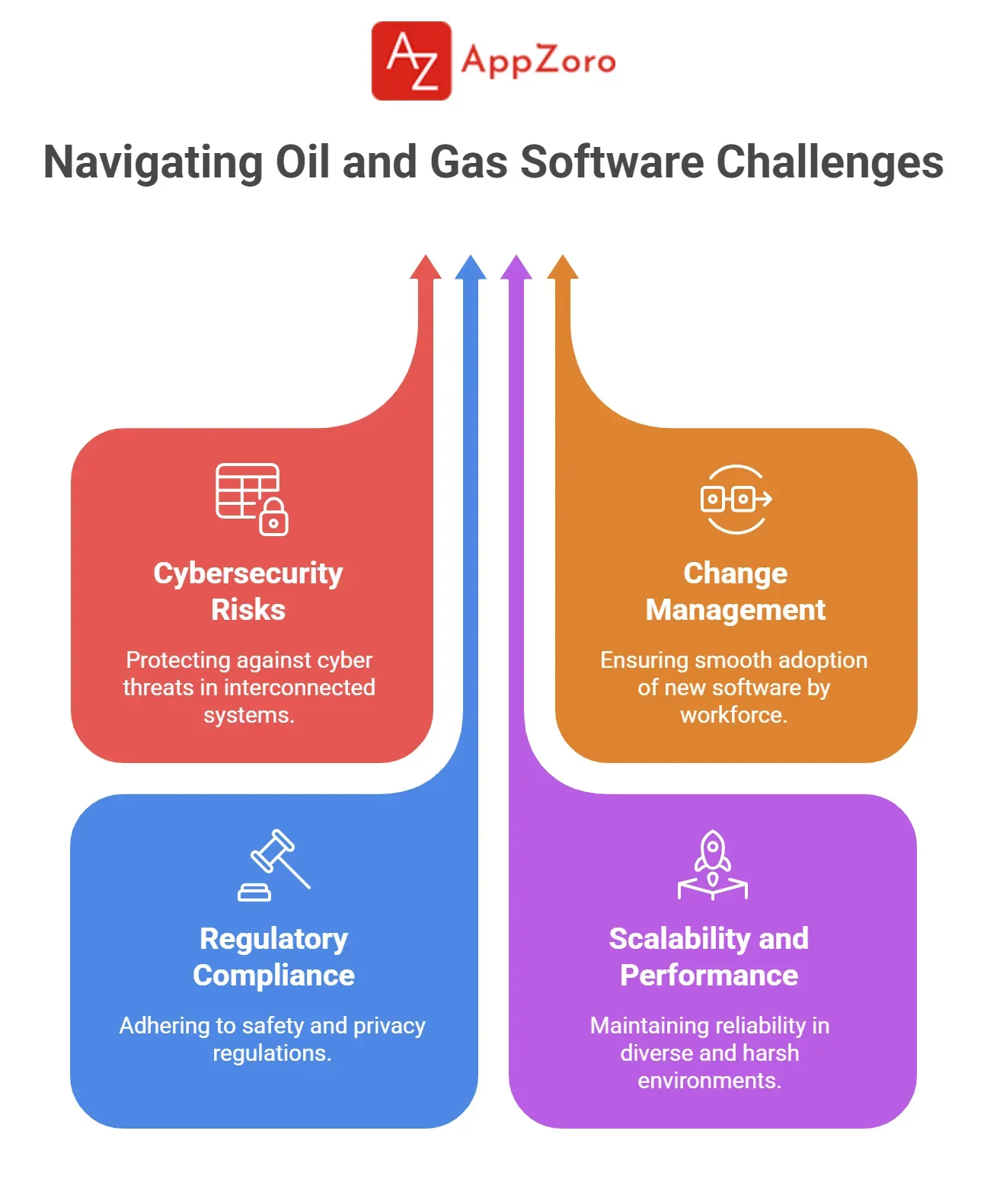
Connecting sensors, control systems, and enterprise applications opens doors to cyber threats. Security cannot be an afterthought. Role-based access, encryption, and intrusion detection protect both data and equipment.
Change Management and Workforce Adoption
New software changes how people work. Adoption is crucial. Clear training, intuitive dashboards, and phased rollouts help teams embrace the system. UI/UX design and development services play a huge role. When a refinery introduced a predictive maintenance tool, hands-on training reduced errors and sped adoption.
Regulatory Compliance and Data Privacy
Oil and gas is heavily regulated. Software must follow safety, environmental, and operational rules while keeping data private. Ignoring this can lead to fines or shutdowns. Partnering with an oil and gas software development company experienced in regulations ensures compliance from day one.
Scalability and Performance in Harsh Environments
Operations stretch across remote sites, offshore platforms, and extreme climates. Software must stay fast and reliable. Cloud systems, edge computing, and strong error handling help. Platforms must scale across multiple assets and handle large amounts of real-time data without slowing down.
Competitive Landscape: How Industry Leaders Use Software to Win
The oil and gas industry has always been competitive, but today, the race is increasingly about digital capabilities. Companies that can harness software effectively gain an edge in efficiency, safety, and profitability. Understanding how industry leaders approach this transformation provides a roadmap for others looking to modernize their operations.
Insights from Major Players
Global leaders such as SLB, Baker Hughes, AspenTech, AVEVA, and Honeywell demonstrate the power of strategic software deployment. Their initiatives share several common traits:
-
Integrated Operations: They connect upstream, midstream, and downstream data streams into unified platforms, enabling faster, more informed decisions. For example, Baker Hughes uses predictive analytics tools to monitor equipment health across multiple fields, minimizing downtime.
-
AI and Machine Learning Adoption: AI is no longer optional. SLB, for instance, leverages AI to optimize drilling performance and predict reservoir behavior. These tools reduce uncertainty, improve recovery rates, and allow for more precise planning.
-
Digital Twin Implementation: Companies like AspenTech and AVEVA use digital twins to simulate refinery and pipeline operations. These virtual models enable scenario testing without interrupting real-world processes, reducing risk and enhancing efficiency.
These players combine custom software development solutions with operational expertise to create tangible business outcomes, rather than merely deploying technology for technology's sake. Beyond established corporations, smaller software providers and AI-focused startups are shaking up the market. They often bring specialized solutions, such as predictive maintenance for aging infrastructure, advanced seismic interpretation, or AI-based safety monitoring. These companies can be highly agile, experimenting with innovations that larger firms may be slower to adopt.
For instance, an AI startup focusing on pipeline leak detection successfully partnered with a regional operator to reduce environmental incidents and maintenance costs, proving that even niche solutions can deliver outsized impact.
Why Partner with AppZoro for Oil and Gas Software Development Services
Selecting the right partner can make or break a software initiative. AppZoro has positioned itself as a trusted oil and gas software development company, offering comprehensive services that combine technical expertise with operational understanding.
Expertise in Custom, Scalable Energy Software
AppZoro focuses on delivering custom software development solutions tailored to the unique needs of oil and gas operations. Whether it's predictive maintenance, process optimization, or enterprise-wide analytics, the team builds platforms designed to scale across assets, geographies, and operational complexities.
Agile Development Approach Tailored for Complex Operations
Complex oil and gas operations benefit from iterative development, and AppZoro employs agile methodologies to ensure projects stay aligned with evolving requirements. By deploying software in phases and incorporating real-world feedback, the company minimizes risk while maximizing operational impact.
Focus on AI, Cloud, and Secure Enterprise Solutions
Artificial intelligence is at the core of modern energy operations, and AppZoro specializes in artificial intelligence software development for oil and gas. Combined with cloud computing and robust security frameworks, their solutions deliver real-time insights without compromising safety or data integrity.
Proven Ability to Integrate with Existing Oil and Gas Ecosystems
Many operators struggle to modernize without disrupting ongoing operations. AppZoro's team has experience integrating new software with legacy SCADA systems, ERP platforms, and IoT networks. This ensures that investments in digital transformation complement, rather than replace, existing infrastructure.
For enterprise decision-makers, partnering with a company that understands both technology and operations is critical. AppZoro combines technical know-how, domain expertise, and a collaborative approach to help oil and gas companies achieve measurable efficiency, safety, and profitability gains.
Conclusion
The oil and gas industry has entered an era where software is no longer an optional tool but the backbone of operational excellence. From exploration and drilling to pipeline management and refinery optimization, oil and gas software development services are driving smarter, faster, and safer decision-making. The companies that embrace these digital solutions are gaining not just incremental improvements but transformative advantages across efficiency, safety, and sustainability.
By partnering with an enterprise application development company experienced in the energy sector, firms can bridge the gap between legacy systems and next-generation platforms, turning data into actionable intelligence.
The long-term impact is clear: reduced downtime, lower operational costs, improved environmental compliance, and a workforce empowered with insights rather than overwhelmed by raw data. For companies ready to embrace this transformation, the time to act is now.
Partnering with a trusted oil and gas software development company like AppZoro ensures a tailored approach, combining deep domain knowledge, agile development, and artificial intelligence app development company expertise.