

By 2026, the global telecom software market is expected to reach 263 billion dollars, fueled by rapid 5G expansion and AI-driven automation. Yet nearly 70% of telecom enterprises still fight daily battles with legacy stacks that stall innovation, drain budgets, and limit network performance.
This gap between modern network demand and outdated infrastructure is exactly where strong telecommunication software development makes all the difference. Appzoro helps telecom companies rebuild their foundation with scalable, secure systems designed around real business outcomes, not generic templates.
In this guide, you’ll get a clear view of how the telecom ecosystem is shifting, what modern software must deliver, and where the strongest ROI appears today. You’ll also see how Appzoro approaches telecommunication software development services with a strategy that aligns engineering decisions to network performance, customer experience, and long-term operational efficiency.
We’ll break down key trends shaping software development in telecommunication, the impact of 5G, how custom enterprise software development creates competitive advantage, and what a strong implementation process looks like. You’ll also find answers to the most common questions telecom leaders ask and a simple path to request a free consultation if you want help planning your next upgrade.
The Evolving Landscape of Telecommunication Software for Modern Networks
Telecom operators sit at the center of global digital infrastructure, and the requirements placed on them have multiplied since the post-COVID surge in remote work, streaming, IoT deployments, and enterprise cloud adoption. Network traffic keeps rising. Latency expectations keep tightening. Security threats grow more complex. Customers expect instant, stable connectivity across every device they own.
This environment demands more than incremental fixes. It requires modern telecommunication software development built around automation, intelligent routing, and real-time data handling. Legacy systems can’t keep up with the velocity of authentication requests, edge computing workloads, or the bandwidth demands of 5G.
Businesses today are looking for tailored software development solutions that can handle the telecommunications sector's needs. This includes more than just implementation tool sets and tracking how much billing each customer has used; companies want orchestration ability, predictive analytics, and a custom-built solution for managing their networks; they also want an easily scalable, cloud-native architecture without any operational constraints.
Those who make the investments now in advanced software will be at the forefront of developing new models of service delivery and creating strong partnerships with other types of enterprises and maintaining service levels that consistently exceed customer expectations. To understand these modern telecommunications networks decreasing from 4G to 5G is a significant upgrade: While speed is obviously a key benefit of upgrading to 5G, it is also about completely changing the way in which data gets processed and delivered on networks. A few of the changes involved with 5G include:
-
Latency has decreased to less than one millisecond, allowing for real-time control systems, industrial IoT (Internet of Things) devices, and a mobile experience without significant lag.
-
Support for massively higher device density, essential for smart cities and enterprise IoT
-
Edge computing reducing backhaul pressure and allowing data processing closer to the device
-
Virtualized network functions replacing hardware-bound components, making networks more flexible and cost-efficient
For telecom operators, software becomes the primary driver of network intelligence, automation, and service delivery. That’s why investment in custom enterprise software development is no longer optional. It's the backbone of modern network performance.
Key Trends Shaping Telecom Software in 2026
The telecom industry is moving toward a fully programmable, data-driven architecture. Several trends are defining how software is designed, deployed, and optimized.
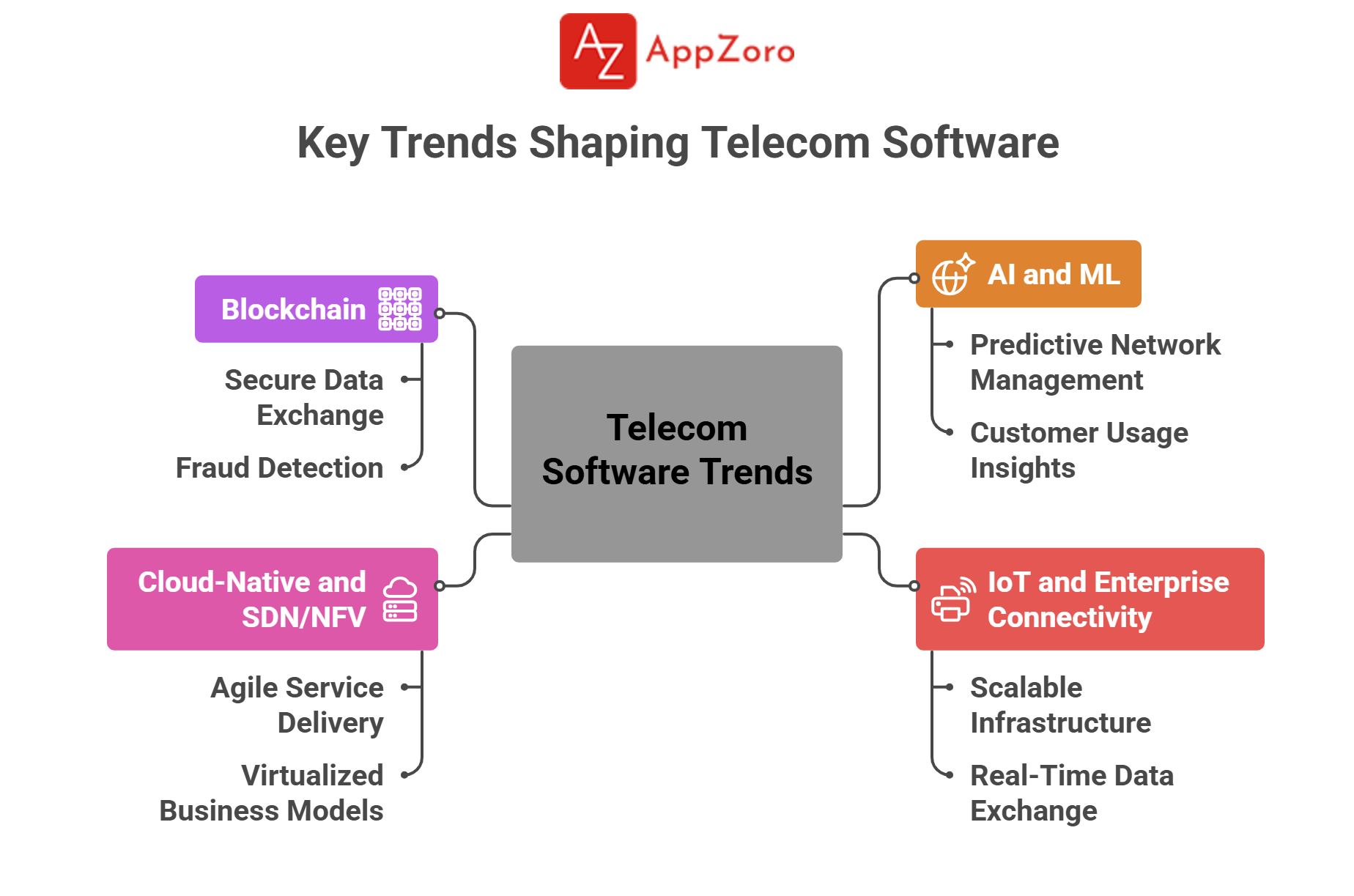
AI and ML for Predictive Network Management
To minimize service interruptions, maximize capacity utilization and predict congestion in the IP Networks, AI-assisted techniques are typically integrated into the operations of telecommunications companies. The use of AI techniques allows network operators and support teams to proactively identify and resolve issues that may arise in IP Networks prior to them escalating to the point of requiring human intervention.
The incorporation of machine learning algorithms into a carrier's software provides additional insight to staff into customer usage behaviour patterns and performance analytics. Automated responses can now trigger from machine learning algorithms which improve the overall reliability of IP Network services and therefore reduce OPEX.
IoT, High Availability and Enterprise Connectivity
Enterprises deploying multiple thousands of IoT devices require a scalable infrastructure capable of managing authentication, allocating bandwidth and enabling device-level visibility throughout the enterprise. Telecommunications Solutions built through strong software development must be highly flexible to enable multiple businesses on a shared optical network, securely provide real time data exchange between devices and provide the carrier with real time metrics.
Through customised enterprise software solutions, carriers can build IoT Management Platforms created specifically for some key verticals including Logistics, Health Care, Energy, and Manufacturing.
Cloud-Native and SDN/NFV
Although Cloud-native telecom systems may be viewed as a trend, cloud-native architecture is quickly becoming the industry standard in telecommunications. Software Defined Networks and Network Function Virtualisation offer the carrier the ability to deliver services much quicker than traditional telecom systems and run more efficiently, therefore freeing up the carrier's infrastructure to invest more into innovation than infrastructure.
Telecom Teams can now provide Service Updates without service outages, and will be capable of scaling only functions where Network Traffic dictates at any point in time and move away from traditional Hardware-based (Prison) Business Models towards more virtualised and agile Business Models driving Innovation.
Blockchain for Secure Data Exchange
As networks expand and devices multiply, secure data exchange becomes a bigger challenge. Blockchain enables tamper-resistant logs, secure identity management, and transparent transactions across distributed networks.
While still early in telecom adoption, blockchain is gaining traction for roaming settlements, fraud detection, and device authentication.
What is Custom Telecommunication Software Development?
Custom telecommunication software development focuses on building platforms, tools, and network systems that match the specific operational goals of a telecom provider. Unlike off-the-shelf products that force your teams to adapt to preset workflows, custom solutions shape the software around your infrastructure, service model, and business priorities.
Telecom operations are too complex to rely on plug-and-play tools. Network orchestration, customer management, billing, security, and device handling all have unique demands. Off-the-shelf software can handle surface-level needs, but it rarely integrates cleanly or supports long-term scalability.
Appzoro’s approach combines bespoke engineering with reusable frameworks, giving enterprises a hybrid model. You get the speed of proven modules along with tailored logic that aligns directly with your network architecture. This is where telecommunication software development services deliver meaningful ROI and long life cycles instead of temporary patches.
Core Components: OSS, BSS, and VAS Explained
Telecom software runs across multiple layers. Understanding these layers makes it clearer how strong software development in telecommunication supports growth, stability, and performance.
Operations Support Systems OSS for Network Optimization
OSS platforms handle everything happening behind the scenes. They monitor network performance, manage faults, route traffic, and ensure resources are assigned efficiently. Strong OSS design reduces downtime, improves routing, and gives teams a real-time view of network health.
Custom enterprise software built into OSS gives operators precise control over configuration, automation, and infrastructure planning, and with custom enterprise software development services, organizations can tailor these systems to meet specific operational, scalability, and integration requirements.
Business Support Systems BSS for Revenue and Customer Management
BSS systems manage the customer-facing side of the business. Billing, provisioning, product catalog, CRM, and usage tracking all fall under BSS. When these components connect smoothly with OSS, the entire operation runs with fewer errors and fewer manual interventions.
With custom software development for telecommunications industry needs, BSS platforms become more accurate, flexible, and personalized.
Value-Added Services VAS for Competitive Edge
VAS includes the services that differentiate your offerings beyond core connectivity. Mobile broadband features, entertainment bundles, IoT services, advanced analytics dashboards, and enterprise solutions are all part of this category.
Operators using custom software development solutions can launch new VAS faster and align them to user behavior and market demands. This is often where operators strengthen brand loyalty and expand revenue.

Custom vs. Off-the-Shelf: Why Enterprises Choose Tailored Solutions
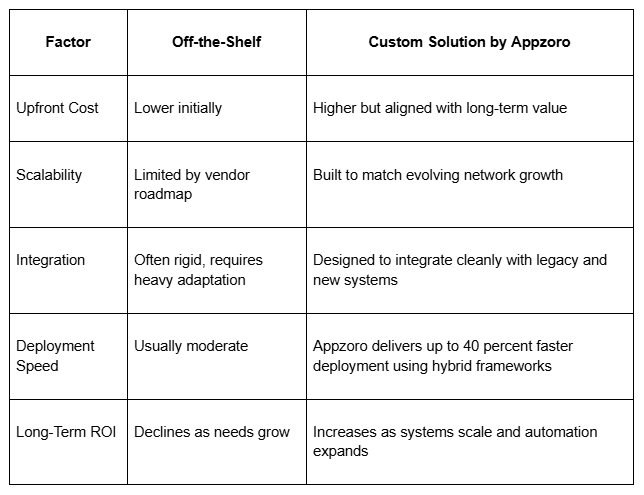
Off-the-shelf solutions seem cost-effective at first glance, but they often become expensive in the long run due to integrations, limitations, and rework. Enterprises that handle high user volume or manage diversified services eventually hit the ceiling of generic platforms.
Custom enterprise software development gives telecom operators the flexibility to scale, integrate new technologies, and shape workflows around real operational needs.
Here’s a clear comparison.
Benefits of Custom Telecom Software for Enterprises
The strongest telecom operators aren’t defined by tower access or subscriber count. They’re defined by how intelligently they run their infrastructure. That intelligence comes from advanced telecommunication software development backed by clear strategy and measurable ROI.
Below are benefits that matter to enterprise-level leaders.
Driving Operational Efficiency and Scalability
Custom systems streamline processes across network management, billing, provisioning, and security. Operators using tailored platforms often see:
-
Up to 31 percent faster time to market for new product launches
-
Major reductions in manual workloads as automation replaces repetitive tasks
-
Lower downtime due to predictive maintenance and intelligent routing
-
More accurate capacity planning and resource allocation
This level of efficiency builds a strong advantage in markets with tight margins and rising customer expectations.
Enhancing Security and Compliance in Modern Networks
Telecom networks are high-value targets. As threats evolve, security can’t rely on bolt-on tools. It has to be built into the software foundation from day one.
Mitigating Cyber Threats with Built-in Encryption
When security is embedded at the architectural level, encryption, identity management, and threat detection operate as part of the workflow rather than an add-on. Custom enterprise software development gives operators full visibility into how data moves, how endpoints behave, and where vulnerabilities may appear.
This integrated approach keeps networks stable, compliant, and more resistant to attacks that exploit outdated systems.
Boosting Revenue and Customer Experience
Revenue growth depends on how well a network serves its users. Faster response times, fewer outages, clearer billing, and more personalized services all contribute to stronger retention.
Appzoro has seen telecom clients achieve up to a 25 percent reduction in churn by deploying personalized VAS powered by custom software. When customers feel understood and supported, they stay longer and spend more.
Telecommunication software development creates the backbone for better offers, smarter analytics, and customer journeys that feel consistent across every touchpoint.
Common Challenges in Telecom Software Development and Appzoro's Solutions
Telecom operators face pressure from every direction. Data traffic grows, regulations tighten, and hybrid infrastructure becomes harder to manage. Leaders know they need stronger telecommunication software development to stay competitive, yet roadblocks often stall progress. Addressing these challenges directly is what separates high-performing networks from those that struggle to keep up.
Appzoro approaches each challenge with a mix of proven engineering patterns and tailored strategy. Instead of reacting to issues after launch, we build systems that anticipate them.
Scalability Hurdles in Hybrid Networks
Many telecom environments run on a mix of physical hardware, virtualized components, and cloud-native services. This blend creates flexibility, but it also adds operational complexity. When traffic spikes or new services roll out, legacy scaling methods break down fast.
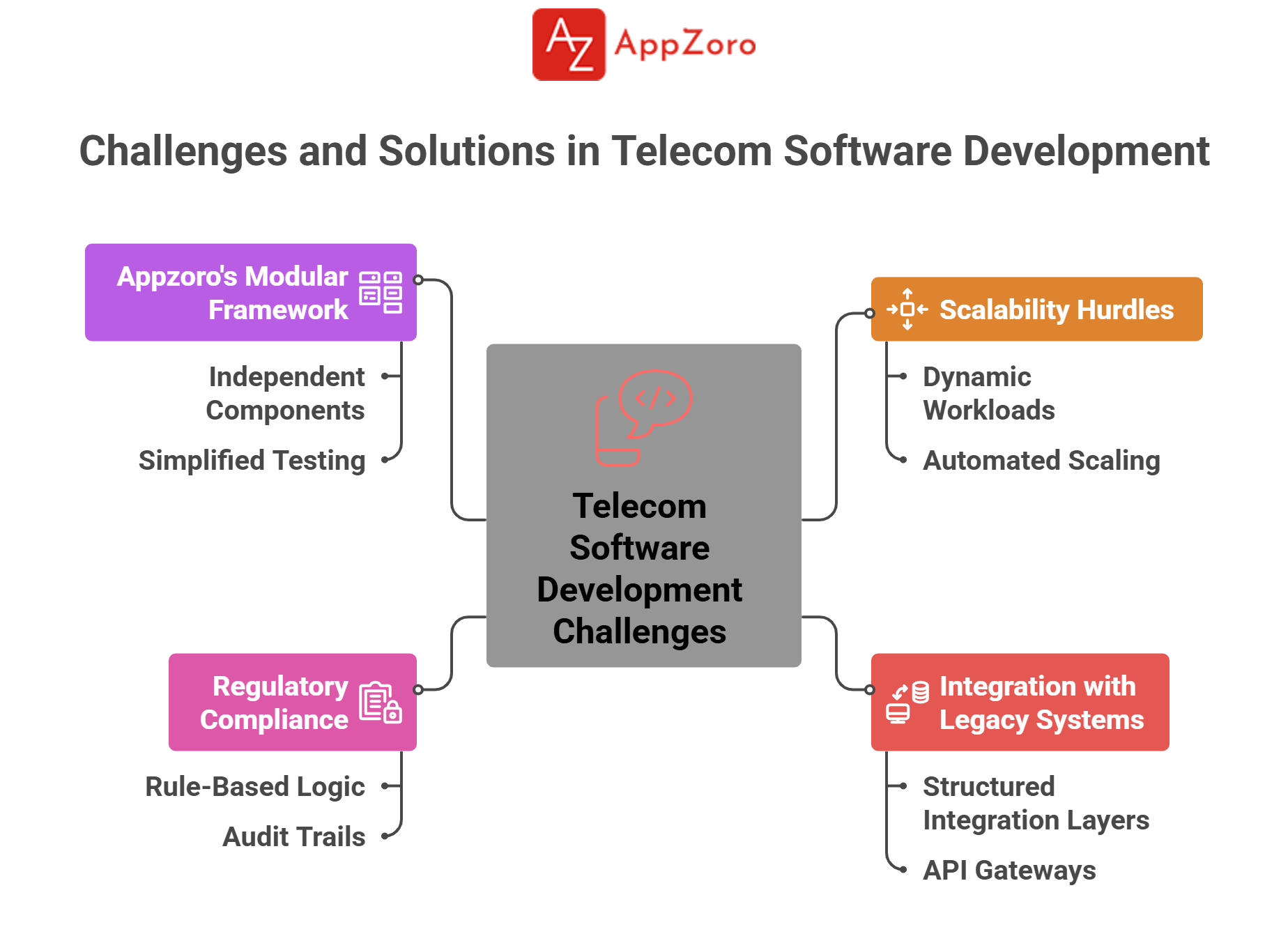
Telecommunication software development services must support dynamic workloads, automated scaling, and high resilience. Without this foundation, networks slow during peak usage, and enterprises lose revenue opportunities.
Appzoro helps clients plan for both horizontal and vertical scaling by designing architecture that adjusts itself based on real-time demand. This keeps performance consistent and predictable.
Integration with Legacy Systems
Legacy equipment is a reality for most telecom operators. Replacing everything at once is too expensive and too risky. Yet these older systems still need to communicate smoothly with new platforms, advanced VAS modules, and cloud-based functions.
Strong software development in telecommunication relies on structured integration layers, API gateways, and clean data pipelines that make old and new systems work together. Appzoro builds these layers so operators can modernize step by step, without disrupting day-to-day service.
Enterprises often share the same concern: how long will integration take. With Appzoro’s hybrid model, we reduce integration time by using reusable modules designed specifically for telecom infrastructure.
Regulatory Compliance GDPR, 5G Standards, and More
Telecom operators operate under strict expectations around privacy, data handling, and service transparency. GDPR, local cybersecurity regulations, and 5G compliance frameworks all add layers of responsibility.
Compliance cannot be something you check at the end. It has to be built into the architecture from the beginning. Appzoro embeds rule-based logic, audit trails, identity management, and automated policy enforcement directly into each system we develop. This gives enterprises confidence that expansion will not introduce new compliance risks.
How Appzoro's Modular Framework Overcomes These Challenges
Appzoro’s approach focuses on modular design. Every feature — whether tied to billing, routing, authentication, analytics, or VAS — is built as a component that can evolve independently.
This structure supports large-scale upgrades without breaking core systems. It also simplifies testing, speeds deployment, and ensures custom enterprise software stays flexible as networks grow.
The combination of modular engineering and custom software development for telecommunications industry requirements lets clients scale without fear of technical debt piling up.
The Appzoro Process: Step-by-Step Guide to Custom Telecom Software Development
Successful telecommunication software development depends on a clear, predictable process. Telecom systems cannot be built with guesswork. They require structure, transparency, and expertise across each phase.
Appzoro’s process goes deeper than the simple three-step models you often see online. Telecom operations are too complex for shallow frameworks. Below is the eight step approach we use to deliver reliable custom enterprise software development for operators worldwide.
Phase 1: Discovery and Requirement Analysis
This phase sets the direction for the entire project. We start by mapping your current infrastructure, workflow gaps, subscriber behavior, and regulatory environment. Every requirement is documented clearly, from network orchestration needs to customer touchpoints.
By the end of discovery, both teams share a unified blueprint that guides the design and development process. Accurate planning at this stage is the reason projects stay predictable and aligned.
Phase 2: Design, Prototyping, and Tech Stack Selection
Once we know the full picture, we translate it into architecture diagrams, workflow designs, user paths, and prototypes. This gives your team visibility into how the solution will function.
Tech stack selection follows shortly after. Telecom systems must be built on mature, scalable technologies that support AI-driven automation, real-time communication, and high-availability workloads.
Recommended Stacks
-
AWS or Azure for cloud environments
-
Python for AI driven analytics and network prediction models
-
Java or Go for high performance backend systems
-
Kubernetes for orchestrating distributed components
-
React or Angular for dashboards used by NOC and operations teams
This foundation helps custom software development solutions grow alongside your network.
Phase 3: Agile Development and Iterative Testing
Once the design is approved, development begins in agile sprints. Every sprint produces a functional module that goes through rigorous testing. Telecom environments demand stability, so testing focuses on load performance, security, integration behavior, and data flow accuracy.
This structure delivers two benefits. First, stakeholders can review progress often. Second, issues surface early, when they are easier and less expensive to fix.
Agile development is also ideal for telecom operators who need custom enterprise software to shift as new requirements emerge.
Phase 4: Deployment, Integration, and Ongoing Support
Deployment in telecom is never a simple push to production. Each component must work with existing systems, third party services, and user platforms. Appzoro handles rollout in controlled phases to keep your network stable at all times.
After deployment, our team remains engaged through monitoring, updates, and continuous support. Telecom operations run around the clock, so support must match that level of responsibility. Appzoro offers 24 hour monitoring and rapid response to keep your system protected from outages, vulnerabilities, or sudden traffic changes.
Custom enterprise software stays healthy over time only when it is actively maintained. This is where long term value becomes visible.
Cost Considerations and ROI for Enterprise Telecom Projects
Clear cost expectations make telecom planning far easier. Too many vendors avoid transparency or provide estimates that don’t match real implementation needs. Enterprises deserve a realistic breakdown based on scope, system complexity, integrations, and long-term maintenance requirements.
Telecommunication software development covers everything from network orchestration tools to AI driven analytics and enterprise grade billing systems. Each layer influences the final investment. Appzoro follows a structured pricing model so clients understand exactly how budget aligns with capability and scale.
Factors Influencing Development Costs
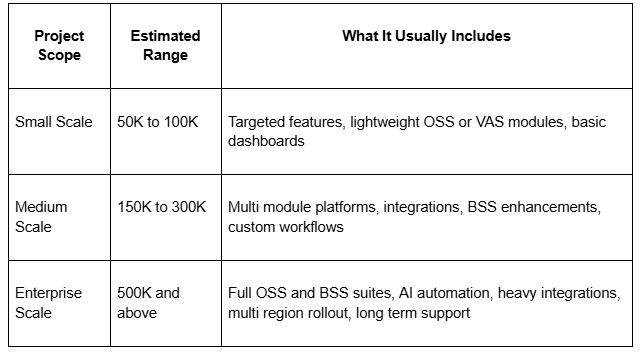
Several variables shape total investment. These include network size, feature depth, cloud or hybrid infrastructure, integration with legacy components, compliance requirements, and ongoing support.
Below is a simple view of typical project tiers.
Custom enterprise software development for telecom is a long term investment. When built properly, it pays for itself in efficiency, stability, and new revenue opportunities. You can read more about typical software development costs in our detailed guide.
Maximizing ROI: Appzoro's Proven Metrics
A strong ROI is not just possible. It is expected when systems are custom built for telecom operations.
Our clients typically see:
-
Up to 75 percent cost savings from automation replacing manual processes
-
A payback window of 12 to 18 months, depending on network scale
-
Increased uptime due to predictive maintenance
-
Higher ARPU through personalized VAS offerings
-
Stronger compliance and reduced penalties through built in policy controls
Telecommunication software development services should not be viewed as a cost center. When engineered well, they become a profit driver.
Why Partner with Appzoro for Your Telecom Software Needs
Telecom operators partner with Appzoro because they want more than engineering. They want strategic guidance from a team that understands how networks actually function. The goal is not only to build software but to strengthen operations, reduce long term costs, and support growth without technical limitations.
Appzoro combines strategic consulting with deep technical expertise, delivering custom software development solutions that align with enterprise priorities.
Appzoro's Expertise: 10+ Years in App Development for Telecom
For more than a decade, Appzoro has helped telecom providers modernize infrastructure, simplify operations, and roll out new services at scale. We have experience across 4G, 5G, IoT, and hybrid network models.
Our work spans OSS, BSS, VAS, edge computing, AI automation, and large scale integrations. Whether clients need incremental modernization or full system replacement, Appzoro designs solutions that stay reliable under heavy enterprise traffic.
Real results are the strongest way to show value. Below are two examples where our approach to telecommunication software development delivered measurable impact.
Case Study 1: 5G Network Orchestration for a Tier One Provider
A leading operator needed to improve routing efficiency as 5G traffic surged. Their legacy orchestration tools couldn’t keep pace with new device density and latency expectations.
Appzoro delivered a custom enterprise software platform that automated routing decisions, analyzed live traffic patterns, and optimized capacity allocation.
The outcome: a 40 percent gain in operational efficiency and a significant drop in congestion during peak hours.
Case Study 2: AI Powered BSS for an Enterprise IoT Rollout
A telecom company serving large industrial customers needed a billing and customer management system that could support thousands of IoT endpoints with variable usage.
Appzoro built a flexible BSS backed by predictive analytics. This system adjusted billing models, monitored device behavior, and supported new pricing structures.
The result: a 30 percent increase in revenue from enterprise clients adopting IoT services.
These examples show how software development in telecommunication can reshape both operations and revenue.
Conclusion
Telecommunication software development is the core driver of growth for modern operators. With rising demand for 5G services, expanding IoT deployments, and tougher compliance standards, the systems supporting your network must be flexible, secure, and built for scale.
Appzoro brings deep industry knowledge, strong engineering practices, and a collaborative process that keeps you involved at every step. From strategy to deployment and long term support, our goal is to help you operate confidently in a fast changing telecom landscape.
If you are planning your next upgrade or looking for a partner to modernize your infrastructure, we are ready to help.
Book your free consultation today and explore how Appzoro can support your next phase of growth.