Cross-Platform App Development Services
Built to Scale Across Devices & Industries
AppZoro builds production-grade apps in Flutter and React Native from a single shared codebase. Backed by AWS competency and SOC 2-aligned engineering, we help teams launch on iOS, Android and web together.
Trusted, Certified & Recognized Globally








TRUSTED, CERTIFIED & RECOGNIZED GLOBALLY










































What Cross-Platform App Development Means for Modern Products
From strategy to post-launch support, AppZoro brings the technical expertise, scalable architecture, and delivery experience needed to build reliable cross-platform products.
-

One Shared Codebase
Your team writes business logic, screens and state management once, then compiles it for every target platform without maintaining parallel versions of the same feature.
-

Native Rendered Output
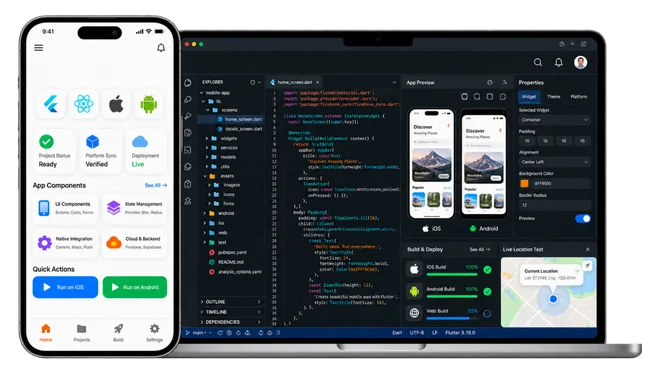
Modern frameworks compile to native widgets and native ARM binaries, so scrolling, animation and camera access behave the way the operating system expects.
-

Faster Release Cycles
A single pipeline builds, tests and ships both stores at once, which removes the lag where Android trails iOS by several sprints.
-

Lower Cost of Ownership
One engineering pod replaces two, and every bug fix lands across platforms simultaneously, which keeps long term maintenance spend genuinely predictable.
-

Consistent Brand Experience
Design tokens, components and copy stay identical across devices, so support teams stop fielding questions about features that only exist on one platform.
-

AI Ready Foundation
A unified data layer makes it far simpler to add AI search, recommendations or in app assistants without rebuilding integrations twice over.
Cross-Platform Apps Development Services from Strategy to Launch
-

Cross-Platform App Consulting
We audit your current stack, model the build against native alternatives, and give you a costed recommendation before a single line of code is written.
-

Product Design and UI Systems
Our designers build one component library that respects both Material and Human Interface guidelines, so the app feels native without splitting the design effort.
-

Flutter App Development
We use Flutter where pixel level design control and animation quality matter most, shipping compiled ARM binaries for iOS, Android, web and desktop.
-

React Native App Development
We use React Native where your team already lives in the JavaScript ecosystem, reusing existing components and hiring from a much wider talent pool.
-

Backend and API Engineering
Your app needs APIs that hold up under load, so we build the services, auth layers and data models that sit underneath the interface.
-

AI Feature Integration
We embed LLM search, recommendation engines and in app assistants into your existing product surface, using your own data rather than generic model output.


- 250+ Products Delivered
- 2X Faster release cadence once both stores ship from a single continuous integration pipeline.
- 30+ Industries Served
Our Featured Case Study
-


Challenge
The key development challenges centered on making the rental model flexible while keeping the experience practical, secure, and scalable.
Solution
The development approach translated these requirements into a scalable platform with secure onboarding, intuitive rental flows, and supporting integrations.
Impact
- 96%
- Customer Satisfaction
- 100%
- Payment Accuracy
- 2X
- Faster Operations
-


Solution
What was built, on both sides of the marketplace.
Impact
- 500+
- App Downloads
- 200+
- Total Users
- 120+
- Push Notifications
-


Challenge
Content curation, engagement, security, scalability, integration, and cross-platform delivery required careful planning to build a dependable healthcare education and networking experience.
Impact
- 95%
- Process Improvement
- 97%
- User Interaction
- 3X
- Performance Engagement
We're Proud of our Customers' Success.
-

Calls and sales are up by at least 20% now that we've launched the site.
President, Apex Textile Company Paawan Mathur  Read Paawan Mathur's review on Clutch (opens in a new tab)
-

What stands out most is their strong execution and commitment to problem-solving.
CEO, Freedom RideShare Rentals, LLC Cole Sturdevant Read Cole Sturdevant's review on Clutch (opens in a new tab) 
-

They go above and beyond to communicate direction and are responsive to feedback.
CEO, MEDcraze Carey Markey Read Carey Markey's review on Clutch (opens in a new tab) 
-

AppZoro made each project feel like it was their baby, and they seemed to care about nothing else.
Founder, VINwiki Ed Bolian Read Ed Bolian's review on Clutch (opens in a new tab) 
-

There's never been a language barrier or an issue with our difference in time zones. Their team has been really great.
VP of Operations, Judicial Innovations Mario Gonzales Read Mario Gonzales's review on Clutch (opens in a new tab) 
-

They grasped what I wanted to accomplish and helped me get there. I'll never go elsewhere for an IT provider.
Founder, Beverage Solutions Group, LLC Steve Thompson Read Steve Thompson's review on Clutch (opens in a new tab) 
-

I've been very impressed with the dedication the AppZoro Technologies, Inc. team has to our project.
Chief Strategy Officer, Jax Automotive, LLC Max Hockley Read Max Hockley's review on Clutch (opens in a new tab) 
-

In addition to superb communication, they built a very smooth app with intuitive navigation and a clean interface.
Founder, Turns Financing Services Thad Joseph Read Thad Joseph's review on Clutch (opens in a new tab) 
-

They do great work with integrity.
Director, Atlanta Tech Village Karen Houghton Read Karen Houghton's review on Clutch (opens in a new tab) 
-

AppZoro is a young company, and I've seen them grow and get better in the short time we've worked together.
CEO, CopyThat Technologies, LLC Michael Patterson Read Michael Patterson's review on Clutch (opens in a new tab) 
-

We haven't seen any weaknesses in their work.
Co-Owner, Convoy Judicial Transport LLC John Cox Read John Cox's review on Clutch (opens in a new tab) 
Cross-Platform Apps for Finance, Healthcare, Commerce and Operations

Our multi-platform mobile app development work spans regulated industries and high traffic consumer products, so the architecture decisions change with the sector. What stays constant is the engineering discipline underneath, because a payment flow and a booking flow both fail the same way under load.
[1] Fintech and Banking Apps
We build KYC onboarding, account aggregation, card controls and peer to peer transfers on a shared codebase, with encryption and audit logging handled at the data layer rather than bolted onto each screen. Compliance reviewers get one implementation to certify instead of two.
[2] Healthcare and Telemedicine Apps
Appointment booking, secure video consults, prescription management and device data sync run from one build, with HIPAA aligned storage and access controls. Clinicians and patients use different interfaces, but both sit on the same tested foundation and the same release schedule.
[3] Ecommerce and Marketplace Apps
Catalogue browsing, search, cart, checkout and post purchase tracking ship together across iOS and Android, so merchandising teams stop waiting for the second platform. We integrate directly with Shopify, commercetools or your existing order management system.
[4] On Demand and Delivery Apps
Customer, driver and admin experiences share one backend, one dispatch engine and one live tracking layer. Location updates, route changes and payment settlement stay consistent across every role, which is where most delivery products quietly break down.
[5] Travel and Hospitality Apps
Search, availability, booking, loyalty and in stay services run on cloud native infrastructure built for seasonal traffic spikes. Offline itinerary access matters here, so we cache the right data locally for travellers moving through poor connectivity.
[6] Enterprise and Workforce Apps
Field teams get scheduling, forms, approvals and offline capture on whatever devices your company already issues. Single sign on connects to your existing identity provider, and role based access keeps sensitive records out of the wrong hands.
Have an App Idea but No In-House Tech Team?
From strategy through to launch, we handle everything you need to develop cross platform mobile app products that reach real users, including architecture, design, engineering, store submission and the first release cycle.
Start Your Project Today
Core Features for Scalable Cross-Platform Mobile Apps
-
Secure Onboarding and Login
Email, phone and social sign up sit alongside biometric unlock and single sign on, so users get in quickly without weakening your account security model.
-
Real Time Sync and Offline Mode
The app keeps working when the connection drops, queuing actions locally and reconciling them cleanly once the device reconnects to your backend services.
-
Integrated Payments and Wallets
We connect Stripe, Razorpay, Apple Pay and Google Pay through one shared payment layer, so refunds and reconciliation behave identically on both platforms.
-
Push Notifications and Journeys
Segmented, event triggered messaging reaches users on iOS and Android from one campaign setup, with deep links that open the exact screen you intended.
-
AI Assistants and Smart Search
In app assistants answer questions from your own content and data, while semantic search surfaces results that keyword matching consistently misses.
-
Role Based Dashboards
Customers, operators and administrators each see a different interface built from the same component library, which keeps permissions logic in one auditable place.
-
Analytics and Event Tracking
Every meaningful action is instrumented from day one, feeding Mixpanel, Amplitude or GA4, so product decisions after launch rest on behaviour rather than opinion.
-
Localisation and Accessibility
Multi language support, right to left layouts, dynamic type and screen reader labels are built into the component library instead of retrofitted before an audit.


Cross-Platform Mobile Application Development with Modern Frameworks
Our cross platform mobile application development stack is chosen per project rather than by habit, because the right framework depends on your team, your timeline and the hardware you need to reach.
Why Choose Cross-Platform App Development?
Cross platform application development wins on economics and speed for most products, and the six reasons below are the ones finance and engineering leaders actually raise in evaluation calls.
-
Lower Build Cost
One engineering pod replaces two platform teams, which removes duplicated standups, duplicated code review and the duplicated QA cycle that follows every release.
-
Faster Time to Market
Both app stores receive builds from the same pipeline, so you stop launching on iOS in March and Android somewhere around June.
-
One Product Roadmap
Features land everywhere at once, which ends the awkward support conversations about capabilities that only half your user base can currently access.
-
Wider Market Reach
Emerging markets skew heavily toward Android while revenue often skews toward iOS, and a shared codebase lets you serve both without choosing.
-
Simpler Maintenance
A single bug fix propagates across platforms immediately, so your long term maintenance spend stays flat instead of scaling with each new operating system release.
-
Easier Team Scaling
Hiring Dart or TypeScript engineers is faster and less expensive than staffing two senior native teams, particularly for companies outside major tech hubs.
Mobile App Cross Platform Development vs Native: What Changes?
Cost and Budget
-
30–40% lower build cost
A shared codebase typically lands between 30 and 40 percent cheaper than funding two parallel native teams.
-
One team instead of two
Native builds require separate Swift and Kotlin specialists, and senior rates for both remain stubbornly high.
-
QA effort cut in half
QA effort roughly halves, since one regression suite covers the shared logic across every target platform.
-
When native pays off
Native becomes the better investment once your app depends on hardware features that no framework wraps well.
Speed to Market
-
A single release pipeline
One build pipeline pushes to both stores together, which usually removes an entire release lag of several weeks.
-
MVP live in 12–16 weeks
A cross-platform MVP commonly reaches store review in 12 to 16 weeks rather than the 20 plus native equivalent.
-
Parity without the planning
Feature parity across platforms stops being a planning exercise, because it happens automatically with every merge.
-
Where native stays ahead
Native teams can move faster on day one platform features, since framework support usually trails Apple and Google announcements.
Performance and UX
-
Native-compiled, native-feeling
Flutter and React Native compile to native code, so typical business applications feel indistinguishable to ordinary users.
-
Graphics-heavy work is the exception
Heavy 3D rendering, real time video processing and advanced camera work still favour a fully native implementation.
-
Adaptive, not one-size-fits-all
Platform conventions are respected through adaptive components rather than a single interface forced onto both systems.
-
The app size trade-off
App size tends to run slightly larger with cross-platform, which matters most in bandwidth constrained markets.
Maintenance and Scale
-
Fix once, ship everywhere
One fix ships everywhere, which keeps your defect backlog from splitting into two divergent platform queues.
-
One upgrade cycle, not two
Dependency upgrades and operating system updates are handled once per cycle rather than twice every year.
-
A deeper hiring pool
Hiring stays simpler over a five year horizon, since Dart and TypeScript talent pools are considerably deeper.
-
Control over breaking changes
Native gives you direct control when a platform ships a breaking change, without waiting on framework maintainers.
Security Standards for Cross-Platform Mobile Apps Development
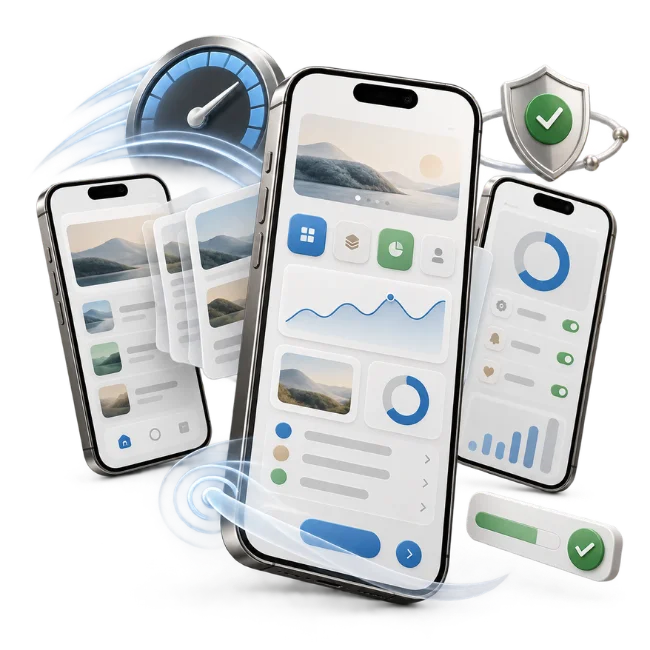
Security in cross-platform mobile apps development carries one advantage that gets overlooked, because a single shared implementation means one place to review, one place to patch and one place to certify. The risk shifts instead to third party packages, which is where most mobile vulnerabilities in shipped applications originate today.
So we treat the dependency tree as part of the codebase. Every package gets version pinned and scanned, secrets stay out of the client bundle, and our QA suite runs automated regression, device farm and penetration testing before any build reaches a store review queue.
-
Secure Code and Dependency Review
Static analysis runs on every pull request, and third party packages are pinned, scanned and replaced whenever a maintainer stops shipping security patches.
-
Automated Test Coverage
Unit, widget and end to end suites run on real device farms across a matrix of operating system versions, screen sizes and network conditions.
-
Compliance Readiness
We build toward GDPR, HIPAA, PCI DSS and SOC 2 requirements from the architecture stage, so audit preparation isn't a scramble months later.
-
Continuous Monitoring
Crash reporting, performance tracing and anomaly alerts run in production, and we agree the response times for each severity level before launch.


How We Work
A Proven Cross-Platform App Development Process from Discovery to Release
A structured cross platform app development process keeps strategy, design, engineering, testing, and optimization aligned from the first idea through post-launch growth.
Why Choose AppZoro for Cross-Platform Mobile Application Development
From strategy to post-launch support, AppZoro brings the technical expertise, scalable architecture, and delivery experience needed to build reliable cross-platform products.
 Let's Build Your App
-
10+ Years of Shipped Products
We've been building mobile products since 2016, across market cycles, framework generations and several complete rewrites of how mobile applications get delivered.
-
Senior Only Engineering Pods
Your project gets engineers who have shipped to production before, not a senior architect on the sales call and juniors on the codebase.
-
AWS Competency and Security Depth
Advanced Tier Services status plus Security and Cloud Operations competencies mean our infrastructure decisions have been reviewed by somebody other than us.
-
Design and AI Under One Roof
Product design, mobile engineering and applied AI sit in the same team, so features don't get lost in handoffs between three separate vendors.
-
Transparent Sprint Reporting
You see the board, the burndown and a working build every two weeks, which makes scope conversations factual rather than uncomfortable.
-
Your Code and IP Stay Yours
Repositories, infrastructure and intellectual property transfer to you contractually from day one, so you're never locked into us by access alone.
Post-Launch Support for Cross-Platform Products
-

Essential Care
Keeps a shipped app healthy, compliant and available, which suits products in a stable phase where the roadmap has deliberately slowed down.
- Operating system and framework compatibility updates
- Crash monitoring with agreed response times
- Security patching and dependency upgrades
- Quarterly performance and health reporting
-

Growth Retainer
A fixed block of engineering hours every month, aimed at teams shipping steady improvements against conversion, retention or activation targets after launch.
- Everything included in Essential Care
- Monthly feature development sprints
- Conversion and funnel experimentation
- App store optimisation and release management
-

Dedicated Product Pod
A full embedded team of engineers, designers and QA working only on your product, for companies treating mobile as a core revenue channel.
- Named engineers, designers and QA specialists
- Dedicated technical lead and sprint cadence
- Roadmap planning and architecture ownership
- Direct access through your own communication channels
Turning Your Questions into Confidence
What is cross-platform app development?
Cross-platform app development is the process of building applications from a shared codebase that can run across multiple platforms such as iOS, Android, web, and desktop while maintaining a consistent user experience.
What are the main benefits of cross-platform app development?
Cross-platform app development can reduce development time, simplify maintenance, improve feature consistency, and help businesses launch across multiple platforms without maintaining separate codebases for each operating system.
Which technologies are used for cross-platform app development?
Common technologies used for cross-platform app development include Flutter, React Native, Kotlin Multiplatform, .NET MAUI, Ionic, and Expo. The right framework depends on the app’s features, performance requirements, integrations, and long-term roadmap.
How much does cross-platform app development cost?
The cost of cross-platform app development depends on the app’s complexity, number of features, UI requirements, backend integrations, security needs, and platform coverage. A detailed estimate is usually prepared after reviewing the project scope.
How long does it take to develop a cross platform mobile app?
The timeline varies based on the size and complexity of the product. A typical cross-platform app development project may include discovery, UX/UI design, development, integrations, testing, deployment, and post-launch optimization.
Is cross-platform app development suitable for both iOS and Android?
Yes, cross-platform app development is commonly used to build applications for both iOS and Android from a shared codebase while still supporting platform-specific functionality where required.
Can an existing native app be migrated to cross-platform app development?
Yes, existing Swift or Kotlin applications can be migrated to a cross-platform app development framework in phases. The migration approach depends on the current architecture, feature complexity, integrations, and business requirements.
Why choose AppZoro for cross-platform app development services?
AppZoro provides cross-platform app development services covering product strategy, UX/UI design, frontend and backend engineering, cloud integration, testing, app store deployment, and post-launch support for scalable digital products.
Partner with a team that has been shipping software from Atlanta since 2016.
Book your free consultation with a technical lead, not a salesperson.