
In the current business environment, artificial intelligence (AI) and machine learning (ML) have moved from experimental to mission-critical technologies. As time pushes us deeper into 2025, the differentiator is not if the company will use AI, but how it will define AI and who it will partner with to build AI systems that are scalable, secure and efficient.
Whether you are deploying predictive models, conversational language interfaces or building distributable generative applications that produce text, code, or visual media, finding the right [ai/ml development company ](https://appzoro.com/services/ai-and-ml-development-company-usa) is essential for success. This guide will give you a good understanding of what to consider when selecting a technology partner and how to assess their capability to deliver on each of the technical, operational, and strategic dimensions.
## Why Selecting the Right AI/ML Development Company is Important?
Developing an AI application is not just building a traditional application; building an AI application is entirely different and has its challenges. AI applications differ from deterministic applications, where systems are programmed to follow a prescribed path. In contrast, AI systems are taught to learn autonomously based on data and adapt over time, yielding probabilistic outcomes. In particular, for AI/ML, an underqualified partner can deploy an overfit model with bias due to poor data best practices and an inability to optimize for production-grade inference. This creates complexities in the design, training, deployment, and post-deployment phases.
The right AI/ML development services can help navigate this complexity, ensuring:
Robust model training and evaluation
Ethical and compliant data handling
Seamless integration into existing tech stacks
Scalable infrastructure for deployment
Continuous improvement through model retraining and monitoring
## Core Competencies of Modern AI/ML Development Services
### End-to-End AI/ML System Design
The best AI/ML development services in 2025 can demonstrate expertise across the entire machine-learning lifecycle, from the ingestion and pre-processing of data through to deployment and monitoring. This will further involve architecting scalable data systems for both structured and unstructured data, automating the individual processes within ML workflows—using orchestration tools such as Airflow, Kubeflow, or MLflow—and managing a complete model registry using apps like Weights & Biases or SageMaker. They should integrate MLOps principles like CI/CD for models, experiment tracking, reproducibility and model lineage into all factors of their processes.
### Generative AI Development Knowledge
One aspect of AI/ML development services that has become far more important is the ability to create generative models. With the rapid growth of content-producing applications, any development partner—or [generative ai app development company](https://appzoro.com/services/ai-app-development-company)—must be capable of building, fine-tuning, and deploying generative models at scale. This includes fine-tuning large language models such as GPT-4o or LLaMA 3, implementing diffusion models for media generation, and applying techniques like quantization or model distillation to improve inference efficiency. In addition, robust safeguards should be embedded into these systems, including content filters, output validation layers, and reinforcement learning from human feedback, to reduce hallucinations and ensure reliable performance in production environments.
### Model Training at Scale
If your development partner must demonstrate strong capabilities in training models against large, high velocity datasets in support of enterprise AI workloads. The successful training of large models goes beyond simply un-leveraging cloud accelerators such as AWS GPU instances or Google TPU pods to optimize resource utilization. Your development partner should also support distributed model training using frameworks such as Horovod or TensorFlow MultiWorker strategies. These frameworks make it possible to get better resource utilization when running simultaneous data ingest and processing pipelines, as well as better model training. Your development partner should also be capable of building workflows for automated hyperparameter optimization using frameworks such as Optuna or Ray Tune to tune models automatically during the training process. Furthermore, your development partner should provide capabilities to mitigate data drift (i.e. changes in statistical properties of your training data), a model ‘retrain’ schedule to retrain models on regular intervals, and they should also provide a basis for incremental learning to take into account new observations.
### Data Collection and Curation
Good AI/ML development services will always make data quality a first class consideration when building AI/ML solutions. Your development partner should be capable of sourcing training data in an ethical manner that respects copyright and user consent purchasing data ethically and making sure that the training datasets have balance, diversity and representativeness. Your development partner should also provide automated data labeling in their solutions (either through people or automation methodology using active learning or semi-supervised labeling). They should also consider building validation pipelines for outlier detection, deduplication, and failure of schema enforcement (validation) of the data sourced. The ability of your partner to collect and curate training datasets will directly impact the performance and fairness of your AI models.
### Robust Model Validation
Good model validation practice is a differentiator for mature AI/ML development services. Leading AI/ML development service providers tend to go beyond evaluating the accuracy of a trained model(s) and will validate their models using task appropriate metrics (i.e. F1-score, ROC-AUC, BLEU, perplexity, etc). They vary in their approach to validating generalizability and often have extra steps to verify complete endpoints of models in each stage of development which gives insight on model robustness. They run cross-validation on stratified data sets and real-world edge case or adversarial inputs to stress-test the robustness of your model. It is good to confirm generalization performance across multiple user environments to confirm that your AI system will safely extend beyond your in-house development environment.
### Explainability and Responsible AI
In 2025, being explainable will be required, especially in finance, healthcare, or any type of regulated industry. Even reputable AI/ML development service companies incorporate explainable AI abstraction in their architecture (e.g. through the use of SHAP, LIME, Captum) to increase trust in the model’s predictions. They should visibly conduct fairness audits to identify all algorithmic biases and correct them, but also abide by the various global regulations (like GDPR, HIPAA, ISO/IEC 42001). It is important they can also create override functions and ensure human accountability when you need it in a critical application.
### Infrastructure Set-Up & Production Home-Ready
When selecting a reputable and reliable service for AI/ML development, deployment and integration capabilities are a crucial consideration. They should understand API-first development and be able to plan for multiple API forms, such as RESTful, GraphQL, or gRPC, to access your model one main modality at a time. They should also be capable of giving a way to deploy inference engines on an edge device or other options using ONNX, CoreML, or TensorRT depending on the latency or offline needs of your solution.For scalability and maintainability, look for containerized environments using Docker and Kubernetes, along with automated CI/CD pipelines that support version control, rollback strategies, and A/B testing of model iterations.
## Budgeting, Timelines, and Strategic Questions to Evaluate AI/ML Development Services
When working with advanced AI/ML development services, it’s crucial to understand where major costs accumulate. One of the primary cost centers is data preparation especially if your use case requires extensive labeling or cleaning of datasets. Poor data equals poor models; as such the data must be first and prioritized with enough resource allocation.
Another very important consideration in the machine learning lifecycle is compute infrastructure. Training deep learning models will use a GPU or TPU with a high enough performance threshold affordable in a cloud compute model and can add considerable cost to cloud compute expenditures (often running into tens of thousands for complex workloads).
Moreover, there are ongoing costs related to post-deployment monitoring and observability. Enterprise grade systems will generally use tools such as Evidently AI, Arize or Fiddler to monitor ongoing model drift and latency/performance degradation in real-time. These tools are indispensable for both production readiness and production longevity, but the business will have to commit dedicated engineering and operations expenditure to their use.
### Project Timelines Across AI/ML Lifecycle
AI/ML projects are best approached in iterative phases, where each stage builds foundational elements for the next. Here’s a general breakdown of typical timelines when engaging AI/ML development services:
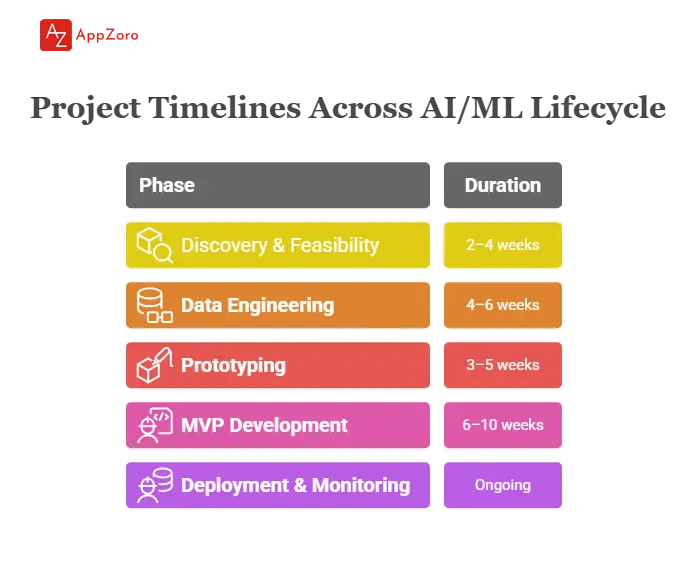
Note that timeframes may vary depending on the complexity of the problem domain, model requirements, and infrastructure constraints. Leading AI/ML development services will always include mechanisms for continuous learning and model updates beyond initial deployment, ensuring long-term performance and business alignment.
## Critical Questions to Ask Before Finalizing Your AI/ML Partner
Before you make a vendor selection, ask the following technical and strategic questions to assess that vendor’s practical capability and ability to meet your business objectives:
### What model architectures have you deployed in production?
Find out whether they have worked with architectures that are relevant to your domain, such as transformer-based LLMs (large language models), convolutional neural networks (CNNs) for vision tasks, GANs (general adversarial networks) for generative tasks, or hybrid ensemble methods. Ask for production-level deployment case studies, not just prototypes.
### How do you monitor and manage data drift and concept drift, over time?
All AI models undergo a decay process as they are exposed to live real-world data that may be evolving. Look for partners that have established real-time monitoring pipelines, as well as active learning processes, to identify and manage drift in data, and to implement corrective actions. Following data drift and concept drift includes alert systems, retraining, and data versioning procedures.
### What frameworks and infrastructure do you support for MLOps (Machine Learning Operations)?
Any modern AI/ML development services should include a robust approach to MLOps. Ask about their experience with operational tools–for example MLflow for tracking experiments, SageMaker Pipelines or Kubeflow for workflow orchestration, and Prefect for data engineering automation. Ensure that their development stack is compatible with your cloud space and compliance process.
### Do you provide post-deployment support and retraining services?
AI is not a one-time setup. Be sure to confirm the vendor includes continual support, (e.g. retraining schedules, bug fixes, model rollback procedures, monitoring dashboards): look for lifecycle support beyond the MVP stage.
### How do you think about model interpretability, especially in regulated domains?
For the industries concerned with regulation (Healthcare, Finance, insurance) explainability is required. Be sure they have assurances that they are employing formal methods (e.g. SHAP, LIME, or counter-factual analysis) to ensure their AI decisions are understood by stakeholders, regulators, or non-specialist users.
## Common Mistakes to Avoid When Selecting AI/ML Development Services in 2025
Despite the maturity of the AI ecosystem in 2025, many organizations still fall into the same traps when selecting AI/ML development services. The most common of these is the mistaken belief that out-of-the-box AI platforms (e.g. ChatGPT, GitHub Copilot, or Hugging Face models) can be expected, on their own, to achieve production outcomes in enterprise scale. While they are capable of incredibly powerful things, and indeed demonstrate astonishing human-like behavior, there is no guarantee that they can meet your specifications, as they require task-specific customization, fine-tuning, and domain adaptation. Without these, performance will degrade, hallucinated outputs may arise, and outcomes may be misaligned with business objectives.
Another classic mistake is not architecting for infrastructure scale from the beginning. High performing AI systems need well trained models, but they also need a resilient infrastructure that offers real-time inference capabilities, high throughput, and secure data access. If your selected AI/ML development service does not engage compute planning, edge deployment limitations, storage capacity, or latency sensitive architecture, your models will crash under production load, or provide sub-optimal user experiences.
Perhaps the biggest mistake is that AI efforts do not tie to business purpose. No matter how sophisticated, if the efforts do not focus on measurable business goals—reduction in churn, better conversions, operational cost savings, etc.—they won’t provide meaningful ROI. A trustworthy provider would start any engagement by defining success as measured by metrics, outcomes, and key performance indicators (KPIs) and tying the development of AI models back to it.
Finally, be careful of vendors that promise immediate success using pre-trained models, but lack a full lifecycle in AI from data preparation to fine-tuning, benchmarking, retraining, and monitoring. Successful adoption of AI in the enterprise takes time and cannot be shortcut.
## Strategic Trends to Future-Proof Your AI Investment in 2025
In 2025, AI/ML development services are already infusing their roadmaps with several transformative technologies. One of the most important to consider is multimodal AI, which allows models to process and generate multiple modalities of data (e.g., text, images, audio, and video) simultaneously. This enables chatty applications and assistants that can “see” images, “hear” audio, and “respond” intelligently—all enabled by unified, multimodal architectures like GPT-4o, Gemini, or LLaVA.
Synthetic data generation is another initiative that will continue to grow. Many industries are still limited by access to real world data (such as healthcare, defense, or finance). Generative AI models can now create high fidelity, privacy-compliant datasets that can help augment model training and effectively eliminate much of the friction of working with data in highly regulated industries. Providers with expertise in synthetic data can help customers i as a bootstrap stage to get ML solutions off the ground, even when labeled data is limited and/or inaccessible.
Federated learning is also gaining visibility as a form of privacy-preserving AI. Federated learning enables models to be trained across distributed environments (e.g., hospitals, IoT or edge devices, financial institutions) without centralizing the data set. As a result, the risks inherent in compliance and potential sanctions are mitigated, and the security of the data is improved, while enabling a form of collaborative learning from organizations in siloed, legacy market structures.
In the future for information retrieval and semantic search, it seems likely that more organizations will embrace neural search engines that use vector databases, such as Pinecone, We aviate, or FAISS. These approaches provide support for functions, including retrieval-augmented generation (RAG), intelligent document understanding, and personalized recommendations, by supporting the use of embeddings to surface semantically relevant results, rather than exact keyword matches.
## Concluding Remarks
The decision to choose your AI/ML development services is no longer a purely technical one; it is also a strategic decision that will affect your organization’s digital capabilities in the long term. The best partners are those who can combine their depth of machine learning knowledge with their appreciation for your industry, regulatory considerations, and actual business realities. They place equal emphasis on model accuracy, scalability, ethical standards, and measurable impact.
At [AppZoro](https://appzoro.com), we specialize in delivering full-spectrum AI solutions—from fine-tuned LLMs to multimodal systems and scalable MLOps pipelines. We partner with organizations to build solutions that are secure, explainable, and engineered for ROI. With a strong focus on research-backed AI/ML development services and enterprise-grade deployment, we help future-proof your AI investments and transform ideas into intelligent products.
Let’s build something great together.
**Also Read :** [How Do AI ML Development Services Revolutionize the Healthcare Industry
](https://appzoro.com/blog/how-do-ai-ml-development-services-revolutionize-the-healthcare-industry)