
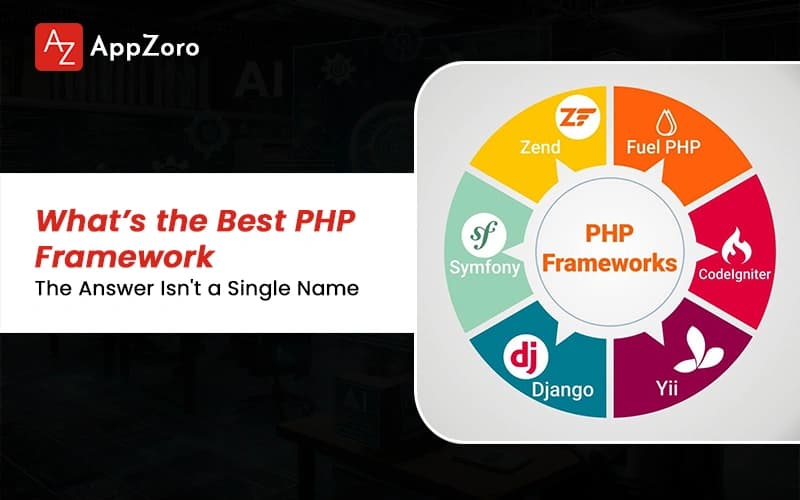
Quick Answer: The best PHP framework in 2026 is Laravel for most teams, because it balances developer speed with the deepest ecosystem in the language. However, if your project requires a high-performance handheld extension, you should partner with a mobile app development company USA to ensure your backend API scales seamlessly. Symfony remains the stronger pick for large enterprise systems, while CodeIgniter wins when you want something lightweight and fast for your specific application.
Ask ten developers for the best PHP framework and you will get "Laravel" said ten times, often before you finish the question. They are not wrong, exactly. Laravel really is the safe default for most teams in 2026. But "most teams" is doing a lot of quiet work in that sentence and if you are not most teams, the popular answer can cost you months.
Here is what the listicles skip. The best PHP framework is not a trophy; it is a fit. A two-person startup chasing a launch, a bank with a ten-year system and a solo developer learning the ropes should not all reach for the same tool, even though the internet keeps insisting they should.
So instead of crowning a single winner, let us match the framework to the job. Here is the honest version.
What "Best PHP Framework" Even Means in 2026
The phrase best PHP framework hides a trap, because it assumes one tool wins every situation. None does. What changed over the last few years is that the gap between the top frameworks narrowed, PHP itself got fast and modern with versions 8.2 through 8.4 and the real differences are now about ecosystem, structure and how your team likes to work.
The field really comes down to a few clear lanes:
Laravel for speed and ecosystem, the default for startups and SaaS, with tooling that turns weeks of plumbing into an afternoon.
Symfony for enterprise scale, with 50-plus reusable components and the long-term support a ten-year system genuinely needs.
CodeIgniter and Slim for lightweight builds, where you want raw speed and a small footprint instead of a giant toolbox.
There Is No Universal Best and That Is Fine
The uncomfortable truth is that the best PHP framework for a SaaS startup is rarely the best one for a bank or a beginner. Laravel saves a small team weeks, Symfony's structure pays off across a decade of maintenance and CodeIgniter's simplicity wins on a tiny project. Choosing well just means being honest about which of those you actually are.
What Actually Changed in PHP by 2026
PHP spent years as the language people loved to mock and that reputation is now badly out of date. Versions 8.2 through 8.4 brought real speed and proper types, often serving as the perfect foundation for a cloud based app development guide where elastic scaling and serverless functions take center stage. Your choice is now about fit and ecosystem, not about escaping a slow language, as modern frameworks feel current rather than legacy.
The Best PHP Frameworks, Compared
The typical best PHP frameworks list ranks the same names in a slightly different order and calls it a day. The ranking matters less than the fit, so here is how the main options actually compare on the things that decide a project:
Framework | Best For | Strength | PHP Version | Watch Out For |
Laravel | Startups, SaaS, most apps | Ecosystem and speed | 8.2+ | Can feel heavy for tiny tools |
Symfony | Enterprise, long-lived systems | Structure and LTS | 8.4+ | Steeper learning curve |
CodeIgniter | Lightweight, fast projects | Simplicity and speed | 8.1+ | Smaller ecosystem |
Slim | APIs and microservices | Minimal footprint | 8.1+ | You build a lot yourself |
If you scanned that and your eye landed on Laravel, you are in good company, since it fits the widest range of projects. But the right framework for your specific case might be the boring lightweight one, especially if your app is small or your team is tiny.
Why Laravel Is the Default and When It Is Not
Laravel earns its popularity honestly, with Livewire, Inertia, Filament and a tooling ecosystem that removes most of the busywork. For a startup racing to launch, that head start is worth a great deal and the huge community means answers are a search away. The catch is weight, so for a tiny API or a micro-tool, Laravel can feel like renting a warehouse to store a bike.
Picking the Best Framework of PHP for Your Situation
The smartest way to choose the best framework is to start from your project, not from a popularity chart. Whether you are building an MVP or an enterprise system, consulting a custom mobile app development guide can help you align your backend technology with your specific product maturity stage. Match the tool to the situation and the whole framework debate mostly answers itself once you understand the integration footprint required.
A few common situations point to clear answers, even when the internet insists on just one:
Learning the language or shipping your first real app, where good docs and a gentle path matter more than raw power.
Building a small, fast tool or an API, where a heavy framework is overkill and a light one ships sooner.
Running an enterprise system for years, where structure, testing and long-term support beat short-term speed every time.
The Best PHP Framework for Beginners
The best PHP framework for beginners is usually Laravel, which sounds backwards until you see its documentation and the free Laracasts library behind it. Yes, it is large but the learning path is gentle and the community answers almost any question you can think to ask. If you want something even simpler to start with, CodeIgniter strips the concepts back to the essentials.
The Best Lightweight PHP Framework
When you want the best lightweight PHP framework, the answer shifts to CodeIgniter or Slim, which keep the footprint small and the speed high. Reviewing a detailed mobile app development cost breakdown associated with these lighter choices can help small teams allocate more budget toward frontend polish and marketing, trading a large ecosystem for better control and immediate performance wins on a focused project.
The Front-End Question: Best Front-End Framework for PHP
People keep asking for the best front-end framework for PHP, which is a slightly tangled question, because PHP itself is a backend language. Inside Laravel, the real choice is Livewire versus Inertia, the two first-party ways to build a UI without leaving the ecosystem.
One keeps you in PHP, the other hands the front end to Vue or React and both are production-ready in 2026.
The honest way to settle the front-end question is to look at how interactive your app needs to be:
Livewire keeps everything in PHP and Blade, which is ideal for admin panels, forms and CRUD-heavy apps and it now sees wider adoption.
Inertia hands the UI to Vue or React while Laravel handles the routing, which suits complex, highly interactive front ends.
Plain Blade with a sprinkle of JavaScript is still fine for simple, mostly static pages that do not need much reactivity at all.
Livewire or Inertia, in Plain Terms
If your team thinks in PHP and your screens are mostly forms and tables, Livewire is the calmer choice and its 62 percent adoption in the Laravel community reflects that. If you need rich, app-like interfaces or your team already knows React, Inertia gives you that power while keeping Laravel underneath. Neither is wrong. They just suit different apps and different teams.
Where AI and Tooling Fit Now
The newest shift is not a framework at all; it is the tooling and AI wrapped around it. Laravel's starter kits and AI coding assistants now scaffold in minutes what used to take days of fiddly setup. Learning how to use AI in mobile app development can further accelerate this process, allowing a small team to punch well above its weight by using automated scaffolding for both their web dashboards and their mobile API endpoints simultaneously.
If you are choosing a real project, not just curious, picking the best PHP framework on a deadline is far easier with a second opinion from people who have shipped in both Laravel and Symfony. Our senior team is glad to talk through your project and the trade-offs and we would rather help you choose right than watch a popular pick turn into an expensive rewrite.
Final Thoughts
The best PHP framework in 2026 is whichever one disappears into the background and lets you ship the thing you actually care about. For most teams, that is Laravel and choosing it is rarely a mistake. But "most teams" is not everyone and the right call still depends on your project, your people and your timeline.
The developers who regret their choice were usually lured by hype and grabbed the loudest name instead of the right fit. Many successful teams find that adopting a robust agile methodology allows them to pivot their tech choices or refine their backend architecture as the project scales. Start from what you are building, be honest about your team, and the framework follows from there to ensure you ship the thing you actually care about.
If you are torn between two solid options, that is normal and it often means either one would work. Talk it through with someone who has shipped real apps in more than one of them and the fog usually clears fast.
Leave a Comment