
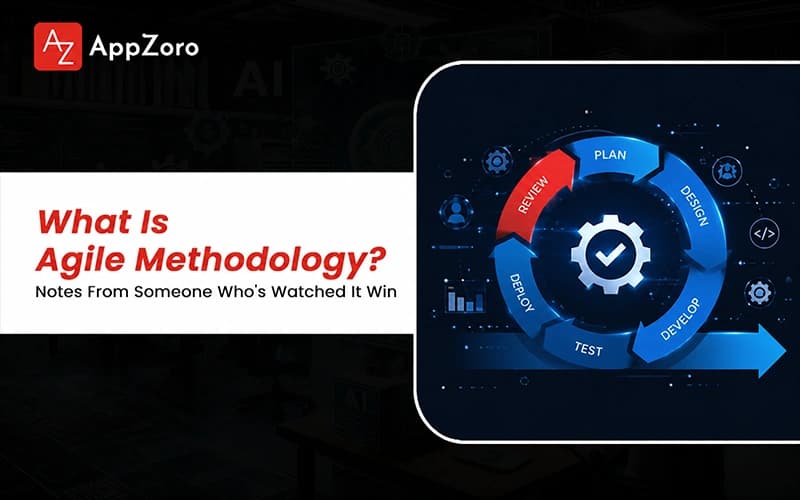
Quick Answer: What is agile methodology in plain terms is a family of software approaches built on the 2001 Agile Manifesto's four values and twelve principles, emphasizing working software and customer collaboration. When building complex products, many businesses partner with a leading mobile app development company USA that truly understands these principles to ensure they respond to change effectively. Modern 2026 practice includes Scrum, Kanban, XP, and Lean, allowing teams to pick practices selectively based on operational reality rather than adopting any framework wholesale.
A VP of Engineering I work with sat through her team's daily standup last Tuesday, the one that ran 47 minutes and concluded with no clear decisions on the two blockers flagged the previous Thursday. The standup had been on her calendar for two years, yet the team was shipping noticeably slower than before they hired an agile coach. This confusion often happens when the mobile app development process isn't properly aligned with the team's internal workflows, leaving leaders to wonder what the methodology is actually supposed to look like at this point.
"I think we're agile?" she texted me afterwards, with the kind of question mark even Slack does not render properly. The standup had been on her calendar for two years, the sprint board was meticulously maintained and yet the team was shipping noticeably slower than during the "we'll figure it out" months before they hired an agile coach. What is agile methodology supposed to look like at this point and where did the actual practice drift from the simple posture the seventeen signatories described in 2001?
That question is the version of what is agile methodology most leaders never discuss openly, because the consulting industry built around it has strong incentives to defend whatever framework they sold last quarter. The teams benefiting from what is agile methodology in 2026 read the original 2001 Manifesto and picked the practices that fit their work; the teams losing follow someone else's template.
What follows is the conversation an experienced engineering leader would have with another over coffee rather than the polished slide deck a consulting firm delivers. By the end you will know what is agile methodology in honest practice, where it works, where it quietly breaks and how senior teams adopt it without losing themselves to ceremony.
What Is Agile Methodology? According to the 2001 Manifesto Itself
If you want to get an answer to what agile methodology is without consulting overlay, start with the 2001 Agile Manifesto signed by seventeen practitioners (Kent Beck, Martin Fowler, Ken Schwaber, Jeff Sutherland and others) at Snowbird, Utah. The document is four sentences long and lists twelve principles shorter than the SAFe handbook most enterprise transformations require.
The four values describe a posture rather than a process. The signatories valued individuals and interactions over processes and tools, working software over comprehensive documentation, customer collaboration over contract negotiation and responding to change over following a plan. Notably they wrote "while there is value in the items on the right, we value the items on the left more" the nuance most modern implementations drop.
Here is what defines agile when teams actually read the source material:
Working software over documentation that nobody reads after the project ships
Short feedback loops between people doing the work and people receiving it
Team autonomy and craft over the elaborate ceremonies consultants built into enterprise frameworks
Why the Original Manifesto Matters More Than Modern Implementations
The original manifesto matters more than modern implementations because the signatories were practitioners describing what worked, not consultants building a methodology to sell. Several signatories (Dave Thomas, Ron Jeffries) have publicly distanced themselves from what "agile" became, the credibility signal teams reading the source catch immediately.
What the Twelve Principles Genuinely Demand
The twelve principles demand customer satisfaction through continuous delivery, welcoming changing requirements, working software frequently, business and developer collaboration, motivated individuals trusted to do the work, face-to-face conversation, sustainable pace, technical excellence, simplicity, self-organising teams and regular reflection. Most enterprise "agile" violates at least seven.
Why "Agile" Became Synonymous With Scrum
Asking what is agile methodology in 2026 often returns scrum-flavoured answers because the Certified ScrumMaster industry grew rapidly across the last decade. Scrum is just one framework inside the broader family, a distinction most teams miss when they assume "doing agile" means following scrum exactly. For those planning a unique build, consulting a custom mobile app development guide can clarify how these workflows should function for a specific product idea rather than just following a generic template.
The Agile Methodology Process Teams Use
The agile methodology process that works in 2026 looks different from the textbook because teams shipping clean work figured out which ceremonies generate value and which quietly drain morale. The pattern stabilised across the last decade: short cycles (one to three weeks), small batches, working software at the end of each cycle and honest retrospectives that change behaviour rather than producing JIRA tickets nobody reads.
The teams I watched answer what is agile methodology productively treat it as practices to adopt selectively. Sprint planning matters when the team has real choices; standups matter when the team is blocked on dependencies; retrospectives matter when leadership changes something. When those conditions break, ceremony becomes theatre:
Sprint planning works when the team has genuine autonomy over what they commit to
Daily standups work when they identify real blockers in under fifteen minutes and conclude with clear decisions
Retrospectives work when leadership actually changes something based on what surfaces rather than producing action items nobody owns
Why Standups Quietly Drain Most Teams
Standups drain teams because they evolved into status meetings reporting upward rather than coordination solving blockers. A standup running longer than fifteen minutes signals something structural is wrong with team autonomy or work shape, not that the team needs facilitation training. These are common mobile app development challenges that founders face when scaling a project, where the ceremony of the process begins to overshadow the actual engineering progress.
How Sprint Planning Either Empowers or Crushes the Team
Sprint planning either empowers or crushes the team depending on whether the team chooses what to commit to or commitments are handed down by product. Teams without real autonomy in planning are not practising agile they are practising waterfall with two-week increments.
Why Retrospectives Mostly Fail in 2026
Retrospectives mostly fail because leadership stops attending after surface issues get addressed and team members learn nothing changes from raising deeper concerns. A retro that does not result in behaviour change inside two weeks is theatre and teams catch on quickly.
Agile Scrum Methodology Is Not All of What Is Agile Methodology
The agile scrum methodology equation most teams quietly assume is a structural confusion hurting adoption. Scrum is one framework inside the broader agile family, defined by sprints, scrum roles (Product Owner, Scrum Master, Development Team) and specific ceremonies. Agile is a posture; scrum is one way to implement it.
This matters because teams forced into scrum when their work does not fit sprints (operations, support, exploratory research) end up with all the ceremony overhead and none of the benefit. The strongest organisations pick the framework that fits the work rather than forcing work to fit scrum:
Scrum fits product engineering with predictable iteration cycles and clear feature backlogs
Kanban fits operational work, support and exploratory research where work flows continuously
Shape Up (Basecamp's six-week cycle) fits product teams with stable strategic direction and senior engineering autonomy
When Scrum Genuinely Fits the Work
Scrum fits when work batches into predictable sprints, when the team has a clear backlog with real priorities and when feature development dominates. Product engineering teams shipping improvements fit scrum cleanly when leadership supports the autonomy scrum requires. It also helps to have a carefully selected tech stack for mobile app development that supports rapid iteration, allowing the team to ship functional code at the end of every short cycle without hitting technical bottlenecks.
When Kanban Beats Scrum
Kanban beats scrum when work flows continuously rather than batching, when WIP limits matter more than sprint commitments and when interruptions are part of the work. Support, platform engineering and operations consistently work better on kanban than forced scrum cadence.
Why Shape Up Is Quietly Winning Adoption
Shape Up is winning adoption among product teams tired of two-week sprints producing endless feature increments without strategic clarity. The Basecamp approach uses six-week cycles with two-week cool-downs and trades sprint planning ceremony for upfront problem framing.
Types of Agile Methodology Teams Actually Use in 2026
The types of agile methodology serious teams use have stabilised into a handful of frameworks each fitting different team shapes. What is agile methodology in practice today rarely matches the Spotify Model consulting firms continue to recommend Henrik Kniberg, the original author of that 2012 paper, has said this publicly multiple times since 2014.
The pattern emerged through fifteen years of teams trying frameworks and settling on the ones that produced real outcomes. Several frameworks coexist productively what is agile methodology explained honestly is a menu, not a religion:
Scrum (1995, formalised by Schwaber and Sutherland) for predictable product engineering
Kanban (formalised for software by David Anderson around 2010) for continuous-flow work
Extreme Programming or XP (Kent Beck, 1999) for technical excellence and TDD
Shape Up (Basecamp, 2019) for senior teams with strategic clarity
Scrumban (hybrid) for teams transitioning from scrum to kanban as they mature
Why XP Matters More Than Modern Teams Realise
Extreme Programming matters more than modern teams realise because the technical practices XP introduced—pair programming, TDD, and refactoring—are what separate teams shipping quality from teams shipping bugs. Knowing how to hire the best mobile app developer means looking for these specific technical disciplines rather than just a certification in a project management framework, as technical excellence is the core of true agility.
When ScrumBan Genuinely Helps Teams Mature
Scrumban helps teams mature when they have outgrown rigid sprints but are not ready for full kanban discipline. The hybrid keeps useful ceremonies while adopting WIP limits and continuous flow the gradual transition mature teams find sustainable.
Why Frameworks Matter Less Than Team Maturity
Frameworks matter less than team maturity because, functionally, what is agile methodology is whatever a mature team makes work, while an immature team struggles inside any framework. Leaders who invest in maturity, psychological safety and technical excellence outperform those who invest in framework selection alone. This is why knowing how to choose a mobile app development company with a mature engineering culture is so vital to the long-term success of any digital transformation or product launch.
What Senior Teams Quietly Get Right About Agile Methodology and Scrum
The strongest teams I watched succeed with agile methodology and scrum share disciplines that compound across years. What is agile methodology looks like in their hands is more like the original Manifesto and less like the SAFe handbook they read the original sources, picked practices selectively and protected team autonomy from ceremonial creep.
Here is what senior teams do differently in 2026:
They read the 2001 Manifesto directly rather than letting consultants summarise it
They pick practices that fit their work shape rather than adopting any framework wholesale
They protect team autonomy and technical excellence from the ceremonial creep that drains engineering organisations
Why Reading the Source Material Matters
Reading the source matters because consultants answering what is agile methodology have strong incentives to add complexity that sells additional training. Teams who read the original four values and twelve principles directly catch the discrepancy between what the Manifesto says and what their consultant recommends.
How Selective Practice Adoption Compounds Across Years
Selective adoption compounds because practices fitting the team's work shape produce sustained value while practices imposed against team preference produce resentment. Teams who adopt standups, planning and retrospectives selectively outperform teams adopting them wholesale. This efficiency eventually reflects in a more favorable mobile app development cost breakdown as fewer developer hours are wasted on unnecessary ceremonies and more time is spent on features that drive user retention.
Why Technical Excellence Matters More Than Ceremony
Technical excellence matters more than ceremony because the Manifesto's ninth principle ("Continuous attention to technical excellence and good design enhances agility") gets quietly dropped in most enterprise implementations. Teams investing in TDD, CI and refactoring ship better work than teams investing in ceremony alone.
If you are reorganising around agile methodology and want a no-pitch second opinion on which framework fits your work shape, our senior team has lived through multiple adoptions and can flag structural risks. Happy to compare notes before you sign with another consultant.
Final Thoughts
What is agile methodology in 2026 is a more useful question than three years ago but only if you read the source material and pick practices fitting your team's work shape. The honest version of the methodology is still genuinely valuable, especially when you need to manage a complex mobile app integration process while keeping the user experience at the center of the build. If your current proposal feels impossible to evaluate honestly, get a second opinion from someone who has lived inside enough teams to see through the ceremonial overhead.
If the agile transformation proposal on your desk feels impossible to evaluate honestly, get a second opinion from someone who has shipped through multiple framework adoptions. The right advisor walks you through the Manifesto without flinching, because they have lived inside enough teams.
Leave a Comment