
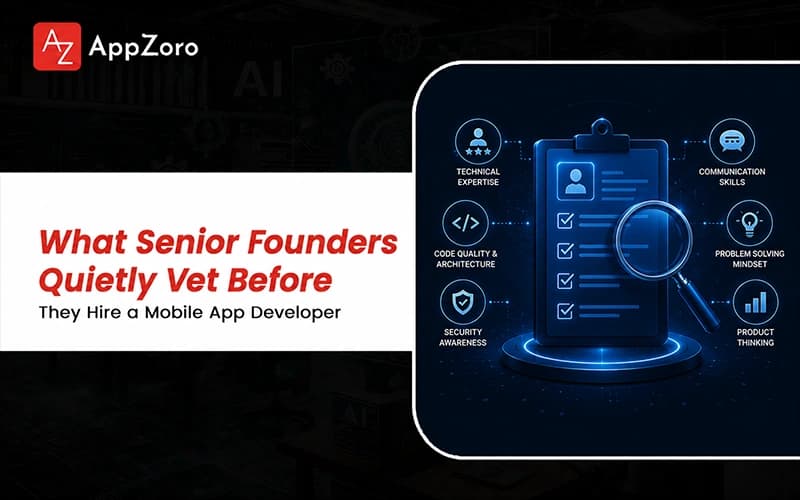
Quick Answer: To hire mobile app developer talent who actually ships in 2026, you need three vetting gates: verified App Store credits, a live architecture conversation, and reference calls. Realistic rates for a leading mobile app development company USA run 70−70−200/hour for senior contractors in North America, while vetted offshore engagements determine whether you ship or rebuild. Skip any of these and you join the founders paying for a costly rebuild in month seven of their project.
A founder I work with forwarded me her shortlisted developer's portfolio last March with five glossy case studies, all under NDA and not a single verifiable App Store link. The contract she nearly signed sat at $96,000 over four months, a risk she mitigated by consulting a custom mobile app development guide to understand the baseline for spec-built products. The rebuild she avoided would have run her closer to $240,000 by the time she replaced the codebase mid-flight, showing why hiring depth matters before signing.
The contract she nearly signed sat at $96,000 over four months and the rebuild she avoided would have run her closer to $240,000 by the time she replaced the codebase mid-flight. The hire mobile app developer conversation that followed was the version most founders never have before signing their first development contract.
That story is the version of mobile hiring reality most founders never hear during agency pitch calls, because every firm or freelancer selling you their services has strong incentives to highlight glossy case studies and skip the verification reality deciding whether you actually ship.
The founders shipping in 2026 treat developer vetting as a structural design constraint from week one; the founders burning runway sign on portfolio aesthetics and discover the gap when iOS background fetch breaks three months into the engagement. What follows is the conversation a senior engineering leader would have with a non-technical founder over coffee rather than the polished pitch deck a hiring platform delivers.
By the end you will know what mobile app developer hire decisions actually require, where each talent pool breaks under production pressure and how senior founders build vetting gates that catch portfolio padding without burning two months on the shortlist.
What "Hire a Mobile App Developer" Actually Means in 2026 (and Why the Bar Moved)
If you have searched for how to hire mobile app developers and walked away with conflicting answers ranging from "find a freelancer on Upwork" to "use a vetted agency" to "build in-house," you are running into the residue of a hiring market that fundamentally restructured between 2022 and 2025.
The discipline today, when you hire talent, means evaluating engineers against shipped App Store evidence and their expertise in various mobile app development frameworks to ensure they can handle high-performance requirements. Live code-reasoning ability and stack fluency are the primary filters that AI autocomplete tools cannot fake on a live screen-share during a technical interview. Real mobile engineering at 2026 standards includes platform-specific knowledge of the review process and the device profile testing matrix.
What changed across 2023-2025 was talent stratification. Senior mobile engineers who survived the layoff cycles consolidated into smaller pools commanding higher rates, while a flood of junior engineers presented as senior because Copilot and Cursor let them produce code that looked competent until production load hit. The hiring signal that worked in 2019 (years of experience, GitHub commits, polished resume) became noise.
Here is what defines the category in 2026:
Senior engineers who shipped at least three apps with verifiable App Store presence under their own developer account or credited team role
Stack fluency in Swift, Kotlin, React Native or Flutter sufficient to reason aloud about background fetch, memory pressure and async patterns
Architecture taste shaped by App Store rejection rounds, OS version migrations and on-call rotations rather than tutorial completion
The Definition Founders Still Get Wrong
The phrase "hire mobile app developer" typically gets confused with "find someone who writes mobile code," which conflates output volume with shipping competence. Real mobile engineering at 2026 standards includes platform-specific knowledge of Apple's review process android fragmentation across OEM skins and the device profile testing matrix shaping whether your app crashes for 14% of users on launch day.
Why the Senior Developer Pool is Stratified
The senior pool stratified because layoff cycles between 2022-2024 pushed mid-tier engineers into consulting, while genuinely senior talent either consolidated into staff roles at FAANG-adjacent companies or commanded premium contracting rates. The candidate flow that hits founders' inboxes skews heavily toward engineers who never shipped under production load.
How AI Coding Tools Reshaped What You're Actually Hiring
AI coding tools reshaped what it means to hire mobile app developer talent because Copilot, Cursor and Claude can produce code looking competent during a take-home assignment. The Senior founders I watched hire successfully often integrated contractors into the long-term vision of how to develop an app and make money by offering equity splits. Offering 0.25%-1.0% equity to senior contractors converts a transactional relationship into a co-founder-level commitment, ensuring they stay engaged through the rebuild conversations every successful product eventually hits. This anchors talent whose opportunity cost the cash rate alone rarely matches, creating a durable and motivated engineering partnership.
How to Hire Mobile App Developers
If you are searching for how to hire mobile app developers without burning runway on the wrong shortlist, the honest answer is that vetting depth matters more than candidate volume. The founders I watched succeed ran three verification gates: App Store credit verification, live architecture conversation and reference calls, ensuring the talent could handle a modern mobile app development process from start to finish. This approach avoids the resume-screening theatre most hiring platforms encourage and prioritizes actual shipping competence over theoretical knowledge. Pick three to five candidates from referrals, verify their presence under their actual developer name, and run a 90-minute architecture deep-dive
The pattern stabilised through painful learning. Pick three to five candidates from referrals or vetted networks, verify their App Store presence under their actual developer name, run a 90-minute architecture deep-dive on their last shipped app and call the engineering lead they shipped alongside before signing anything:
Verification of App Store or Play Store credits where the candidate is listed as the developer of record, not just a UI contributor
Live architecture walkthrough where the candidate explains decisions about state management, networking and offline behaviour from their last shipped product
Reference calls with the engineering lead or CTO at the candidate's most recent role, rather than the marketing or product lead
Why Portfolio Verification Beats Resume Screening
Portfolio verification beats resume screening because App Store and Play Store listings are public, attributable and impossible to fake at the developer-account level. The candidates I watched hire successfully shared App Store links where their team credit was verifiable; candidates failing this gate hid behind NDA claims when asked for a single live product link.
The Live Coding Round Senior Founders Insist On
The live coding round senior founders insist on involves a 45-minute pair-programming session where the candidate adds a small feature to a real codebase rather than solving an abstract algorithm puzzle. This round catches engineers who relied on autocomplete heavily, because the conversation forces them to explain why their code works the way it does.
How References From Real App Store Shipments Reveal What CVs Cannot
References from engineering leads at past shipments reveal what CVs cannot, because the lead remembers exactly what the candidate owned, debugged and shipped under deadline. Before you hire mobile app developer candidates, the reference calls I sat in on routinely surfaced details (who actually wrote the networking layer, who handled the App Store rejection round) that the candidate's resume conveniently flattened.
Mobile App Developers for Hire: Where the Talent Pools Actually Sit
The mobile app developers for hire conversation hinges on which talent pool matches your product stage and budget reality. Vetted agencies, dedicated developer firms, and independent senior contractors each occupy distinct economic niches. Before deciding, reviewing a mobile app development cost breakdown helps founders avoid mismatching their talent pool to their stage, which otherwise leads to overpaying for a simple prototype or underpaying for a complex build. The pool that fits depends on your build complexity, regulatory exposure and how much engineering management bandwidth you actually have.
Most procurement skips the honest pool conversation because every vendor pitches their own model as universal. The pool that fits depends on your build complexity, regulatory exposure and how much engineering management bandwidth you actually have:
Independent senior contractors land between $90-$180/hour in North America and Western Europe, suitable for greenfield builds where you can manage one engineer directly
Dedicated developer teams through vetted firms ($45-$110/hour blended) when you need a team, plus engineering management you cannot run yourself
Vetted offshore engagements through firms like Toptal or Andela run $35-$80/hour for senior talent, with depth varying significantly by region and vetting rigour
When Hiring In-House Justifies the Total Cost
In-house hiring justifies its total cost (typically $180,000-$300,000 fully loaded for a senior North American engineer) when the product needs continuous development across years rather than a focused build. Founders hiring in-house for a six-month sprint routinely overpay; founders contracting through agencies for a three-year product roadmap routinely underpay by skipping institutional knowledge.
Why Hire Dedicated Mobile App Developers Through Vetted Firms
Founders who hire dedicated mobile app developers through vetted firms typically buy three things in one contract: engineering capacity, engineering management you do not have to run and replacement insurance if the assigned engineer leaves. The premium for this model runs 30-50% above straight contractor rates but pays back when the founder cannot directly manage daily standups. Learning how to choose a mobile app development company with proven management layers ensures you buy engineering capacity and insurance against turnover, which is vital for long-term product roadmaps. This model provides three things in one contract: engineering capacity, management you do not run yourself, and replacement insurance if an engineer leaves.
How to Spot Freelancer Quality at the Vetting Stage
Freelancer quality reveals itself at vetting through three signals: depth of past App Store credits, willingness to do live architecture walkthroughs and rate honesty. The mobile app developer for hire is worth signing, quote rates matching their actual seniority; the ones to avoid quote suspiciously low rates and hide their past work behind NDAs.
The Vetting Process That Catches Junior Pretending to Be Senior
The vetting discipline that catches junior engineers presenting as senior involves three rounds; the founders I watched succeed never skipped. A live architecture walkthrough of past work surfaces depth instantly because senior engineers explain tradeoffs while junior engineers narrate features.
A targeted background fetch or memory pressure question separates engineers who understand the tech stack for mobile app development at a production level from those who only built simple tutorials. This reveals a level of reps that cannot be faked on a screen share, as it requires reasoning aloud about decisions that shape the app's performance. Portfolio padding gets caught by architecture walkthroughs, autocomplete dependency by live coding, and resume inflation by peer reference calls.
The pattern works because each gate catches a different failure mode. Portfolio padding gets caught by architecture walkthroughs, autocomplete dependency gets caught by live coding and resume inflation gets caught by reference calls with engineering peers:
An architecture walkthrough where the candidate explains state management, networking and offline behaviour from a real shipped app for at least 45 minutes
Targeted technical questions about iOS background fetch, Android Doze mode and memory pressure scenarios
Code-style conversation about a specific past decision (why they chose Combine over RxSwift, why they migrated from REST to GraphQL)
Live Architecture Walkthrough of Their Past Work
The live architecture walkthrough works because senior engineers naturally explain why they made the decisions they made rather than just what the decisions were. Junior engineers tend to narrate the feature list; senior engineers describe the tradeoffs they weighed and the production incidents that shaped the architecture.
The Background Fetch and Memory Question Pattern
The background fetch question pattern works because iOS and Android both punish naive implementations brutally in production. Senior engineers explain how they handle BGTaskScheduler limits, JobScheduler constraints or memory-mapped resource cleanup; junior engineers describe what they read in a tutorial without production scars.
Why Code-Style Conversations Reveal Years of Reps
Code-style conversations about specific past decisions reveal years of production reps because the answers require remembering decisions that only matter once you have shipped through enough OS migrations. The candidates I watched succeed had opinions shaped by real common mobile app development challenges, such as navigating App Store rejection rounds or managing platform churn. Those who failed typically provided textbook answers that ignored the messy reality of shipping and maintaining a live product across multiple OS migrations. Code-style conversations about specific past decisions reveal these years of production reps because the answers require remembering trade-offs that only matter in the real world.
What Senior Founders Quietly Get Right About Mobile App Developer Hire Decisions
The strongest founders I watched succeed at mobile app developer hire decisions share disciplines compounding across multiple shipped products. They win because they treated vetting depth, rate honesty and trial-sprint structure as structural design constraints rather than transactional negotiation tactics under deadline pressure.
Here is what senior founders do differently when they hire mobile app developers in 2026:
They run three-week paid trial sprints before signing multi-month contracts, so misalignment surfaces inside a contained engagement
They quote rates honestly upfront rather than negotiating against the lowest bidder and inheriting quality problems mid-build
They structure equity-plus-cash splits with senior engineers who could plausibly join the company, rather than treating every hire as transactional
How Rate Conversations Shape Long-Term Outcomes
Rate conversations shape long-term outcomes because the mobile app developer for hire who feels underpaid disengages quietly, while the one paid at market rate stays engaged through the rebuild conversations every product hits. Founders who paid 20% above market for senior contractors I watched succeed routinely got the engagement extended; founders who saved 30% on rate when they went to hire mobile app developer talent routinely paid double on the rebuild.
Why Trial Sprints Beat Long Engagements at the Start
Trial sprints beat long engagements because a contained three-week paid project surfaces alignment problems while the relationship still has clean exit paths. The trial-sprint pattern catches communication mismatches, code-quality disagreements and timezone friction before founders who hire mobile app developer talent commit to a 12-month runway.
How Equity-Plus-Cash Splits Anchor Senior Talent
Equity-plus-cash splits anchor senior talent because the engineers worth keeping have opportunity cost the cash rate alone rarely matches. Senior founders, I watched hire successfully offered 0.25%-1.0% equity to senior contractors, becoming long-term engagements, converting a transactional relationship into something resembling co-founder commitment.
If you are about to hire mobile app developer talent and want a no-pitch second opinion on whether the shortlisted candidates actually shipped what their portfolios claim, our senior team reviews these vetting calls almost every week. Happy to flag the red flags before you sign.
Final Thoughts
The founders who successfully hire mobile app developers in 2026 treat the vetting cycle as a four-to-six-week structural process rather than a two-week transactional shortlist. They verify App Store credits under the candidate's actual developer identity, run live architecture conversations that catch autocomplete dependency and structure trial sprints before signing multi-month contracts.
The vetting depth costs three extra weeks upfront and saves the $200,000 rebuild that catches founders who skipped the gates. If you are reading this with a shortlist on your desk, the question worth asking is not whether the candidates look impressive on paper but whether their last shipped app survived the production scenarios your product will hit by month four.
Leave a Comment