The Mobile App Development Process Behind High-Performing Apps

Last Updated :
Quick Answer: The mobile app development process is a 7-step sequence covering discovery and strategy, UX and product design, architecture and tech spec, build and iteration, QA and compliance, launch and store submission, and post-launch iteration. Modern 2026 builds are integrating AI co-pilots like Cursor, Copilot, and Figma AI across every step, are running on cross-platform frameworks like Flutter and React Native by default, and are shipping with mature CI/CD pipelines from day one. To manage this high-speed environment, many organizations partner with a professional mobile app development company USA to ensure engineering standards are met from kickoff to launch.
Building a mobile app can be stressful, dealing with shifting feature scope, missed deadlines, frozen budgets, and compressed QA cycles giving a bad first impression. To tackle these risks, smart teams equip themselves with a custom mobile app development guide that establishes clear expectations for product quality and maintenance.
What Is the Mobile App Development Process?
So, what is the mobile app development process actually about? Well, it is the structured sequence of activities that is turning a raw app idea into a shipped and properly maintained product, spanning strategy, design, engineering, and QA. Mastering these steps is critical to realizing the full mobile app development benefits, such as improved user retention and operational scalability.
But a strong process is more than just a list of phases lined up on a slide. It is the combination of
-
The right sequence of steps,
-
The specific deliverables expected per phase,
-
Clear decision gates between every phase, and
-
The feedback loops that are flowing back into the team from real production data.
Older treatments of this topic were focusing almost entirely on waterfall sequencing, however modern teams are now treating it as an iterative loop where discovery and post-launch monitoring are continuous functions rather than one-time checkpoints on the timeline.
What’s Changed: The Build Mobile App Development Process in 2026
Anyone publishing a mobile app development process article without addressing AI co-pilots, on-device LLM features, or the 2025-era CI/CD tooling is essentially publishing a 2020 guide with a fresh 2026 date stamp on the front of it. The build mobile app development process 2026 looks meaningfully different from anything that was being used five years ago, and the comparison table below is showing exactly where the shifts are happening today.
|
Process Element |
Traditional (Pre-2023) |
Build Mobile App Development Process 2026 |
|
Default stack |
Native iOS + Native Android |
Flutter or React Native first |
|
Design tools |
Sketch / static mockups |
Figma + Figma AI + auto-generated handoff |
|
Coding |
IDE + manual development |
IDE + Cursor / Copilot (30 to 50% faster) |
|
Backend setup |
Built from scratch |
Firebase / Supabase / AWS Amplify |
|
QA |
Manual + late in cycle |
Automated + AI-assisted + shift-left |
|
Release |
Manual store submission |
Bitrise / App Center / Xcode Cloud automation |
|
Analytics |
Crash + basic events |
AI-driven anomaly detection, real-time |
|
In-app AI |
None |
Genuine product feature (chat, summarization, vision) |
Overall timelines have compressed by roughly 25 to 40% for comparable scope versus where the same project would have landed five years ago. Much of this efficiency comes from selecting a modern tech stack for mobile app development that utilizes managed backend services and automated deployment pipelines.
The 7 Mobile App Development Process Steps (Step-by-Step)
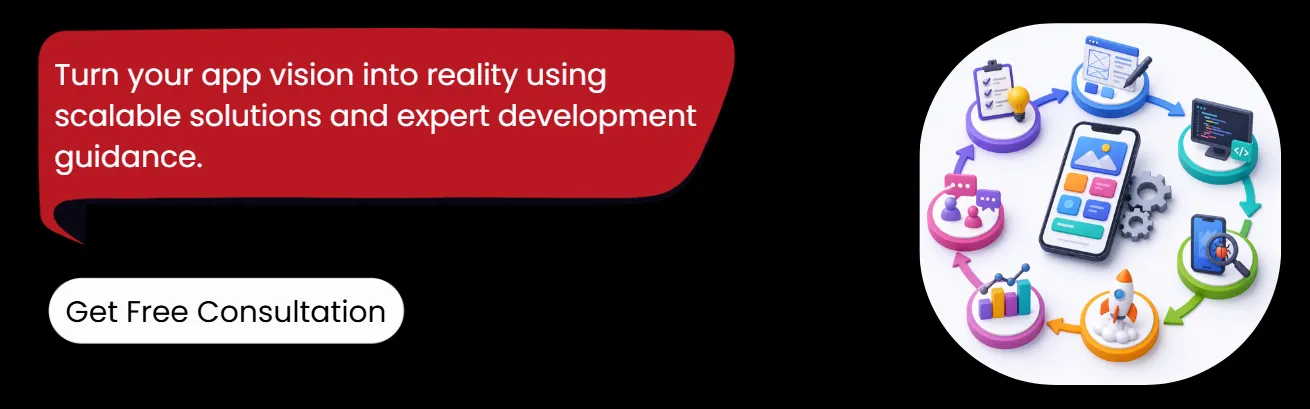
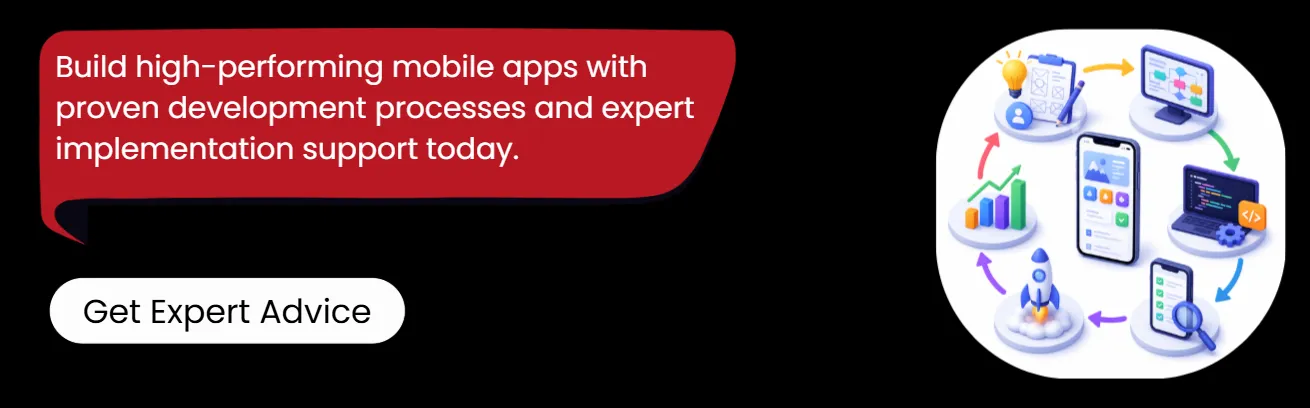
The seven mobile app development process steps below are forming the spine of any well-run modern build, and each one is carrying its own deliverables, its own typical pitfalls, and its own decision gate. This mobile app development step by step process is what is separating the teams that are shipping reliably from the ones that are stuck rebuilding the same broken app for years.
Step 1: Discovery And Strategy (1 to 3 Weeks)
The team is mapping the actual problem, the target user personas, the competitive landscape, and the success metrics before any wireframe is being drawn on screen. The main deliverable is a tight scope document, and the most common mistake is skipping this step because the team is convinced they already know the user.
Step 2: UX And Product Design (3 to 6 Weeks)
Information architecture, low-fidelity wireframes, a high-fidelity Figma prototype, and a full design system are being produced and validated with real users before any production code is written. The most common mistake here is designing in a vacuum without running any user testing rounds during this critical phase.
Step 3: Architecture And Technical Specification (1 to 2 Weeks)
The stack choice, API design, data model, security model, and cloud architecture are all being finalized into a proper technical specification during this short but critical phase. During this stage, architects must evaluate various mobile app development frameworks to determine which platform offers the best balance between performance and development speed.
Step 4: Build And Iteration (8 to 24 Weeks)
Sprint cycles are running on a 1 to 2 week cadence with stakeholder demos at the end of every sprint, and internal builds are being distributed through TestFlight. Adopting a strict agile methodology ensures that integration work is handled progressively, preventing major bugs from surfacing right before the launch date.
Step 5: QA, Compliance, And Pre-Launch Testing (2 to 4 Weeks)
Manual testing, automated regression suites, accessibility audits, security reviews, and store guideline compliance checks are all being completed during this phase to produce a clean release candidate. It is essential to implement rigorous mobile application security testing strategies at this point to protect user data and pass App Store reviews without delays.
Step 6: Launch And Store Submission (1 to 2 Weeks)
App Store and Play Store assets are being finalized, the review submissions are being filed, a soft-launch market is being selected, and the production monitoring stack is being set up across the entire app. The most common mistake is launching without a documented rollback plan if something is going wrong in production.
Step 7: Post-Launch Monitoring And Iteration (Ongoing)
Crash monitoring, analytics review, in-app feedback collection, and a monthly release cadence are being established to keep the app evolving based on real user behavior after launch. This is one of the most underrated mobile app development process steps because the work is genuinely never ending.
Where AI Co-Pilots Fit Into Each Step
AI co-pilots have moved well past simple coding assistance into the design, QA, and analytics phases of the mobile app development process, and every single step now has at least one tool that is meaningfully compressing the cycle time inside that phase.
|
Step |
AI Tool / Capability |
Impact |
|
Discovery |
ChatGPT / Claude for competitor teardown and persona drafting |
Cuts research time by ~40% |
|
UX Design |
Figma AI, v0, Galileo for wireframe and screen generation |
Cuts initial design time by ~30% |
|
Architecture |
GitHub Copilot Chat for stack and architecture review |
Faster spec drafting cycles |
|
Build |
Cursor, Copilot, Windsurf for code generation |
30 to 50% faster shipping |
|
QA |
Applitools, Testim, AI-driven visual regression |
Cuts manual regression by ~60% |
|
Launch |
AI-generated store screenshots, listing copy drafting |
Faster store submission turnaround |
|
Post-launch |
Sentry, Datadog AI anomaly detection, AI session replay |
Catches issues in hours, not days |
AI tools are accelerating the entire process, however they are not replacing the steps themselves in any meaningful way. Teams are finding that learning how to use AI in mobile app development allows them to catch edge-case bugs and generate initial design mockups in a fraction of the traditional time.
How to Build a Mobile App Development Process for Your Team
Teams trying to build a mobile app development process from scratch are usually copying a generic template off the internet and then watching it fail under the weight of their own real project. The smarter approach is to start lean and to add proper gates only as the team is hitting actual operational pain points.
-
Define The 7 Steps Explicitly: Even if your version is compressing some of them, name them out clearly so that everyone on the team knows where they stand.
-
Set Deliverables Per Step, Not Just Activities: Activities are easy to fake on a status report, while deliverables either exist or they don’t on the actual project.
-
Define Decision Gates Between Steps: Who is signing off to move the project forward, and what is the documented rollback path if something is going wrong?
-
Pick One Owner Per Step: Diffuse ownership is the most common failure mode inside any modern mobile app development process across teams of all sizes.
-
Instrument Process Health From Day 1: The KPIs covered in the next section are what is making the whole thing genuinely measurable across the build lifecycle.
Most teams figuring out how to create a mobile app development process for the first time are underestimating how much of the required discipline is cultural rather than purely procedural in nature.
Process Variations by App Type
The 7-step mobile app development process is applying broadly across the industry, however the specific gates, the timelines, and the weight given to each step are shifting meaningfully based on the type of app being built.
Consumer Apps
The weight is sitting heavier on Step 1 (market validation) and Step 7 (retention iteration), while Step 5 is staying lighter due to the reduced compliance load on consumer-facing products. The total build window is running between 4 and 7 months.
Enterprise Internal Apps
Step 3 is expanding to handle integration architecture, SSO, and MDM configuration, while Step 5 is loaded with security reviews and audit log validation. This is a hallmark of enterprise mobile app development, where the complexity of internal corporate systems requires a much more robust architectural foundation.
Startup MVP
Steps 1 through 3 are being compressed aggressively, Step 4 is run in very tight iteration cycles, and Step 7 is essentially continuous from Day 1 of the launched product. The total window is running between 8 and 14 weeks.
Regulated Industry (Fintech, Healthtech)
Step 5 is being expanded heavily to cover HIPAA, SOC 2, PCI, and FDA SaMD where applicable, with mandatory compliance gates being placed between Steps 4, 5, and 6. The total window is running between 6 and 14 months.
KPIs to Measure Whether Your Process Is Actually Working
A mobile app development process is only as healthy as the metrics that the team is actually tracking, and the five KPIs below are what is separating real engineering discipline from a glossy checklist that nobody is using.
-
Cycle Time From Idea To Production: The median time for a feature to ship end-to-end, with healthy mature teams sitting comfortably under 2 weeks per feature.
-
Escape-Defect Rate: The percentage of bugs caught only in production versus total bugs found, with the target sitting under 10% for healthy teams.
-
Release Frequency: The number of releases shipped per month, with healthy consumer apps landing between 2 and 4 releases per month consistently.
-
Sprint Demo Coverage: The percentage of sprints ending with a real stakeholder demo, which should always be sitting at 100% across every active project.
-
Time From Crash To Fix In Production: The P90 time for critical issues should be sitting under 48 hours from initial alert to deployed fix in the store.
If you cannot measure these numbers reliably, then your process is not actually real, it is just a checklist that the team is following on autopilot. Most founders find that tracking these KPIs helps them better understand the mobile app development cost breakdown and justify ongoing investments in new feature iterations.
Common Mobile App Development Process Failures
Even with a well-defined mobile app development process on paper, the same five anti-patterns are showing up again and again across teams of every size and seniority level.
-
Compressing Discovery To “Get Started Faster”: This is the leading cause of teams building the wrong product entirely, and correcting it later is brutally expensive.
-
Designing In A Vacuum: When Step 2 is happening without any user testing rounds, the team is producing beautiful screens that do not convert real users.
-
Frozen Scope Mid-Sprint: Refusing to adjust the build based on demo feedback is eliminating the entire value of running an iterative process at all.
-
QA As An Afterthought: Compressing Step 5 to hit an aggressive launch date is costing 5 to 10 times more in post-launch fixes later.
-
No Post-Launch Owner: Treating launch as the project end means crashes are piling up unaddressed and store reviews are tanking within weeks of the public release.
Conclusion
The mobile app development process is no longer just a slideshow that is being shared at the project kickoff and then forgotten. It has become an operational baseline for any team shipping a professional product, especially when navigating mobile app development challenges like platform fragmentation and shifting user expectations.
Frequently Asked Questions
What Is The Mobile App Development Process?
The mobile app development process is a 7-step sequence covering discovery, design, architecture, build, QA, launch, and post-launch iteration that turns an idea into a shipped product.
What Are The Main Mobile App Development Process Steps?
The main mobile app development process steps are discovery, UX design, architecture, build, QA, launch, and post-launch iteration, each one carrying its own clearly defined deliverables.
How Long Does The Mobile App Development Step By Step Process Take?
A typical mobile app development step by step process is taking between 3 and 9 months from kickoff to launched v1, depending on the scope, stack, and team size.
How Is The Build Mobile App Development Process 2026 Different From Older Versions?
The 2026 process is integrating AI co-pilots into every step, is defaulting to cross-platform stacks, and is using automated CI/CD that 2020-era teams simply did not have.
How Do I Create A Mobile App Development Process For My Team?
Start with the 7 standard steps, define deliverables and decision gates per step, assign one owner per step, and measure cycle time and escape-defect rate continuously.
What Is The Biggest Mistake In The Mobile Apps Development Process?
Compressing the discovery and QA phases is the biggest mistake, since those are the two phases most often shortened and the two most expensive ones to skip later.
Can AI Tools Replace The Mobile App Development Process?
No, AI co-pilots are accelerating each step by 30 to 50%, however they are not replacing the strategy, design, architecture, or post-launch ownership work at all.