Mobile App Development Benefits That Drive Growth, Loyalty and Revenue

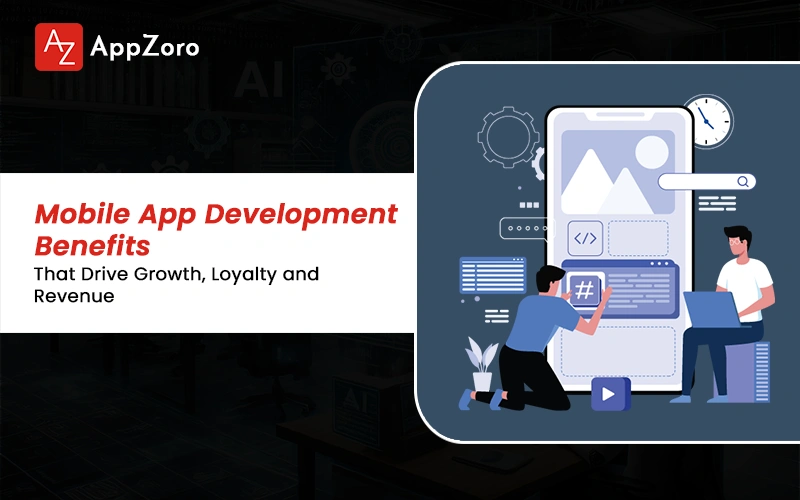
Businesses that built mobile apps five years ago are not asking whether apps were worth it – they are asking how to make their apps better. The businesses still debating mobile app development benefits in 2026 are competing with one hand behind their back while their app-first competitors collect behavioral data, reduce service costs and convert customers at higher rates every quarter. This guide covers every significant business outcome that a well-built mobile app delivers across revenue growth, customer relationships, operational efficiency and competitive positioning.
What Mobile App Development Benefits Look Like Across Business Types
Mobile app development benefits fall into four outcome categories — revenue growth, customer relationships, operational efficiency and competitive positioning — and the relative weight of each category shifts substantially depending on the business model. To align these categories with your specific strategy, many executives consult a comprehensive custom mobile app development guide that helps them map internal priorities against these four value dimensions before committing to a technical roadmap or investment frame.
A restaurant chain measuring mobile app benefits will center the conversation on order volume and commission elimination while an enterprise logistics company will center it on field productivity and workflow latency reduction the same four outcome categories apply to both but with entirely different priority weightings across each operational context. In order to give every business type a clear view of where their primary value sits, this guide maps each of the four outcome categories to a dedicated section so readers can weight each benefit dimension against their own operational priorities before reaching the business case and investment framing at the close.
-
B2C Retail and E-Commerce: Direct revenue through mobile commerce, loyalty programs and push-driven repurchase campaigns are the primary benefit drivers for consumer-facing retailers competing against both national chains and marketplace aggregators on speed and convenience.
-
Service Businesses and Restaurants: Appointment and order management through a branded app removes third-party platform dependency and the associated commission fees from every transaction that would otherwise flow through a delivery or booking aggregator at rates of 15–30% per order.
-
Financial Services and Healthcare: Compliance-governed industries benefit most from the operational efficiency and customer self-service dimensions rather than pure commerce revenue and the regulatory environment in both sectors reinforces app-based data security and documentation requirements that align with internal compliance obligations.
-
Enterprise and B2B Operations: Internal mobile apps for field teams, logistics workflows and approval processes deliver benefits through productivity gains and reduced process latency rather than direct consumer revenue and frequently return higher ROI than consumer-facing apps in industries like construction and professional services.
Revenue Growth as a Core Mobile App Development Benefit
Building a mobile app is stressful, dealing with uncertain development timelines, unclear ROI projections, integration complexity with existing commerce platforms and the pressure of launching a product that represents the brand experience every customer will evaluate. This is why growth-focused teams must start by understanding the mobile app development cost breakdown for their specific category, ensuring they equip themselves with conversion architecture rather than feature lists that look comprehensive in a proposal but do not drive measurable transaction volume.
So, what does the direct revenue case for mobile app investment actually look like in data? Well, the data.ai State of Mobile 2025 report shows that app-based mobile commerce converts at 3x the rate of mobile web on comparable shopping journeys – establishing conversion uplift as the most immediately quantifiable benefit in the full business case regardless of industry vertical or average order value.
This conversion gap has widened rather than narrowed over the last three years as app UI quality, biometric payment integration and persistent login have matured beyond what mobile web can deliver at equivalent development investment. For those in retail, following a complete guide to eCommerce mobile app development shows how benchmarks like Starbucks and Domino’s generate 30% of their total US transactions through loyalty-driven revenue growth and member-exclusive experiences that are not available through traditional web channels.
-
Mobile Commerce Conversion Rate: App-based shopping experiences convert at 3x the rate of mobile web sessions because of persistent login, saved payment methods and faster checkout flows that remove the friction points responsible for the majority of mobile cart abandonment events across every product category.
-
In-App Purchase and Subscription Revenue: Subscription businesses and content platforms generate significantly higher lifetime value from app subscribers than web subscribers due to lower churn rates and higher engagement frequency across every content and product category measured in the data.ai State of Mobile 2025 annual report.
-
Push Notification Sales Lift: Time-limited offer notifications sent to opted-in users consistently deliver 7–10x higher open rates than promotional email and drive measurable same-day revenue spikes that email and paid social campaigns cannot reproduce at equivalent cost per conversion across any consumer-facing vertical.
-
Loyalty Program Revenue Concentration: Branded loyalty programs tied to a mobile app concentrate repeat purchase behavior and increase average order value by giving customers a tangible and trackable reason to return to the brand rather than accepting a competitor’s equivalent offer at the next occasion.
Mobile App Benefits for Business in Customer Relationships and Retention
The relationship-building mobile app benefits for business are harder to quantify in a quarterly revenue report than transaction volume figures but they compound more powerfully over time because they reduce customer acquisition costs. By focusing on what is enterprise mobile app development, large-scale organizations can reframes the investment conversation from build costs to the lifetime value of building the relationship infrastructure that produces a significant customer tenure differential over a five-year window.
Forrester’s Customer Experience Index data shows that emotionally engaged mobile app users carry a 306% higher lifetime value than average customers – a figure that reframes the entire mobile investment conversation from “how much does the app cost to build” to “what is the cost of not building the relationship infrastructure that produces that lifetime value differential over a five-year customer tenure.” And that is not all – the mobile app benefits for business at the relationship layer include a first-party communication channel that no platform algorithm can deprecate and no policy change can restrict between the business and the customers who have opted in to receive direct communications.
Nike represents the benchmark for relationship-driven app strategy the Nike Run Club and SNKRS apps generate community engagement and behavioral loyalty that media-spending competitors cannot replicate because the community is built on consistent daily interaction rather than impression frequency and the data that interaction generates belongs to Nike rather than to any advertising intermediary.
-
Personalized Experience at Scale: App-based behavioral data enables product recommendations, content curation and offer personalization at a specificity that web cookie-based targeting cannot achieve due to session fragmentation and cross-device tracking limitations that do not apply inside an authenticated app environment with a persistent user identity.
-
Direct Communication Channel: A branded mobile app gives businesses a first-party push notification channel that no platform algorithm controls and no intermediary can monetize or deprioritize between the business and the customers who have opted in to receive direct communications from the brand.
-
Loyalty Program Infrastructure: Mobile apps provide the natural and most effective home for points, rewards and tiered loyalty programs that increase purchase frequency without requiring the margin-eroding discounting that promotion-only retention strategies demand from businesses operating without an owned engagement channel.
-
Reduced Churn Through Engagement Triggers: Automated re-engagement notifications triggered by inactivity thresholds recover lapsed users at a fraction of the cost of paid reacquisition campaigns targeting cold audiences who require a full brand consideration cycle before converting again at any measurable rate.
-
Customer Service Deflection: In-app chat, order tracking and FAQ automation reduce inbound contact volume while improving the experience for users who prefer self-service resolution over phone queues that erode satisfaction scores regardless of the quality of the agent handling the interaction.
Operational Efficiency Benefits of Mobile App Development
Businesses in most cases undercount the mobile app development benefits on the operational side because the entire business case is built around consumer-facing revenue metrics and cost reduction is treated as a secondary consideration. However, internal mobile apps for field service teams and logistics operations routinely deliver high ROI, provided the team follows a structured mobile app development process that eliminates paper forms, manual data entry, and desktop-dependent approval chains across the entire employee workflow.
Walmart’s internal mobile app infrastructure demonstrates operational leverage at scale, Walmart associates use mobile tools for inventory management, price checking and task assignment that measurably reduce the labor hours required per store operation across a retail footprint where even small efficiency gains translate into substantial cost impacts at the system level. The mobile app development benefits on the operational side are most visible to businesses that audit their current processes for paper-based steps, phone-based coordination and desktop-locked workflows that field staff are forced to complete at a desk rather than at the point of work where the information is actually generated in real time.
-
Customer Self-Service Automation: Appointment booking, order tracking, account management and payment processing handled through the app reduce inbound contact center volume by 25–40% across service industries where these tasks currently consume agent time that carries full labor cost per interaction handled through a staffed channel.
-
Field Team Productivity: Mobile apps for technicians, sales representatives and delivery drivers consolidate job assignments, route optimization, digital forms and real-time reporting into a single device rather than a disconnected stack of paper documentation and desktop tools that require office-based data entry after field work is complete.
-
Approval and Workflow Automation: Internal enterprise apps route expense approvals, purchase orders and compliance sign-offs through mobile-accessible workflows that reduce processing time from days to hours by eliminating the email chains and desktop login requirements that create approval queue latency across distributed organizations.
-
Inventory and Asset Management: Real-time mobile inventory tools eliminate the cycle count delays and data entry errors that batch-processing systems generate in warehouse and retail environments, reducing carrying costs through more accurate stock visibility across every location in the distribution network simultaneously.
Competitive Advantages of Mobile App Development in 2026
The advantages of mobile app development that most businesses consistently underestimate are competitive rather than operational — specifically the first-party behavioral data advantage that grows in strategic value every year. In 2026, the biggest differentiator is learning how to use AI in mobile app development to turn that behavioral data into predictive engines, ensuring that late-moving competitors cannot acquire the same intelligence depth regardless of the budget they commit to closing the gap.
Amazon represents the defining benchmark for a competitive moat built through app-generated behavioral data – the recommendation precision, delivery expectation management and repurchase convenience that define the Amazon customer experience are not replicable by competitors through advertising because they are built on behavioral data depth that requires years of owned transaction history to generate at the accuracy level customers have been conditioned to expect. The advantages of mobile app development extend beyond data, however, into brand experience architecture and switching cost creation that structural marketing activities alone cannot build at equivalent cost or durability over a competitive timeframe.
-
First-Party Behavioral Data: Every session, search, tap and purchase inside the app generates behavioral signals that feed recommendation engines and targeting models with precision that no advertising platform can match using inferred intent signals drawn from third-party browsing data across fragmented sessions.
-
Platform and Algorithm Independence: A branded app is the only customer engagement channel where the business controls the algorithm, the communication cadence and the full data relationship without paying per-impression fees or accepting platform mediation between the brand and its customers at any layer of the interaction.
-
Brand Differentiation Through Experience: The app interface is a complete design environment that allows businesses to express brand identity through interaction patterns and personalization mechanics in ways that third-party marketplaces and standard browser experiences systematically constrain for all participants on the platform equally.
-
Switching Cost Creation: Customers who build behavioral history and loyalty point balances inside a branded app face meaningful friction when considering a switch to a competitor and that friction compounds with tenure – creating a durable retention mechanism that price competition alone cannot easily dislodge from a well-engaged and reward-active user base.
Benefits of Mobile Apps for Small Businesses and Independent Operators
The benefits of mobile apps for small businesses operate through a different mechanism than for large enterprises; they allow independent operators to deliver the same convenience that national chains offer. To achieve this parity, small business owners must know how to choose a mobile app development company that understands their niche, allowing them to eliminate third-party commission fees of 15–30% and recapture the customer relationship directly.
Platforms including Glue Loyalty and custom-built ordering apps are enabling independent operators and small restaurant groups to recapture both the margin and the customer data that delivery aggregators previously captured entirely – converting platform-dependent transactions into owned customer relationships that the business can communicate with, reward and retain without paying a per-order access fee to a platform that controls the customer’s purchase history and identity.
The benefits of mobile apps for small businesses are disproportionately large relative to the investment because every commission dollar saved and every customer retained through a push notification carries the same percentage impact on a small revenue base as on an enterprise one – however the small business keeps the entire margin improvement rather than distributing it across a corporate overhead structure that absorbs the gains.
-
Commission Elimination: A branded ordering or booking app removes third-party platform fees of 15–30% per transaction and returns that margin directly to the business owner on every order that would otherwise flow through a delivery or reservation aggregator that owns the customer relationship.
-
Direct Customer Communication: Small businesses with a branded app communicate directly with their customer base through push notifications rather than paying for social media reach or competing against national brands in paid search auctions where cost per click scales with competitor budget rather than relevance to the local audience.
-
Loyalty Programs at Consumer Brand Scale: Mobile loyalty programs were previously available only to chains with enterprise technology budgets and the app development market of 2026 makes points, rewards and punch card programs fully accessible to businesses operating from a single location at a development cost that the first year of commission savings alone typically covers.
-
Customer Data Ownership: Every transaction and interaction inside a branded app belongs to the business rather than to a marketplace or delivery platform that can end the relationship, raise commission rates or suppress the business’s visibility at any time without notice or contractual recourse.
-
Competitive Parity with Larger Competitors: A well-designed small business mobile app creates an experience indistinguishable in quality from national chain apps and removes convenience as the primary reason a customer would choose a larger competitor over a local operator they already prefer on product quality or personal service.
How Mobile Apps Help Businesses Grow Through Data and Personalization
Understanding how mobile apps help businesses grow requires framing the relationship as a flywheel — more users generate more behavioral data which enables better personalization. To sustain this loop, selecting the right tech stack for mobile app development is vital, as it ensures the data architecture can scale with the usage accumulation into a longitudinal record that no paid acquisition channel can produce at equivalent fidelity across the customer lifecycle.
McKinsey research shows that personalization at scale drives 10–15% revenue lifts and that the behavioral data required for that personalization is most completely and continuously collected through owned app environments rather than through fragmented web sessions or third-party platform profiles that carry significant gaps in behavioral continuity between purchase occasions. So, how mobile apps help businesses grow in practice is less about the individual feature the app offers and more about the data architecture that feature generates over time as usage accumulates into a longitudinal behavioral record that no paid acquisition channel can produce at equivalent fidelity or continuity across the full customer relationship.
-
Behavioral Segmentation: App session data segments users by purchase frequency, category preference and engagement depth with a granularity that web analytics tools and CRM import data cannot achieve from external sources that lack session-level behavioral continuity across the full customer journey from discovery through repeat purchase.
-
Predictive Personalization: Machine learning models trained on in-app behavioral sequences predict next purchase intent and surface the right product or offer at the right moment in the session rather than in a retargeting ad shown hours or days after the original purchase signal was generated and the consideration window has already closed.
-
A/B Testing at Speed: Apps allow continuous UI and offer testing across user segments without the deployment friction of website changes and with session-level attribution that isolates the specific variable being tested from the confounding factors that contaminate web-based experiment results conducted across fragmented device and browser environments.
-
Cohort-Level Growth Analytics: Retention curves, lifetime value trajectories and churn prediction can be calculated at the cohort level for app users in ways that give growth teams a precision planning instrument that no other digital channel provides at equivalent behavioral data fidelity and longitudinal completeness.
Why Businesses Need a Mobile App in 2026 and the Cost of Waiting
Why businesses need a mobile app in 2026 is now as much a question of competitive survival as it is of competitive advantage – because in retail, restaurants, financial services and healthcare the expectation of app availability has shifted from a differentiator that impresses customers to a baseline requirement that customers notice the absence of rather than the presence of when every competitor in the category already provides it. Forrester data indicates that 73% of customers now expect a branded app experience from any business they purchase from more than twice per year – a figure that reframes the “should we build an app” conversation from a strategic consideration into an operational necessity for any business with a meaningful repeat customer base generating more than a fraction of revenue from returning buyers.
The competitive cost of not having an app compounds annually because competitors who built earlier are accumulating behavioral data, loyalty tenure and personalization depth that takes years to replicate regardless of the budget committed to catching up from a later starting position. Bank of America’s mobile banking platform demonstrates the operational case for why businesses need a mobile app in high-frequency service contexts – the platform now handles the majority of all customer service interactions without a branch visit or phone call and the cost per interaction through the app is a fraction of the equivalent contact center cost at the same transaction volume.
-
Customer Expectation Gap: Businesses without a branded app are now operating below the experience baseline in their category and customers in most cases notice the absence of an app rather than rewarding the presence of one when every direct competitor already provides the same capability as a standard offering.
-
First-Party Data Deficit: Every year without an app is a year of behavioral data that competitors are collecting and compounding into personalization and retention advantages that widen the competitive intelligence gap with every additional month the investment decision is deferred rather than closed.
-
Third-Party Platform Dependency: Without an owned app, customer relationships live on platforms that charge commissions, control visibility rankings and can change their terms or raise their fees at any time without notice – removing the business’s ability to plan its customer acquisition economics with any stability across a multi-year growth horizon.
-
Rising Development Cost with Delay: The longer development is deferred the more complex the technical environment becomes – legacy integration requirements, competitor feature parity demands and customer experience expectations all increase the scope and cost of a first app build year over year as the competitive feature bar rises and the gap to close widens.
Why Develop a Mobile App and How to Build the Business Case
Why develop a mobile app is not a question most businesses in 2026 need to answer from first principles – the question is which use case to prioritize first and what investment level is appropriate for the specific revenue opportunity and competitive context the business is operating in rather than whether the investment category itself is justified at a general level.
The decision splits cleanly across three starting conditions that determine urgency and scope: businesses with an existing customer base and no app represent the highest-urgency priority because the loyalty and retention value is already present in the customer relationship and the app is the infrastructure required to capture it systematically; businesses with an app that has not been updated in more than two years face a refresh priority where the current product is likely below customer experience expectations and delivering a fraction of the revenue potential a current-generation app would generate from the same user base; and businesses evaluating their first mobile presence from a greenfield position face a strategic planning priority where investment scope should be matched to the highest-certainty ROI driver in the specific business model rather than to a feature set driven by competitive mimicry without a revenue model behind it.
A basic consumer app with loyalty and ordering functionality in most cases recoups its development cost within 12–18 months when the commission elimination and customer retention improvement benefits are modeled together against the realistic user adoption curve for the specific business and category vertical.
-
Existing Customer Base Without App: If your business has more than 1,000 repeat customers and no branded app it represents the highest-urgency candidate for mobile investment regardless of industry because the behavioral data and loyalty value those customers represent is not being captured or compounded in any owned system that the business controls.
-
Third-Party Platform Dependency: If more than 20% of revenue flows through a platform that charges commission and controls the customer relationship the app ROI calculation is immediately straightforward because commission elimination alone produces a measurable payback timeline against the full development investment cost.
-
Competitor App Parity: If direct competitors have apps and your business does not the competitive disadvantage is already active and growing every month as competitors accumulate behavioral data and loyalty tenure that compounds into personalization advantages that widen with each passing quarter of inaction.
-
Customer Lifetime Value Potential: Businesses with high LTV customer bases benefit most from app investment because the loyalty and personalization capabilities that apps enable compound over longer customer relationships and produce the greatest incremental revenue differential against a no-app baseline across a three-to-five-year measurement window.
Conclusion
Mobile app development benefits are no longer just a technology investment proposition – they have become an operational baseline for any business serious about customer retention and service efficiency. By preparing for the common challenges of mobile app development early, brands can build longitudinal behavioral data advantages and loyalty infrastructure that take years for a late entrant to replicate, ensuring they capture the full revenue and retention value that the right mobile experience delivers.
The businesses that built apps in 2019 and 2020 are operating today with behavioral data advantages and customer loyalty infrastructure that would take years for a late entrant to replicate even with a superior development budget because the compounding value of longitudinal behavioral data and loyalty tenure cannot be purchased or accelerated past the time it takes to accumulate through consistent customer interaction.
At Appzoro, we help businesses build their first app and improve existing apps to capture the full revenue and retention value that the right mobile experience delivers from the first customer session through to a sustainable competitive position in their category.
Frequently Asked Questions
What Are the Main Advantages of Mobile App Development for a Business?
The main advantages of mobile app development include direct customer communication, first-party behavioral data ownership, reduced operational costs through self-service automation and measurable increases in repeat purchase revenue across every business model that serves repeat customers at scale.
Why Do Businesses Need a Mobile App in 2026?
Businesses need a mobile app because customer expectations now treat app availability as a baseline requirement and competitors with apps are accumulating behavioral data and loyalty advantages that compound into a widening competitive gap with every month the investment is deferred.
What Are the Mobile App Benefits for Business Revenue?
Mobile app benefits for business revenue include 3x higher conversion rates than mobile web, push-notification-driven sales lifts and loyalty program mechanics that increase average order value and repeat purchase frequency across consumer-facing business models measured in the data.ai State of Mobile 2025 report.
What Are the Benefits of Mobile Apps for Small Businesses?
The benefits of mobile apps for small businesses include commission elimination from third-party platforms, direct customer communication through push notifications and loyalty program access at a development cost that was previously only available to national chains operating with enterprise technology budgets.
How Do Mobile Apps Help Businesses Grow?
Mobile apps help businesses grow by generating behavioral data that enables personalization and retention improvements that compound into higher customer lifetime value and lower acquisition costs over a multi-year customer relationship measurement period that no other owned channel can replicate.
What Is the Importance of Mobile App for Business Today?
The importance of mobile app for business has shifted from competitive advantage to competitive necessity in most consumer-facing industries as customer expectations for app-first experiences have become the standard baseline rather than a premium differentiator that rewards early-moving businesses with outsized market share.
Why Develop a Mobile App Rather Than Improve a Mobile Website?
Why develop a mobile app rather than improve a mobile website comes down to push notifications, offline functionality, behavioral data depth and conversion rates that mobile web cannot match regardless of the optimization effort invested in the browser experience at any budget level.