
Budgeting used to feel heavier than it should. Teams collected numbers from spreadsheets, emails, and disconnected tools, then spent days verifying what was already outdated. Traditional financial systems created a few common headaches!
We have seen finance teams spend more time fixing formulas than analyzing results. That approach worked when businesses moved slower, but it struggles today.
Cloud technology changed that pace. Finance teams now access real time data, collaborate instantly, and adjust budgets without waiting for system updates or local installations. This shift opened the door to smarter tools that support faster planning and clearer financial visibility.
That is where cloud based financial management software comes in. Instead of wrestling with outdated processes, teams can focus on strategy and decision making. This article explores how these platforms simplify budgeting and why more organizations rely on them.
What is Cloud Based Financial Management Software?
Unlike traditional setups, updates happen automatically and data syncs in real time. You do not depend on IT teams to maintain infrastructure, and collaboration becomes seamless across departments or locations. At its core, cloud based financial management software refers to financial tools hosted online rather than installed on local servers.
A typical cloud based financial software platform combines several essential functions that support modern budgeting.
Expense tracking
You monitor spending as it happens instead of reviewing it weeks later.
For example, a project manager records expenses immediately, and finance teams see updated totals without manual consolidation.
Forecasting
The system uses historical data to project trends.
This helps businesses anticipate revenue gaps or spending spikes before they occur.
Reporting
You generate financial reports in minutes rather than hours.
Dashboards show performance metrics visually, making it easier to communicate insights to leadership.
Budget planning
Teams build, adjust, and compare budgets collaboratively.
Scenario planning allows you to test strategies such as expansion or cost reduction without disrupting live data.
Many organizations adopt a cloud based financial management solution because these features exist within one unified platform instead of scattered tools.
On Premise vs Cloud Solutions
Finance leaders increasingly recognize the practical value here. Faster access to reliable data directly improves budgeting accuracy and speed.
When businesses partner with a capable finance software development company, they often tailor platforms around their workflow rather than adapting their workflow to rigid tools. Some even expand capabilities through custom enterprise software development services to integrate ERP systems or analytics modules.
And as forecasting grows more data driven, organizations work with an AI/ML development company to enhance predictive modeling and automate financial insights.
Common Bottlenecks in Manual or Traditional Budgeting
Budgeting shapes everyday decisions. It influences hiring, expansion, vendor contracts, and even product launches. When teams build budgets slowly, leadership reacts slowly. And that delay costs opportunities.
Data Silos
Departments store financial data separately. Consolidation becomes messy and time consuming. Teams struggle to maintain a single version of truth.
Spreadsheet Errors
Manual entry invites mistakes. A small formula issue can distort projections and mislead planning discussions.
Limited Collaboration
Email chains and version conflicts disrupt teamwork. Finance staff spend time reconciling files instead of refining strategy.
Adopting connected platforms such as cloud based financial accounting software addresses these bottlenecks by centralizing information and enabling real time collaboration.
And when organizations implement a tailored cloud-based financial management software system through experienced providers offering custom software development solutions, they align technology closely with internal workflows. Some also consult an AI/ML development company to strengthen forecasting and automate analysis.
These changes do more than speed budgeting. They improve confidence in every decision tied to financial planning.
Overview and Market Trends Toward Cloud Financial Management
Financial management keeps evolving alongside digital infrastructure, and cloud adoption no longer feels experimental. Organizations treat it as a practical step toward better visibility, efficiency, and control over financial planning. The global finance cloud market is said to be roughly USD 217.30 billion by 2034, growing at nearly 19.78 percent annually.
Numbers like these show that adoption does not simply inch forward. It accelerates. Adoption of intelligent technologies further reinforces this trend. Artificial intelligence could reduce operational costs in financial services by about 22 percent by 2030, encouraging organizations to integrate smarter cloud driven planning systems.
AI and Machine Learning in Financial Analytics
Financial analytics continues to deepen as predictive models grow more capable. AI driven tools refine forecasting accuracy, detect anomalies early, and strengthen risk monitoring. Cloud deployment already accounts for more than 81 percent of revenue share in AI fintech environments, showing how closely intelligence and cloud infrastructure now connect.
Organizations often work with an AI/ML development company to extend these analytical capabilities and translate raw data into planning insights.
SaaS First Platforms
Subscription driven delivery models reshape financial software adoption. Instead of large upfront investments, companies adopt services that update continuously and scale when needed. This approach aligns with digital transformation goals and supports ongoing innovation in planning tools.
It also connects closely to the broader adoption of cloud based financial planning software, since SaaS delivery removes infrastructure barriers and shortens implementation cycles.
Integration Focused Ecosystems
Modern financial tools rarely operate in isolation. Businesses prioritize systems that integrate with CRM, ERP, and operational platforms to create unified data visibility. Integration supports strategic alignment by reducing fragmentation and strengthening cross functional planning accuracy.
These connected environments often form the backbone of a complete cloud based financial management solution, where budgeting insights reflect the full operational picture.
Increased SME Adoption
Smaller enterprises adopt digital finance tools faster than before, partly because flexible pricing and scalable infrastructure reduce entry barriers. Analysts expect the SME segment in finance cloud markets to grow at over 24 percent annually through the forecast period, outpacing large enterprise expansion.
Growth in Emerging Markets
Emerging regions continue to accelerate adoption as connectivity improves and digital ecosystems mature. Asia Pacific already shows the fastest projected growth rate in finance cloud expansion, signaling strong long term momentum.
This expansion creates new opportunities for organizations implementing cloud based financial management software to support distributed and growing business environments.

Benefits of Cloud-Based Financial Planning Software
The organization operates its functions through specific features while benefits provide actual results which users can see. The existing advantages of the cloud based financial accounting software lead to continued adoption by users who prefer benefits of cloud-based financial planning software.
Improved Accuracy and Reduced Human Error
The budgeting process becomes vulnerable to human mistakes because manual data input and spreadsheet use create flaws. The system achieves better data consistency through its cloud platform, which stores all information and performs automatic calculations. The cloud based financial planning software enables teams to trust their data because it checks their inputs and displays unexpected changes.
Finance leaders use cloud-based financial planning software to prove its reliability, which allows them to make better decisions based on accurate data.
Faster Financial Cycles
The budget process becomes faster because the new tools simplify all steps, which include preparation and review and revision. Finance teams have eliminated the need to spend multiple days on data consolidation and file inconsistency resolution. Their new responsibilities involve making strategic decisions while they conduct their data assessments. Organizations can use enhanced cycles to implement adaptive planning, which helps them adjust to changing market conditions.
Cloud-based financial software solutions improve operational efficiency, which enables organizations to treat budgeting as an ongoing financial activity rather than a single scheduled task.
Cost Efficiency
The infrastructure costs which companies spend on their local systems decrease when they adopt cloud technology. Companies avoid investing in dedicated hardware and extensive maintenance. Teams achieve operational efficiency because they finish their work with reduced mistakes. Financial management becomes more effective when savings work together to create better results over time.
Scalability
Business growth creates new challenges which require organizations to update their budgeting methods. Cloud platforms enable organizations to increase their capacity without needing to replace their entire system infrastructure. Organizations use the system to handle more data and additional users while creating new reporting requirements. Organizations maintain operational flexibility because their chosen cloud-based financial management system will continue to function during their future growth periods.
Enhanced Security and Compliance
Financial data requires strong protection measures because of its sensitive nature. Established cloud providers implement encryption, monitoring, and compliance protocols that strengthen security standards. Companies control access to their sensitive data while they follow operational requirements that meet industry standards. This cloud based financial accounting software establishes responsible governance practices which enhance trust among stakeholders.
Remote Work Support
Modern workplaces function across various locations while their employees work throughout different time zones. Cloud-based budgeting tools enable finance teams to work together from any location without needing physical presence. Employees complete their budget approvals and report reviews from any location they choose to work. The system provides access to cloud-based financial management software which supports continuous business operations in distributed work environments.
Key Features of Cloud Based Financial Management Software
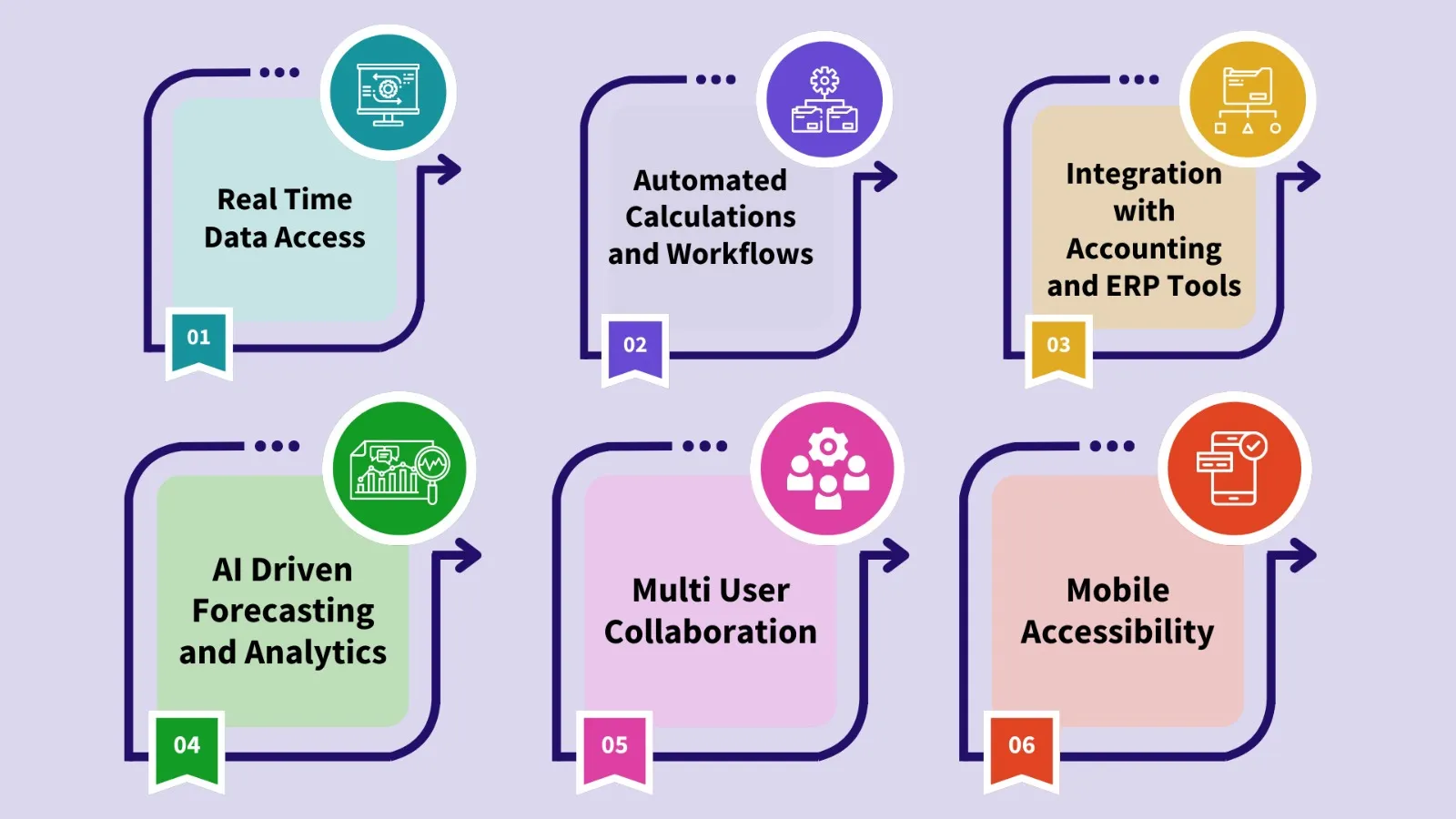
Budgeting speeds up when tools remove friction from everyday financial work. Well designed cloud based financial management software brings together several practical capabilities that help teams plan, adjust, and execute budgets without delays. Each feature contributes in its own way, and together they reshape how finance teams operate.
Real Time Data Access
Financial data enables real-time access which affects organizational decision-making processes. The teams now receive immediate data updates instead of waiting until the end of each week when updates occur. The custom enterprise software development services monitors spending patterns in real-time which enables them to modify their strategies. The system provides immediate information which enables managers to handle unplanned cost or revenue changes without impacting their entire planning process.
A dependable cloud financial software solution enables all users to access the latest data which helps organizations maintain clarity and complete their tasks promptly throughout their different departments.
Automated Calculations and Workflows
Financial planning processes become more efficient when organizations use automated systems because they eliminate the need for manual calculations which create potential errors. The software resolves this problem by using automation to perform all repetitive procedures without human intervention. The budget total updates itself whenever data changes while the system creates reports at predetermined times and approval tasks progress without the need for continuous monitoring.
Automation within a cloud financial management system enables finance teams to handle administrative tasks while they conduct research on financial patterns and develop organizational plans.
Integration with Accounting and ERP Tools
Budgeting accuracy improves when different systems establish communication links with each other. Financial planning requires access to accounting information and payroll data and operational performance data. The integrated cloud based financial planning software enable automatic data exchange between different systems, which eliminates the need for manual data entry operations that occur between different software applications.
Organizations partner with finance software development companies to develop custom-built enterprise software solutions, which enable them to connect their existing financial systems through specialized software development services, while maintaining seamless data flow and accurate financial reporting.
AI Driven Forecasting and Analytics
The value of forecasting increases when tools use their capacity to interpret historical data. AI technology detects market patterns which it uses to find market anomalies while predicting future market trends. The guidance enables teams to evaluate various scenarios while they track potential results before resource allocation.
Companies that establish partnerships with AI/ML development firms acquire better forecasting abilities which help them identify potential risks and opportunities during their budget development process.
Multi User Collaboration
The process of budget planning needs input from multiple stakeholders instead of relying on a single person. Department directors and analysts together with executives share their insights. The collaborative cloud platform enables multiple users to work together in real time while they make comments about modifications and monitor document progress.
The cloud-based financial management software creates a shared workspace which helps teams to work together and eliminates version conflict problems which create confusion.
Mobile Accessibility
Leaders now have the ability to manage financial resources outside of their workplace environment. Mobile accessibility enables leaders to access financial reports and approve changes while they work in various locations. This cloud based financial accounting software maintains its active status because it functions beyond specific sites and business hours.
Integrating Cloud Based Financial Reporting Software with Existing Systems
Integration rarely sounds exciting at first, yet it plays a decisive role in how well financial tools perform in real business environments. Companies already rely on multiple platforms for operations, sales, and workforce management. When financial reporting tools connect smoothly with those systems, budgeting and analysis become consistent and reliable.
Strong integration ensures operational continuity. Teams avoid duplicating data, leaders access unified insights, and processes flow without interruption. That stability often shapes the success of adopting modern cloud based financial management software.
Common Systems Integrated with Cloud Reporting Tools
Financial reporting tools interact with several foundational platforms across organizations. Integration with ERP systems allows budgeting data to reflect procurement, production, and supply chain activity. When connected to CRM platforms, financial teams understand revenue pipelines and customer related spending patterns.
Accounting software connections strengthen record accuracy by synchronizing transactions and ledgers, while HR and payroll platform integration ensures workforce costs align with planning forecasts.
Together, these connections create a holistic view of financial performance within a cloud based financial planning software ecosystem that supports coordinated decision making.
Integration Approaches and Best Practices
Organizations approach integration differently depending on their technical infrastructure and long term strategy.
APIs enable direct communication between applications and allow real time data exchange
Middleware solutions act as intermediaries that translate and route information between platforms
Data synchronization tools align records across systems at scheduled intervals
Many enterprises partner with a finance software development company offering custom enterprise software development services to tailor these approaches according to operational complexity. Integration works best when handled methodically rather than rushed into deployment. Teams usually begin by assessing existing infrastructure, identifying dependencies, and clarifying integration objectives.
Next comes data mapping and migration, where information structures align across systems to maintain accuracy. Testing and validation follow to confirm functionality under real operational conditions. Finally, user training ensures employees understand workflows and adopt new processes confidently.

Why Choose AppZoro for Cloud Based Financial Management Solutions
Choosing technology alone does not transform financial operations. The partner behind the implementation often determines whether organizations see real value or struggle through fragmented adoption. Businesses need a team that understands financial workflows, system architecture, and long term scalability. AppZoro steps into that role with a practical, outcome focused approach that goes beyond surface level deployment.
Instead of offering generic packages, our fintech mobile app development company works closely with organizations to design solutions that align with their budgeting processes, reporting needs, and operational structure. This approach allows companies to extract measurable value from cloud based financial management software while maintaining continuity across existing systems.
Industry Expertise and Solution Flexibility
AppZoro brings hands on experience across industries where financial clarity directly influences performance. Their teams examine how finance actually functions inside an organization before building or implementing tools. They analyze workflows, identify inefficiencies, and create solutions that strengthen everyday decision making rather than adding technical complexity.
This flexibility allows businesses to implement customized environments that reflect real operational demands. By adapting platforms to fit organizational processes, AppZoro helps clients unlock the full potential of cloud based financial software without forcing teams to reshape established practices.
Scalable Architecture and Integration Capabilities
Growth rarely follows a predictable pattern, and financial systems must keep pace. AppZoro designs architecture that evolves alongside business expansion, ensuring tools remain effective as data volume, user access, and reporting needs increase. Companies avoid disruptive replacements because their infrastructure adapts naturally.
Integration represents another strength. AppZoro connects ERP, CRM, and reporting platforms to create cohesive financial ecosystems. These integrations support seamless data flow and consistent visibility, enabling organizations to operate within a unified cloud based financial management solution environment that strengthens strategic planning.
Comprehensive Service Offerings
AppZoro supports clients throughout the lifecycle of financial technology adoption, ensuring guidance extends beyond initial deployment. Their services typically include:
Strategic implementation and configuration of financial platforms
Data migration support that protects legacy information integrity
Continuous maintenance and optimization
Security and compliance alignment for regulated environments
This breadth of capability positions AppZoro as more than a vendor. It reflects the reliability organizations expect from a trusted finance software development company delivering dependable custom enterprise software development services.
Differentiators That Deliver Real Impact
What distinguishes AppZoro lies in how they approach collaboration and innovation. Their engagement model prioritizes transparency, communication, and measurable outcomes. Clients participate in solution shaping rather than receiving rigid frameworks.
Their technology expertise extends into advanced analytics and automation. Organizations seeking predictive insights benefit from AppZoro's ability to integrate intelligent capabilities similar to those offered by leading AI/ML development company environments, enhancing forecasting and financial visibility.
Experience and execution reinforce these strengths. A consistent track record of improving operational efficiency, accelerating reporting cycles, and increasing financial transparency positions AppZoro as a trusted partner for companies pursuing digital transformation through cloud based financial management software.
Conclusion
Financial planning no longer revolves around static spreadsheets or delayed reporting cycles. Organizations operate in environments where decisions demand speed, clarity, and accuracy. Throughout this discussion, one theme keeps surfacing. Modern tools reshape budgeting not only by improving efficiency, but also by changing how teams approach financial strategy.
Adopting cloud based financial management software allows organizations to centralize information, automate routine work, and collaborate across locations without friction. Teams gain better control over forecasting, reporting, and resource allocation, which leads to smarter planning. Over time, the strategic value becomes clearer. Companies adjust budgets as markets shift, scale infrastructure as they grow, and explore predictive capabilities through collaboration with an experienced AI/ML development company.
This is where choosing the right technology partner makes a real difference. AppZoro supports organizations looking to modernize their financial operations through tailored digital solutions. Their experience in building scalable financial platforms, integrating analytics, and delivering adaptable architectures helps businesses transition confidently toward cloud driven environments. By aligning tools with operational goals rather than forcing rigid implementation models, AppZoro ensures companies gain measurable value from their investment.