Embedded Software Development 2026: How The Hard Part Was Never the Code

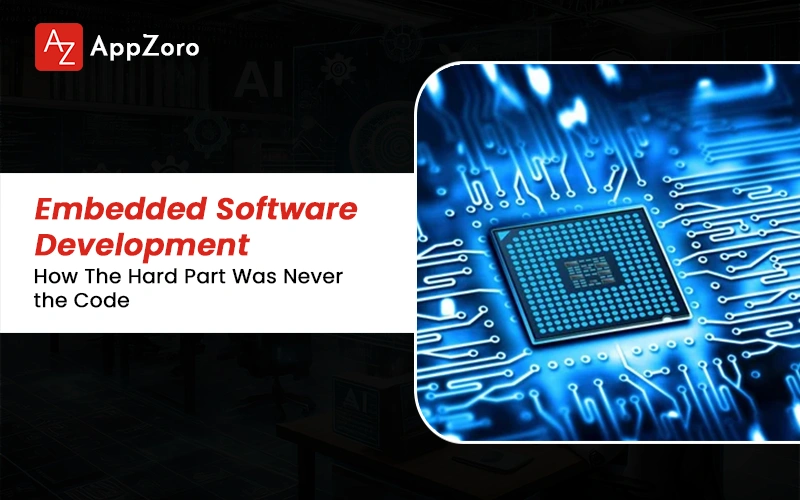
I once spent nine days chasing a bug that only showed up after a device had been running for about a week. No crash, no error, just a sensor that quietly started lying. Turned out to be an integer overflow in a counter nobody expected to ever get that high. That week taught me what embedded software development actually is and it isn’t typing clever code. It’s living inside constraints that a web developer never has to think about and respecting hardware that will absolutely punish you for forgetting them.
People picture this work as “programming but for gadgets.” Close but the gap matters. On a server, you can throw more RAM at a problem or restart the thing when it misbehaves. On a microcontroller with 256 kilobytes of memory, soldered into a product that’s already in a customer’s wall, you get neither luxury. You get one shot and the code has to be right the first time.
So let me lay out what’s really going on in this field right now, where the money and the danger sit and why the languages everyone argues about online are the least interesting part of the story.
What Embedded Software Development Really Means in 2026
Strip away the buzzwords and embedded software development is the craft of making code behave perfectly on hardware that gives you almost nothing to work with. Tiny memory, a slow clock, a battery that has to last years and timing deadlines measured in microseconds.
The market for this keeps swelling, from around $103 billion in 2024 toward a projected $169 billion by 2030, because everything now has a chip in it, from your toothbrush to the grid.
A few things separate this work from ordinary software and they shape every decision you make:
-
The hardware is unforgiving. You can’t just add memory or spin up another server when something gets tight.
-
Timing is sacred. A motor controller that responds 5 milliseconds late isn’t slow, it’s broken and possibly dangerous.
-
Updates are hard or impossible. Plenty of devices ship and never get patched, so the code has to survive on its own for years.
It’s Constraints First, Code Second
The mental shift that trips up newcomers is that the limits come before the logic here. You design around the memory budget, the power draw and the worst-case response time and only then do you write the feature. I’ve thrown away perfectly elegant code because it allocated memory at the wrong moment. On a desktop nobody would notice. On a device that has to run untouched for a decade, that allocation is a time bomb.
Why Debugging Is Most of the Job
Here’s where embedded software development stops looking like normal programming. You often have no screen, no console and no easy way to see what the device is thinking.
You’re reading blinking LEDs, poking at pins with an oscilloscope or staring at a logic analyzer trying to reconstruct what happened in the microseconds before everything froze. The coding is maybe a third of the work. Finding out why the hardware did something weird at 3am is the rest.
Embedded Systems Software Development and the Language You Pick
Ask any room about embedded systems software development and within a minute they’ll be arguing about C versus C++ versus Rust. It’s a fun fight but it’s mostly downstream of the real question, which is how much safety and how much control your device actually needs.
Most teams I know aren’t choosing one language. They’re mixing them, deliberately, based on which part of the system can hurt someone if it goes wrong.
Here’s roughly how the main options stack up for embedded systems software development in 2026:
|
Language |
Best for |
2026 reality |
Trade-off |
|
C |
Bare-metal, tiny MCUs |
Still the default, runs everywhere |
Easy to shoot your own foot |
|
C++ |
Complex, performance-critical |
Battle-hardened, deeply entrenched |
Heavier, more to misuse |
|
Rust |
Safety-critical, networking |
Up ~15% in embedded in a year |
Smaller talent pool, learning curve |
|
MicroPython |
Prototyping, hobby, scripting |
Great for fast experiments |
Too slow for hard real-time |
The pattern worth noticing is the hybrid one. Most 2026 projects keep their proven C code and wrap a “Rust shell” around the riskiest parts, usually the networking stack, where memory bugs turn into security holes. Chip vendors are leaning in too, with Espressif officially supporting Rust and STM32 and Nordic building real communities around it.
Why C Refuses to Die
People keep predicting the death of C in this space and they keep being wrong. It maps almost directly onto the hardware, every microcontroller has a C compiler and forty years of drivers and libraries are written in it. The downside is the one everyone knows: it trusts you completely, including when you’re about to write past the end of an array. That trust is exactly why the safety-critical world is slowly, carefully bringing in Rust beside it.
Automotive Embedded Software Development: Where the Stakes Get Real
If you want to see embedded work under maximum pressure, look at automotive embedded software development. A modern car runs tens of millions of lines of code across dozens of controllers and some of that code decides whether the brakes engage.
The industry’s whole shift toward the “software-defined vehicle” means the car is becoming a computer on wheels, which is thrilling and a little terrifying depending on how much you trust the code.
This is why automotive embedded software development is wrapped in standards that don’t exist anywhere else in software. A few are worth knowing by name:
-
ISO 26262, the functional safety standard that governs how anything that could cause harm gets designed, written and tested.
-
ISO 21434, which covers cybersecurity, because a connected car is now a target, not just a vehicle.
-
ISO 8800, newer and aimed squarely at the safety of AI and machine learning as those systems move into driving decisions.
Safety Standards Change How You Write Every Line
In a normal app, you ship, watch for bugs and patch. In a brake controller, you can’t work that way and ISO 26262 makes sure you don’t. You document the hazards, you trace every requirement to test and you justify design choices that on a website would be obvious. It feels slow and bureaucratic until you remember the failure mode is a crash, not a 500 error. That mindset sits at the heart of serious embedded software development at this level and it’s why the field pays well and moves carefully.
Why Rust Is Quietly Entering the Car
The interesting recent move is Rust creeping into the vehicle. ETAS built a Rust toolchain called CARS for AUTOSAR and Elektrobit teamed up with QNX to use it for reliability and security. The automotive Rust market was worth around $428 million in 2024 and is projected to hit $2.1 billion by 2033. That’s not hype, it’s engineers betting that compile-time safety beats catching memory bugs after a recall.
Software Development for Embedded Systems vs. Building a Normal App
People who cross over from web or mobile work are often blindsided by how different software development for embedded systems feels. The skills overlap less than you’d think.
You’re not reasoning about users and screens, you’re reasoning about interrupts, registers, clock cycles and a real-time operating system juggling tasks that all think they’re the most important.
When you actually sit down to do this work, a handful of realities reshape everything:
-
Real-time operating systems run the show, which is a major factor in telecommunication software development where missing critical millisecond deadlines can compromise an entire network.
-
Memory is something you manage by hand and watch like a hawk, because no garbage collector is coming to save you.
-
You test on real hardware, not just a simulator, because the device always behaves slightly differently than the model said it would.
The Edge AI Twist Nobody Saw Coming
This shift aligns with the latest trends in software development, where engineering teams are increasingly squeezing machine learning onto chips that barely have room for it. With TensorFlow Lite for Microcontrollers and tricks like INT8 quantization, a sensor with kilobytes of memory can now run a trimmed neural network and spot a failing bearing before it seizes. It’s genuinely clever work and it’s opening jobs that didn’t exist three years ago.
Why Software Development in Embedded Systems Work Rewards Patience
Good software development in embedded system projects rewards a different temperament than web work does. You can’t move fast and break things when “things” is a medical pump or a factory robot. The engineers who thrive here are the ones who enjoy reading datasheets, who get satisfaction from shaving a few bytes off a build and who don’t mind that a single feature might take weeks to get genuinely right. It’s slower. It’s also the work that keeps planes in the air.
Before you scope a device project on a web-app budget, understanding how much custom software development costs in the physical realm is essential, as the debugging, the safety work and the hardware testing hide where nobody thinks to look.
If you’re planning a connected product, partnering with an experienced custom software development company can help you identify realistic engineering timelines before you commit to hardware production.
Final Thoughts
After years around this work, my honest take is that embedded software development is one of the last corners of programming where you can’t fake your way through. The hardware doesn’t care about your framework or your hot takes. Either the device runs for ten years on a coin cell without freezing or it doesn’t and the gap between those two outcomes is craft.
The field is changing in ways that genuinely excite me. Rust is making safety-critical code less scary, edge AI is putting intelligence into things that used to be dumb and cars are turning into rolling software platforms. None of that removes the fundamentals, though. Constraints first, timing is sacred and the device has to survive on its own once it ships.
If you’re moving into this from another kind of development or scoping a product that has a chip at its heart, talk to someone who has actually shipped hardware and watched it fail in the field. The lessons here are expensive to learn the hard way and a good partner will save you the nine-day bug hunt I had to live through myself.
Frequently Asked Questions
What is embedded software development, in plain terms?
It's writing the code that runs inside physical devices, usually on small, constrained hardware that has strict timing rules and often can't be updated once it's out in the world.
How is embedded systems software development different from app development?
It deals with tiny memory, real-time deadlines and direct hardware control, so you manage resources by hand and test on actual devices instead of reasoning about users and screens.
Which programming languages dominate embedded work in 2026?
C and C++ still run most of it, while Rust is rising fast for safety-critical and networking code, usually added alongside existing C rather than replacing it outright.
What does software development for embedded systems involve day to day?
Expect a real-time operating system, manual memory management, talking directly to hardware registers and a lot of debugging with tools like oscilloscopes and logic analyzers.
Can microcontrollers really run AI now?
Yes. Edge AI now lets trimmed and quantized models run on chips with only kilobytes of memory, handling tasks like anomaly detection or voice recognition without ever touching the cloud.
What's the hardest part of software development in embedded system projects?
The hardest part is usually debugging, since you often have no screen and no logs and you have to reconstruct failures that only show up after days of continuous running.