
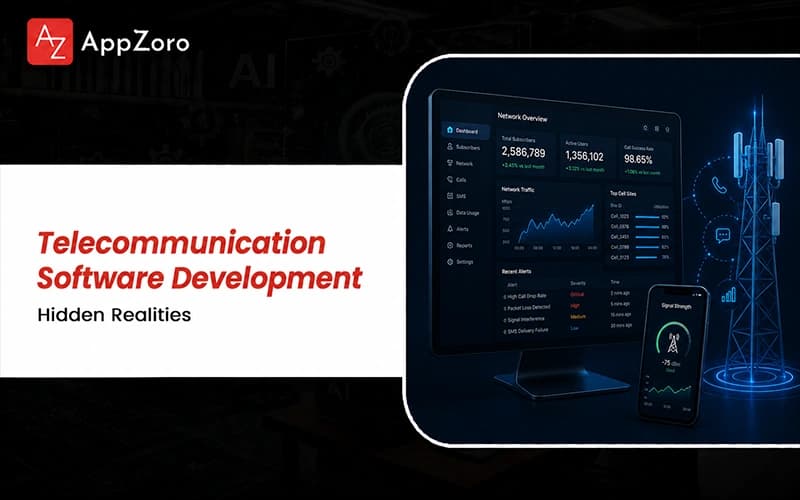
Quick Answer: Telecommunication software development is the work of building the systems that run communication networks and the businesses behind them, from provisioning and billing to network monitoring and customer apps. In 2026, that means cloud-native OSS and BSS, integration with standardized network APIs like CAMARA and AI that helps networks watch and increasingly heal themselves. Budgets run from around $60,000 for a focused tool to well past $400,000 for carrier-grade platforms, since reliability and integration drive most of the cost.
For a deep dive into pricing models, read our analysis on how much custom software development costs.
Picture a telecom operations room on any random morning during an outage, where thousands of alarms scroll past faster than any human can read them. The team is not short on data; they are drowning in it and the single alarm that actually matters is buried somewhere in the flood.
That scene is the quiet reason telecommunication software development has changed so much, because the old habit of adding more dashboards stopped scaling years ago. The category is unusually unforgiving, because telecom software sits at the point where a dropped call, a wrong bill or a minute of downtime reaches millions of people at once.
Reliability is not a nice-to-have in this world; it is the entire job and most teams badly underestimate just how high that bar really sits. What follows reads less like a vendor pitch and more like the conversation you would have with someone who has shipped systems inside real carriers. By the end you will know what the work truly demands, where the cheap shortcuts break and how the strongest teams keep the network honest.
What Telecommunication Software Development Actually Involves in 2026
If you have looked into telecommunication software development and pictured a slick customer app, that app is honestly the easy ten percent.
A serious telecommunication software development build sits behind it, in the operations and business support systems that provision services, rate usage and keep the network standing.
A serious build in 2026 has to get a few unglamorous layers right before any customer ever notices.
An OSS layer that handles provisioning, network monitoring and fault management, so a problem gets caught and ideally fixed before a customer feels it.
A BSS layer covering billing, rating and customer management, where a single charging error multiplied across millions of accounts becomes a very public disaster.
A network and integration layer that speaks the protocols carriers actually use, from SIP and Diameter to the newer CAMARA network APIs.
The OSS and BSS Backbone Nobody Sees
Most telecom value lives in two acronyms the public never hears, the operations support and business support systems that run the carrier behind the scenes. OSS handles the network itself, the provisioning, monitoring and assurance, while BSS handles the money, the billing, rating and customer relationship. Get either one wrong and the damage is immediate and enormous, since both touch every subscriber on the network at the same time.
Why Carrier-Grade Reliability Changes Everything
Telecom runs on the idea of five nines, meaning 99.999 percent uptime, which leaves a budget of roughly five minutes of downtime across an entire year. That single number reshapes every engineering decision, from redundancy and failover to how cautiously you dare to deploy a change. A team used to ordinary web uptime is in for a shock the first time a five-minute blip turns into a regulatory conversation.
Software Development in Telecommunication: How It Really Works
If you want software development in telecommunication to go smoothly, the order of the work matters far more than the language or cloud you pick. The teams that ship cleanly settle the standards, the protocols and the integrations first, long before they build anything a user will touch.
A realistic project tends to move through a few clear stages and the part founders underestimate almost always sits near the start:
Pinning down the standards the system must speak, since SIP, Diameter and the TM Forum APIs leave very little room for creative interpretation.
Mapping the integrations into existing OSS, BSS and network systems, because a carrier never lets a new tool break the stack it already runs on.
Building and certifying for reliability, then proving the system holds under real traffic rather than the gentle load of a quiet demo.
Why Standards and APIs Come First
The fastest way to stall a telecom build is to design in isolation, then discover the carrier expects strict TM Forum or 3GPP conformance. Standards are not bureaucracy here, they are the only reason a phone on one network can reach a phone on another at all. The bright spot is CAMARA, whose 2025 release of sixty stable network APIs finally made the network itself something developers can program against cleanly.
The Integration Reality of Legacy Systems
No carrier runs on a clean slate, so most work means integrating with systems older than some of the engineers now touching them. A new tool has to fit alongside billing platforms, provisioning systems and network equipment that nobody can simply switch off for an upgrade. Senior teams plan for that constraint from day one, because pretending the legacy stack does not exist is how telecom projects quietly die.
If you are working with hardware-level infrastructure, our embedded software development guide provides more technical detail on managing firmware integrations
Custom Software Development for the Telecommunications Industry vs Off-the-Shelf
At some point every operator weighs custom software development for telecommunications industry needs against the large suites from vendors like Amdocs, Netcracker or Oracle.
Off-the-shelf platforms cover huge ground and arrive battle-tested, yet they are heavy, costly to customize and slow to bend to a smaller operator's ideas. Here is roughly how experienced teams weigh the two paths when planning a new system in 2026:
Factor | Custom Build | Off-the-Shelf Suite |
Time to first launch | Slower, shaped to your network | Faster, broader features ready |
Fit to your operation | Matches your exact processes | You adapt to the vendor's model |
Cost shape | Higher upfront development | Large licenses plus heavy services |
Flexibility | You own the roadmap | Vendor and release cycle rule |
Reliability proof | You have to earn it | Carrier-grade track record |
Best fit | Niche, agile or differentiated needs | Large incumbent operators |
For a large incumbent carrier, a proven suite often wins despite the cost, because the reliability track record alone is worth a great deal. Custom software development for telecommunications industry players makes more sense for agile operators and niche services, where owning the roadmap beats inheriting a vendor's.
Where AI Software Development Meets Telecommunications
AI has moved from pilot to backbone in telecom and serious AI software development in telecommunications now targets the network operations that used to drown teams in alarms. This shift represents some of the latest trends in software development where systems are designed to be self-optimizing.
The goal is no longer a chatbot bolted onto support, it is a network that watches, predicts and increasingly heals itself without waiting for a person.
The strongest teams point AI at the jobs where the payoff is large and genuinely measurable:
AIOps that cuts through alarm noise, finds the one real fault in a storm of alerts and closes the loop without waiting on a tired engineer.
Churn and fraud models that flag a leaving customer or a stolen account early, where every percentage point recovered becomes real annual revenue.
Capacity and network optimization that predicts demand and reroutes traffic, so quality is maintained during the spikes that used to cause outages.
AIOps and the Self-Healing Network
The dream the industry now chases is the self-healing network, one that spots a developing fault, diagnoses it and corrects it before a customer ever notices. Agentic AI pushes this further, acting in near real time rather than just flagging a problem for a tired engineer to chase down later. An AI software development telecommunications project aimed here can cut both downtime and the high operational cost of chasing false alarms.
AI for Revenue, Not Just Operations
AI earns its keep on the business side too, where churn prediction and fraud detection protect revenue that quietly leaks away every month. A model that flags a likely cancellation in time for a real offer pays for itself across millions of subscribers many times over. Used with care, that intelligence turns raw network and billing data into decisions, instead of a dashboard nobody finds the time to read.
If you have a quote for telecommunication software development or a vendor proposal on your desk, our senior team is glad to give it a straight, no-pressure second opinion on reliability, standards and the integration plan. We review work like this most weeks and would far rather flag the costly gaps now than after a carrier-grade launch wobbles.
Final Thoughts
Telecommunication software development in 2026 rewards teams that respect reliability and standards far more than teams chasing the slickest possible interface. The systems that last are the ones built carrier-grade from the start, fluent in the protocols and ready to integrate with a stack that has run for decades.
The winners in telecommunications software development are rarely the platforms with the busiest demo shown off at an industry conference. They settle standards early, design for five nines, plan the legacy integration and aim AI at the network and revenue problems that genuinely move the needle.
Telecommunication software development is hard to judge from a proposal alone, so ask someone who has shipped inside a real carrier where the scope looks suspiciously thin. A good partner walks you through OSS, BSS and the standards without flinching, because they have seen exactly where these builds tend to break.
Leave a Comment