
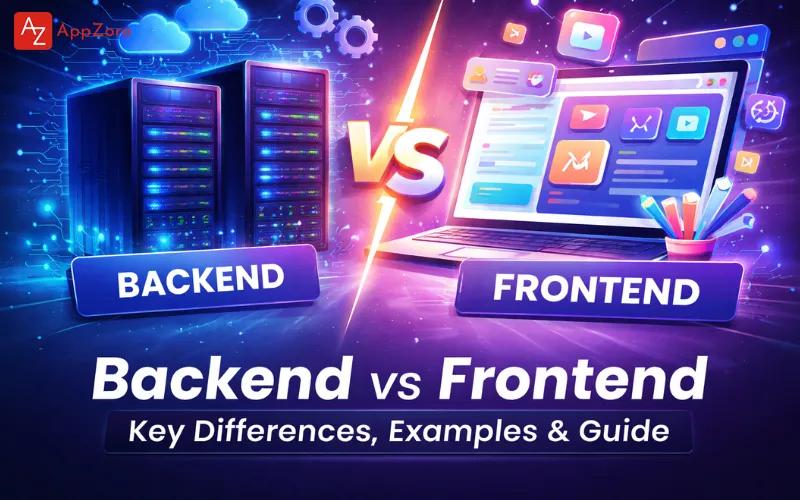
If you are new to software engineering, the terms backend vs frontend pop up everywhere, and it is perfectly normal to feel a little lost about what each side actually does. This guide explains the concept for web, mobile, and software products in plain language, with real examples you already use every single day.
Backend vs Frontend: The Short Answer
Frontend is what you see and tap inside any website or application, while backend is every server, database, and API that powers what you see. In a food delivery app, the restaurant list, menu screens, and checkout buttons are frontend, while the pricing engine, order routing, and payment processing all live on the backend. The backend vs frontend difference is really about visible work versus invisible work, and modern software products need both sides to succeed together equally.
Aspect | Backend | Frontend |
What it does | Runs servers, stores data, processes logic | Draws UI, handles input, shows results |
Where it runs | Cloud servers, containers, databases | Browser, phone, desktop application |
Languages | Node.js, Python, Java, Go, .NET | JavaScript, TypeScript, Swift, Kotlin, Dart |
What users see | Nothing directly, only results | Everything, all the time |
Failure looks like | Slow responses, errors, outages | Broken UI, crashes, confusion |
Hiring cost (2026) | 10-15% higher than frontend | Competitive but more widely available |
Market Overview: Why Backend and Frontend Development Both Matter in 2026
Let's zoom out for a moment and look at a handful of numbers that explain every backend vs frontend development decision teams are making during planning and budgeting this year.
Global digital application revenue is projected to exceed nine hundred thirty-five billion dollars in 2026 across web, mobile, and embedded commerce categories combined.
Stack Overflow's developer survey consistently places JavaScript, Python, and Java among the most-used languages inside backend and frontend engineering work worldwide every single year.
Backend-as-a-service platforms like Firebase, Supabase, and AWS Amplify now power a significant share of new web and mobile launches across startups and mid-market teams today.
API-first architectures have become the default across serious software programs, because web, mobile, and desktop clients all consume the same shared backend contracts consistently.
Backend engineers command ten to fifteen percent higher average compensation than frontend engineers across most North American and Western European talent markets across 2026.
Frontend frameworks like React, Vue, SwiftUI, Jetpack Compose, Flutter, and React Native now ship real production apps at scale across every consumer category worldwide today.
Notice how interdependent the two sides really are, because you cannot succeed in one without investing meaningfully in the other across the full software lifecycle. The frontend vs backend development economics are tightly linked, and once you see the connection, every scoping conversation becomes far easier to understand and manage.
What Is Backend vs Frontend Development in Software Products
Let's build a clear mental model first, because what is backend vs frontend development becomes much easier to reason about once you have simple definitions to anchor the vocabulary.
Frontend is everything the user actually sees and touches, including screens, navigation, animations, gestures, forms, and the small bits of state living inside a single application client.
Backend is every server, database, queue, API, and authentication service that powers the client from behind the scenes across network calls and background jobs consistently.
API contracts are the formal agreement between the two sides, describing request shapes, response schemas, tokens, and error behaviors that both teams must respect across releases.
BFF, which stands for Backend for Frontend, is a pattern where a thin backend service shapes data specifically for one client rather than sharing a generic web API.
DevOps, observability, and data infrastructure all sit quietly behind the backend and decide how reliably your product actually performs under real user traffic every single day.
The backend vs frontend difference in any software product is mostly about ownership rather than importance, because no application can ship without both sides collaborating under a single shared contract. When students first learn about this, the frontend dev vs backend dev split often feels like a simple divide, but you'll see in practice that the boundary is more like a handshake than a wall.
Frontend relies heavily on modern frameworks and tooling and choosing the right stack becomes easier when you explore the best front-end development tools, while backend performance depends on selecting the best back-end web development tools for scalability.
Backend vs Frontend: Simple Examples You Already Know
Let's ground the concept in examples you already use every day, because real products often teach the backend vs frontend boundary faster than any textbook definition ever does.
Food delivery apps like Uber Eats or DoorDash: the restaurant cards, cart, and checkout screens are frontend, while order dispatch, restaurant inventory, pricing engine, and driver matching all run inside the backend.
Instagram: photo feeds, stories, likes, DMs, and reels scrolling are frontend, while content ranking, recommendation algorithms, media storage, and notification delivery all live inside the backend layer.
WhatsApp: the chat screen, contact list, voice call UI, and status updates are frontend, while encryption key exchange, message routing, media storage, and delivery acknowledgments all happen on the backend.
Netflix: the video player, movie grid, and profile selector are frontend, while transcoding pipelines, catalog metadata, recommendation systems, and subscription billing all sit inside the backend.
Online banking apps: every account balance, transaction list, and transfer button you tap is frontend, while fraud detection, ledger updates, compliance reporting, and identity verification all run on the backend.
These examples show the backend vs frontend difference in a way that really sticks, because you already use each product and you can almost feel which parts are visible versus hidden. When someone asks you what is backend vs frontend development, you can answer with any of these apps and explain exactly which pieces sit on which side of the invisible line.

Core Backend vs Frontend Difference Across Real Product Work
Now let's look closely at how the frontend vs backend difference actually shows up inside real delivery, because the theory only becomes useful when you can map it onto everyday product work.
Frontend owns perceived quality, which includes animations, responsiveness, and polish that shape user retention and app-store or website ratings during the first twelve months of launch.
Backend owns actual quality, including correctness, security, data integrity, and performance under concurrency, which together shape user trust and your long-term regulatory posture across markets.
Frontend iterates quickly because web deploys and store releases happen every week or two, while backend iterates slower because deployments carry migration and compatibility risk every time.
Backend carries more permanent cost, because once your data models and API contracts go live, changing them later forces migrations across every client already installed in the wild.
Frontend carries more visible cost, because polish demands designer hours and ongoing platform-specific work on web, iOS, and Android as those platforms evolve every single calendar year.
Here's the lesson most teams learn the hard way: the backend vs frontend difference in practice means frontend mistakes are usually cheap to fix, while backend mistakes quietly compound across time and the entire user base. Once you internalize this asymmetry, you'll allocate senior engineering hours differently in the early months, which is the exact period where most products lock in their long-term architectural trajectory.
Six Factors That Shape Every Backend vs Frontend Development Decision
Let's turn theory into a simple scorecard, because the backend vs frontend investment balance becomes much less mysterious when you break it into six measurable factors that any team can evaluate.
Expected scale, which includes peak concurrent users, transactions per second, and total data volume across the first eighteen months of production life under realistic load.
Integration depth with existing ERPs, CRMs, payment gateways, identity providers, and legacy systems across your broader enterprise technology portfolio over the long term consistently.
Regulatory posture covering HIPAA, PCI-DSS, GDPR, SOC2, and other compliance controls that almost always push more investment toward backend than toward frontend during delivery.
Experience fidelity, which captures animation richness, offline support, and device-specific polish that demand heavy frontend engineering and real designer collaboration across every release cycle.
Release cadence, which decides how often the frontend ships to stores or browsers and how often the backend migrates data without downtime across staging and production environments.
Team composition and the backend vs frontend developer ratio your organization can realistically sustain across the first two years of hiring, onboarding, and feature delivery cycles.
Rate each factor from one to five for backend and for frontend separately, then compare the totals to see which side genuinely needs more investment during the current quarter. This is exactly the kind of exercise I would have you run in a classroom if you were scoping your first software product, because the numbers remove the emotional debate and reveal where the real engineering weight sits.
If you're unsure about team structure or execution, this guide on how to choose the best mobile app development company in USA can help you make the right decision.
Backend vs Frontend Developer Roles and the Hiring Market Today
The frontend vs backend developer hiring market shapes delivery timelines and cost almost as much as the underlying technology choices do, and learning the hiring landscape is a core part of understanding how software products actually get built.
Backend engineers typically specialize in one primary language like Node.js, Python, Go, Java, or .NET, plus one cloud platform like AWS, Google Cloud, or Azure.
Frontend engineers usually specialize in web through React, Vue, or Angular, native iOS through Swift, native Android through Kotlin, or cross-platform frameworks like Flutter or React Native.
The backend vs frontend developer compensation gap runs roughly ten to fifteen percent in favor of backend engineers across most North American and Western European talent markets consistently.
Frontend developer candidates are easier to find at junior levels, while backend developer candidates require more sourcing effort especially at senior and staff levels across 2026.
Full-stack engineers do exist, but in smaller numbers, and they usually lean stronger on one side than the other despite the generalist label on their resume during interviews.
The frontend dev vs backend dev hiring split inside any software program should match the product's long-term priorities rather than the founder's background or current comfort zone during planning. If you remember one thing from this section, remember that over-hiring one side early almost always forces a painful rebalance during the first funding round when real user load starts pressuring the system. Many companies choose to partner with a trusted mobile app development company in USA instead of building in-house teams to balance frontend and backend expertise.
Step-by-Step Framework for Balancing Backend vs Frontend Development
Let's walk through a six-step framework together, because a repeatable process is far more useful than vague advice when you're actually scoping a software product from scratch.
Before balancing frontend and backend responsibilities, it helps to understand the full mobile app development process from planning to deployment, because every decision you make here impacts both sides of the architecture.
Step 1: Map every user-facing feature to the backend capability it requires, and flag features with heavy integration, data, or security weight for extra planning attention.
Step 2: Estimate peak traffic, data volume, and concurrency across the first eighteen months of production, then validate those numbers against realistic market penetration and growth assumptions.
Step 3: Pick a backend architecture pattern like monolith, modular monolith, microservices, or BFF that matches your expected scale rather than whichever pattern looks most impressive.
Step 4: Lock API contracts before designing the final UI screens, because frontend work will always bend around backend constraints rather than the other way around during delivery.
Step 5: Allocate senior engineering hours roughly sixty-forty toward backend for enterprise programs, then shift by ten to fifteen points for consumer-heavy experiences that emphasize polish.
Step 6: Staff observability, logging, and monitoring from day one rather than bolting them on after launch, because diagnosing issues without tracing costs far more engineering time later.
Score each step from one to five based on your current readiness state, then add the totals to see where your program genuinely needs attention before the next sprint or release cycle. A disciplined frontend vs backend web development balance at this stage avoids the classic classroom-level mistake of letting visible frontend progress mask invisible backend technical debt accumulating silently.
Technology Stack Comparison for Backend vs Frontend Development
Let's look at the concrete tools each side uses, because seeing the stacks side by side makes the backend vs frontend development boundary feel much more tangible and easier to remember clearly.
Layer | Backend | Frontend |
Language | Node.js, Python, Go, Java, .NET | JavaScript, TypeScript, Swift, Kotlin, Dart |
Framework | Express, NestJS, Django, FastAPI, Spring Boot | React, Vue, Angular, SwiftUI, Jetpack Compose, Flutter |
Data Storage | PostgreSQL, MySQL, MongoDB, DynamoDB, Redis | localStorage, Core Data, Room, IndexedDB, DataStore |
API Pattern | REST, GraphQL, gRPC, WebSockets | Fetch, Axios, URLSession, Retrofit, Apollo, TanStack Query |
Authentication | OAuth2, OpenID Connect, JWT, API gateways | Secure cookies, Keychain, EncryptedSharedPreferences |
Infrastructure | AWS, GCP, Azure, Kubernetes, serverless functions | Vercel, Netlify, Xcode Cloud, Bitrise, GitHub Actions |
Observability | Datadog, New Relic, Grafana, Sentry backend SDK | Sentry browser SDK, Firebase Crashlytics, browser DevTools |
Backend stacks go deeper into infrastructure and data concerns, while frontend stacks go deeper into rendering, gestures, and design fidelity across web, iOS, and Android platforms worldwide. The lesson here is simple: pick a stack on each side that matches your long-term hiring pipeline and target infrastructure, rather than chasing whichever framework happens to be trending loudly this quarter.
Frontend frameworks like React, Vue, and Angular dominate modern UI development, and understanding the front-end frameworks for web development helps teams choose the right approach.
Cost and Timeline Breakdown for Backend vs Frontend Development
Now let's walk through realistic numbers together, because understanding real budgets helps you reason about every backend vs frontend development decision with far more confidence than abstract guesses.
Complexity | Backend | Frontend (Web + Mobile) | Combined | Timeline |
MVP | $35K-$70K | $55K-$115K | $90K-$185K | 12-18 weeks |
Mid-Complexity | $80K-$170K | $115K-$255K | $195K-$425K | 18-28 weeks |
Feature-Rich Product | $170K-$380K | $255K-$525K | $425K-$905K | 28-42 weeks |
Enterprise-Grade | $380K-$850K | $525K-$1M+ | $905K-$1.85M+ | 42-62 weeks |
Backend investment is usually smaller in absolute dollars on most engagements, but it has a disproportionate impact on scalability, architecture, and compliance posture across every software product category today. Frontend investment tends to be larger because it often duplicates work across web, iOS, and Android teams, or pays for Flutter and React Native expertise when a cross-platform delivery approach is chosen. The budget gap usually widens in year two, when user load, data complexity, and compliance audits force unexpected backend work that the original plan underestimated during scoping. For businesses planning scalable products, investing in professional web app development services ensures both frontend and backend are aligned from the start.
Common Challenges Across Backend vs Frontend Development
Every software program runs into the same friction patterns across both sides, and preparing for them in advance saves teams from avoidable rework during the first twelve months.
Backend challenges include schema evolution after launch, migration of in-flight data, and API versioning for older web or mobile clients still running out there in the wild.
Backend challenges include scaling problems during organic viral moments or heavy marketing launches, which often catch undersized infrastructure before the engineering team can respond quickly.
Frontend challenges include browser or operating system updates that break existing behavior, deprecated platform APIs, and review cycles that slow releases across multiple platforms consistently.
Frontend challenges include design debt that compounds when multiple designers contribute without a strict design system governing patterns, components, and interaction behaviors across the application.
Both sides face handoff friction during incidents, which often shows up as finger-pointing across teams rather than clean root-cause analysis rooted in shared logs and telemetry tooling.
Think of the fifteen to twenty percent time buffer as a safety net rather than extra slack, because teams that skip it consistently hit cost overruns and missed deadlines by month three. This pattern holds across the backend vs frontend development lifecycle regardless of vertical, company size, or the delivery model you choose at project kickoff.
When Backend Work Dominates and When Frontend Work Dominates
Let's apply everything you've learned so far to a few industries, because the backend vs frontend difference plays out differently in different verticals, and seeing real patterns will help you recognize them in your own work.
Backend dominates across fintech, banking, healthcare, insurance, regulated commerce, and multi-party marketplaces where data integrity and compliance drive most of the real engineering load.
Backend dominates across logistics, warehouse management, and IoT-heavy platforms where real-time data ingestion, event processing, and integration with physical systems drive most of the work.
Frontend dominates across consumer media, short-form video, creator tools, and social discovery apps where polish and responsiveness directly drive retention and viral growth over time.
Frontend dominates across gaming, augmented reality, and spatial computing products where rendering, input handling, and frame pacing matter more than raw backend complexity inside every session.
Balanced programs include retail and e-commerce, where both the commerce backend and the shopping frontend need meaningful investment to compete in saturated consumer categories every day.
If your product fits clearly inside one of those buckets, the frontend development vs backend development ratio should follow the category pattern closely rather than ignoring what the vertical genuinely demands. When nothing obviously fits your situation, run the six-factor framework and let the scorecard decide instead of an internal debate between engineers advocating their own side.
Future Trends Shaping Frontend vs Backend Development
Here are five shifts worth learning about today, because they will actively reshape the way teams structure their backend and frontend work across the rest of this decade.
Edge computing pushes backend work closer to users through CDNs and edge functions, which cuts latency for web and mobile clients across global deployments during peak traffic windows significantly.
Backend-as-a-service platforms like Firebase, Supabase, AWS Amplify, and Convex reduce initial backend effort for startups and mid-market apps across most standard consumer categories today.
On-device artificial intelligence is shifting inference to the frontend via Core ML, ML Kit, and browser WebGPU pipelines, which moves certain workloads from backend to device.
Type-safe API contracts through GraphQL, tRPC, and protobuf-based tooling reduce integration friction between backend and frontend teams across release cycles over time consistently.
Observability-first design now shares unified tracing across tools like OpenTelemetry, which eliminates the old finger-pointing culture between the two sides of serious software engineering programs.
The frontend vs backend web development conversation is increasingly informing mobile and desktop programs too, because modern teams borrow API contracts, component libraries, and observability patterns from web engineering culture deliberately. Most teams pick one architecture call per year and stick with it, rather than re-litigating frontend vs backend decisions every sprint across the product roadmap.
How AppZoro Technologies Helps Enterprises With Backend and Frontend Development
Let's ground everything in real examples, because you understand concepts far better when you can see them applied inside actual products shipped for real organizations across real industries. Convoy Transports runs on iOS and web for prisoner transport and off-duty officer enrollment, where identity handling, audit trails, and scheduling logic drove most of the backend engineering work across the delivery timeline.
Freedom Rideshare runs on iOS and Android for rideshare driver fleet rentals, and the build required a shared rental-state backend, regional inventory synchronization, and pricing logic exposed through consistent API contracts across both platforms. PoliSci is another iOS and Android build in the education and law-and-justice space, where accessibility compliance and content governance drove significant frontend work alongside the backend content platform powering everything behind the scenes daily.
Medcraze in healthcare, ADR Boost in hotel revenue management, and Cowork Oasis in events and community each treat the app as one surface of a larger system, with the heavier engineering sitting inside backend data models and integrations that outlast any single product version. The lesson for any enterprise planning a backend vs frontend development program is that every successful web and mobile product rests on a backend that can evolve without breaking the clients already installed on real user devices. The full portfolio is public at appzoro.com/portfolio for anyone who wants a reference on how real products scoped their backend and frontend investment across the complete delivery timeline.
Conclusion on Backend vs Frontend Development
Let's bring everything together into a few sentences you can remember long after you close this guide and head back to your own scoping conversations at work or school. Backend investment wins on scalability, data integrity, security, and long-term architecture across every software product category where those attributes genuinely drive commercial outcomes across time. Frontend investment wins on perceived quality, conversion, and retention across consumer products where polish directly drives app-store ratings, website conversions, and organic growth throughout the lifecycle.
The right backend vs frontend development balance depends on product category, user expectations, and regulatory posture, not on any universal rule that somehow applies equally across every vertical. Whichever ratio you pick during planning, remember to budget both sides for three years rather than one, because the frontend vs backend development tradeoffs only reveal themselves fully across that longer horizon. If you want a data-led recommendation mapped specifically to your product, team, and revenue model, that conversation typically takes roughly one hour of scoping rather than a full month of deep analysis.
Leave a Comment