
Gartner says global AI spending will hit $2.52 trillion in 2026, that's 44% more than last year and honestly, even that figure only tells part of the story.
The real shift isn't just about money, it's about how companies actually build and use AI now. Three years ago, most businesses were running small pilots but today, McKinsey reports that 72% of companies use AI in at least one business function - that jump happened quicker than most people expected.
In this guide, we'll break down the AI/ML development trends worth watching in 2026 and beyond, we'll cover fresh market data, the tech that's gaining real traction, which industries are changing fastest and the problems nobody has solved yet.
The current market stats of AI/ML
Let's start with the numbers, because they paint a clear picture.
Gartner projects $2.52 trillion in total AI spending for 2026. On top of that, GenAI model spending alone is expected to grow by 80.8% this year. Its share of the overall software market will rise by 1.8 percentage points. For a category this large, that growth rate is unusual.
Meanwhile, McKinsey estimates that generative AI could add between $2.6 trillion and $4.4 trillion in yearly value across industries. IDC puts total AI spending at $632 billion by 2028. And according to AmplifAI, 92% of companies plan to raise their AI budgets over the next three years.
One stat that really stands out: 33% of business software will include agentic AI by 2028. In 2024, that number was under 1%. That's not steady growth. That's an entire software category getting rebuilt.
The bottom line? Waiting on the sidelines isn't really an option anymore. The gap between companies investing in AI/ML development and those still thinking about it gets wider every few months.
Also Read: AI/ML Development Services: What Smart Businesses Need to Know
Top AI and ML trends to watch in the future
Not all of these are brand new. Some have been building quietly for years. But they all share one thing: real companies are putting them into production right now. That's what separates a trend from a talking point.
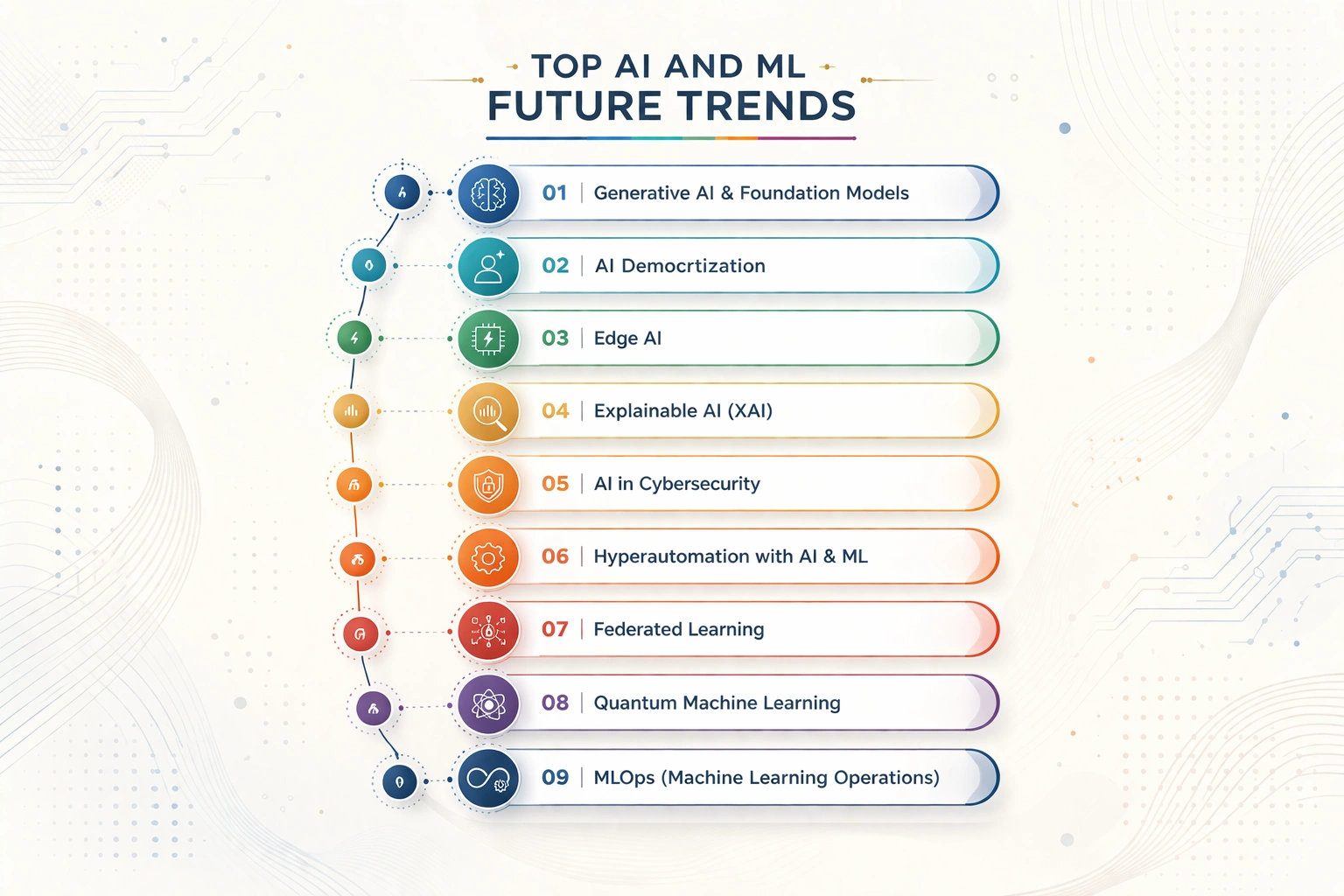
Generative AI and foundation models
Generative AI isn't a novelty anymore. What started as a chatbot writing text has grown into something much bigger. Today, these models create images, write code, produce videos and even help discover new drugs.
The interesting change in 2026, though, is the move toward smaller models. Not every company needs a 400 billion parameter system. Smaller, cheaper models like GPT-4o mini are making this tech available to startups and mid size businesses that couldn't afford it before. For companies working with an AI development company, the real value is in custom models trained on their own data. Using the same tool as every competitor won't create any advantage.
AI democratization
You don't need a PhD to build a useful AI tool anymore. Low code and no code platforms let people in marketing, operations and analytics create working models without writing complex algorithms. AutoML handles the messy parts like data cleanup and tuning.
Still, easy tools solve easy problems. When you need custom LLM work, multi modal systems, or an AI setup that talks to your entire tech stack, you still need experienced people. Democratization shifts what experts work on. It doesn't replace them.
Edge AI
Some things can't wait for a cloud server to respond. Edge AI runs machine learning models directly on devices like phones, sensors, cameras and medical equipment. Everything happens locally. That means faster results, lower costs and better privacy since the data never leaves the device.
How big is this trend? Gartner says AI PCs will make up 55% of the total PC market in 2026. On a factory floor or inside a self driving car, edge processing isn't a luxury. It's the difference between a system that reacts in time and one that doesn't.
Explainable AI (XAI)
Here's the problem with many AI systems: they give you an answer but not a reason. Explainable AI fixes that. It makes model decisions readable by humans, so a loan officer can see why an application was denied, or a doctor can review the logic behind a diagnosis.
In industries like banking, healthcare and law, this isn't a nice feature. It's a requirement. You can't tell a customer "the algorithm said no" and leave it at that. Companies that build explainability into their AI products are finding it gives them an edge over competitors who treat it as an afterthought.
AI in cybersecurity
Cyber threats move fast. Faster than any human team can track on its own. AI security tools can scan network traffic, detect unusual patterns and stop attacks before damage happens. ML models trained on past attacks can spot new threats that traditional rule based systems would miss.
But here's the catch. Attackers use AI too. So this turns into an ongoing race. The companies that invested in AI security early have a growing advantage. The ones that didn't are falling further behind with every passing quarter.
Hyperautomation with AI and ML
Automating a single task is useful. Automating an entire process is a different level. Hyperautomation combines AI, ML, robotic process automation and process mining to handle full workflows from start to finish. Think about it this way: instead of automating one email reply, you automate the whole customer onboarding process.
Most companies looking at this want partners who can build it on top of their current systems. Nobody wants to tear everything down and start over. That's why demand for custom software development that integrates with existing setups keeps growing.
Federated learning
Usually, machine learning needs all the data in one place. Federated learning flips that. Instead of moving data to the model, the model goes to the data. Each device trains the model locally and sends back only the updates, never the raw information.
Why does this matter? Because some data simply can't be moved. Hospital patient records, for example. With federated learning, hospitals can work together on diagnostic models without ever sharing a single patient file. That wasn't possible a few years ago. Now it is.
Quantum machine learning
This one is further out than the others on this list, but it's worth knowing about. Quantum computers can handle certain types of problems, like optimization and molecular simulation, much faster than regular computers.
Most businesses won't use quantum ML directly in 2026. However, companies like IBM, Google and Microsoft are pouring money into research. The organizations building quantum ready systems now will have a head start when the technology hits its stride.
MLOps (machine learning operations)
Building a model is one thing. Running it in production, watching it for errors, retraining it when data changes and managing it at scale? That's a completely different challenge. MLOps brings DevOps thinking to machine learning: version control, automated tests, continuous deployment and live monitoring.
Without it, models go stale. Costs creep up. The gap between what a model does in the lab and what it does in the real world keeps growing. Any company running AI at scale needs MLOps. The teams that skip it usually learn that lesson the expensive way.
Also Read: How to Choose the Right AI/ML Development Services
Future predictions for AI and ML development
Nobody can predict the future perfectly. But some directions are clear enough to plan around. The machine learning future prediction that keeps showing up everywhere is simple: AI is moving from experimental to operational. And that changes how every company works.
AI becoming a core business strategy
AI used to live in a lab somewhere. Not anymore. Smart companies are building their product plans, supply chains and customer strategies around AI. They're not treating it as a feature to add later. Instead, it's the foundation they build on. The companies that bolt AI on as an afterthought are getting outrun by those who put it at the center.
Human-AI collaboration
The future isn't robots taking jobs. It's people doing better work with AI at their side. For example, radiologists using AI catch more problems than either the doctor or the software would find alone. Developers with AI coding assistants ship features faster without cutting corners. The best teams in 2026? They're the ones figuring out how to partner with AI, not compete against it.
Personalized AI experiences
Generic outputs are fading. In their place, we're seeing AI that shapes itself around each user. Netflix has done this with movie picks for years. But the next wave goes deeper: treatment plans matched to a patient's genetics, learning platforms that adjust in real time to a student's pace and shopping experiences that know what you want before you type it.
If you're exploring AI app development, personalization is quickly becoming the feature that makes or breaks a product. Users expect it now.
Regulation and ethical AI growth
The EU AI Act set a global standard by sorting AI systems into risk levels and putting strict rules on high risk tools. Other countries are following. The direction is clear and it's not slowing down.
Companies that build compliance into their process early will save time and money. Those that ignore it risk losing access to major markets. This isn't something that might happen. It's already underway.

Industries being transformed by AI/ML development
Different industries feel AI/ML development trends in different ways. Here's where the changes are showing up most clearly right now.
Healthcare
ML models can spot early stage cancers in scans with accuracy that matches experienced doctors. AI tools are cutting drug development time from years down to months. And federated learning lets hospitals team up on research without sharing any patient data. Healthcare is moving fast on this, partly because the stakes are so high.
Finance
Banks and financial companies run on AI now. JPMorgan uses it to read legal documents in seconds that would take human lawyers hours. Fraud detection systems save the industry billions every year. And the push into fintech keeps picking up speed, especially around AI agents that can handle complex, multi step tasks on their own.
Autonomous vehicles
Self driving cars rely on computer vision, sensor data and reinforcement learning all working together. Tesla, Waymo and Cruise keep pushing the tech forward. But it's not just cars. Autonomous trucks, delivery drones and warehouse robots all use the same core ideas. Edge AI is critical here because split second decisions can't wait for a cloud server.
Manufacturing and robotics
Predictive maintenance with ML cuts equipment downtime across factories worldwide. AI quality control inspects products faster and more accurately than human eyes. Collaborative robots work side by side with people on assembly lines. Factories that combine IoT sensors with machine learning are hitting efficiency targets that weren't possible five years ago.
Education
AI is making personalized learning available to more students than ever. Adaptive platforms change the difficulty, content and speed based on how each student performs. That kind of one on one attention used to require a private tutor. AI in education now covers everything from grading essays to providing real time tutoring feedback.
Real estate
ML handles property values, market trend predictions and investment analysis. AI chatbots answer buyer questions around the clock. Computer vision tools check property conditions using photos and drone footage. For real estate app development, features like predictive pricing have gone from "nice to have" to "expected."
Retail and eCommerce
AI powers product recommendations, dynamic pricing, demand forecasts and visual search across retail sites. Amazon's recommendation system drives about 35% of its revenue. Retailers of every size are copying that model. Cashier free stores use computer vision and chatbots handle customer questions that used to need a human agent.
Also Read: AI/ML Development Solutions That Drive Business Growth
Challenges and ethical considerations in AI/ML
AI isn't all smooth sailing. There are real problems that companies need to face head on. Ignoring them doesn't make them go away. It usually makes them worse.
Privacy and security concerns
AI needs data to work. That data often includes sensitive personal details. The hard part is collecting enough information to train good models while still protecting people's privacy. If a breach hits an AI system, the damage can be wider than a typical data leak. The models can expose patterns across entire groups, not just single records.
Bias and fairness
AI models pick up biases from their training data. Hiring tools that filter out qualified people. Lending models that repeat old patterns of discrimination. Face recognition that works worse on some skin tones. These aren't theoretical risks. They've already caused harm. Fixing bias takes diverse data, regular audits and teams that look like the people they're building for.
Regulation and governance
The rules around AI are still being written. Companies working in multiple countries deal with a patchwork of different regulations. The EU AI Act gives a starting framework, but the details are still being worked out. Other regions are taking their own paths. For businesses working with an AI development company, it's much cheaper to build compliance in from day one than to add it later.
High development costs
Good AI isn't cheap, you need skilled people, solid infrastructure and quality data. Training large models can cost millions in computing power alone. Keeping those models running adds ongoing expense. Yes, costs are dropping as tools get better. But AI development still needs clear budget planning and honest ROI conversations.
Impact on employment and workforce
AI will take over some jobs. There's no getting around that. But the numbers are more nuanced than the headlines suggest. The World Economic Forum estimates a net gain of about 58 million jobs worldwide. The real issue isn't total job loss. It's making sure people in affected roles get retraining and that companies handle the change with care instead of dropping it on workers overnight.
How AI and machine learning are accelerating AppZoro's growth
At AppZoro, we build AI and ML into the products our clients use every day. We work with businesses in healthcare, fintech, logistics, retail and education. As an AI and ML development company based in Atlanta, we've helped both startups and larger companies move from AI concepts to working products.
Our projects cover custom LLM development, automation, predictive analytics and AI powered mobile apps. One thing we've noticed over and over: the companies getting real value from AI treat it as part of their core business. The ones running it as a side experiment usually don't see the same results.
Whether you need generative AI development services or want to build an AI product from scratch, our team brings practical experience across multiple industries. We'd love to talk about what you're working on.
Conclusion
The AI/ML development trends we covered here aren't speculative. They're backed by trillions in investment and adoption rates that doubled in three years. Generative AI, edge computing, MLOps and agentic systems are all changing how software gets built. And the pace keeps picking up.
The companies that do well going forward will be the ones that stop treating AI as a tech project. Instead, they'll treat it as infrastructure. That means picking the right partners, thinking about ethics from the start and staying ahead of regulations before they become emergencies.
Ready to talk about what AI can do for your business? Reach out to AppZoro and let's start the conversation.
Leave a Comment