
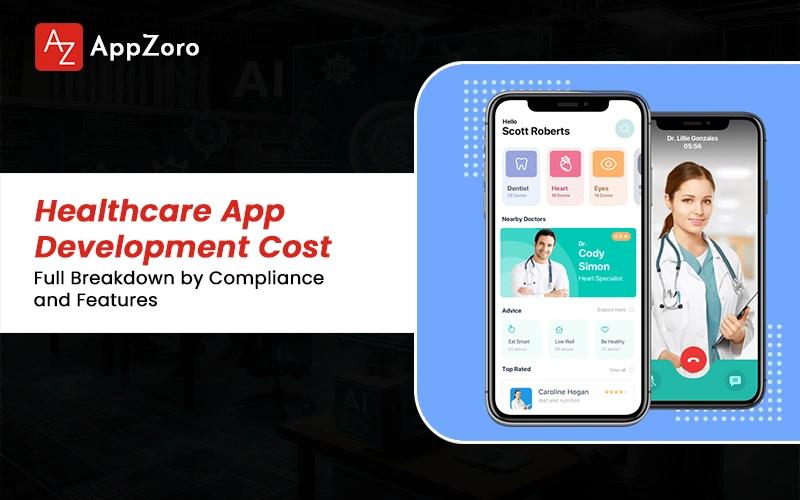
Quick Answer: Healthcare app development cost in 2026 is typically ranging $80K to $1.5M+, with most builds landing $200K to $600K across the major categories. Cost drivers include the app category (wellness apps are cheapest, while medical device companion apps are the most expensive), the FDA SaMD classification, the EHR integration scope, and the HIPAA compliance load. Healthcare apps are costing 30 to 50% more than equivalent consumer apps due to compliance, FHIR integration, and clinical validation requirements. Class II FDA SaMD apps are adding $150K to $500K to baseline development cost, while Class III apps are adding $500K to $2M+.
Budgeting healthcare app development cost can be stressful, dealing with HIPAA compliance scoped too late, FDA classification misjudged at concept, and EHR integration being treated as a single line item rather than a full project. Most healthcare app projects are missing budget for predictable reasons that surface only after the contract is signed. This guide is breaking down healthcare app development cost line by line, explaining the healthcare premium versus consumer apps, addressing FDA SaMD classification cost impact, EHR integration cost, HIPAA compliance allocation, the phase-by-phase cost breakdown, the 3-year total cost of ownership, and tactics to reduce cost without cutting any compliance corners.
How Much Does It Cost to Develop a Healthcare App?
So, how much does it cost to develop a healthcare app in actual practice? Well, the cost to develop a healthcare mobile app is depending primarily on app category, FDA classification, EHR integration scope, and team geography. Most validated healthcare app builds are landing $200K to $600K, with simple wellness apps sitting lower and FDA-cleared medical device companions reaching $1.5M+ at the high end of the range.
The range table below is answering how much does it cost to develop a healthcare app across the major complexity tiers in 2026.
Complexity Tier | Cost Range | Timeline | Examples |
Simple wellness / mHealth app | $80K to $200K | 4 to 8 months | Meditation, fitness tracking, low regulation |
Standard telehealth or patient portal | $200K to $500K | 6 to 12 months | Video consult, EHR-linked patient app |
Remote patient monitoring (RPM) | $250K to $600K | 8 to 14 months | Device integration, time-series infra, CMS billing |
Clinical decision support / provider app | $300K to $700K | 10 to 16 months | FHIR write-back, possible FDA SaMD review |
FDA SaMD-Classified medical device companion | $500K to $1.5M+ | 12 to 24 months | FDA premarket submission, IEC 62304 documentation |
Cost variance within each tier is genuinely wide, driven by integration depth, compliance gates, and clinical validation requirements layered into the build. Buyers requesting healthcare app quotes without specifying FDA classification and EHR scope are receiving estimates that vary 3 to 5x for the same described project across vendors.
Healthcare App Development Cost by App Category
The healthcare app development cost is varying sharply across the 7 healthcare app categories, and the cost to develop a healthcare app within each category is depending on distinct technical complexity, regulatory exposure, and integration scope across the build.
Below are typical cost ranges for each healthcare app category in 2026, with the primary cost drivers identified per category.
Telehealth And Virtual Care Apps: $200K to $500K. Major cost drivers are including HIPAA-eligible video infrastructure (Twilio Video for HIPAA, Vonage), provider scheduling backbones, e-prescribing integration through Surescripts, and EHR-linked patient records.
Patient Portal And Engagement Apps: $150K to $400K. Primary cost drivers are EHR integration via HL7 FHIR (Epic MyChart-style features), multi-system data aggregation for patients with care across networks, secure messaging infrastructure, and accessibility compliance (WCAG 2.1 AA).
Remote Patient Monitoring (RPM) Apps: $250K to $600K. Cost drivers include connected device integration (BLE pairing, FHIR Observation resources), time-series database infrastructure for continuous data, CMS billing code automation (CPT 99453, 99454, 99457), and provider-facing dashboards.
mHealth Wellness And Mental Health Apps: $80K to $200K. The lightest regulatory load is meaning the lowest cost. mHealth Wellness app drivers include standard mobile development with FTC consumer protection compliance and selective HIPAA scope depending on whether protected health information is being collected.
Clinical Decision Support And Provider Apps: $300K to $700K. Higher FDA SaMD classification risk is driving the cost. Drivers include clinical reference database licensing, FHIR write-back to EHR systems, clinical validation studies, and IEC 62304 software lifecycle documentation.
Hospital Operations Apps: $200K to $500K. Cost drivers are EHR and scheduling system integration, multi-system orchestration, and enterprise security and governance requirements across the operation.
Medical Device Companion Apps: $500K to $1.5M+. This is the highest-cost category in the market. FDA premarket clearance, IEC 62304 documentation, device-specific BLE protocols, and post-market surveillance reporting infrastructure are all driving the total cost.
The Healthcare Premium - Why Healthcare Apps Development Costs Exceed Consumer App Cost
Healthcare apps development costs are typically running 30 to 50% higher than equivalent consumer apps. The premium is concentrating in specific line items that consumer apps simply do not carry across their build budgets.
Below is a side-by-side cost comparison for a typical $300K healthcare app versus a $200K equivalent consumer app across the major line items.
Cost Line Item | Consumer App | Healthcare App | Healthcare Premium Driver |
Product strategy and PM | $25K to $40K | $35K to $55K | Regulatory and clinical scope work |
UX design with clinical review | $25K to $45K | $35K to $60K | Clinical SME review, accessibility compliance |
Mobile engineering | $80K to $130K | $90K to $150K | Encryption, audit logging, BAA-required infrastructure |
Backend engineering | $30K to $55K | $50K to $90K | FHIR APIs, EHR integration, HIPAA-compliant data layer |
HIPAA architecture and compliance | $0 | $25K to $60K | Privacy Impact Assessment, Risk Analysis, BAA management |
EHR / FHIR integration | $0 | $40K to $200K | Single-EHR FHIR at low end, multi-EHR write-back at high end |
FDA SaMD work (if applicable) | $0 | $0 to $2M+ | Class-dependent, $150K to $500K typical for Class II |
Clinical validation | $0 | $15K to $80K | User testing with clinicians, evidence collection |
Security and penetration testing | $5K to $10K | $20K to $45K | Third-party HIPAA security audit, deeper pen testing |
The healthcare premium across healthcare apps development costs is concentrated in compliance, integration, and validation work that is adding line items consumer apps simply do not have on the budget sheet. Most buyers who are underestimating cost to develop a healthcare app are missing one or more of these categories entirely in the initial budget conversations.
FDA SaMD Classification Impact on Healthcare App Development Cost
FDA Software as a Medical Device (SaMD) classification is the single largest cost variable in healthcare app development across the market. Apps providing diagnosis, treatment, or clinical decision support are facing premarket FDA review with documented validation studies, quality management systems, and ongoing post-market surveillance requirements.
The classification tier impact on healthcare app development cost is shown clearly in the table below.
FDA Classification | Cost Impact Beyond Baseline | Timeline Impact | Typical Examples |
Not FDA-regulated (general wellness, administrative) | $0 added | None | Fitness tracking, scheduling, billing apps |
Class I (Low Risk) | $15K to $60K added | +2 to 6 weeks | Basic patient education, electronic health records |
Class II (Moderate Risk, 510(k) submission) | $150K to $500K added | +6 to 12 months | Most clinical decision support, RPM with clinical analytics |
Class III (High Risk, PMA submission) | $500K to $2M+ added | +12 to 24 months | Apps replacing critical clinical decisions |
Cost implications across the classification tiers are stacking quickly during the build.
Premarket Submission Fees: The 510(k) submission fee is roughly $22K for standard businesses and $5.5K for small businesses (FY 2026 rates).
IEC 62304 Software Lifecycle Documentation: Required for Class II and III, adding 200 to 600 engineering hours across the project.
Clinical Validation Studies: Required evidence of safety and effectiveness, costing $50K to $500K per study depending on the scale being run.
Quality Management System (QMS): 21 CFR 820 compliance for design controls, often costing $50K to $150K to establish properly.
Post-Market Surveillance: Ongoing reporting, MDR (Medical Device Reporting), and annual reports at $30K to $100K per year of operation.
Misclassifying an app's FDA pathway at concept is the single most expensive mistake being made in healthcare app development. Pre-submission consultation (Q-Sub) with FDA early is genuinely worth the engagement cost across borderline classifications.
EHR Integration Cost Within Healthcare App Development
Electronic Health Record (EHR) integration is one of the largest cost line items in any serious healthcare app development project. The cost to develop a healthcare mobile app with proper EHR integration is varying sharply by integration scope, target EHR systems, and read versus write access requirements.
EHR integration cost tiers across the major scenarios in 2026 are shown below.
Integration Scope | Cost Range | Notes |
FHIR read-only, single EHR (Epic, Oracle Health, or athenahealth) | $40K to $80K | Standard SMART on FHIR launch |
FHIR read-write, single EHR | $70K to $150K | Write-back to clinical records adds workflow validation |
Multi-EHR support (3+ vendors) | $150K to $350K | Each EHR has FHIR variations and conformance issues |
Custom integration via HL7 v2 or proprietary APIs | $100K to $400K+ | Required for older systems or non-standardized data |
Specialized integrations (lab systems, imaging, e-prescribing) | $25K to $100K per system | Surescripts, lab interfaces, PACS, and similar systems |
Ongoing EHR integration costs are extending beyond the initial build and stacking into the recurring spend.
App Marketplace Annual Fees: Epic App Orchard, Oracle Health Code Console, and athenahealth Marketplace are typically running $5K to $50K per year per EHR depending on tier and access level.
FHIR Version Maintenance: FHIR R5 is the current standard, and upgrades from R4 are requiring integration updates across the codebase.
EHR Version Compatibility Work: When EHRs are updating their platforms, integration updates may be required across the connected app.
Marketplace Certification Renewals: Annual or biennial recertification cycles per EHR marketplace being supported.
EHR integration is rarely a one-time cost in healthcare app development. Multi-EHR support is transforming a single-EHR app into effectively a different product, with proportional cost increases across engineering and ongoing maintenance.
HIPAA Compliance and Security Cost Allocation in Healthcare App Development
HIPAA compliance work is not actually a separate phase inside healthcare app development. It is a cost overlay being distributed across every phase of the project, and the total HIPAA-related cost to develop a healthcare app is typically adding 15 to 25% to the project budget.
The HIPAA cost allocation across the project phases is shown clearly below.
Project Phase | HIPAA Cost Component | Typical Cost |
Discovery and architecture | Privacy Impact Assessment, HIPAA Risk Analysis | $10K to $25K |
Design | Compliance review of UX flows, PHI display patterns | $5K to $15K |
Engineering | Encryption, audit logging, RBAC, signed BAAs | $20K to $60K (embedded in engineering) |
QA and testing | HIPAA security testing, audit log validation | $10K to $25K |
Pre-launch | Third-party HIPAA security audit, penetration testing | $15K to $45K |
Ongoing HIPAA compliance maintenance costs are extending beyond launch and stacking into the recurring spend.
Annual Security Audits: $10K to $30K per year for third-party audit of HIPAA Security Rule controls.
Penetration Testing: Annual or biennial third-party pen tests, costing $15K to $50K per engagement.
BAA Management: Maintaining BAAs with all PHI-handling vendors as the vendor stack is evolving over time.
HIPAA Training: For all development and support staff working with PHI across the operation.
Breach Response Readiness: Documented procedures, tabletop exercises, and incident response retainer arrangements.
The cost of developing a healthcare mobile app without proper HIPAA budgeting from kickoff is routinely creating 20 to 30% cost overruns when compliance gaps are surfacing late in the project lifecycle.
Healthcare App Development Cost Breakdown by Project Phase
To understand healthcare apps development costs in detail, the most useful frame is a phase-by-phase decomposition for a representative project. Below is the breakdown for a typical $400K telehealth platform build across the major phases.
Phase | Cost Range | Share of Total | Key Activities |
Concept and regulatory classification | $15K to $30K | 4 to 7% | FDA classification, business case, clinical advisor input |
HIPAA architecture and Privacy Impact Assessment | $15K to $30K | 4 to 7% | BAA template, risk analysis, security framework |
UX design with clinical review | $35K to $60K | 9 to 15% | Clickable prototype, accessibility audit, clinical workflow validation |
Technical architecture and EHR integration planning | $15K to $30K | 4 to 7% | FHIR strategy, infrastructure decisions, identity architecture |
Mobile and backend engineering | $180K to $260K | 45 to 55% | Core build, FHIR integration, video infrastructure, payment integration |
HIPAA-compliant infrastructure setup | $10K to $25K | 3 to 6% | HIPAA-eligible cloud, encrypted databases, audit logging |
QA, security testing, and clinical validation | $25K to $50K | 6 to 13% | Functional QA, HIPAA validation, third-party pen test |
FDA submission (if applicable) | $0 to $500K+ | Variable | Class II 510(k) work, not applicable for non-SaMD apps |
App store submission and launch | $5K to $15K | 1 to 4% | Listing, healthcare data declarations, production deploy |
Engineering is dominating the spend at 45 to 55% of total healthcare app development cost across most builds. Compliance and validation work is concentrating in the middle and pre-launch phases. Strategy and architecture phases are smaller in dollar terms, however they are disproportionately affecting total project cost when they get shortcut by impatient teams.
3-Year Total Cost of Ownership for Healthcare App Development
Healthcare app development cost is extending far beyond the initial build line. The 3-year total cost of ownership is typically running 2.5 to 3.5x the initial build cost, with compliance maintenance, FHIR upgrades, and FDA post-market surveillance all driving the ongoing spend across years 2 and 3.
The sample 3-year TCO for a $400K telehealth platform build is shown clearly in the table below.
Cost Component | Year 1 | Year 2 | Year 3 |
Initial build / ongoing dev | $400K | $120K | $120K |
HIPAA-compliant cloud hosting | $24K | $42K | $65K |
Third-party services (video, e-sign, payments) | $30K | $55K | $85K |
FHIR maintenance and EHR upgrades | $15K | $25K | $35K |
Annual security audit and penetration testing | $25K | $30K | $35K |
BAA management and vendor compliance | $8K | $10K | $12K |
App store, OS compatibility, FDA reporting (where applicable) | $10K | $15K | $20K |
Annual total | $512K | $297K | $372K |
3-year cumulative | $1.18M |
The 3-year TCO multiplier for this project is roughly 2.95x the initial build cost, which is typical for any serious healthcare app. FDA SaMD-classified apps are pushing the multiplier higher due to the post-market surveillance requirements layered onto the operation.
Healthcare app developers and product owners that are modeling only the initial build cost are routinely facing budget shortfalls in year 2 when compliance maintenance, FHIR upgrades, and security audits are all arriving at the same time.
How to Reduce Healthcare App Development Cost Without Cutting Compliance
Most healthcare app projects can reduce cost 15 to 25% without compromising HIPAA, FDA, or clinical validation requirements. The five tactics below are delivering most of the realistic savings across the healthcare app development cost line.
Scope FDA Classification Honestly And Early: Misclassification at concept is causing the most expensive downstream rework on any build. Engage FDA pre-submission (Q-Sub) consultation for any borderline classifications upfront.
Start With Single-EHR Integration, Expand Later: Single-EHR FHIR integration is costing $40K to $80K, while multi-EHR support is adding 3 to 5x. Most apps are reaching product-market fit on one EHR before expanding.
Use HIPAA-Eligible Cloud Services Rather Than Building Compliant Infrastructure: AWS HIPAA-eligible cloud services, Azure for Healthcare, and GCP Healthcare API are eliminating infrastructure-level HIPAA work that custom-built stacks would otherwise require.
Choose Cross-Platform Frameworks For Non-Performance-Critical Apps: Flutter or React Native is saving 35 to 45% engineering cost versus dual-native. Most healthcare apps are fitting cross-platform's capability ceiling without issue.
Engage Healthcare-Specialized Development Partners: Healthcare-experienced vendors are saving 20 to 30% by avoiding compliance learning curves and by bringing pre-built FHIR and HIPAA reference implementations.
Cost reduction in healthcare app development is mostly about scoping discipline and vendor selection. It is genuinely not about cutting corners on compliance, which is always costing more downstream when the gaps surface during audits or breach incidents.
Conclusion
Healthcare app development cost is varying from $80K for simple wellness apps up to $1.5M+ for FDA SaMD-classified medical device companion apps, with most builds landing $200K to $600K across the categories. The healthcare premium (30 to 50% above equivalent consumer apps) is concentrating in HIPAA architecture, EHR integration, FDA work, and clinical validation across every project. The 3-year total cost of ownership is running 2.5 to 3.5x the initial build cost. Healthcare app teams should be scoping FDA classification, EHR integration depth, and HIPAA compliance load before requesting vendor estimates, because these three decisions are driving roughly 70% of project cost variance.
Leave a Comment