
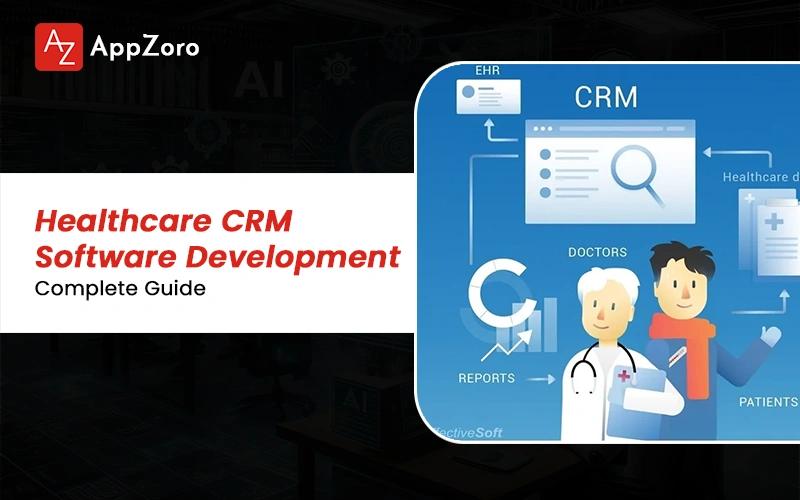
Quick Answer: Healthcare CRM software development involves building or configuring HIPAA-compliant platforms that manage patient relationships across the full patient lifecycle - from acquisition and onboarding through active care, retention and re-engagement. Unlike EHR systems, CRM software for healthcare focuses on marketing automation, referral management, care coordination outreach and patient engagement rather than clinical documentation. Development options include custom builds, platform configurations like Salesforce Health Cloud and purpose-built solutions. All implementations require a signed Business Associate Agreement before processing any protected health information.
Healthcare organizations routinely leave patient relationship data untouched while struggling with high no-show rates, poor care gap closure and declining patient loyalty across their network. CRM software for healthcare transforms that data into structured, automated engagement workflows that general-purpose tools cannot replicate without significant HIPAA compliance engineering built in from the ground up. This guide covers everything a health system, specialty practice or development team needs to understand before commissioning or building healthcare CRM software in 2026.
What Healthcare CRM Software Development Involves in 2026
Healthcare CRM software is the operational layer that manages patient relationships, acquisition workflows, care coordination outreach and engagement automation across the full patient lifecycle. Unlike commercial CRM tools such as Salesforce Sales Cloud - built for sales pipeline management with no native PHI handling - healthcare CRM software development must embed HIPAA compliance at the architectural level, not as an afterthought. Every data field that touches a patient's identity, contact history or clinical trigger requires audit logging, role-based access control and encryption that general-purpose platforms cannot provide without substantial custom engineering.
The market opportunity reflects this complexity. Grand View Research projects the global healthcare CRM market will exceed $21 billion by 2030, driven by health systems investing heavily in patient retention and digital engagement infrastructure. KLAS Research benchmarks consistently show healthcare organizations using purpose-built CRM platforms report 15–25% reductions in patient no-show rates - a direct operational ROI that justifies the development investment for health systems of any size.
Patient Relationship Management: Tracks every patient interaction across touchpoints - marketing campaigns, referrals, appointments, care outreach - in a unified, HIPAA-compliant contact record.
Care Coordination Outreach: Automates preventive care reminders, chronic disease management follow-ups and care gap alerts based on patient segment and clinical criteria pulled from integrated EHR data.
Referral and Network Management: Manages inbound and outbound referral workflows between primary care providers, specialists and hospital systems, tracking conversion rates and referral source performance.
Marketing and Patient Acquisition: Runs segmented digital campaigns targeting new patient acquisition across demographics, service lines and geographic markets with HIPAA-compliant consent tracking throughout.
Healthcare CRM vs. EHR: What CRM Software for Healthcare Actually Does
The most persistent misconception in this category is that CRM software for healthcare and an EHR system are either the same tool or competing systems performing overlapping functions. The confusion leads healthcare organizations to one of two expensive mistakes: over-investing in EHR customization to fill CRM gaps or under-investing in CRM software for healthcare by assuming the EHR already covers relationship management, marketing automation and referral tracking. Neither assumption holds.
Dimension | CRM Software for Healthcare | EHR System |
Primary Function | Patient relationship management, engagement and acquisition | Clinical documentation, care delivery and medical records |
Data Type | Contact history, marketing engagement, referral records, satisfaction scores | Medical history, diagnoses, prescriptions, lab results, clinical notes |
Primary User | Marketing, patient services, care coordinators, business development | Physicians, nurses, clinical staff, billers |
Regulatory Driver | HIPAA BAA, marketing consent, CAN-SPAM | HIPAA, HITECH, CMS, ONC certification requirements |
Integration Direction | Pulls clinical flags from EHR to trigger outreach campaigns | Pushes appointment and clinical data to CRM for relationship context |
Example Platforms | Salesforce Health Cloud, NexHealth, Kyruus, Klara | Epic oracle Health (Cerner), athenahealth, Allscripts |
The two systems are complementary, not competitive. Best-practice implementations integrate them bidirectionally - the EHR pushes appointment completion and clinical status data into the CRM, while the CRM pulls care gap flags and chronic condition markers from the EHR to trigger targeted outreach workflows. The technical integration layer that makes this exchange possible is the HL7 FHIR R4 API standard, now supported natively by Epic oracle Health and athenahealth, eliminating the need for custom interface engineering in most enterprise deployments.
The Six-Stage Patient Lifecycle That CRM Software for Healthcare Must Support
CRM software in healthcare only delivers measurable ROI when its feature set is mapped to the patient journey rather than scoped as a generic contact management tool with healthcare data fields added on top. The six-stage patient lifecycle below defines both the structural spine of this guide and the feature scope any healthcare CRM development project must cover. Most purpose-built platforms handle Stages 1–3 effectively; Stages 4–6 are where configured or custom-built platforms consistently outperform out-of-the-box solutions.
1: Awareness and Lead Generation
CRM captures prospective patient data from digital campaigns, health fair registrations, website inquiries and referral partner introductions, assigning each contact to a service line pipeline with source attribution tracked throughout. At this stage, the CRM functions as a marketing data layer - collecting consent, assigning lead scores and routing inquiries to the appropriate acquisition workflow before any clinical contact has occurred.
2: Patient Acquisition and Intake
CRM manages first appointment scheduling, insurance eligibility pre-verification and digital intake form completion, coordinating with the EHR for patient record creation and reducing front-desk administrative workload at the point of first contact. Integration with intake platforms such as Phreesia or NexHealth is standard at this stage for organizations prioritizing digital-first patient acquisition.
3: Onboarding and Care Initiation
CRM delivers automated new patient welcome sequences, care plan enrollment workflows and provider introduction communications, ensuring patients understand their care team and next steps before their first clinical encounter. Onboarding automation at this stage directly impacts first-appointment show rates and long-term patient retention metrics.
4: Active Care and Engagement
CRM triggers appointment reminders, medication adherence nudges, care gap alerts and preventive screening outreach based on clinical flags pulled from the integrated EHR, keeping patients engaged between appointments rather than only at the point of care. This is the stage where EHR integration depth determines the CRM's clinical value - shallow integrations produce generic reminders; deep FHIR integrations produce clinically relevant, personalized outreach at scale.
5: Retention and Loyalty
CRM executes post-visit satisfaction surveys integrated with Press Ganey or NRC Health, annual wellness visit reminders and loyalty program engagement, monitoring patient satisfaction scores at the individual and cohort level across every service line. Retention-stage CRM workflows consistently represent the highest-ROI investment for health systems focused on lifetime patient value rather than single-episode acquisition cost.
6: Win-Back and Re-Engagement
CRM identifies lapsed patients through EHR appointment gap analysis, triggers automated re-engagement sequences and manages referral-based reactivation campaigns targeting patients who have not visited within a defined inactivity window. Win-back campaigns require documented patient consent for non-TPO communications under HIPAA's Privacy Rule, making the consent management architecture established in Stage 1 a prerequisite for Stage 6 execution.
Three CRM Healthcare Software Buyer Profiles and Their Development Requirements
CRM healthcare software requirements differ so significantly across buyer types that scoping a development project without identifying the buyer profile first consistently produces over-engineered or under-built systems. A payer organization managing member engagement under value-based care contracts has almost nothing in common architecturally with a specialty dermatology practice managing online scheduling and post-visit reviews. Understanding which of the three profiles below describes your organization is the first and most consequential decision in any CRM healthcare software development project - payer organizations currently represent the fastest-growing buyer segment in the category, driven by CMS member engagement requirements under value-based care contracts.
1: Hospital and Health System
The highest-complexity CRM buyer, typically managing ten or more service lines, a referring physician network and multiple patient acquisition channels simultaneously. Core requirements include referral management with leakage tracking, service line marketing automation, physician relationship management (PRM) and bidirectional Epic or Oracle Health integration. CRM platforms favored at this scale include Salesforce Health Cloud and Microsoft Dynamics 365 with the Healthcare Accelerator.
Referral Leakage Tracking: Monitors which referred patients converted and which sought care outside the network, calculating leakage rate by service line and referring provider.
Physician Relationship Management (PRM): Tracks outreach history, visit frequency and referral volume for every physician in the network, alerting business development teams to at-risk referring relationships.
Population Health Segmentation: Groups patients by chronic condition, risk score or care gap status for targeted outreach campaigns tied to value-based care performance metrics.
2: Specialty Practice
Focused on high-volume patient acquisition within a specific clinical domain - orthopedics, oncology, fertility, dermatology - where appointment conversion rates and patient retention cycles are the primary CRM performance metrics. Core requirements include online scheduling integration, post-visit follow-up automation, review management and intake platform integration with Phreesia or NexHealth. The specialty practice profile prioritizes fast deployment and pre-built clinical workflows over deep enterprise customization.
3: Payer and Insurance Organization
The Payer and Insurance Organization manages member engagement, care management outreach and utilization management workflows rather than appointment-based patient journeys. Core requirements include member segmentation by risk tier, chronic disease management campaign automation, provider directory management and integration with claims data warehouses for care gap identification.
Core Features Required in Healthcare CRM Software Development
The benefits of healthcare CRM software are only fully realized when the platform covers all eight feature categories below. Implementations that address patient communication alone - without referral management, population segmentation or ROI reporting - deliver a fraction of the operational value a comprehensive platform produces. Healthcare CRM software development must scope all eight features from the start, not phase them in after initial launch. Salesforce's State of the Connected Patient report consistently shows that patients who receive proactive outreach from their providers score 20 or more points higher on satisfaction surveys than those who receive only reactive communication.
Patient Contact Management: Maintains a unified, HIPAA-compliant patient record with full interaction history across marketing, scheduling, clinical outreach and satisfaction touchpoints in one consolidated view.
Marketing Automation and Campaign Management: Runs segmented email, SMS and direct mail campaigns by service line, demographics and clinical criteria, with CAN-SPAM and HIPAA consent tracking built into every communication.
Referral Management: Tracks inbound and outbound referrals from initial physician request through appointment completion, calculating conversion rates, leakage percentages and referring provider ROI by source.
Appointment Scheduling Integration: Connects CRM-driven outreach directly to online scheduling platforms, reducing the friction between a patient receiving a reminder and booking their next appointment.
Care Gap and Preventive Outreach: Queries EHR data to identify patients overdue for screenings, vaccinations or chronic disease follow-ups, triggering automated outreach sequences to close gaps before they affect quality metrics.
Patient Satisfaction and Feedback Management: Deploys post-visit surveys via Press Ganey or NRC Health integrations, aggregates scores at the provider and location level and routes negative feedback to service recovery workflows.
Reporting and ROI Dashboard: Tracks patient acquisition cost by channel, referral conversion rate by source, campaign attribution and net patient revenue generated per CRM-driven interaction across all active campaigns.
Role-Based Access Control: Enforces data access permissions by user role - marketing, care coordinator, executive - ensuring minimum necessary access to PHI as required under HIPAA's Privacy Rule.
HIPAA Compliance Architecture for CRM Software in Healthcare
HIPAA compliance in a CRM context is meaningfully more complex than in a pure clinical system, because CRM software in healthcare sits at the intersection of marketing operations and PHI - a combination that creates unique compliance risks around consent tracking, data minimization and third-party marketing tool integrations that clinical EHR platforms never face. A healthcare organization's marketing team using a CRM to run re-engagement campaigns is operating under the same regulatory framework as its clinical staff, a reality many CRM implementations fail to account for at the architecture stage.
Compliance Area | Requirement | CRM-Specific Risk |
Business Associate Agreement (BAA) | Required with every vendor that accesses, stores or transmits PHI | Email providers, SMS platforms and CRM SaaS vendors all require signed BAAs |
Minimum Necessary Standard | CRM users may only access the PHI their role specifically requires | Marketing users should not see clinical data beyond what campaign segmentation requires |
Audit Trail and Access Logging | All PHI access events must be logged with user, timestamp and action | CRM audit logs must be immutable and retained for six years per HIPAA Security Rule |
Consent and Authorization | Marketing communications using PHI require patient authorization beyond standard TPO | Re-engagement and win-back campaigns require documented patient consent for non-TPO outreach |
Data Encryption | PHI must be encrypted at rest (AES-256) and in transit (TLS 1.2+) throughout the CRM | All third-party integrations - email, SMS, analytics - must maintain equivalent encryption standards |
Breach Notification Readiness | CRM systems must support 60-day breach notification workflows | Marketing database breaches are reportable under HIPAA Breach Notification Rule if PHI is exposed |
The BAA requirement extends beyond the CRM platform itself to every third-party tool integrated into the stack - including email service providers, SMS delivery platforms, analytics tools and advertising pixels. These integrations are the most frequent source of HIPAA violations in healthcare marketing operations, not the core CRM platform. An organization running HIPAA-compliant email through Salesforce Health Cloud while simultaneously sending PHI-enriched campaign data to a standard Google Analytics property has a reportable gap. HHS HIPAA Business Associate guidance is explicit: any vendor receiving PHI to perform a service on the organization's behalf requires a signed BAA before data flows into their infrastructure.
Build vs. Configure vs. Buy: Selecting the Best CRM Healthcare Software Approach
The build vs. configure vs. buy decision is the single most consequential choice in any healthcare CRM project because it determines total cost of ownership, time to first patient interaction and the organization's capacity to adapt the platform as care delivery models evolve. CRM healthcare software procurement defaults toward either excessive complexity - organizations over-building custom infrastructure they could configure in Salesforce Health Cloud at half the cost - or insufficient flexibility, with organizations buying a purpose-built tool that cannot support referral management or physician relationship workflows eighteen months after go-live.
Dimension | Custom Build | Configure Platform | Purpose-Built Buy |
Examples | Bespoke development by a software partner | Salesforce Health Cloud, Microsoft Dynamics 365 + Healthcare Accelerator, Veeva CRM | NexHealth, Kyruus, Klara, HubSpot (HIPAA tier) |
Best For | Unique workflows, proprietary data models, competitive differentiation | Health systems and payers needing enterprise scale with EHR integration | Specialty practices needing fast deployment and pre-built clinical workflows |
Time to Deploy | 6–18 months | 4–12 months | 4–12 weeks |
Total Cost (3-Year) | $300K–$1M+ | $150K–$500K (license + implementation) | $30K–$150K (subscription-based) |
HIPAA Compliance | Designed in from architecture | Platform BAA available; custom integrations require additional coverage | BAA provided; limited customization of data handling |
EHR Integration Depth | Fully custom - any integration possible | Strong for Epic oracle Health via pre-built connectors | Limited to pre-built integrations; custom connections costly |
Long-Term Flexibility | Highest | Moderate - constrained by platform data model | Lowest - product roadmap dependent |
Hospital systems and payer organizations typically default to the configure lane - Salesforce Health Cloud or Microsoft Dynamics 365 - because the combination of enterprise scale, pre-built HIPAA controls and available EHR connectors reduces both implementation risk and time-to-value compared to a ground-up build. Specialty practices increasingly choose purpose-built tools precisely because the best CRM software for healthcare industry decisions at that scale come down to speed and simplicity over configurability. Organizations with genuinely unique workflows - proprietary care models, multi-entity referral networks or competitive IP embedded in their patient engagement process - represent the clearest case for custom development. The decision ultimately turns on three variables: existing technology stack, internal IT support capacity and whether the organization's workflows can conform to a packaged product's data model without material compromise.
Technology Stack for Healthcare CRM Software Development
All technology choices in CRM software for healthcare are shaped by three requirements that do not apply to commercial CRM builds: HIPAA data residency obligations, bidirectional EHR integration via HL7 FHIR R4 and marketing automation compliance that requires consent management built into the data layer from the start - not bolted on as a compliance layer after the core application is live. AWS HIPAA-eligible services and Azure Health Data Services are the two dominant cloud infrastructure choices for custom healthcare CRM builds and both require executed Business Associate Agreements before any PHI enters the environment.
Layer | Recommended Choices | Healthcare-Specific Notes |
Frontend | React, Angular, Vue.js | Patient portal modules require WCAG 2.1 AA accessibility compliance |
Backend | Node.js, Python (Django/FastAPI), Java Spring Boot | Consent tracking, PHI audit logging and RBAC must be built into the API layer from the start |
Database | PostgreSQL, Microsoft SQL Server | PHI fields encrypted at column level; audit log tables must be immutable |
Cloud Infrastructure | AWS HIPAA-eligible services, Azure Health Data Services | Executed BAA required before PHI enters the environment; data residency documented |
EHR Integration | HL7 FHIR R4 APIs (Epic FHIR oracle Health FHIR, athenahealth API) | Care gap and clinical flag queries pull from EHR to CRM via SMART on FHIR authorization |
Marketing Automation | SendGrid (HIPAA BAA tier), Twilio (BAA available), Klaviyo Healthcare | All email and SMS providers must execute BAAs; tracking pixels require PHI-safe implementation |
Security | OAuth 2.0 + MFA, AES-256 at rest, TLS 1.2+ in transit, session timeout enforcement | Minimum necessary access enforced at API gateway level per HIPAA Privacy Rule |
Healthcare CRM Software Development Cost and Timeline
Healthcare CRM software development costs vary more by procurement approach - build vs. configure vs. buy - than by organization size. A specialty practice commissioning a fully custom CRM build can spend more than a health system deploying a configured Salesforce Health Cloud instance with pre-built Epic connectors, purely because the custom build scope expands to cover integrations and compliance infrastructure that pre-configured platforms provide out of the box. The cost table below maps all three procurement lanes across the three buyer profiles, providing a decision-ready reference for initial budget planning.
Buyer Profile | Custom Build | Configure Platform | Purpose-Built Buy |
Specialty Practice | $80K–$200K / 6–10 months | $60K–$150K / 3–6 months | $5K–$20K/year / 4–8 weeks |
Hospital / Health System | $300K–$700K / 10–18 months | $150K–$400K / 6–12 months | $40K–$120K/year / 8–16 weeks |
Payer Organization | $250K–$600K / 10–16 months | $200K–$500K / 8–14 months | $60K–$150K/year / 8–14 weeks |
Add the following to any budget regardless of procurement approach:
EHR Integration (HL7 FHIR): $30K–$120K - the most consistently underestimated line item in healthcare CRM development budgets across every buyer profile and procurement lane.
HIPAA Compliance Audit and BAA Documentation: $10K–$40K - covers third-party compliance review, BAA execution with all integrated vendors and documentation required for internal audit trails.
Staff Training and Change Management: $15K–$50K - adoption rates for CRM platforms in healthcare are directly correlated with structured onboarding, particularly for care coordinator and marketing team users.
Annual Maintenance and Security Patching: 15–20% of initial build cost per year - a recurring budget line frequently excluded from initial project proposals that should be confirmed before contract execution.
How to Choose a Healthcare CRM Software Development Partner
Healthcare CRM software development partner selection is a compliance decision as much as a technology one. A development partner without documented HIPAA compliance architecture experience will consistently underestimate the scope of BAA execution, audit logging and consent management work required - producing a system that needs expensive remediation before it can legally handle PHI in a production environment. The evaluation criteria below are specific and verifiable; a qualified partner should be able to demonstrate each one with named client references and completed project examples.
Healthcare-Specific CRM Portfolio: The partner must demonstrate completed healthcare CRM implementations - not generic CRM projects - with references from health systems, practices or payer organizations willing to speak to regulatory outcomes as well as technical delivery.
HIPAA BAA Execution Track Record: Verified experience executing BAAs with every integrated third-party vendor in a prior CRM project is the minimum qualifying threshold for engagement.
EHR Integration Experience: Direct integration experience with Epic FHIR APIs oracle Health APIs or athenahealth API is required for any buyer profile that needs clinical data flowing into CRM outreach workflows.
Consent and Marketing Compliance Expertise: Experience building HIPAA-safe marketing automation workflows - including consent tracking, suppression lists and advertising pixel governance - is essential for any CRM covering patient acquisition.
Post-Launch Compliance Support: The partner should offer ongoing security patching, BAA review and HIPAA audit support as a standard post-launch engagement, not a separately scoped billable activity.
Green Flags | Red Flags |
References from healthcare clients who have passed HIPAA audits post-launch | References are from non-healthcare CRM implementations only |
Has executed BAAs with all integrated vendors in prior healthcare CRM projects | Treats BAA execution as the client's responsibility to manage independently |
Demonstrates HL7 FHIR R4 integration in a prior live production environment | Claims "we can integrate with any EHR" without naming a specific completed integration |
Understands the distinction between TPO communications and marketing under HIPAA | Describes HIPAA compliance as "just encryption and password protection" |
Conclusion
Healthcare CRM software development delivers its strongest ROI when the platform is scoped around the full six-stage patient lifecycle - from initial awareness and acquisition through active care engagement, long-term retention and win-back - rather than built as a point solution for a single use case like appointment reminders or referral tracking alone. Organizations that invest in lifecycle-complete platforms consistently outperform those running disconnected point solutions across every patient engagement metric that matters.
Appzoro builds HIPAA-compliant, EHR-integrated CRM platforms for health systems, specialty practices and payer organizations seeking measurable improvements in patient acquisition, retention and satisfaction. If your organization is ready to scope a CRM built around your specific patient journey, contact Appzoro's healthcare software development team to start the conversation.
Leave a Comment