
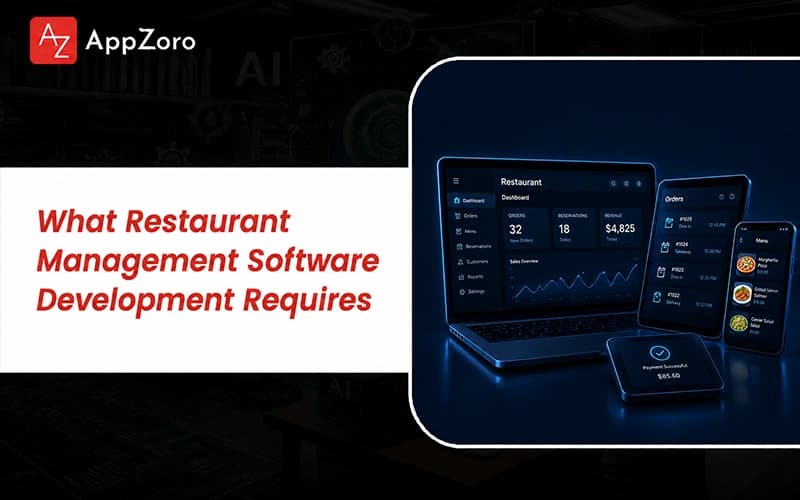
Quick Answer: Restaurant management software development is the work of building the systems a restaurant runs on, from point of sale and kitchen displays to online ordering, inventory, staff scheduling and reporting. In 2026 most new builds are cloud-based but offline capable, integrate natively with delivery platforms and payment processors and increasingly fold in AI for forecasting and upselling. Budgets usually run from around $50,000 for a focused build to well past $300,000 for a full multi-location platform with payments and analytics.
Walk into a busy restaurant at seven on a Friday, when the card reader freezes mid order and a line builds to the door. The manager is not thinking about dashboards or loyalty points then, they just need the next order through and the kitchen moving. That single scene is what serious restaurant management software development has to survive, long before anyone admires the reporting screen.
The category has changed a great deal between 2024 and 2026, as cloud systems took over and delivery became a huge slice of revenue. Toast, Square and Lightspeed quietly set the expectations that every new build now gets measured against, whether a founder likes that benchmark or not.
What follows reads less like a feature checklist and more like a chat with someone who has shipped these systems through real dinner rushes. By the end you will know what the work truly demands, where the cheap shortcuts fail and how the strongest teams build software a restaurant can fully trust.
What Restaurant Management Software Development Actually Involves in 2026
If you have looked into restaurant management software development and felt buried under POS, KDS, inventory and other acronyms, that confusion is fair.
The honest version is that you are building several connected systems at once, each holding up when the restaurant is busiest and least forgiving.
A serious build in 2026 usually pulls together a set of modules that all have to talk to each other cleanly and quickly:
A point of sale core that takes orders and payments in seconds, since every extra tap during a rush costs the floor real time.
A kitchen display system and online ordering flow that pull web, app and delivery orders into one queue instead of scattered tablets.
Inventory, staff scheduling and reporting that quietly track food cost and labor, the two numbers that ultimately decide whether a restaurant survives.
The Modules Behind Restaurant Operations Management Software
Good restaurant operations management software ties the front counter, the kitchen and the back office into one system instead of three that email spreadsheets around. The point of sale, kitchen display and inventory count share the same data, so a sold out special leaves the menu when the last plate goes out. Teams that map these workflows before writing code tend to build something the staff keep using well past week one.
The Offline-First Reality Most Vendors Skip
Restaurant internet goes down more often than any sales deck admits, usually at the worst possible moment on the busiest night. That is why strong systems run offline first, taking orders and printing tickets locally, then syncing back to the cloud the second the connection returns. A build that freezes when the wifi drops is not finished software, however polished its reporting screen looks in a demo.
How Restaurant Management System Development Actually Works
If you want restaurant management system development to go smoothly, the order of work matters more than the framework or cloud provider you pick. The teams that ship cleanly spend real time on workflows and integrations first, because a restaurant runs on habits software must fit rather than fight.
A realistic project tends to move through a few clear stages and the parts founders underestimate usually live near the end:
Discovery that maps how this specific restaurant actually takes, fires and settles an order, since no two kitchens ever run in quite the same way.
A core build covering point of sale, payments and the kitchen flow, tested hard against the messy edge cases that only surface during a real rush.
Integration and rollout, where delivery platforms, payment processors and accounting tools get wired in before a single live shift depends on them.
Why Workflows Come Before Any Code
The fastest way to waste a restaurant management software development budget is to build screens before watching how the staff really move during service. Senior teams sit in the restaurant, follow a ticket from the till to the pass and design around that real flow rather than a tidy diagram. That groundwork feels slow, yet it prevents an expensive rebuild three months in when the early assumptions fall apart.
The Integrations That Make or Break It
Payments, delivery platforms and accounting are where restaurant projects quietly succeed or fail, since each touches money and none forgive sloppy handling. Native links to DoorDash, Uber Eats and Grubhub keep every order in one queue, sparing staff the tablet juggling that causes missed tickets. Getting payments right also means PCI compliance from day one, because a breach in hospitality now invites ransomware nobody can afford.
Cloud-Based Restaurant Management Software vs On-Premise
One early decision shapes the whole project and that is whether to build cloud-based restaurant management software or keep everything on a server in the back office. Most new systems now live in the cloud for updates and multi location reporting, though the smartest ones keep working when that connection briefly drops.
Here is roughly how experienced teams weigh the two approaches when planning a new restaurant platform in 2026:
Factor | Cloud-Based | On-Premise |
Updates | Pushed automatically to every location | Manual, handled site by site |
Multi-location reporting | Real time across all venues | Slow, often stitched together by hand |
Upfront cost | Lower, paid as a subscription | Higher, with servers to buy and maintain |
Offline behavior | Best builds keep running and sync later | Naturally local but harder to scale |
Maintenance | Handled by the provider | Falls on the restaurant or its vendor |
Best fit | Most new restaurants and growing groups | Rare cases with strict local data rules |
For most new builds, cloud wins on cost, updates and the multi location view any growing group eventually needs, while on-premise survives only where strict local data rules demand it. The one rule that never bends is that the system has to keep selling even when the internet briefly drops out.
What the Best Restaurant Business Management Software Teams Get Right
The teams behind the best restaurant business management software share a few habits that show up on the busy nights, not in the polished sales demo. They build for the rush, plan for the connection to drop and add AI only where it saves real money, not where it sounds impressive.
Here is what those senior teams reliably get right once a system has to survive real service, week after week:
They design for the Friday rush rather than the calm demo, because software that feels fine at noon can buckle completely at seven in the evening.
They wire payments and delivery in early, with PCI compliance and SOC 2 treated as foundations instead of paperwork rushed through near launch.
They add AI where it pays, using demand forecasting that reads weather, local events and past sales to cut both food waste and stockouts.
They Build for the Rush, Not the Demo
Almost any restaurant system looks fine in a quiet room with three test orders and a stable connection on a laptop. The real exam comes on a packed Friday, when fifty tickets stack up, the card network lags and a server works a cracked handheld. Teams that design and load test for that moment ship software a restaurant trusts, while the rest ship something that cracks under pressure.
They Add AI Where It Actually Pays
AI is the easy thing to promise and the hard thing to deliver, so the strongest teams point it at problems with a clear payback. Demand forecasting that predicts orders down to the hour, using weather and nearby events, trims food waste and keeps bestsellers in stock. Used that way, AI measurably protects margin, rather than serving as a buzzword stapled onto a deck to win the contract.
If you have a quote for restaurant management software development or a vendor proposal on your desk, our senior team is glad to give it a straight, no pressure second opinion on scope, integrations and the offline plan. We review work like this most weeks and would far rather flag the costly gaps now than after a launch night goes sideways.
Final Thoughts
Restaurant management software development in 2026 rewards teams that respect how a restaurant really runs far more than teams chasing the longest possible feature list. The systems that last are the ones that keep selling when the wifi dies, pull every order into one clean queue and treat payments and compliance as genuine foundations.
The winners in restaurant management software development are not the platforms with the flashiest dashboard shown off at a trade booth. They build for the rush, integrate delivery and payments early, choose cloud without losing offline resilience and add AI only where it clearly protects margin.
If a proposal on your desk is hard to judge fairly, ask someone who has run software through a real dinner rush where the scope looks suspiciously thin. A good partner walks you through point of sale, integrations and the offline plan without flinching, because they have seen exactly where these builds tend to break.
Leave a Comment