
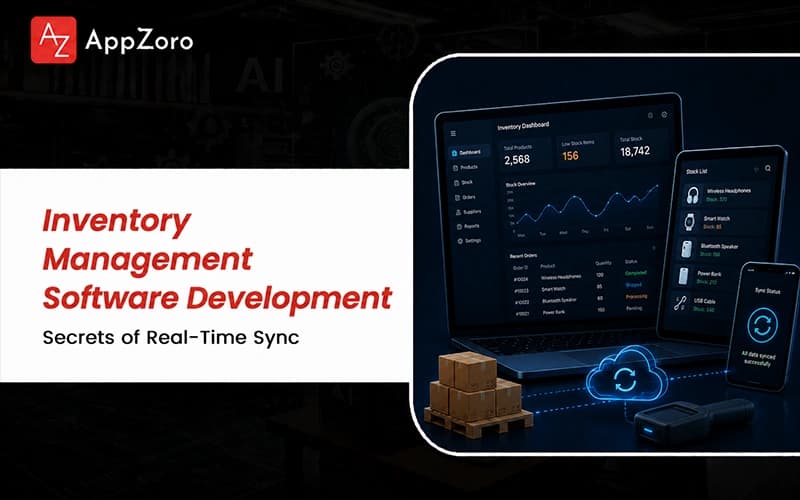
Quick Answer: Inventory management software development is the work of building the systems that track stock, movements, orders and suppliers across one or many locations in real time. In 2026 that means bi-directional sync with sales channels and ERPs, barcode or RFID scanning on the floor and increasingly AI that forecasts demand and triggers purchase orders automatically. Budgets usually run from around $40,000 for a focused single-warehouse build to well past $250,000 for a multi-location platform with forecasting, deep integrations and full warehouse features.
A founder once called me the morning after a flash sale, not to celebrate but to ask how the store had just sold ninety units of a product that only had sixty in stock. The answer sat in a sync lag nobody had budgeted for, where the website kept selling while the warehouse count crawled along behind it. That kind of quiet, expensive failure is exactly what serious inventory management software development has to prevent from the very first day. For early-stage businesses running into these scaling hurdles, learning how to develop software for startups requires balancing fast growth with technical reliability.
The category is far less forgiving than most founders expect, because stock is not really a number in a database, it is a promise to a customer. When the software and the shelf disagree, someone gets a refund, a bad review or a warehouse worker hunting for a box that the system swears still exists.
What follows reads less like a feature list and more like the conversation you would have with a custom software development company that has shipped inventory management software into real warehouses. By the end you will know what the work truly demands, where the cheap shortcuts break and how the strongest teams keep the count honest.
What Inventory Management Software Development Actually Involves in 2026
If you have looked into inventory management software development and pictured a tidy table of products and quantities, the real work is much messier. Underneath sits a constant stream of movements, sales, returns and transfers that all have to agree, in real time, across every channel at once.
A serious build in 2026 has to get a few unglamorous things right before anyone trusts the numbers:
A stock engine that records every movement like a ledger, so the count stays traceable and never silently drifts away from reality.
Real-time, bi-directional sync with sales channels, point of sale systems and any ERP, since a stale number is what quietly causes overselling and stockouts.
Barcode or RFID scanning that works on the warehouse floor, including the moments when the wifi at the back of the building gives out.
The Stock Ledger That Stops Overselling
The teams that get this right treat stock like an accounting ledger, where every receipt, sale and transfer is a recorded movement rather than an edited number. That design keeps the count auditable and lets the system reserve units the instant an order lands, which is what actually prevents overselling during a rush. Skip it and you meet the classic phantom inventory problem, where the screen and the shelf drift apart until nobody trusts either one.
Why Scanners Still Run the Floor
For all the talk of AI, the warehouse floor still runs on barcodes and increasingly on RFID, because a scan is faster and far more accurate than typing. Good software treats the handheld scanner as a first-class device, working offline when the signal drops and syncing the moment it returns. A system that assumes a perfect connection at the far end of a steel warehouse has never been used in a real one.
How to Develop Inventory Management Software Without Usual Traps
If you want to learn how to develop inventory management software without the usual expensive detours, the order of the work matters more than the feature list.
The teams that develop inventory management software well settle the integrations and the data model first, long before they polish a single screen.
A realistic project tends to move through a few clear stages and the part founders underestimate almost always sits near the start:
Mapping how this business really receives, stores, picks and ships goods, since no two operations move stock in quite the same way.
Wiring the integrations to sales channels, accounting and any ERP early, because those handshakes decide whether the count ever stays truthful.
Migrating the messy existing stock data, which is slower, dirtier and far more emotional than any founder expects on the first pass.
Why Integrations Come Before Features
The fastest way to waste a budget is to develop inventory management software features before connecting the systems that feed and consume the stock data. Sales channels, accounting tools and an ERP like NetSuite all have to share one truth or the warehouse and the books quietly drift apart. Teams that wire those connections first, then build features on top, ship something a business can run on rather than a pretty demo.
The Data Migration Founders Underestimate
Every existing operation arrives with years of messy stock data living in spreadsheets, an old system and a few warehouse managers' heads. Cleaning, mapping and importing that history is slow, unglamorous work that quietly decides whether the new system launches trusted or doubted. Senior teams plan a real migration phase with a physical stock count, because launching on wrong numbers poisons confidence before the software gets a fair chance.
Custom Build vs Off-the-Shelf Inventory Software
At some point every team faces the build or buy question, weighing a custom software development inventory management project against ready-made tools like Cin7, Fishbowl or NetSuite.
Off-the-shelf platforms cover the common ground fast, yet they bend only so far before your own process starts fighting their defaults. Here is roughly how experienced teams weigh the two paths when planning a new system in 2026:
Factor | Custom Build | Off-the-Shelf Platform |
Time to first launch | Slower, shaped around your flow | Faster, common features ready |
Process fit | Matches how you actually work | You adapt to the vendor's model |
Integrations | Built for your exact stack | Limited to supported connectors |
Upfront cost | Higher, paid as development | Lower, paid as a subscription |
Ongoing control | You own the roadmap | The vendor sets the roadmap |
Best fit | Unusual flows and real scale | Standard stock and orders |
For a fairly standard operation, an off-the-shelf platform usually wins on speed and cost and choosing one is no failure of ambition. A custom software development inventory management project earns its place when your picking, your forecasting or your integrations are the very thing competitors cannot copy. Understanding the general benefits of custom software development can help you decide if bespoke tools are necessary for your operational goals.
Warehouse Inventory Management: Where the Build Gets Harder
Inventory gets dramatically harder at warehouse scale, where a warehouse inventory management development software build has to track not just what you own but exactly where each unit sits. Bins, zones, pick paths and putaway rules turn a simple count into a logistics problem the moment volume climbs.
A warehouse inventory management development software project therefore adds a layer of physical reality that simpler inventory tools never have to face:
Location logic that knows which bin holds each unit, so a picker walks the shortest path instead of hunting across the whole building.
Putaway and slotting rules that place fast movers near packing, which quietly shaves seconds off thousands of picks every single day.
Integration with scanners, conveyors and increasingly robots, since modern warehouses lean on automation that the software has to direct cleanly.
Custom Warehouse Management Software Development on the Floor
Custom warehouse management software development pays off when your floor does something a generic system was never shaped to handle. That might be cold-chain zones, serialized parts or a pick-and-pack flow tuned to your exact products and the way your team has always worked. In those cases, the control you gain over routing, slotting and devices repays the heavier investment within the first busy season.
Where AI Pays Off
AI finally earns its keep here through demand forecasting that reads sales, seasonality and lead times to predict what to order and when, This integration of predictive analytics matches the latest trends in software development across logistics and operations. Modern models cut forecast error to roughly eight to fifteen percent, against thirty-five to forty-five for the simple averages most teams still rely on. Used well, that accuracy trims excess stock and triggers purchase orders weeks ahead, instead of reacting only after the shelf has gone empty.
If you have a quote for inventory management software development or a vendor proposal on your desk, our senior team is glad to give it a straight, no-pressure second opinion on the sync model, integrations and the migration plan. Our expert team reviewes work like this every week and would far rather flag the costly gaps now than after the counts drift on launch day.
Final Thoughts
Inventory management software development in 2026 rewards teams that obsess over an honest count far more than teams chasing a crowded dashboard. The systems that last are the ones that sync in real time, treat stock like a ledger and keep working when the warehouse's Wi-Fi flickers at the worst moment.
The winners in inventory management software development are rarely the platforms with the busiest charts shown off in a sales meeting. They wire integrations early, plan the messy data migration, treat AI forecasting as a tool rather than a slogan and respect the warehouse floor.
If a proposal on your desk is hard to judge fairly, ask someone who has run real stock through a real launch where the scope looks suspiciously thin. A good partner walks you through sync, integrations and migration without flinching, because they have seen exactly where these builds tend to break.
Leave a Comment