
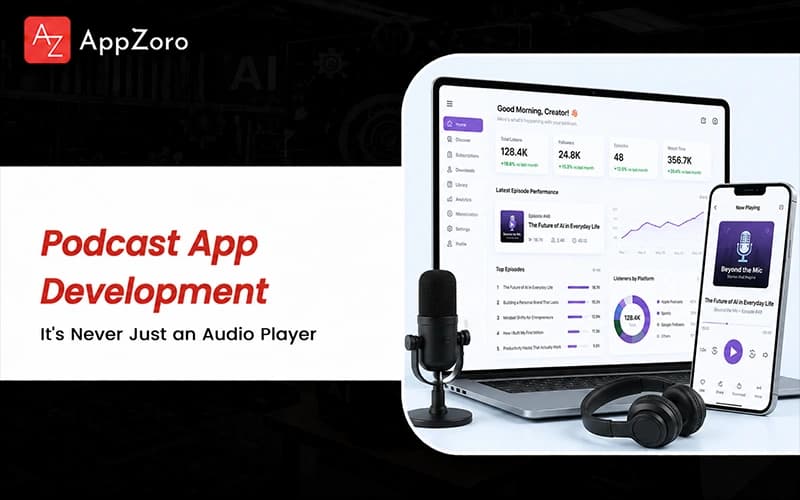
Quick Answer: Podcast app development means building an app that finds, streams and plays podcasts and it leans far more on infrastructure than on the play button people picture. Partnering with a specialized mobile app development company USA ensures you build a rock-solid RSS engine that can parse millions of shows without stuttering. A basic listening MVP starts around $25,000, while a full app with discovery, monetization and a creator side runs from $100,000 into the six figures.
Quick fork in the road before we start. If you typed app development podcast or mobile app development podcast hoping for a show to listen to on your commute, this is not that. This is a guide to building one, the kind of app a show plays inside. If you are here to create a podcast app of your own, you are in exactly the right place, so let us keep going.
Most people picture a podcast app as a play button sitting on a list of episodes. That picture is wrong in a way that quietly costs money. Real podcast app development is RSS ingestion at scale, streaming that does not stutter on the subway, downloads that survive a flaky signal and a discovery system that decides whether anyone opens the app a second time.
So where does the effort actually go and why is the simple version a trap? Here is the honest breakdown.
What Podcast App Development Really Involves in 2026
Search podcast app development and you will find tutorials that stop at "play an MP3." The interesting problems start right after that. A podcast app has to ingest and refresh thousands of RSS feeds, stream cleanly across bad networks, store downloads for offline trips and keep playing when the screen locks in someone's pocket.
You are paying for a few systems that have nothing to do with the play button:
An RSS engine that ingests, parses and refreshes feeds, because every podcast on earth publishes through RSS, not through your database.
A playback core that streams smoothly, downloads for offline and survives a screen lock, a phone call and a dead spot in the tunnel.
A discovery layer of search, categories and recommendations, since a catalog nobody can navigate is just noise with a logo on it.
It Runs on RSS, Not on a Catalog You Own
The freeing truth of podcast app development is that you do not license content the way a music app licenses songs. Podcasts are open RSS feeds, which is a great reason to follow a comprehensive custom mobile app development guide to manage the messy, inconsistent, and occasionally broken data typical of this space. You can pull in millions of shows for free, but making that chaos feel clean requires serious engineering rather than just UI work.
Background Audio and Offline Are the Quiet Hard Parts
Playing audio sounds like the easy bit until you fight the operating system over background playback for a solid week. The app has to keep streaming when the screen is off, resume after a phone call and hand off to a car or headphones without a hiccup. Offline downloads bring their own pain, since people grab episodes on wifi and then expect them to just work in a tunnel with no signal.
Listening App or Creator Platform? Two Very Different Builds
The biggest decision in podcast app development is the one most founders skip: are you building for listeners or for the people who make the shows? A listening app competes with giants on discovery and playback, while a creator platform focuses on hosting and analytics, which is why understanding how to develop an app and make money from these two distinct audiences is crucial. The two paths pull your budget in opposite directions, so pick one before writing code.
A creator platform competes with Buzzsprout and Transistor on recording, hosting and getting a show onto every directory. Same word, completely different product.
The two paths pull your budget and your roadmap in opposite directions, so pick one before you write any code:
A listening app lives or dies on discovery and playback and its hardest job is standing out in a category full of excellent free apps.
A creator platform lives or dies on hosting, RSS generation and analytics and its job is making a nervous first-time host feel capable.
A hybrid sounds clever but usually means building two half-products, which is how timelines and budgets quietly double on you.
The Listening App Trap
Building another listening app is tempting, because the catalog is free and the idea feels obvious. That is also the trap, since you are stepping into a ring with Apple and Spotify, who give their apps away for nothing. A listening app only wins on a sharp angle, a niche, a community or a discovery experience the giants cannot be bothered to build.
Why Creator Tools Are Often the Smarter Bet
The quieter opportunity in podcast app development is the creator side, where hosts pay real money for tools that save them time. Recording, editing, automatic RSS generation, one-click distribution and honest analytics all solve problems people will happily pay to avoid. It is a smaller audience than listeners but they have their wallets open and far fewer free alternatives.
How to Develop a Podcast App, Step by Step
If you want to know how to develop a podcast app without lighting money on fire, the order of decisions matters more than the tech stack. Successful teams sequence the work carefully by following a standard mobile app development process and resisting the urge to build everything at once. Design around the one job that defines your app-whether it is listener discovery or creator hosting-and only then move into frameworks and coding.
Pick listener or creator first, design around the one job that defines your app and only then argue about frameworks. Here is roughly what it costs to develop a podcast app in 2026, tier by tier:
Build Tier | Rough Cost | What You Get |
Listening MVP | $25,000–$45,000 | RSS feeds, search, streaming, basic offline |
Full app | $60,000–$120,000 | Recommendations, downloads, accounts, monetization |
Creator or scale | $150,000+ | Hosting, RSS generation, analytics, AI features |
Ongoing each year | 15–25% of the build | Maintenance, feed upkeep, new features |
Those numbers cover the build, not the marketing it takes to get noticed in a crowded store. The bigger surprise when you start developing a podcast app is how much effort goes into the unglamorous plumbing, the feeds, the playback and the storage, rather than the screens people actually see.
Why the Cheapest Quote Falls Apart First
A cheap quote to develop podcast app projects usually covers the play button and skips the hard plumbing underneath it. The RSS edge cases, the background audio, the offline sync and the search at scale all show up later as bugs nobody priced in. Paying a fair rate for a team that has shipped audio before is almost always cheaper once the refunds and rebuilds are counted.
Monetization and Where AI Helps
A podcast app can make money but rarely by charging for the audio itself, since most shows are free. The money comes from premium subscriptions, dynamic ad insertion or being the paid tool a creator leans on every week. Get the model wrong and you have a beautiful app with no business behind it.
AI has earned a real place in podcast apps but only in a few spots that save time or surface the right show. Learning how to use AI in mobile app development specifically for transcription, auto-chapters, and semantic search can make episodes more searchable and let people jump straight to the parts they want. Point it at discovery and time-saving rather than just gimmicks, and the intelligence pays for itself through higher user retention:
Transcription and auto-chapters that make episodes searchable and let people jump straight to the part they want.
Recommendations that learn from listening habits, which is the single feature most likely to make someone open the app again.
Smart search that understands a vague "that episode about sleep" instead of demanding the exact title.
AI That Earns Its Keep, Not a Gimmick
The useful AI in podcast app development is unglamorous and it works in the background. It transcribes audio so search and accessibility improve, generates chapters so long episodes are navigable and learns taste so recommendations stop feeling random. Point it at discovery and time-saving, not at a mascot on the home screen and it pays for itself.
The Business Model Comes Before the Build
Decide how the app makes money before you design a single screen, because the model shapes everything after it. A subscription app needs a paywall and a reason to renew, an ad-supported app needs serious scale and a creator tool needs to be worth a monthly fee. Founders who skip this end up with downloads and no revenue, quietly wondering where the plan went.
If you have a quote for a podcast app and it reads like a glorified audio player, you are missing most of the real podcast app development underneath. Our senior team reviews these proposals most weeks and we would much rather flag the RSS, the playback and the discovery work now than after launch.
Final Thoughts
Podcast app development in 2026 is an infrastructure problem dressed up as a media one. Since RSS at scale and background audio are the parts that decide whether anyone stays, you must know how to choose a mobile app development company that has shipped audio apps before and fought the operating system over playback rules. A good partner is honest about the unglamorous feeds and the months it takes before the flywheel finally turns.
The teams that win do not try to out-Spotify Spotify on day one. They pick a side, listener or creator, choose one job to be great at and earn an audience before they add everything else. It sounds narrow. It is also the only version that survives a crowded store.
If your quote feels suspiciously cheap, talk to someone who has shipped an audio app and fought the operating system over background playback. A good partner is honest about RSS, offline and the business model long before the first screen ever gets designed.
Leave a Comment