
The late-night hum of a highway, the sudden thud of a flat tyre, and the sinking realization that help is miles away. The old ritual—scrambling for numbers, calling a dispatcher, waiting—breeds anxiety. A different ritual exists now: one tap, precise GPS telemetry, live ETA, and transparent pricing. That is the ethos of tow truck app development — converting chaotic roadside moments into orderly, trustworthy interactions.
On-demand platforms have rewired consumer expectations. If a service can be summoned like a ride, delivered with predictability, and paid for seamlessly, users will adopt it. Roadside assistance is not immune to this tectonic shift, which is why many operators are turning to on demand app development to meet rising expectations. Market demand for faster, more reliable towing solutions is expanding; customers prize speed, visibility, and assurance. For towing operators, the equation is simple: digitize or cede market share.
Appzoro brings seasoned technical craftsmen and product strategists who translate operational nuance into elegant digital workflows—apps that do more than dispatch; they orchestrate trust.
Why Your Towing Business Needs a Mobile App
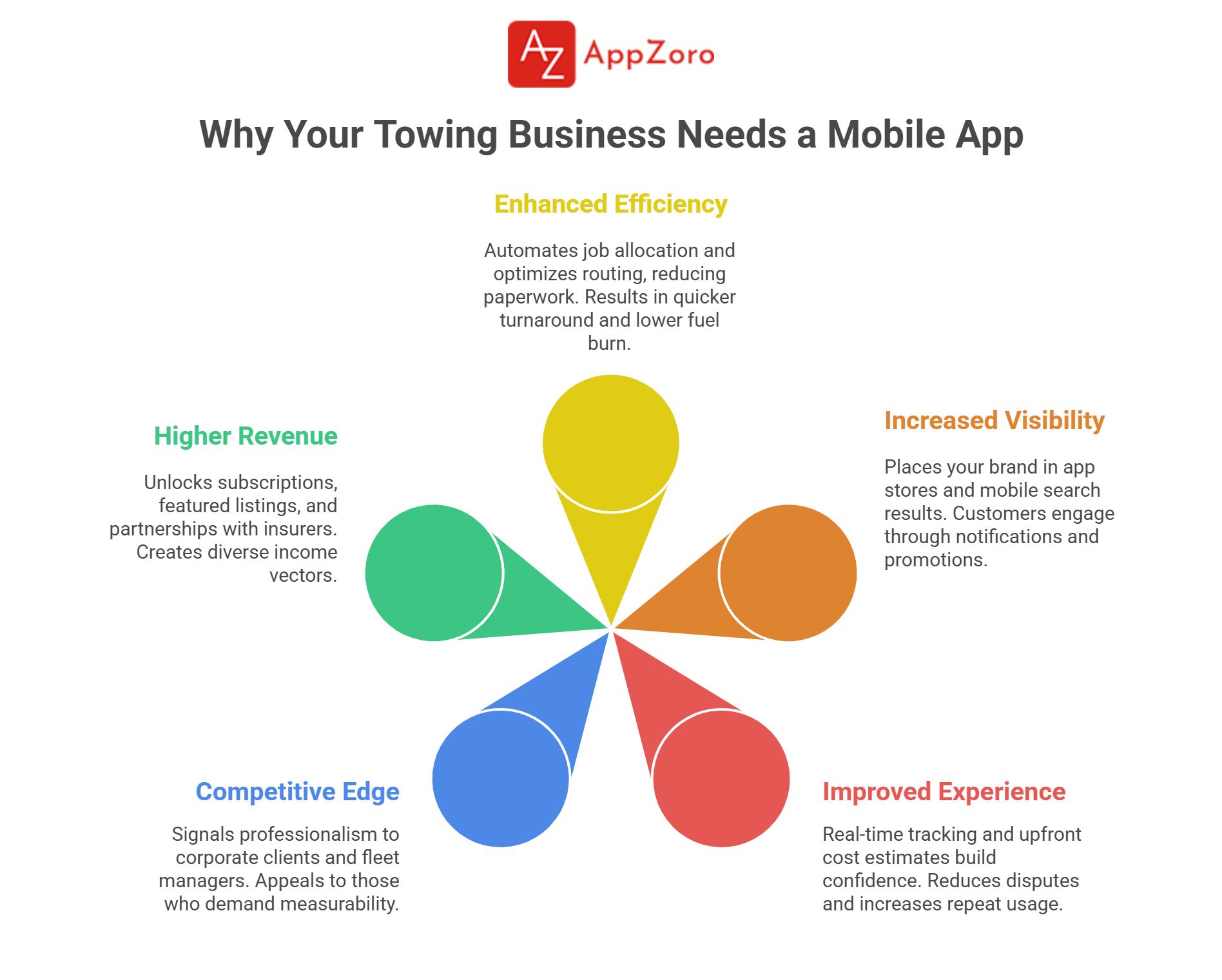
Enhanced Business Efficiency
Manual dispatching is error-prone and slow. An app automates job allocation, optimizes routing through live traffic data, and reduces paperwork through digital invoices. The net effect: quicker turnaround, lower fuel burn, and fewer missed opportunities.
Increased Visibility and Customer Reach
A presence in app stores and mobile search results places your brand at the point of need. New customers find you through high-intent queries; existing customers engage through push notifications and in-app promotions.
Improved Customer Experience and Trust
Real-time tracking, upfront cost estimates, and verified driver profiles convert uncertainty into confidence. Trust reduces dispute rates and increases repeat usage.
Competitive Advantage
Many local operators still rely on radio calls or phone trees. A polished app signals professionalism, appealing to corporate clients, rental agencies, and fleet managers who demand measurability.
Higher Revenue Potential
Beyond per-job fees, apps unlock subscriptions, featured listings, partnerships with insurers, and advertising from automotive vendors—diverse income vectors that compound growth.
Essential Features of a High-Performing Tow Truck App
A robust tow truck ecosystem requires distinct feature sets for Customers, Drivers (or Service Providers), and Admins. Each panel serves unique workflows yet must interoperate seamlessly.
Customer App Features
-
Simple User Registration: Fast sign-up via phone, email, or social login to reduce friction.
-
Real-Time Service Booking: Instant requests and scheduled jobs with estimated arrival windows.
-
GPS-Based Location Tracking: High-accuracy geolocation and the ability to share precise coordinates (not just a pin).
-
Multiple Service Options: Towing, flat-tire assistance, battery jump-starts, emergency fuel delivery, lockout service—presented clearly.
-
Upfront Fare Estimation: Algorithmic fare estimator using distance, service type, and surge logic to prevent pricing ambiguity.
-
Secure In-App Payments: PCI-compliant gateways, wallets, UPI, cards—all encrypted.
-
Driver Ratings & Reviews: Post-service feedback to maintain quality and accountability.
-
Service History & Receipts: Full transactional provenance for corporate clients and personal records.
-
In-App Communication: Encrypted chat and VoIP calls for coordination without exposing personal numbers.
-
Push Notifications: Dynamic status updates—driver en route, arrived, job completed, invoice sent.
Driver / Service Provider App Features
-
Easy Onboarding & Verification: Document upload, background checks, and vehicle registration flows with status indicators.
-
Real-Time Service Requests: Geofenced dispatch that prioritizes proximate drivers.
-
Accept/Reject Mechanism: Flexibility to manage workload and reduce forced acceptances.
-
Built-in Navigation: Native maps integration with turn-by-turn guidance and ETA recalculations.
-
Earnings Tracker & Payouts: Transparent dashboards showing fares, commissions, and pending payouts.
-
Availability Toggle: Drivers set online/offline status with shift summaries and idle-time analytics.
-
Job Notes & Attachments: Allow drivers to upload photos, signatures, or damage reports for compliance.
Admin Panel Features
-
Centralized Dashboard: Aggregate KPIs—active jobs, average response time, utilization rates, and revenue telemetry.
-
Driver & Customer Management: Verification queues, document expiry reminders, and dispute logs.
-
Fleet Management: Live vehicle telemetry, maintenance scheduling, and utilisation heatmaps.
-
Pricing & Commission Controls: Dynamic pricing rules, promo engines, and per-driver commission settings.
-
Analytics & Reporting: Cohort analysis, retention metrics, service heatmaps, and profitability reports.
-
Dispute Resolution: Ticketing workflows, evidence capture (photos, chat transcripts), and refund logic.
Choosing the Right Business Model for Your Tow Truck App
-
Single Business Model (Operator App): Ideal for an established company digitizing internal dispatch and customer acquisition. Keeps total control of fleet and pricing.
-
Aggregator Model (Marketplace): Connects independent operators to demand; platform monetizes via commissions. Scales faster but requires rigorous quality controls and SLA enforcement.
-
Subscription Model: Offer premium roadside plans—priority service, discounted fares, or business accounts for fleets. Predictable recurring revenue is the hallmark here.
Each model has trade-offs in capital expenditure, regulatory compliance, and operational complexity. Choose based on current assets, growth ambitions, and the appetite for marketplace governance.
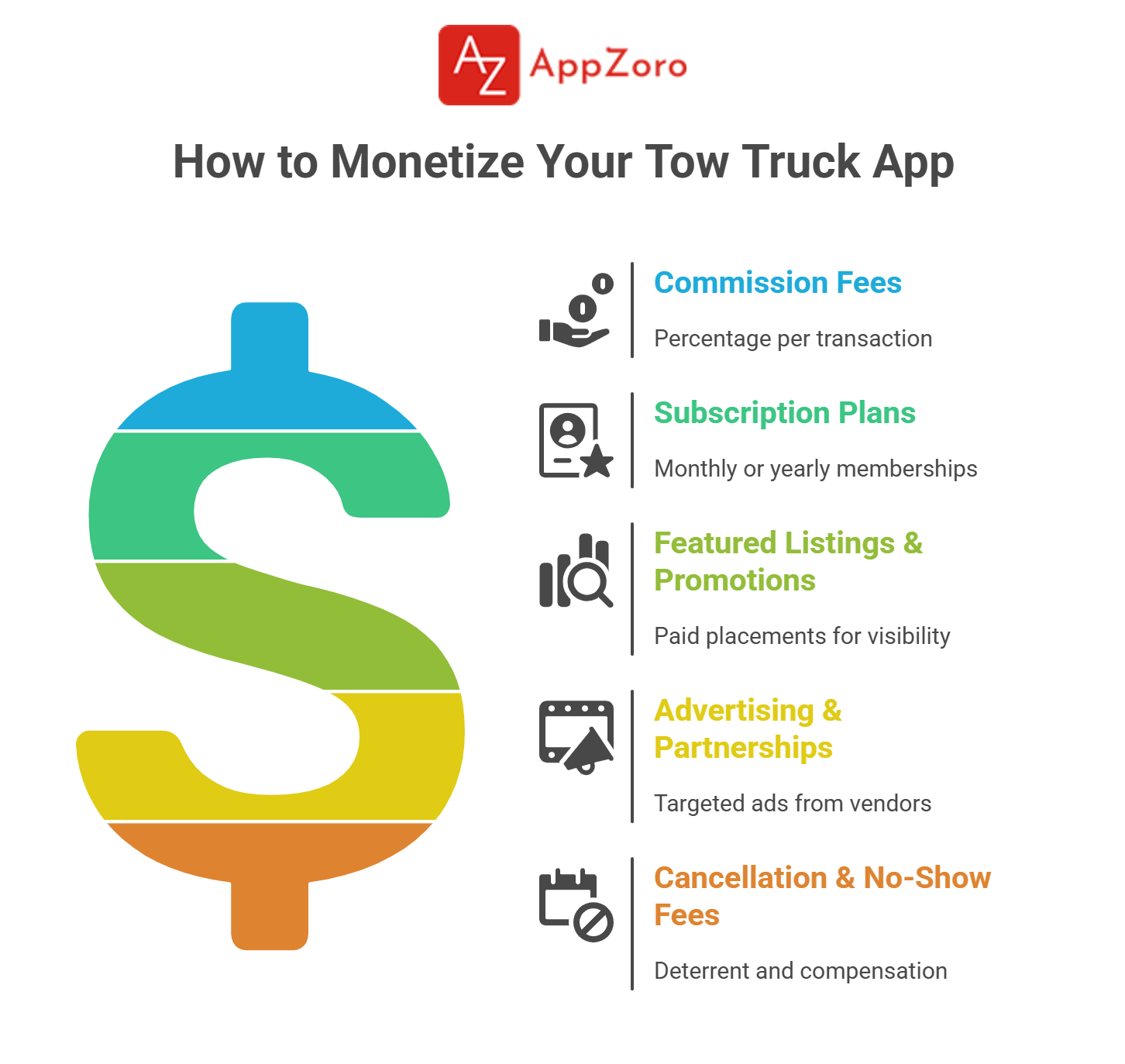
How to Monetize Your Tow Truck App
-
Commission Fees: A percentage per transaction when the app matches customers with third-party providers.
-
Subscription Plans: Monthly or yearly memberships offering perks—priority dispatch, waived cancellation fees, partner discounts.
-
Featured Listings & Promotions: Paid placements for service providers to increase visibility.
-
Advertising & Partnerships: Monetize app real estate with targeted ads from insurers, body shops, battery retailers, or car accessory vendors.
-
Cancellation & No-Show Fees: A deterrent and compensation mechanism for last-minute cancellations.
Combine monetization strategies strategically—balance customer value with revenue needs to avoid alienating users.
The App Development Process with Appzoro
Step 1: Discovery & Strategy
Conduct stakeholder interviews, map core journeys, and draft an MVP scope that aligns with business metrics—customer acquisition cost, lifetime value, and unit economics.
Step 2: UI/UX Design
Construct wireframes, prototype the key flows (booking, dispatch, payment), and iterate with usability testing using professional ui/ux design and development services to ensure every interaction feels intuitive. Prioritize clarity over ornamentation so users can complete tasks quickly and confidently without friction.
Step 3: App Development
Build modular, API-driven services. Native or cross-platform decisions hinge on performance needs and budget. Include telemetry, logging, and security from day one.
Step 4: Quality Assurance & Testing
End-to-end testing: functional, load, security, and real-device trials. Simulate edge conditions—poor GPS, intermittent connectivity, and cancelled jobs.
Step 5: Deployment
Compliance checks and app-store readiness—store metadata, screenshots, and staged rollouts to monitor performance.
Step 6: Ongoing Support & Maintenance
Feature iteration, security patches, and performance tuning. Analytics guide product evolution; customer feedback seeds new capabilities.
Understanding the Cost of Tow Truck App Development
Factors That Drive Cost
Complexity of features (real-time tracking, payments, verification), integrations (mapping, SMS gateways, payment providers), platform choice (iOS, Android, Web), and UI sophistication.
Estimated Cost Range (Industry Benchmarks)
A minimal viable product with core booking, driver app, and admin dashboard often starts around $25,000–$40,000. A fully featured cross-platform solution—fleet telemetry, advanced analytics, subscription engines, and enterprise integrations—can escalate to $80,000–$150,000+. These are indicative ranges; precise estimates depend on scope and SLAs.
Ongoing Maintenance
Plan for annual maintenance costs—typically 15–20% of initial build cost—to cover hosting, updates, and minor feature enhancements. For mission-critical enterprise deployments, allocate more for 24/7 support and compliance audits.
Why Choose Appzoro for Your Tow Truck App Development?
-
Proven Expertise: Experience delivering on-demand platforms and logistics solutions.
-
Tailored Solutions: Custom flows and integrations—not cookie-cutter templates.
-
Transparent Process: Milestone-driven delivery and clear communication channels.
-
Dedicated Team: Product managers, UX designers, backend and mobile engineers, QA specialists, and post-launch support.
-
Outcome Focused: Emphasis on metrics—reduced response times, higher utilization, and improved NPS.
A partner should be as invested in operational outcomes as in clean code. Appzoro’s approach ties technical deliverables to business KPIs to ensure ROI.
Conclusion: Take Your Towing Business to the Next Level
Towing and roadside assistance are ripe for digitization. An app is more than software; it is an operational paradigm shift. It transforms first-response rhythm, reduces uncertainty for customers, and opens diversified revenue lines for operators. For businesses that want predictability, scale, and reputational uplift, tow truck app development is the lever that accelerates growth.
Ready to convert stranded moments into dependable experiences? Discuss your roadmap and receive a pragmatic, ROI-driven plan.