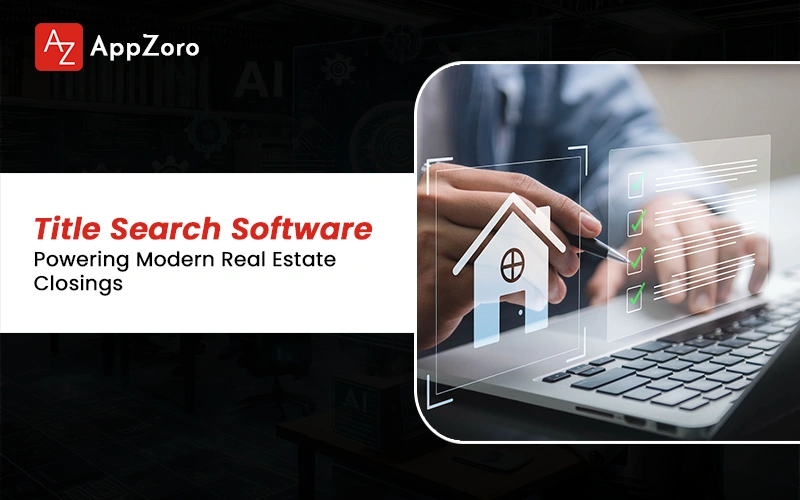
Title Search Software Powering Modern Real Estate Closings

Last Updated :
Running a title operation can be stressful, dealing with manual public records pulls, paper-based examiner workflows, inconsistent county data quality and turnaround pressure giving operators headaches before every single closing. The American Land Title Association is estimating that the title industry is processing roughly $15 billion annually, with title search representing the largest labor cost component across the entire workflow. This is not suitable nor suggested for any modern title operator at scale and to tackle that, smart teams are now equipping themselves with real estate software development services that are reliable, accurate and integration-ready across the closing stack.
What Is Title Search Software?
So, what is title search software actually doing? Within the real estate software development guide framework, this platform is searching public real records to identify ownership history, liens, encumbrances, judgments and interests affecting marketable title on a property.
But what is the software actually producing at the end of the workflow? Let’s break it down.
-
Chain Of Title Report: The full ownership history is being reconstructed back through a 30 to 60 year period depending on state requirements.
-
Title Commitment: The document that the underwriter is using to issue the actual title insurance policy on the property.
-
Exceptions Schedule: The list of items that the title policy is going to explicitly not cover once it is issued.
-
Recording Package: The documents being prepared for post-close county recording after the transaction closes successfully.
The core job of title search software is to compress what was historically a 4 to 10 hour manual abstract into a 1 to 2 hour reviewed product that is ready for the underwriter.
The Title Search Workflow – 6 Stages from Order to Commitment
The title search workflow is moving through six distinct stages from the moment an order is opened to the moment the final policy is issued and title search software is handling specific work at every single one. Let’s walk through each stage properly.
1: Order Intake And Property Identification
The customer is submitting an order with the property address and parcel ID and the software is validating the address, pulling the parcel data and identifying the legal description and county jurisdiction.
2: Public Records And Title Plant Search
The software is querying the relevant title plant or the county records API for that jurisdiction, pulling all the deeds, mortgages, releases and recorded liens that are relevant to the parcel.
3: Chain Of Title Construction
The algorithm is reconstructing the ownership chain back to the legally required period for the state and is flagging any gaps, missing releases or broken chains for examiner review.
4: Exception Identification And Review
The software is surfacing judgments, tax liens, HOA dues, easements and restrictions found in the records and the examiner is reviewing each one and classifying it as a policy exception or a curable item.
5: Title Commitment Generation
The platform is generating the title commitment with Schedule A covering the insured party, the amount and the legal description and Schedule B covering the exceptions and the policy requirements.
6: Post-Close Recording And Policy Issuance
Once the closing is happening, the software is handling the document recording at the county recorder office and is issuing the final title insurance policy for the underwriter to back.
Core Components of Title Search Software
Title search software is typically built around six functional modules that are combining differently across the leading platforms and understanding each one is making the vendor comparison conversation much clearer for any title operator that is in the market.
-
Property Database And Parcel Lookup: Handling address validation, parcel ID resolution and legal description retrieval from the relevant county data sources.
-
Title Plant Integration: Connecting to proprietary or shared title plants which are regional databases of indexed property records maintained by data vendors.
-
County Records Access: Direct API or aggregator-based access to county recorder offices, which is varying dramatically by state and even by individual county.
-
Document Imaging And OCR: Optical character recognition running on deeds, mortgages and releases, which are very often scanned PDFs with poor source image quality.
-
Examination Workflow And Commitment Builder: The examiner-facing application where the chain is being constructed and the title commitment is being drafted for review.
-
Underwriter And Closing Platform Connectors: Integrations into Stewart, First American, Fidelity and Old Republic underwriter systems, plus connections to the closing platforms used downstream.
The real differentiation across competing title search software platforms is rarely the examiner UI itself, it is the breadth and the freshness of the data sources sitting behind that UI in the background.
Where Title Search Software Actually Gets Its Data
The value of any title search software is genuinely bounded by the quality of the data sources it is accessing, because the vendors themselves are not usually owning the underlying data, they are licensing, aggregating or scraping it from disparate sources.
-
Title Plants: Privately maintained indexed databases of property records organized by parcel, with the best coverage in California, Texas and Florida and sparse coverage elsewhere.
-
County Recorder Offices: Roughly 3,300 US counties exist, with each one operating different access mechanisms ranging from modern APIs to paper-only systems.
-
Judgment And Lien Indexes: State court systems, federal judgment indexes and IRS lien records are all being accessed during the exception review stage.
-
UCC Filings: State secretary of state offices are being queried for any commercial transaction liens that are affecting the property being searched.
-
Tax Assessor Data: County and municipal tax records are typically being pulled through aggregators like ATTOM and CoreLogic rather than direct sources.
-
Plat Maps And Subdivision Records: County engineering or recorder offices are providing the survey data needed for legal description verification.
-
HOA Dues And Assessment Records: Increasingly available through integrators like HomeWiseDocs and CondoCerts across major HOA-governed markets.
Vendors with national title plant coverage like DataTrace and TitlePoint are commanding pricing premiums for good reason, because direct county-by-county integration is genuinely hard engineering work that almost nobody is doing well at scale.
Real Estate Title Search Software (Residential vs. Commercial)
Real estate title search software for residential transactions is high-volume, low-margin and heavily automated, while commercial title search is lower-volume, higher-margin and is demanding meaningfully more examiner judgment at every stage of the workflow.
|
Dimension |
Residential |
Commercial |
|
Typical search depth |
30 to 60 years |
60+ years often |
|
Entity tracing |
Rare (individuals) |
Constant (LLCs, partnerships, trusts) |
|
Document types |
Deeds, mortgages, releases |
Add: CC&Rs, easements, ground leases, environmental, UCCs |
|
Examiner time |
1 to 3 hours |
8 to 40+ hours |
|
Average policy size |
$200K to $1M |
$5M to $500M+ |
|
Software emphasis |
Automation, throughput |
Examiner tools, document management |
The choice of real estate title search software is depending heavily on which side of this split the operator is sitting on and most platforms in the market are leaning clearly toward one vertical or the other rather than being equally strong across both.
-
Residential Strength Platforms: SoftPro, Qualia, ResWare and RamQuest are leading for high-volume residential property title search software workflows.
-
Commercial Strength Platforms: TitlePoint enterprise, ResWare commercial module and Stewart’s NetSmart for commercial users are leading on the commercial side.
The Best Commercial Title Search Software Platforms
The best commercial title search software is rarely the same platform that is winning for residential operators, because commercial users are needing much stronger entity tracing, deeper document management and far more capable examiner tooling for the complex chains they are working with daily.
-
TitlePoint (ICE Mortgage Technology / Black Knight): Strongest national plant coverage and is dominating with enterprise commercial users across the largest US markets.
-
ResWare (Adeptive Software / Qualia): Strong commercial module that is workflow-heavy and is suiting mid-market to enterprise commercial operators well.
-
DataTrace (Stewart Title): The best fit for users already operating inside Stewart underwriter relationships across their entire book of business.
-
RamQuest: A mid-market option that is handling both commercial and residential work for operators sitting in the middle volume tier.
-
SoftPro: Better suited for residential and small commercial work rather than for large enterprise commercial title operations at scale.
-
Stewart NetSmart Commercial: An underwriter-bundled commercial platform that is making sense for Stewart-aligned operators specifically.
Selecting the best commercial title search software for your operation should come down to these four criteria across any vendor evaluation conversation.
-
Title Plant Coverage In Your Markets: National coverage versus regional coverage is the single biggest differentiator across all the platforms.
-
Entity Tracing Tools: Critical for the LLC, partnership and trust work that is dominating commercial transactions across the country.
-
Document Management Depth: Commercial title work is generating roughly 10x more documents than the residential equivalent on every deal.
-
Underwriter Relationships: Whether your operation is tied to a specific underwriter or is running an open underwriter model across deals.
Custom Title Search Software Development – When It Makes Sense
Custom title search software development is uncommon, however, when learning how to develop a real estate app, certain scenarios exist where building custom is actually making sense for the operator because standard platforms are covering roughly 95% of standard workflows already.
-
High-Volume Operator With Unique Workflow: $2 million+ in annual title revenue with a proprietary examination process not fitting any standard platform off the shelf.
-
Proptech Or Closing Platform Build: Embedding title search inside a broader closing or transaction platform as part of an integrated proptech offering.
-
Underwriter Building Direct-To-Consumer Tooling: Owning the entire stack end-to-end rather than depending on third-party platforms in the workflow.
For any team moving forward with a real estate app development cost breakdown, these five considerations are what most build estimates are missing during the initial planning phase.
-
Data Licensing Is The Biggest Cost: Plant access fees from DataTrace and TitlePoint are running $50K to $500K+ annually depending on the coverage required.
-
County Record Integration Is Manual Work: Each non-standardized county is essentially its own engineering project with its own quirks and requirements.
-
OCR Quality Matters More Than Most Devs Realize: Scanned 1970s deeds are consistently breaking commodity OCR engines that work fine elsewhere.
-
Underwriter Integration Is Mandatory For Production Use: The platform simply cannot ship without it in any serious title operation today.
-
MISMO Compliance Is The Industry Standard: The document and data exchange format used across every modern title search software development project.
Integration and Compliance Requirements
No title search software is operating in isolation from the rest of the closing stack and the integration breadth combined with the compliance load is what is separating production-ready platforms from proof-of-concept builds being shipped today.
Must-Have Integrations:
-
Closing And Escrow Platforms: Qualia, RamQuest closing modules and SoftPro are the dominant downstream closing platforms.
-
Underwriter Systems: Stewart Access, FAST (First American), Fidelity and Old Republic are the main underwriter integration targets.
-
E-Recording Vendors: Simplifile, CSC and ePN are handling the post-close county recording workflow across the country.
-
Tax Service Providers: First American Tax and LERETA are providing tax certifications across the major US markets.
-
HOA Document Services: HomeWiseDocs and CondoCerts are the leading HOA document and assessment integrators in the market.
-
Property Data Aggregators: ATTOM and CoreLogic are providing parcel data and tax assessor information at meaningful scale.
Compliance Frameworks:
-
ALTA Standards: Title commitment and policy form standards being applied across the entire industry.
-
MISMO: The data exchange format being used across mortgage and title transactions in the US market.
-
State Title Insurance Regulations: These vary widely across jurisdictions and are affecting storage, retention and audit requirements.
-
CFPB / TRID: Closing disclosure timing rules that are affecting the commitment delivery timelines on every transaction.
Conclusion
Title search software is now an operational baseline, much like construction inventory management software, where data source quality, integration depth and examiner workflow are all genuinely mattering to the bottom line of a modern title firm. The best commercial title search software is meaningfully different from the best residential platforms and custom title search software development is making sense for high-volume operators or for proptech founders embedding title inside broader workflows. Map data source access and underwriter requirements honestly before evaluating any platforms in the market.
Frequently Asked Questions
What Is Title Search Software?
Title search software is automating the search of public records and title plants to identify property ownership, liens and encumbrances, then generating the title commitment for issuing title insurance.
What Is The Best Commercial Title Search Software?
The best commercial title search software is depending on title plant coverage in your markets and on underwriter relationships, however TitlePoint and ResWare are leading for enterprise commercial users.
How Does Real Estate Title Search Software Differ From Commercial?
Real estate title search software for residential transactions is high-volume and automated, while commercial title software is emphasizing entity tracing, document management and examiner workflow depth across the board.
When Is Custom Title Search Software Development Worth It?
Custom title search software development is typically worth it at $2 million+ annual title revenue, for proptech founders building closing platforms or for underwriters owning the stack end-to-end.
What Data Sources Does Property Title Search Software Use?
Property title search software is using title plants, county recorder offices, judgment and lien indexes, UCC filings, tax assessor data and HOA document records.
How Much Does Title Search Software Cost?
SaaS platforms are ranging $100 to $500+ per user per month plus per-search fees, while custom title search software development is typically running $200K to $1 million depending on scope.