
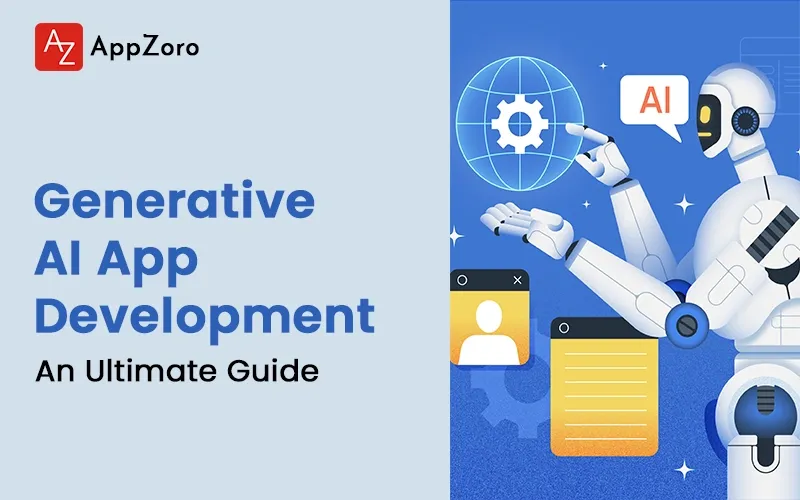
Generative AI transitioned from a niche novelty to a mainstream game-changer in 2024-2025. Overnight, companies began to use it to automate content, build intelligent chatbots, and assist developers with code suggestions. Innovative waves of change are crashing through every industry.
Generative AI is fundamentally different from earlier AI systems because it is creative. Rather than merely classifying photos, predicting numbers, etc., generative models create new forms of content-text, images, audio, and code-on-demand. They are not merely tools; they are co-creators.
That is why more companies are choosing to work with a [generative AI app development company](https://appzoro.com/services/ai-app-development-company). Creating this type of application will take unique skill sets in designing prompts, fine-tuning models and managing output quality. If done well, this technology will give businesses a strategic advantage over the competition. If done poorly, it may at best feel gimmicky or at worst feel risky.
## What Is Generative AI and How Does It Work?
Generative AI utilizes large models, namely large language models (LLMs) and diffusion models, to produce unique content. In essence, these models build on a vast collection of data to establish how to produce new content that mimics patterns found in the data.
Some of the model types you will encounter include:
– GPT (e.g., GPT-3, GPT-4): Excels at generating text – chatbot conversations, open text summaries, articles, etc.
– DALL·E and Stable Diffusion: Generate images from text prompts.
– Codex: Provides power for code generation and may have utility for developer tools and automation.
– Claude and other models: Focus is on creating safe and controlled generative behavior.
There also exists a growing disparity between open-source and proprietary tools. Open-source can provide more flexibility, lower costs, but will often require some expertise and/or fine-tuning to yield any level of quality. A proprietary solution such as OpenAI’s ChatGPT will usually generate a more polished result more quickly than open-source solutions; however, there will be a monthly API cost, restrictions, and limitations around the solution.
Generative AI is being utilized by numerous industries, including:
– Marketing and content creation: Automatically generated blog posts, social media images, and video scripts.
– Customer support: AI agents that can engage naturally and adaptively.
– Design and creativity: Applications that generate new product idea or UI mockers.
– Developer tools: Auto-complete in word processing applications, code generation, and documentation generators.
– Learning and training: Applications that provide personalized lessons, realistic simulations, and writing support.
## Business Use Cases for Generative AI Applications
If you’re exploring these use cases, working with a specialized generative AI app development company ensures your app delivers real business value and doesn’t just look flashy.
Generative AI is providing real business value, and fast. When done correctly, it can provide more than just automation; it heralds creativity, efficiency, and new products where none existed before.
Content Creation: Writers and marketers can generate written content, social media content, scripts for videos, and even visual assets quickly and efficiently. A well-designed generative AI application keeps the ideas flowing and reduces production costs.
Code Generation & Developer Tooling: Applications using models such as GPT or Codex are widely used and facilitate writing code, writing boilerplate, or generating full features. Developers use less time writing repetitive stuff and more time creating value.
Chatbots for Customer Service: Generative chat-based agents can successfully hold complex conversations using generative AI, adapting their tone to brand requirements, and only passing through when truly necessary. This reduces support costs and increases customer satisfaction.
## Choosing the Right Generative AI App Development Company
Finding the right partner starts with understanding what makes a real specialist different from developers who can work in general terms. You have to look for a company that excels in prompt engineering – that is, they fully understand how to create inputs to get accurate quality responses from the model. Unsummoning it should also be part of their skill set, that is, the adjustment of models with your own data to get accuracy and context.
API integration is another must. Your app will need seamless connections to your generative AI resource, whether you are working with OpenAI, Anthropic, or an open-source model. This is where an application will begin to break down, particularly with data flowing between the AI, back-end logic, and user interface. A leading generative AI app development firm should have this covered for you.
More importantly, ethics and safety are priority number one. A strong partner will have the display of bias detection incorporated, an aspect of robustness testing, and ongoing real-time “guardrails” or fault-tolerance for issues. Model hallucination, irrelevant outputs, and wrongful use of data are not just an ‘oops’; they will cause brand damage. Building a culture of ethical and compliant (GDPR, HIPAA, and standards in your industry) AI practice should be built in from the ground up.
And do not skip this; review their portfolios. Assess their previous generative AI projects and determine if they align in terms of your desired use case. Ask about their tech stack and whether they have experience with your preferred model providers, vector databases, or frameworks like LangChain or Hugging Face. A legible endpoint that is ultimately the correct fit, will have previous success stories that are relevant to your application, as well as the technical fluency you envision.
## Core Tech Stack for Generative AI App Development
If you’re serious about building a generative AI app that actually delivers value, you need the right tech stack behind it. A seasoned generative AI app development company brings together cutting-edge tools with real-world engineering discipline.
Here’s what the core stack typically includes:
### Model Frameworks
Whether you’re working with OpenAI’s GPT models, Anthropic’s Claude, Stability AI’s image generation models, or Hugging Face’s open-source options, your app needs to plug into a reliable foundation. Each platform has its strengths depending on the use case: text, image, audio, or code generation.
### Development Stack
Most generative AI apps are built using a modern full-stack approach. You’ll commonly see:
Python for AI logic and orchestration
Node.js or FastAPI for backend services
React or Next.js for building responsive, dynamic frontends
LangChain or LlamaIndex to chain AI calls and memory
Vector Databases like Pinecone, Weaviate, or FAISS for retrieval-augmented generation (RAG), which helps apps remember and respond with context
### Infrastructure
Cloud is essential, both for scalability and AI performance. Most generative AI app development companies rely on:
AWS (EC2, SageMaker, Bedrock)
Azure OpenAI Service (especially for enterprises needing compliance and regional control)
Google Cloud AI for Vertex AI, AutoML, and scalable deployment
### Cross-Platform Integration
Regardless of whether your app is mobile, web, or desktop, powering APIs are going to make it better. The APIs will securely connect the user interface to the AI engine while preventing latency and preserving the user experience. This is when a tech-savvy generative AI app development company can really show how valuable they are by ensuring your AI features are sound and ready for user usage.
## A Step-by-Step Process to Build a Generative AI App
A good idea is only the beginning. To turn it into a reliable generative AI app, you need more than code—you need a team and a process that understands the challenges ahead. [How an AI app builds scalable solutions](https://appzoro.com/blog/how-ai-app-development-company-builds-scalable-intelligent-solutions) depends on anticipating roadblocks early and designing with scale in mind. Here are the key steps that experienced generative AI app development companies follow to create applications that actually work in the real world
#### 1. Define Business and User Goals
What’s the real-world problem your app is solving? Who’s using it, and how will they interact with AI? This step grounds your app in purpose, not just possibilities.
#### 2. Choose the Right Foundation Model
Text, image, audio, or multimodal? Closed-source (like GPT-4) or open-source (like Mixtral or LLaMA)? The model choice defines your app’s capabilities, scalability, and cost structure.
#### 3. Build Prompts or Fine-Tune Models
Prompt engineering helps guide pre-trained models, but if your use case needs domain expertise (e.g., legal or medical content), fine-tuning on your data is the way to go.
#### 4. Develop App Frontend/Backend
Now the code comes in. The user interface is built out, APIs are wired in, and your backend architecture is prepared for handling data, auth, and AI interaction.
#### 5. Integrate AI via API or Direct Model Deployment
Some apps call hosted APIs (OpenAI, Anthropic); others deploy models locally or in a private cloud. Your deployment method depends on latency, privacy, and budget needs.
#### 6. Test for Accuracy, Ethics, and Performance
You can’t launch blindly. This phase includes:
Accuracy checks
Prompt validation
Bias and toxicity testing
Performance tuning under load
#### 7. Deploy, Monitor, and Retrain
Your app goes live but it doesn’t stop there. AI performance will degrade without regular retraining or updates. A smart generative AI app development company includes monitoring tools, A/B testing setups, and feedback loops for continuous learning.
## Key Challenges in Generative AI App Development
Building generative AI apps in 2025 is exciting, but it’s not plug-and-play. These apps come with real technical and operational hurdles. Any experienced generative AI app development company knows how to plan for, work around, or solve these issues:
#### Data Privacy & Model Hallucination
Generative models can sometimes create facts, also known as hallucinations. Combine that with the sensitivity of user or business data, and you’ve got a high-stakes trust issue. Guardrails, content filters, and privacy-preserving workflows are must-haves, not nice-to-haves.
#### Costs of API Usage & Compute Infrastructure
Powerful AI comes with an even more powerful compute burden. Whether you’re fine-tuning your model or calling APIs like GPT-4 or Claude, it is easy to go through your budget quickly. A good AI partner can help you optimize your prompts, cache responses, and budget responsibly for scale.
#### Scaling Inference for Real-Time Applications
Delivering dynamic, AI-generated content in real-time (chatbots, assistants, creative tools) requires inference at scale and good latency. This requires the proper architecture, load balancing, and maybe even edge deployments.
#### Providing Relevance, Accuracy, Confidence & Trust
AI-generated content should not only be technically right. It should feel right to the user. This requires thoughtful UX design with easy feedback loops and content moderation in the flow of the app.
#### Staying on Top of Model Change
AI models evolve rapidly. What works today could be obsolete in six months. A good generative AI app development company will design your app with agility and quick integrations to support new models and APIs.
## Future Trends in Generative AI App Development
The next wave of generative AI is already shaping up. If you’re building apps now, keep these trends on your radar, they’ll define the competitive edge:
### Real-Time Generation and Edge AI
Expect AI apps to move closer to the user. Running models on-device or at the edge reduces latency and increases privacy, perfect for industries like healthcare, retail, and industrial IoT.
### Multimodal Generative AI (Text + Image + Video + Audio)
Apps won’t just write, they’ll see, speak, design, and edit. Think LLMs that create videos from scripts, or tools that turn sketches into code. Generative AI is becoming truly multi-sensory.
### AI Copilots for Every Industry and Role
From legal assistants to factory floor copilots, specialized AI tools will support professionals in every niche. The key? Domain-specific data + intuitive UX + explainable AI.
### Native Generative AI in Browsers and Mobile Apps
Expect generative capabilities built directly into devices, browsers, and OS-level tools. Lightweight models and web-based inferencing are making this possible.
### Regulation & Ethical AI Mandates
Governments and industries are laying down rules for transparency, traceability, and fairness. Working with a responsible generative AI app development company means you stay ahead of compliance while still innovating.
## To Sum Up
Here’s the reality: generative AI isn’t a fleeting trend, it’s a fundamental shift in how we build and interact with software. But it’s not magic. Success depends on execution, trust, and choosing the right team.
A great generative AI app development company, as outlined in any trusted [AI App Development Guide in 2025](https://appzoro.com/blog/ai-app-development-company-a-ultimate-guide-in-2025), won’t just throw an API into your product and call it a day. Instead, they’ll help design intelligent systems that are responsible, scalable, and aligned with your business goals. They’ll know when to integrate models like GPT and when custom fine-tuning is essential. The best teams anticipate what breaks at scale—and solve those issues before your users ever notice.
Looking for a generative AI app development company that delivers more than just code?
At AppZoro, we turn cutting-edge AI into practical, business-ready solutions, whether it’s content generation, smart chatbots, or AI copilots. Our team specializes in prompt engineering, model fine-tuning, and full-stack development using tools like GPT, LangChain, and vector databases. We prioritize ethical AI, data privacy, and long-term scalability from day one.
With AppZoro, you build intelligent value that grows with your business. Let’s create what’s next.