How Much Does Android App Development Cost in 2026? Inside the Real Numbers

A founder I work with sent me her engineering lead’s two vendor proposals last spring and asked, with the particular patience reserved for moments when the math stops making sense, why the Android quote was thirty percent higher than the iOS quote. The answer turned out to involve the kind of fragmentation math nobody discusses honestly during a pitch, which is exactly the part of your comprehensive mobile app development cost breakdown that decides whether your project actually ships on budget.
The Android cost premium over iOS is real, predictable and almost never explained in vendor proposals because it makes the headline number look worse against an iOS-first competitor’s quote.
Founders who reference a custom mobile app development guide to understand the premium upfront end up with realistic budgets and clean executions; founders who only see it surface during month four of the build end up rebuilding the device-coverage spec under deadline pressure they cannot afford. What follows is the version of the Android cost conversation an experienced builder would have with a CTO over coffee on a Wednesday rather than the polished pitch deck a sales rep delivers across the procurement table.
By the end you will know what real builds cost in 2026, why the Android premium exists and the hidden line items that decide whether your project ships on budget.
What Goes Into Android App Development Cost in 2026
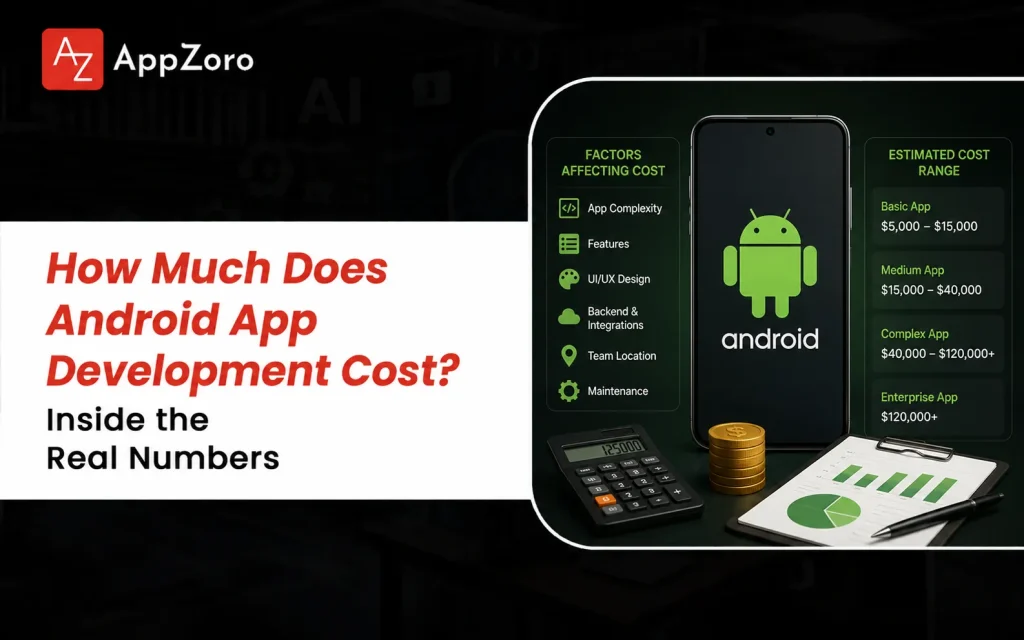
Android app development cost in 2026 breaks into four big buckets vendor proposals rarely separate cleanly: the engineering build itself, the device coverage and testing breadth, the third-party integrations (Firebase, payment processors, analytics) and the post-launch maintenance Google’s annual platform updates impose. Most of the price spread between vendor quotes lives in how each firm handles those four buckets.
The engineering build is what most founders assume the quote covers and most of the time, the quote covers only that. Smart teams ensure the mobile app development process includes deep discovery to prevent device coverage being scoped to only three reference devices when serious products need eight or more device profiles to be successful.
Here is what android app development cost actually breaks into for serious builds:
-
Engineering build (Kotlin codebase, Jetpack Compose UI, state management, backend integration) typically accounts for forty to sixty percent of the total.
-
Device coverage, OEM-specific testing and API level depth account for fifteen to twenty-five percent of the total cost.
-
Third-party integrations, Firebase setup, payment processing and analytics account for ten to fifteen percent.
-
Year-one maintenance, security patches and annual Android platform upgrades run fifteen to twenty-five percent of original build cost annually.
Why Device Coverage Drives the Android Cost Premium
Device coverage drives the Android cost premium because the framework targets 23,000+ device models across at least four major OEMs (Samsung, Xiaomi, OnePlus, Google) with their own customization layers on top of Android. iOS targets twenty-something active iPhone models. That is the math behind why android mobile app development cost runs higher than iOS for the same spec.
What Firebase and Google Play Integration Actually Cost
Firebase and Google Play integration:- Analytics, crash reporting, push notifications, Play Integrity API and in-app billing sit on top of the base Android build and typically add $5,000 to $20,000 depending on depth. Founders consistently underestimate this line item because Google’s tooling looks free at first glance, while real integration takes serious engineering effort.
Why Maintenance Cost Is Higher on Android Than iOS
Maintenance cost is higher on Android than iOS because Google ships major Android releases annually, each requiring compatibility validation across your supported device profiles. This underscores the importance of picking a modern tech stack for mobile app development that optimizes for third-party integrations and Firebase setup early in the build to keep long-term maintenance manageable.
How Much Does Android App Development Cost: The Real Numbers
When founders ask how much does android app development cost, the realistic 2026 answer depends heavily on what tier of build you actually need. Knowing how to choose an Android app development company capable of navigating these tiers is what determines whether procurement feels coherent or chaotic across the next four months of your build.
The number founders quote at conferences ($60K-$200K range) is roughly accurate for the middle tier but understanding which tier your product actually fits is what determines whether procurement feels coherent or chaotic across the next four months:
-
A minimal MVP supporting modern Android (API 28+) with two to three features lands between $25,000 and $55,000 for teams shipping cleanly.
-
A focused MVP with three to five features covering eight device profiles and proper polish lands between $45,000 and $95,000.
-
A full Android product with rich features, Firebase integration and broad device coverage lands between $90,000 and $200,000 depending on scope.
-
A premium product with foldable support, Wear OS android Auto or deep payment integration lands between $150,000 and $300,000.
What a $60,000 Android Build Actually Gets You
A $60,000 Android build buys you a focused MVP with three to four well-scoped features, Material Design 3 UI, basic Firebase integration and testing across four to six device profiles. What it does not buy is comprehensive QA across the Samsung One UI / Xiaomi MIUI / OnePlus OxygenOS edge cases, deep payment integration or post-launch maintenance, which land as separate line items.
When the $150,000+ Tier Is Justified
The $150,000+ tier is justified when your product needs foldable support, a Wear OS companion app android Auto integration or deep payment integration with Google Pay and Play Billing. Skipping any of those line items at this tier is exactly how teams end up rebuilding parts of the product eighteen months later under feature-parity pressure from competitors.
Why Vendor Quotes Span 5-7x for the Same Android Spec
Vendor quotes span 5-7x for the same Android spec because each vendor is silently scoping different device coverage, different API level targets and different OEM testing depth. The $35K quote usually covers three Pixel devices and the latest two API levels; the $200K quote covers eight device profiles, four API levels and the OEM-specific edge cases.
Android App Development Cost Estimate: The Process That Works
Generating an honest Android app development cost estimate requires two to three weeks of structured discovery before any vendor commits to a binding number. The number you get without that discovery is essentially a guess dressed up in a proposal template, which is how procurement spreadsheets end up with quotes that look comparable but price entirely different scopes underneath.
The strongest founders I have watched approach this category force their vendor candidates through structured discovery before locking in pricing. A two-week discovery phase costing $5,000-$15,000 routinely saves $40,000-$120,000 in rework, scope creep and the painful “phase two” change orders that hit founders around month four of execution.
Here is the estimating process that works for Android app development cost in 2026:
-
Spend two to three weeks on structured discovery before requesting binding quotes:- Feature audits, device profile decisions, API level targets, OEM coverage scope.
-
Force vendors to itemize proposals across engineering, device coverage, Firebase integration, Play Store submission and post-launch maintenance separately.
-
Add a 20-30% contingency line item to your internal budget for the fragmentation surprises that surface during execution.
Why Device Profile Decisions Should Happen .in Discovery
Device profile decisions should happen in discovery because they ripple across every cost bucket: engineering complexity, testing breadth, QA depth and maintenance burden. Founders who defer this decision to month two routinely double their device-related costs because the engineering team has already built around a different assumption.
How to Force Honest API Level Comparisons
Forcing honest API level comparisons means asking each vendor which Android versions their quote actually supports. The $35K quote supporting API 31+ only is a different product than the $90K quote supporting API 26+; both are defensible answers but they price entirely different audiences and feature ceilings.
Why a 20-30% Android Contingency Is Non-Negotiable
A 20-30% contingency is non-negotiable for Android (higher than the 15-25% I recommend for Flutter or iOS) because Android fragmentation surprises hit harder than founders expect. Samsung-specific keyboard behavior, Xiaomi-specific background process restrictions and OnePlus-specific notification quirks surface in real testing and demand engineering time that was not in the base scope.
How Much Does It Cost to Develop an Android App: The Tier Breakdown
When founders ask how much does it cost to develop an android app, the most useful framing is the tier breakdown rather than a single number. Different tiers serve different product ambitions and matching your budget to your ambition is what determines whether the launch actually delivers on the underlying business case.
The tiers in 2026 break out into four reasonably distinct bands, each with its own scope assumptions and operational realities. Understanding which tier your product belongs to before you start procurement saves weeks of confused vendor conversations:
-
Tier 1 (MVP for validation): $25,000-$55,000 supports modern Android, three reference devices and two to three features.
-
Tier 2 (Production MVP): $45,000-$95,000 supports six to eight device profiles, four to five features, basic Firebase.
-
Tier 3 (Full product): $90,000-$200,000 supports broad device coverage, rich features, complete Firebase and payment integration.
-
Tier 4 (Premium): $150,000-$300,000+ supports foldables, Wear OS android Auto, deep payment depth and premium polish.
When Tier 1 Is Defensible (and When It Is Not)
Tier 1 is defensible when you genuinely need to validate a hypothesis with a small audience before investing in production-grade Android development. It is not defensible when your business case requires production polish from day one, because the build will need rebuilding within twelve months at meaningful cost.
Why Tier 2 Is Where Most Serious Startups Land
Tier 2 is where most serious startups land because it covers enough device profiles to feel professional, enough features to deliver real value and enough Firebase integration to support honest product analytics. This tier often aligns with the goal of learning how to develop an app and make money through a stable, scalable production MVP that can survive the first year of market competition.
When Tier 4 Genuinely Earns Its Premium
Tier 4 genuinely earns its premium when your product needs foldable support (Samsung Galaxy Fold/Flip, Pixel Fold), Wear OS companion app or Android Auto integration. These features simply do not work at lower tiers because the engineering depth required is structural rather than incremental in scope.
Hidden Android App Development Costs Most Founders Miss
The hidden android app development costs that consistently surprise first-time founders cluster around three categories: OEM-specific testing nobody scoped during discovery, the maintenance burden Google’s annual platform updates impose and third-party API fees that scale with usage as your user base grows. Each category represents money the initial proposal does not cover but that the product genuinely needs to function in market.
The annoying part is that none of these are hidden by malicious vendors. They are hidden by how the category prices itself, which assumes founders will negotiate these as separate line items rather than expecting them bundled into the headline build cost:
-
OEM-specific testing (Samsung One UI, Xiaomi MIUI, OnePlus OxygenOS, Vivo Funtouch) adds $5,000-$25,000 depending on how many you cover.
-
Third-party API fees (Mapbox, Twilio SMS, Stripe processing, Firebase at scale) typically add $300-$8,000 monthly depending on user volume.
-
Google Play Store takes fifteen percent of in-app purchase revenue on the first $1M annually and thirty percent above that threshold.
The OEM Testing Surprise
The OEM testing surprise hits founders around month three when the QA team realises Samsung One UI’s keyboard, notification and share sheet behaviors differ meaningfully from stock Android in ways that affect user flows. Budget $10,000-$30,000 for proper OEM testing upfront rather than treating it as a change order during launch month.
Why Android Maintenance Is Genuinely Higher Than iOS
Android maintenance is genuinely higher than iOS because Google ships major releases annually with breaking changes, each requiring compatibility validation across your supported device profiles. While costly, these updates ensure you maintain the long-term mobile app development benefits of security and user trust that are required to keep a competitive edge in the modern store environment.
Play Store Fees That Quietly Compound
Play Store fees that quietly compound are the operational line item founders underestimate most consistently. Fifteen percent on the first $1M of revenue and thirty percent above translates into real money once your in-app purchase volume crosses any meaningful threshold – money that simply was not in the original build quote.
What Senior Teams Quietly Get Right About Android Mobile App Development Cost
The strongest founders I have watched navigate Android procurement share a small set of disciplines that consistently land them at honest pricing without the painful surprises that define first-time projects. They are not winning because they negotiated harder — they are winning because they understood the structure of android mobile app development cost before the proposals landed on their desk.
Here is what senior founders do differently when approaching android app development costs in 2026:
-
They invest in structured discovery before requesting binding quotes, which lets them compare proposals on equivalent device coverage and API level scope.
-
They force vendors to itemize line items separately across engineering, device coverage, Firebase and maintenance.
-
They budget 20-30% contingency from kickoff, which means fragmentation surprises land as expected business decisions.
Why Device Coverage Decisions Compound for Years
Device coverage decisions compound for years because every supported device profile carries its own QA cost, its own crash report tail and its own support burden across the lifecycle. Founders who pick eight profiles upfront and stick with them save real money against founders who try to support twenty profiles and quietly cut the unprofitable ones at month nine.
How Honest Vendor Itemization Filters Quality
Honest vendor itemization filters quality because vendors who refuse to break out their device coverage, API level support and OEM testing line items are usually hiding scope gaps they do not want to defend during execution. Vendors who embrace itemization deliver cleanly when you actually sign the contract.
Why Higher Android Contingency Is Mature Planning
Budgeting 20-30% Android contingency from kickoff is mature planning, not pessimism. Android fragmentation surprises are structural rather than exceptional and the founders who budget for them land their projects on time while the founders who do not end up rebuilding device-specific behavior at month seven of execution.
If you have a stack of vendor quotes for an Android build sitting on your desk and want a no-pitch second opinion on what is actually scoped versus quietly omitted, our senior team reviews these proposals for founders almost every week. Happy to flag anything underscoped before you sign.
Final Thoughts
Android app development cost in 2026 is more legible than three years ago but only if you bring the discipline of structured discovery, honest device coverage decisions and proper contingency into procurement. The right partner walks you through the line items without flinching, because they have lived inside enough builds to know how to avoid common mobile app development challenges that sink most first-time projects.
If the proposals on your desk feel impossible to compare honestly, get a second opinion from someone who has actually shipped Android products to real users across Samsung, Xiaomi and Pixel devices. The right partner walks you through the line items without flinching, because they have lived inside enough Android builds to know exactly where the costs actually land.
Frequently Asked Questions
What does android app development cost in 2026?
Android app development cost in 2026 lands between $25,000 for a minimal MVP and over $300,000 for a polished product with broad device coverage and deep integration.
How much does android app development cost for an MVP?
A focused MVP supporting modern Android with three to five features and six to eight device profiles typically runs $45,000-$95,000 for a clean build with reasonable polish.
Why is the cost of android app development higher than iOS?
The cost of android app development runs 15-30% higher than iOS for the same spec, primarily because of device fragmentation across 23,000+ models and four major OEM layers.
What is the cost to develop an android app with foldable support?
Foldable support adds $15,000-$40,000 to the base Android build because the engineering work to handle Samsung Galaxy Fold and Pixel Fold layouts requires real depth.
How much does it cost to develop an android app with Wear OS companion?
Adding a Wear OS companion app typically adds $20,000-$60,000 to the base Android build, depending on feature parity with the main app surface.
What hidden android app development costs should founders plan for?
OEM-specific testing, Google Play fees, third-party API fees and Android's annual maintenance burden are the four categories that consistently surprise first-time founders.
How can I improve my Android app development cost estimate accuracy?
Spend two to three weeks on structured discovery covering device profiles and API levels, force vendors to itemize line items and budget 20-30% contingency from kickoff.
Why are Android app development costs so different across vendors?
Vendor quotes span 5-7x because each vendor scopes different device coverage, API level depth and OEM testing breadth — line items rushed proposals never quite spell out honestly.