
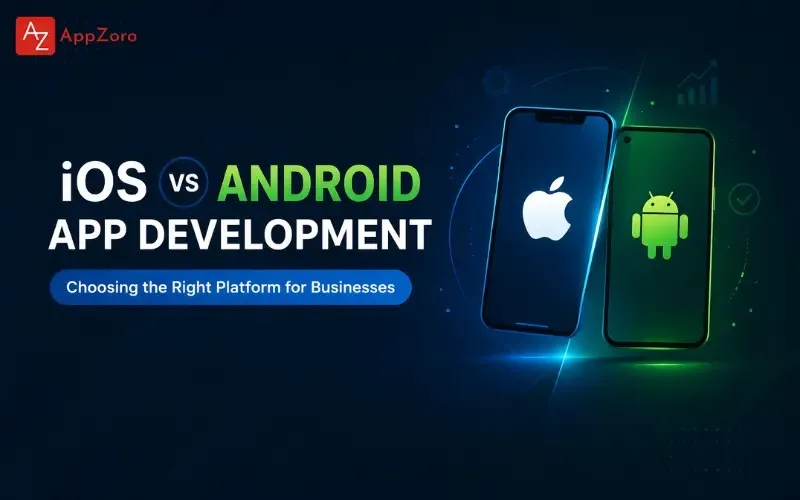
Most mobile product decisions start with the same question, should we go for iOS or Android? In 2026, that’s not really a technical choice anymore but now it’s a commercial one. Where your users actually live, how they actually pay and what your product needs from the hardware all shape the answer. Founders often start this conversation with their engineering team, but the correct starting point is marketing, sales and finance, they know the user better than anyone else in the room.
This guide cuts through the noise of Android vs iOS development with real data, real costs and a framework that works for startups and enterprise teams alike. It’s based on what we see across client engagements every month. The ios vs android app development decision deserves more than a gut call, so let’s run through how to make it properly, using data you can actually defend in a boardroom or an investor update.
Mobile Platform Market Overview and Growth Projections for 2026
A few numbers frame every android development vs ios development decision in 2026 and most of them point in opposite directions.
-
Android holds roughly 72.55% of global smartphone OS share, leading India, Brazil, Indonesia, Vietnam and most of Africa.
-
iOS runs 27-30% globally but holds ~58% of the US smartphone market, plus strong positions in Japan, Canada and Australia.
-
iOS generates about 65% of worldwide consumer app revenue despite the smaller device base.
-
iPhone users spend around $10.40 per month on apps; Android users spend around $1.40.
-
Play Store lists ~2.6 million active apps; the App Store lists ~1.8 million.
-
Global mobile app revenue is projected to cross $935B in 2026 on the back of subscriptions and commerce.
So one platform hands you scale, the other hands you monetization so the iOS vs Android app development decision usually comes down to which of those your business model needs first – often both eventually, but rarely in the same quarter and rarely from a single engineering team working in parallel. Regional nuance matters too; the US and Western Europe behave nothing like India or Brazil and blending them into a single “global user” in your projections hides the real android development vs iOS development tradeoff.
Core Differences Between iOS and Android App Development
The difference between custom iOS and custom android app development company shows up across tooling, design, languages and how your app actually ships to real users.
-
Languages: Swift on iOS, Kotlin on Android. Some enterprise codebases still carry Objective-C or Java for historical reasons.
-
IDEs: Xcode is Mac-only, which means dedicated hardware per engineer. Android Studio runs on Windows, Mac and Linux with no such constraint.
-
Design: Apple’s Human Interface Guidelines favor minimalism; Material Design 3 on Android is bolder and more flexible with color and motion.
-
Review cycle: App Store takes 24-48 hours for most submissions. Play Store clears faster but reviews health, finance and UGC categories more strictly than before.
-
Store commissions: both take 15-30% depending on category, seller size and how long a subscription has been active.
Copy one design across both platforms and retention drops – users expect their own OS patterns. The android development vs ios development budget should reserve real design hours for each side or pick one platform and own it fully rather than shipping a half-translated UI. That single mistake accounts for more post-launch churn than most teams realize and it’s almost always visible in the first two weeks of App Store reviews once power users start leaving feedback.
Seven Factors That Decide the Android vs iOS Development Choice
Score your project against these seven factors and the call stops feeling like guesswork.
-
Audience geography : which OS dominates your actual target market, not the global average or your personal device.
-
Revenue model : subscription, in-app purchase, ad-supported or enterprise license. Each plays differently on each platform.
-
Feature dependencies : NFC, Bluetooth peripherals, background services, widgets or custom hardware accessories.
-
Development & Maintenance : Three-year maintenance cost, considered together, not as separate line items in a pitch deck.
-
Time to market : Especially if you’re tied to investor milestones, seasonal launches or a fixed marketing window.
-
Device fragmentation and your QA capacity : Android spans 24,000+ configurations across 1,300+ manufacturers globally.
-
Security and compliance : HIPAA, PCI-DSS, GDPR and industry-specific rules that may steer the call without you realizing it.
If four or more lean one way, that’s your answer, if it’s close, cross-platform is usually smarter than trying to ship two native apps on a tight budget and the iOS vs Android app development question becomes “which cross-platform stack?” instead. Keep the scorecard in a shared doc and revisit it at each funding round – the best android vs ios development calls get updated when audience data does, not locked in on day one and forgotten.
Industry Scenarios That Shape the Decision
The ios vs android development call flips by industry, a few patterns from real client work at AppZoro Technologies:
-
Premium retail and luxury brands in North America: iOS first android later for broader coverage across mid-tier buyers.
-
Quick-commerce and hyperlocal services across India, SEA and LATAM: Android first, always, because the addressable base is overwhelmingly Android.
-
Digital banking in mature markets: iOS first for premium user value; microfinance and remittance in emerging markets: Android first.
-
Telemedicine in the US: iOS first due to hospital-provisioned iPads; public health in Africa or South Asia: Android first.
-
Enterprise productivity for Fortune 500: iOS-led, because iPhones and iPads dominate corporate refresh cycles.
-
Field service, warehouse and logistics: Android, because most rugged commercial hardware ships with Android stock.
The iOS app development vs android app development question rarely has one universal answer. Your vertical and target geography do most of the deciding before code is even scoped and smart teams let that decision stand instead of arguing with it. If you’re unsure, pull the top five apps in your category on both stores, check their release histories and you’ll usually spot the pattern your competitors are already following.
Step-by-Step Decision Framework for iOS vs Android App Development
Six steps, in order to be sure, do not skip this part as it is extremely important for you to understand and make decisions.
-
Step 1: Pull actual OS-share data for your top three target geographies, raw numbers from StatCounter or Kantar, not assumptions.
-
Step 2: Map your monetization model, from subscription, transactional or ads to each platform’s revenue economics and commission structure.
-
Step 3: List every feature that depends on native hardware or OS-level access, flag platform-exclusive risks early, before design.
-
Step 4: Check team capacity and the local ios developer vs android developer hiring market.
-
Step 5: Project three-year maintenance, not just the build. Apple OS adoption moves fast; Android OEM updates lag and add support cost.
-
Step 6: Decide between native on both, cross-platform or a phased single-platform rollout with a second-platform add-on later.
Totals usually point clearly in one direction or push you toward cross-platform, that’s the whole Mobile app development process framework in practice, nothing too complex, just applied to your real numbers rather than assumptions. Share the framework output with your CFO before you share it with your engineering lead; the commercial read on the ios vs android app development call should drive the technical one, not the other way around.
Technology Stack: iOS Development vs Android Development
The ios development vs android development stack differs at almost every layer and the choice affects your hiring plan more than the code itself.
|
Layer |
iOS Stack |
Android Stack |
|
Language |
Swift 6 (some legacy Objective-C) |
Kotlin 2.x (some legacy Java) |
|
IDE |
Xcode 16 |
Android Studio Koala |
|
UI Framework |
SwiftUI, UIKit |
Jetpack Compose, XML Views |
|
Architecture |
MVVM, VIPER, TCA |
MVVM, MVI, Clean Architecture |
|
Dependency Management |
Swift Package Manager, CocoaPods |
Gradle (Kotlin DSL) |
|
Networking |
URLSession, Alamofire |
Retrofit, Ktor, OkHttp |
|
Persistence |
Core Data, SwiftData, Realm |
Room, SQLDelight, DataStore |
|
Concurrency |
Combine, Swift Concurrency |
Coroutines, Flow |
|
Testing |
XCTest, XCUITest |
JUnit 5, Espresso |
|
CI/CD |
Xcode Cloud, Bitrise, GitHub Actions |
Gradle Play Publisher, Bitrise, GitHub Actions |
Stack maturity matters as much as the language itself, analytics, CI/CD and observability tooling are comparable on both sides now, but the ecosystem around your specific product category (fintech, health, media) may favor one stack over the other. Check plugin support and SDK coverage before you commit the ios vs android app development roadmap to either side.
Cost Breakdown: iOS vs Android App Development
Typical ranges for senior agency builds in North America or Western Europe during 2025-2026.
|
Complexity |
iOS |
Android |
Timeline |
|
MVP |
$30K-$55K |
$25K-$60K |
12-16 weeks |
|
Mid-Complexity Consumer App |
$55K-$120K |
$60K-$135K |
18-26 weeks |
|
Feature-Rich Native App |
$120K-$250K |
$135K-$275K |
28-40 weeks |
|
Enterprise-Grade Product |
$250K-$500K+ |
$275K-$550K+ |
40-60 weeks |
|
Cross-Platform (Flutter/RN) |
Both platforms at 60-70% of dual-native cost |
– |
20-34 weeks |
A mid-complexity native build costs roughly the same across both platforms in 2026, where the numbers shift is in QA and maintenance while Android runs higher because of device fragmentation. The android development vs ios development cost gap usually widens in year two, not year one, which catches a lot of teams off-guard and turns a clean budget into a scramble for extra capacity. Account for at least 20% of the initial build cost annually for ongoing maintenance and budget more if you’re targeting multiple Android OEM segments.
Common Challenges in the Android vs iOS Development Lifecycle
Every mobile program hits the same friction so it is a necessity to plan ahead.
-
Device fragmentation on Android, especially across Samsung One UI, Xiaomi HyperOS and OnePlus OxygenOS skins.
-
Review rejections for finance, health and user-generated content – both stores are stricter than they were in 2023.
-
OS version drift : minimal on iOS because adoption is fast, serious on Android because OEM update cycles lag.
-
Engineer hiring : senior mobile engineers are in short supply across most markets in 2026 and rates reflect it.
-
In-app purchase policy enforcement : both Apple and Google tightened enforcement this year, which affects revenue flow directly.
Budget a 15-20% time buffer for fragmentation and review as the teams that don’t plan for it hit cost overruns and slipped deadlines by month three. That pattern is consistent across almost every android vs ios development project we see, regardless of vertical or team size. A short pre-submission audit – privacy label, data safety form, IAP wiring, background permissions – will save you one rejection cycle on average across both stores.
Cross-Platform as a Strategic Middle Ground
Cross platform app development company isn’t the compromise it was five years ago, in a lot of cases, it’s the right first choice in 2026.
-
Flutter (Dart): Google-backed, near-native performance, strong for consumer apps and internal tools.
-
React Native (JS/TS): Meta-backed, a natural fit if your web team already runs React or Next.js in production.
-
Kotlin Multiplatform: share business logic, keep native UI – growing fast in enterprise contexts with existing Kotlin investments.
-
Typical savings: 30-50% compared to two fully native builds, plus a single release pipeline.
-
Skip cross-platform if you need heavy AR, complex 3D graphics or deep custom hardware integrations.
The Mobile App Development debate in 2026 often ends with “why not both from one codebase?” – and for most consumer and enterprise products, that’s a defensible answer. Just make sure your feature list genuinely fits cross-platform before committing, because retrofitting native modules into a Flutter or React Native app later is rarely cheaper than building native from day one. Run a two-week feasibility sprint on your top five most complex features before you lock the stack and you’ll avoid a costly pivot halfway through development.
Future Trends Shaping iOS and Android Development
Five shifts worth building for today, not retrofitting in year two.
-
On-device AI: Apple Intelligence and Google AI Core now handle personalization locally, cutting cloud costs and latency.
-
Foldables, multi-screen layouts and spatial computing via Apple Vision Pro and Meta Quest.
-
Privacy-first analytics: consent-based telemetry is now the default across both stores.
-
Super-app patterns in Asia: mini-programs and embedded commerce are pushing Western platforms to open up.
-
On-device ML: expect most major apps to ship at least one local ML feature by 2027.
These shifts reshape the android vs ios app development priorities every product team should plan for. Building them on day one is cheaper than adding them later when you’re already scaling and the iOS vs Android app development roadmap you draft this quarter should explicitly name which of these you’ll tackle first. Most teams pick one AI feature, one adaptive-layout improvement and one consent-flow upgrade per release cycle, which keeps scope realistic and ships value every sprint.
How AppZoro Technologies Helps Enterprises Choose Between and Build iOS and Android Apps
Enterprise iOS and Android projects rarely fail on the mobile layer but chances are that they fail on the integrations, compliance and workflow logic behind it. Convoy Transports, built on iOS and web, runs off-duty officer enrollment and prisoner-transport scheduling, where the engineering sits in identity handling and audit trails, not the UI. Freedom Rideshare ships on iOS and Android as a fleet-rental product for rideshare drivers, which meant shared rental state, regional inventory sync, and pricing logic that had to feel identical on both platforms.
PoliSci is another iOS and Android build in education and law-and-justice, where accessibility and content governance drove most of the scope. Medcraze in healthcare and ADR Boost in hotel revenue management both treat the app as one surface of a larger system, with the heavy work living in data models and integrations. For any enterprise scoping the android app vs ios app development question, the lesson is simple: pick platforms where your users actually are, then spend most of your planning on everything behind the app. The full set of these projects is public at appzoro.com/portfolio if you want a reference for how others scoped their mobile layer.
Conclusion
Audience first, revenue model second, feature comes third and that’s how the order should be. iOS wins on speed to launch and revenue per user in premium regions while Android wins on reach and customization, especially across emerging markets. Cross-platform usually wins when the scorecard lands close. Whatever you pick, budget for three years, not one, because maintenance drives most of the real cost and the android vs ios development economics only make sense when you model the full horizon. If you want a data-led android development vs ios development recommendation tied to your audience, product and revenue model, AppZoro Technologies can help turn the ios vs android app development decision into a concrete roadmap with clear timelines, real costs and a scorecard your board will understand.
Frequently Asked Questions
What factors matter most when choosing between iOS and Android for a new business application?
The most important factors include your target geography, monetization model, feature dependencies on native hardware, regulatory context and the long-term maintenance budget that you can realistically commit. Audience geography determines reach potential, monetization model determines expected revenue per user and feature dependencies determine whether a single platform can fulfill the product vision across markets.
How does the android vs ios development reddit developer community generally view platform selection for new projects?
Discussions in android vs ios development reddit communities typically reflect an even split in personal preference but converge on the view that platform choice should follow business inputs rather than developer familiarity. Senior practitioners in those communities consistently recommend starting with audience and revenue model analysis, selecting cross-platform for standard applications and reserving dual native delivery for products with deep hardware integration needs.
Is android vs ios development which is easier a settled question for new developers entering the industry?
The android vs ios development which is easier debate remains unsettled because each platform presents different learning curves across language, tooling and distribution processes that developers must master over time. Swift and SwiftUI are often considered more approachable for pure client-side development, while Kotlin and Android Studio provide a more flexible foundation for developers who prefer open toolchains and cross-platform desktop workflows.
How much does ios vs android app development typically cost in 2026 for a mid-complexity product?
A mid-complexity consumer application typically costs between 55,000 and 135,000 dollars per platform in 2026 when delivered by a specialized agency in North America or Europe, with Android trending slightly higher due to device testing overhead. Cross-platform delivery using Flutter or React Native can cover both platforms at roughly 60 to 70 percent of the combined native cost when feature requirements align well with cross-platform capabilities.
Should a North American startup launch on iOS or Android first when funding and timeline are constrained?
Most North American startups targeting premium consumer or subscription-based products should launch on iOS first because audience concentration, payment behavior and review predictability favor a faster initial release across this region. Products that target broad consumer reach, advertising-supported models or emerging market expansion should often launch on Android first to capture the larger addressable base before building the iOS companion experience.
How does the difference between ios and android development affect three-year maintenance costs for production mobile products?
The difference between ios and android development affects three-year maintenance costs because Android maintenance typically runs 15 to 25 percent higher due to device fragmentation, manufacturer-specific regressions and broader operating system version distribution across the installed base. Teams evaluating ios vs android app development budgets over three years should treat maintenance as 40 to 60 percent of total cost of ownership because feature expansion, security patches and platform migrations consistently accumulate. Teams that budget only for the initial build and neglect maintenance planning frequently face severe cost overruns in year two when android vs ios development technical debt compounds faster than expected across release cycles.
What is the difference between android and ios app development in terms of store approval policies?
The difference between android and ios app development in approval policies is that Apple enforces stricter pre-publication review with manual inspection, while Google applies automated screening first and reserves manual review for policy-sensitive categories. Both stores enforce in-app purchase requirements, privacy nutrition labels and content moderation policies that directly affect monetization design and require upfront product decisions before final submission.