
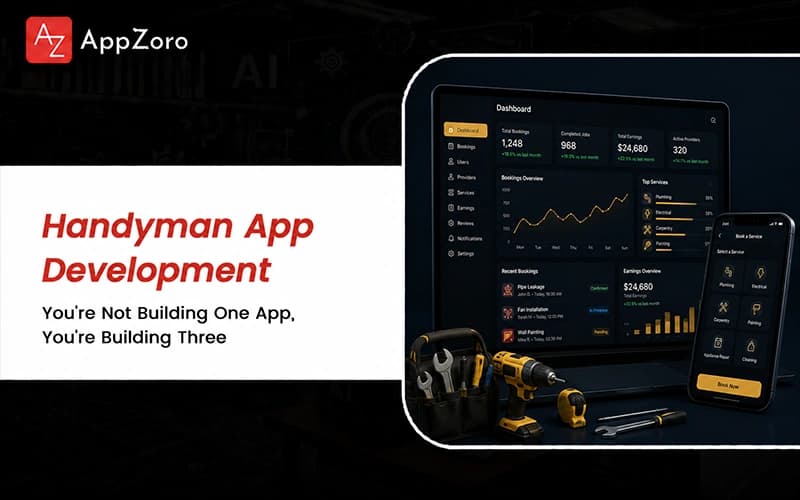
Quick Answer: Handyman app development means building an on-demand marketplace that connects people with vetted local pros and in practice that is three apps, not one. To coordinate this complex ecosystem, many startups partner with a specialized mobile app development company USA to handle the customer app, provider app, and admin panel. A basic MVP starts around $25,000, while a full two-sided marketplace with GPS tracking and real scale runs from $120,000 well into the six figures.
A founder once came to me with a budget for "a handyman app" and a screenshot of TaskRabbit. The screenshot showed the easy ten percent. What he had not pictured was the other two apps hiding behind it, the one his handymen would live in and the dashboard his team would run the whole operation from. That is the first lesson of handyman app development.
You are not building one app; you are building three that have to move in perfect sync. The second lesson is harder. Even with all three apps built and polished, you still have an empty marketplace. No handymen, no customers. No customers, no handymen. Solving that cold start is the real work and it is the part no quote ever puts on the page.
So what does it take and where does the money go? Most founders find that consulting a comprehensive custom mobile app development guide helps them visualize the hidden infrastructure requirements before they commit their capital. Most of it goes somewhere founders never look until it is far too late, so here is the honest version of the marketplace build.
What Handyman App Development Really Involves in 2026
Search for handyman app development and most guides hand you a feature list, as if the job were just ticking boxes. It is not. Underneath a simple "book a plumber" button sits a two-sided marketplace, real-time dispatch, payments that split between you and the provider and a trust system that quietly decides whether anyone ever comes back.
You are really paying for three connected products, not one:
A customer app for browsing services, booking a slot, tracking the pro on a map and paying without friction.
A provider app where handymen accept jobs, manage their schedule, navigate to the address and get paid on time.
An admin panel where your team handles disputes, verifies providers, sets pricing and watches the whole marketplace breathe.
You Are Building Three Apps, Not One
The biggest shock in handyman app development is that "one app" is three products wearing a trench coat. The customer side gets all the attention but the provider app is where retention lives, because unhappy handymen vanish and take their availability with them. Following a structured mobile app development process ensures you don't skip the proper admin panel that keeps your team from running a marketplace via spreadsheets and frantic phone calls.
The Matching Engine Is the Quiet Hard Part
Connecting a job to the right handyman sounds trivial until you try it at scale on a busy Saturday morning. The system has to weigh location, skill, availability, ratings and price in real time, then dispatch fast enough that the customer does not give up and book a neighbor's cousin instead. Get the matching wrong and both sides feel it. The customer waits, the provider sits idle and trust erodes on both ends.
On-Demand Handyman App Development and the Chicken- Egg Problem
This is where on-demand handyman app development stops being a tech project and becomes a business one. You can build the slickest app in the category and still launch to total silence, because a marketplace with no handymen is useless to customers and one with no customers is useless to handymen.
TaskRabbit, Urban Company and Handy all cracked this the same way, by starting tiny, one service in one city and growing from there. To reach both platforms quickly, many founders use hybrid app development to validate their business model in one city before attempting to expand. A few things decide whether the marketplace ever comes alive: picking a single service first, seeding supply by recruiting handymen directly, and giving early customers a reason to forgive thin selection.
A few things decide whether the marketplace ever comes alive and none of them are features:
Pick a single service and a single city first, so you can fill both sides before you even try to expand.
Seeding supply by recruiting handymen directly, often by hand and one coffee at a time, long before the demand shows up.
Giving early customers a reason to forgive the thin selection, usually sharper pricing, faster arrival or a simple guarantee.
Liquidity Beats Features Every Time
You can always add a feature later. You cannot fake a marketplace that has enough handymen to answer a booking within ten minutes. The platforms that win obsess over that balance of supply and demand in one small area, then copy the playbook city by city, which is how serious on-demand handyman app development scales without quietly collapsing under its own promises.
Trust and Payments Are Not Optional Extras
A stranger is walking into someone's home, so trust is the actual product here, not a nice-to-have you add in version two. This requires implementing rigorous mobile application security testing strategies to protect customer payments and pro-background checks, ensuring that money is held safely until the job is done. It also means paying providers quickly and fairly, because a handyman who waits two weeks for payment never opens your app again.
Handyman App Development Cost, Tier by Tier
So what does the handyman app development cost come to once you add up all three of those apps? It depends entirely on scope and the honest ranges are wider than any single number a sales page will quote you. Here is roughly how it breaks down in 2026:
Build Tier | Rough Cost | What You Get |
Single-service MVP | $25,000–$45,000 | One service, one city, basic booking and payments |
Full marketplace | $80,000–$150,000 | Customer, provider and admin apps, GPS, ratings |
Custom two-sided build | $150,000–$250,000+ | Custom matching, real scale, deep integrations |
Ongoing each year | 15–25% of the build | Maintenance, payments upkeep, new features |
Those numbers cover the build, not the marketing it takes to fill both sides, which is often the bigger check. Reviewing a detailed mobile app development cost breakdown reveals that maintenance and payments upkeep typically run 15–25% of the build each year. The handyman app development cost that sinks founders is rarely the code itself; it is the months of paying to attract supply and demand before the flywheel finally spins on its own.
Why the Cheapest Quote Costs the Most
A $20,000 quote usually means someone is quietly building one app and calling it a marketplace. On the provider side, the admin panel, the payment splits and the verification all turn up later as "extras" nobody planned for. Paying a fair price for a team that scopes all three apps honestly is almost always cheaper by the end of year one.
Custom Handyman App Development and Where AI Helps
At some point you will weigh a ready-made clone against custom handyman app development and the right answer depends on how different your idea is. A handyman on demand app development clone gets you live fast and cheap but it boxes you into someone else's decisions about pricing, matching and flow.
Custom work costs more upfront, yet it earns that back when your edge is the very thing a template cannot bend to.
AI has started to earn its place here too but only in a few spots where it saves real money, such as dynamic pricing and support triage. Learning how to use AI in mobile app development can help your platform learn which handyman actually shows up and does good work, rather than just matching based on proximity. These smarter matching algorithms turn unglamorous backend tasks into a scalable advantage that repays the custom build within the first year of operation:
Smarter matching that learns which handyman actually shows up, does good work and gets rebooked, not just who happens to be nearest.
Dynamic pricing that nudges rates up during a storm of demand and back down when handymen are sitting idle.
Support triage, where a model handles the routine "where is my pro" questions so humans can deal with the messy ones.
When Custom Is Genuinely Worth It
Custom handyman app development earns its premium when your model breaks the standard mold, not when you just want a nicer color scheme. Maybe you serve commercial clients on contracts or a regulated trade that needs licensing checks or a pricing model no clone supports. In those cases the control you buy over matching, payments and workflow repays the heavier build within the first year.
Where AI Actually Earns Its Keep
The honest use of AI in a handyman app is unglamorous and that is exactly the point. It quietly improves matching so the right pro gets the job, prices smartly when demand spikes and clears the routine tickets that drown small support teams. Aim it there, at real work and it pays for itself instead of sitting on the home screen as a gimmick.
If you have a quote for a handyman app and it only mentions a single app, you are looking at a fraction of the handyman app development you truly need. Our senior team reviews these proposals most weeks and we would much rather flag the missing provider app, the payment splits and the marketing math now than after launch.
Final Thoughts
Handyman app development in 2026 is less a coding project and more a marketplace you have to bring to life by hand. When you look to hire the best mobile app developer, find a partner who understands liquidity and the slow work of filling both sides in one place. If your quote feels suspiciously clean, talk to someone who has shipped a two-sided marketplace and watched the cold-start phase up close, because foundations decide whether you scale or stall.
The founders who win do not start with a clone of TaskRabbit and a map of the whole country. They pick one service, one city, recruit handymen one conversation at a time and earn trust before they scale. It sounds boring. It is also how every big platform in this space began.
If your quote feels suspiciously clean, talk to someone who has shipped a two-sided marketplace and watched the cold-start phase up close. A good partner is honest about the three apps, the marketing math and the months it takes before the flywheel finally turns.
Leave a Comment