
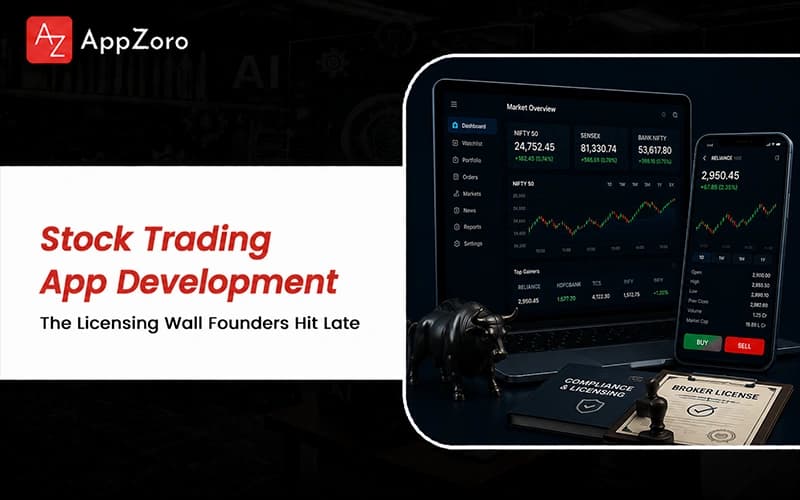
Quick Answer: Stock trading app development is the work of building an app that lets people fund an account, see live market data and buy or sell securities safely. In 2026 the central decision is whether to become a licensed broker-dealer or to build on a broker-as-a-service platform. To manage these complexities, many founders partner with a top mobile app development company USA to ensure the architecture supports secure trade execution and data integrity. Realistic budgets run from around $50,000 to well past $300,000 for an advanced build.
A founder once asked me to build a Robinhood-style app for sixty thousand dollars and seemed genuinely stunned when I asked which broker would actually be executing the trades. That single question is where most first-time founders discover that stock trading app development is far less about screens and far more about licenses. You are not really building a chart app; you are building a regulated financial product that simply happens to have a chart.
Trading apps look simple from the outside, just tap to buy, tap to sell, watch the line move; the machinery behind that tap is enormous. Most successful fintech startups follow a custom mobile app development guide to ensure that the backend architecture handles real-time data and heavy regulation without compromising performance. It blends live market data, real money and heavy regulation into one product and each of those three quietly carries a price tag.
So, where does the money and the time go in stock trading app development and why is that first quote almost never the real one? Well, the cost hides in a few specific places that only surface once you start building, so let's break them down.
What Stock Trading App Development Really Involves in 2026
If you have priced stock trading app development and seen numbers from twenty-five thousand to half a million, that huge spread is honestly fair. The gap exists because a few heavy ingredients sit underneath the app and a cheap quote usually means someone quietly left them out.
A serious build has to pay for a few things long before launch day, ensuring that every step of the mobile app development process includes deep technical discovery and regulatory planning to avoid costs that blindside newcomers. This includes everything from a live market data feed to a brokerage layer that can legally open accounts and execute trades, all while maintaining a compliance backbone of KYC and anti-fraud monitoring:
A live market data feed from a provider like Polygon.io or Finnhub, which is a recurring monthly bill rather than a single line on the build.
A brokerage layer that can legally open accounts, hold money and execute trades, either your own license or a rented one from a partner.
A compliance backbone of KYC, anti-fraud and regulatory reporting, because financial regulators treat shortcuts as violations rather than clever savings.
Real-Time Market Data Is a Recurring Bill
The first cost founders underestimate in stock trading app development is live market data, a subscription that keeps arriving every month the app runs. Providers like Polygon.io, Finnhub and Intrinio price by depth, latency and usage, so real-time quotes cost far more than delayed ones. That feed is not a one-time build expense, which means it shapes your running costs long after the app has shipped.
The Licensing Wall Most Founders Hit Late
The part that truly defines stock trading app development is the brokerage license, which significantly impacts how long it takes to develop a mobile app from scratch, as regulators can take over a year to approve a new broker-dealer. Becoming a broker-dealer in the United States costs roughly fifty-six thousand dollars and can take twelve to eighteen months to clear with the regulators. This timeline alone reshapes the whole plan, which is why so many startups rent a license.
The Real Stock Trading App Development Cost, Tier by Tier
So what does the stock trading app development cost look like once real numbers go against it? Well, it helps to think in tiers, because a basic brokerage app and a Robinhood-style platform are very different beasts with very different budgets.
Here is roughly how those numbers tend to break down across the common build tiers in 2026:
Build Tier | Rough Cost | What You Get |
Basic brokerage MVP | $50,000–$90,000 | Accounts, live quotes, simple buy and sell |
Full trading app | $120,000–$250,000 | Charts, funding, watchlists, broker integration |
Advanced platform | $300,000+ | Options, deep data, AI features, scale |
Your own broker-dealer | $56,000+ extra | License, audits, ongoing compliance |
Those ranges cover the build, however they rarely include the market data, the compliance work or the licensing path. That is the line most quotes quietly skip and it is also the line that decides whether the app ever legally goes live.
Why the Cheapest Quote Usually Costs the Most
A fifty-thousand-dollar quote can look like a steal right up until the data feed, the compliance work and the brokerage path all arrive uninvited. The cheapest vendors win the deal by leaving those lines out, then bill for each one later as a change request nobody ever planned for. For a realistic budget, you should consult a detailed mobile app development cost breakdown that accounts for market data feeds, compliance audits, and platform licensing before signing. The real cost to develop a stock trading app is rarely the headline figure, and a team that scopes honestly always works out cheaper.
Two Ways to Develop Stock Trading App Products: Build or Rent the Broker
When you set out to develop stock trading app products, the very first real decision is whether to become a broker or to rent one. That single choice changes your cost, your timeline and your compliance burden far more than any feature you could add later.
The two paths look completely different on a budget and a calendar, resulting in very different launch stories:
Becoming your own broker-dealer buys full control but adds the $56,000 setup, the long approval and a permanent compliance team you have to fund.
Renting a license through Alpaca or DriveWealth hands you KYC, clearing and execution through an API, so you launch in months rather than years.
Most startups rent first and consider their own license later, once the volume and the revenue genuinely justify carrying that heavy burden.
Broker-as-a-Service Changed the Math
Platforms like Alpaca and DriveWealth quietly rewrote the math, as they provide a clear path for founders researching how to develop an app and make money without the massive upfront capital required for a full brokerage license. Their APIs handle account opening, custody and execution, so a small team can ship a real brokerage without becoming a regulated broker-dealer first. This model is why a fintech startup can now launch in months.
Security Is Not a Feature You Add Later
Stock trading mobile app development moves real money and holds real identities, so security and data privacy have to sit in the foundation rather than get painted on near the end. Encryption, fraud monitoring and strict access controls are not optional extras here, because a single breach in a financial product can end the company outright. Teams that treat security as core scope from day one avoid the far larger cost of a breach that regulators and users never forgive.
AI Stock Trading App Development: Where It Earns Its Keep
AI has moved from a marketing word to a real tool and serious development now points models at genuine insight rather than empty hype. The goal is no longer a chatbot in the corner, it is implementing AI in mobile app development to help users understand risk, spot patterns and act with confidence. The strongest teams point AI at the jobs where the payoff is real, resulting in features users actually keep.
The strongest teams point AI at the jobs where the payoff is real and measurable, resulting in features users actually keep:
Robo-advisors that build and rebalance a portfolio automatically, giving smaller investors guidance that once belonged only to wealthy private clients.
Sentiment and signal models that scan news and markets, surfacing the moves and risks a part-time investor would never catch alone.
Plain-language assistants, since platforms like Alpaca now let large language models place real trades from a simple written instruction.
Robo-Advisors and Signals That Earn Trust
The clearest win in ai stock trading app development is the robo-advisor, which builds and quietly rebalances a portfolio without a human manager. Signal and sentiment models add another layer, scanning news and price action to flag risks and moves a busy person would otherwise miss. Used with care and honest disclaimers, that intelligence helps users without ever pretending to guarantee a return that nobody can promise.
Where AI Still Needs a Human Hand
AI in trading is powerful, yet it is also where overconfidence gets expensive, so it is vital to implement rigorous mobile application security testing strategies to protect user identities and prevent automated fraudulent transactions. Responsible teams frame these features as guidance rather than advice, keep humans in the loop and stay well inside what the regulators allow. The apps that last treat AI as a sharp assistant, not as an oracle.
If you have a quote for a trading app on your desk and it feels suspiciously clean, you should learn how to hire the best mobile app developer who can honestly verify the data feed and brokerage integration requirements. Our senior team reviews these proposals most weeks and would far rather flag the missing licensing and data lines now than after launch day when the budget runs out and the product stalls.
Final Thoughts
Stock trading app development in 2026 is no longer a mystery but it is also rarely the tidy build a first quote suggests. The app is only one slice and the market data, the brokerage license and the compliance are what actually decide whether it ever legally trades.
The founders who win at stock trading app development are not the ones who simply found the cheapest developer and the smallest invoice. They picked the broker path deliberately, budgeted for the recurring data feed, treated compliance as core and used AI as guidance rather than a gimmick.
If a trading app quote on your desk feels suspiciously low, it is worth asking someone who has shipped one through real regulators, where the scope looks thin. The right partner walks you through the license, the data and the compliance without flinching, because they have watched these projects stall before.
Leave a Comment