
You’ve watched your competitors roll out AI features. Your customers are starting to ask why you haven’t. Maybe you’ve even had a few internal conversations about it, sketched out some ideas on a whiteboard, or sat through a vendor demo that promised the moon.
But the problem was never a shortage of AI tools. There are more platforms, APIs, and frameworks than any team could evaluate in a year. The actual problem is figuring out who you trust to build something that works with your data, your systems, and your timeline.
This guide is for decision makers who have budget, have intent, and are stuck on execution. We’ll walk through what to look for when you hire an AI & ML development company, what the process actually looks like from your side, what it should cost, and the mistakes that burn people who skip due diligence.
The Future of AI/ML Development — And Why It Matters for Your Business Right Now
If you’re reading this in 2026, you’re at an inflection point. AI/ML has moved past the “experiment” phase for most industries. The machine learning market was valued at USD 55.80 billion in 2024 and is expected to rise at a steady 30.4% CAGR over the next few years, reaching USD 282.13 billion by 2030.
So where is this headed in the next two to three years? A few areas are worth paying attention to.
AI Predictive Analytics is already changing how companies forecast demand, manage inventory, and price products. If you run an e-commerce business, this means your pricing engine can adjust to competitor behavior in real time instead of relying on quarterly reviews.
We’re not talking about simple rule based workflows anymore. Modern AI systems can read invoices, categorize support tickets, and flag anomalies in financial data without someone writing explicit rules for each scenario.
Natural language processing (NLP) lets your software understand and respond to human language. Think chatbots that actually resolve issues, or contract review tools that flag risky clauses in seconds instead of days.
Computer vision is the technology behind quality inspection cameras on factory floors, real time shelf monitoring in retail, and ID verification in fintech apps. It lets machines “see” and interpret images or video feeds.
The companies that are choosing the right AI/ML partner for business growth now are the ones who’ll have a two year head start on everyone who waits. And two years in AI is a generation.
What Does an AI/ML Development Company Do?
If you’ve never worked with an AI/ML Development Company, the process can feel like a black box. You hand over a problem and some data, and... what exactly happens?
Here’s what a solid company handles so you don’t have to:
Requirements analysis — They sit with your team and figure out what problem you’re actually solving, not just what technology sounds cool.
Data audit and preparation — They assess what data you have, what’s missing, and what needs cleaning or restructuring before anything gets built.
Model development — This is where AI model development and deployment happens: choosing the right algorithm, training it, testing it, tuning it until performance is reliable.
Integration — The model has to plug into your existing stack. APIs, databases, CRM, ERP, whatever you run on.
Deployment — Moving everything from a test environment into production where real users touch it.
Post launch monitoring — Watching performance over time, catching drift, retraining when data shifts, and fixing problems before users notice.
Now here’s a distinction that trips people up: there’s a difference between a company that builds AI features and one that just consults. A consulting firm will tell you what’s possible, hand you a strategy deck, and maybe recommend vendors. A development company actually writes the code, trains the models, and ships the product. Some firms do both, but you need to know which mode you’re paying for.
If you’re exploring AI Application Development for the first time, you want a partner that does the work, not one that just tells you what work should be done.
AI/ML Development Company vs In-House Team vs Freelance: Which Model Fits?
This is the decision that comes before you pick a vendor. You need to figure out which hiring model actually matches your situation. Each one works, but for different reasons and at different stages.
Hiring a freelance AI developer makes sense when you have a narrow, well defined task. Maybe you need a single model trained on a specific dataset, or you want someone to audit your existing ML pipeline. Freelancers on platforms like Upwork or Toptal typically charge $75 to $200 per hour for senior talent. The upside is speed and flexibility. The downside is that freelance AI developers rarely stick around for post launch support, and you’re responsible for managing the work yourself. If the project scope changes mid-build, you’re renegotiating.
Building an in-house AI team is the right call when AI is your core product, not a feature bolted onto an existing product. A full time senior ML engineer in the US costs $180K to $250K in salary, and you’ll need at least two or three people to cover data engineering, model development, and MLOps. Hiring takes 3 to 6 months for good candidates. If you need results in the next quarter, this path won’t get you there.
Partnering with an AI development agency or development company sits in the middle. You get a full team, from data engineers to ML specialists to project managers, without the hiring overhead. The agency handles coordination, infrastructure decisions, and post deployment monitoring. This is the best AI development partner model for companies that want to move fast but don’t have the internal expertise to manage a build from scratch.
Types of AI/ML Engineers You Should Know About
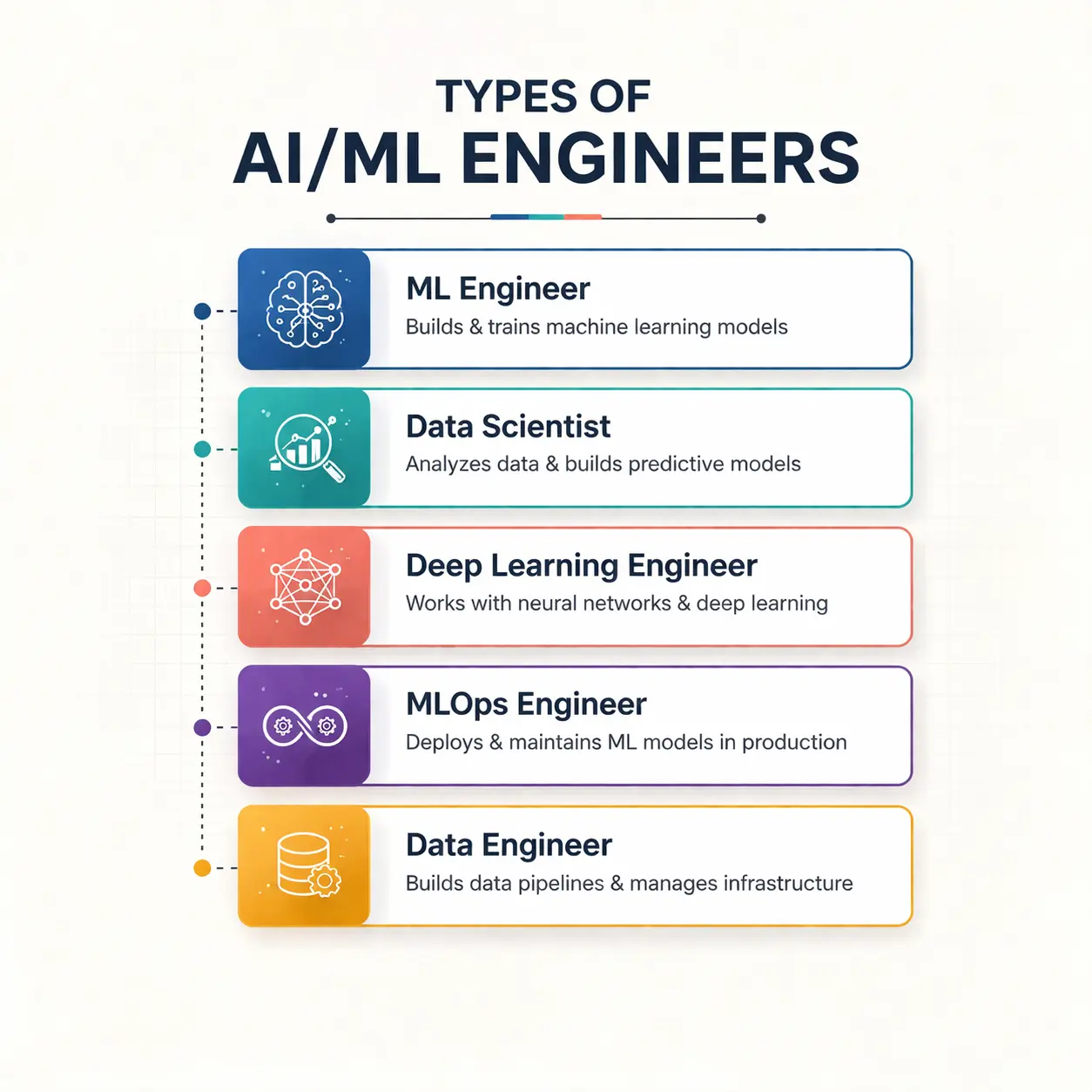
When a development company says they’ll assign “AI engineers” to your project, that’s a broad label. Here’s what the specific roles actually do, so you can ask smarter questions about who’s on your team.
ML Engineer
An ML engineer builds, trains, and deploys machine learning models. He write the code that takes your data and turns it into a working prediction engine, classifier, or recommendation system. Their daily tools typically include Python, TensorFlow, PyTorch, and scikit-learn. If your project involves building a model from scratch, this is the core role you need.
Data Scientist
Data scientists focus on analysis, experimentation, and finding patterns in your data before a model gets built. They help answer the question: is there actually a signal in this data worth building on? They’re heavy users of Python, SQL, pandas, and statistical modeling libraries. On some projects the ML engineer and data scientist are the same person, but on complex builds you want both.
Deep Learning Engineer
specialist in neural networks and architectures like CNNs, RNNs, and transformers. You need this role if your project involves computer vision, natural language understanding, or any task where traditional ML models don’t perform well enough. They work extensively with PyTorch, TensorFlow, and GPU infrastructure.
MLOps Engineer
An MLOps engineer ensures that your model actually runs reliably in production. They handle deployment pipelines, model versioning, monitoring, and automated retraining. Tools of the trade: Docker, Kubernetes, MLflow, AWS SageMaker, or Google Vertex AI. If your AI system needs to serve thousands of predictions per minute without crashing, the MLOps engineer is why it doesn’t.
Data Engineer
Data engineers build and maintain the pipelines that collect, clean, and deliver data to the ML models. Without clean pipelines, your models train on garbage. They work with tools like Apache Spark, Airflow, dbt, and cloud data warehouses like Snowflake or BigQuery.
When you’re evaluating an AI development company, ask which of these roles will be assigned to your project and how many hours each one is allocated. If they can’t answer that, the proposal isn’t real.
Core Technical Skills to Look for in an AI/ML Development Company
You don’t need to understand the tools all by yourself. But you should know enough to ask whether the team has experience with the ones that matter for your project. Here’s a quick reference.
Programming languages: Python is the standard for ML development. Nearly every serious AI team uses it as their primary language. R shows up in statistical analysis. Java and C++ appear in production systems where performance is critical.
ML frameworks: TensorFlow (backed by Google) and PyTorch (backed by Meta) are the two dominant frameworks for building and training models. scikit-learn handles classical ML tasks like regression and classification. XGBoost and LightGBM are common for tabular data problems like fraud detection or lead scoring.
Cloud and infrastructure: AWS SageMaker, Google Vertex AI, and Azure ML are the big three managed ML platforms. Your partner should have hands on experience with at least one, ideally whichever cloud provider you already use.
Data tools: SQL for querying databases. Apache Spark for processing large datasets. Airflow or Prefect for scheduling data pipelines. pandas and NumPy for data manipulation in Python.
MLOps and deployment: Docker for containerization. Kubernetes for orchestration. MLflow or Weights & Biases for experiment tracking. CI/CD pipelines for automated model deployment.
A credible AI/ML development company should be able to tell you exactly which stack they plan to use on your project and why they chose it over alternatives. If they’re vague about tooling, they’re likely figuring it out as they go.
Tips to Hire the Best AI & ML Development Partner for Your Business
This is where decisions get made or get postponed indefinitely. Here are the things that actually separate a good AI development partner from a vendor who wastes your budget.
1. Ask them to explain their reasoning, not their results.
Any firm can show you a polished case study. What you want to hear is why they chose one model architecture over another, why they structured the data pipeline a certain way, or why they rejected an approach that looked promising on paper. If they can’t walk you through the thinking, they followed a template. That’s fine for simple projects. It’s dangerous for anything complex.
2. Check their data handling experience.
AI is only as good as the data it trains on. Ask how they’ve dealt with incomplete data, biased datasets, or data that needed to be sourced from multiple systems. A company that hasn’t wrestled with messy data hasn’t done real work. Real projects involve data that lives in spreadsheets, legacy databases, PDFs, and sometimes people’s heads.
3. Look for industry overlap, not just technical skill.
A team that’s built AI for healthcare will understand HIPAA constraints, data sensitivity, and regulatory timelines. That context matters more than raw coding ability. When you’re evaluating what to look for in an AI & ML development company, domain experience should be near the top of your list.
4. Ask who actually does the work.
This one burns people constantly. You sit in a sales meeting with senior architects and PhDs. Then the project kicks off and you’re working with junior developers you’ve never met, sometimes in a different time zone. Ask directly: will the people in this room be on my project? Get names. Check LinkedIn.
5. Demand a post deployment support plan before you sign.
Building the model is maybe 40% of the work. The rest is what happens after launch, when real data starts flowing through, edge cases appear, and the model needs retraining. Any AI Development Company worth hiring should have a clear plan for what happens at month three, month six, and month twelve after go live.
6. Get transparent pricing in writing.
“It depends” is an acceptable first answer. It’s not an acceptable final answer. By the time you’re signing a contract, you should know what’s included, what costs extra, and what triggers a change order. Common gotchas: deployment infrastructure costs, model retraining fees, and data storage charges that weren’t in the original scope.
7. Talk to their past clients — not the references they hand you.
Anyone can supply two friendly references. Ask for the name of a client whose project didn’t go perfectly. How they handled a rough patch tells you more than how they handled an easy win. If they claim every project went smoothly, they’re either lying or they haven’t done enough projects.
8. Evaluate their communication cadence.
AI projects can drift fast if communication is sporadic. Ask how often they provide updates, what format those updates take, and how quickly they respond when something breaks. Weekly standups and a shared project board are the minimum. If you’re spending $100K+ on AI software development outsourcing, you deserve to know what’s happening every week.
Benefits of Hiring AI/ML Engineers
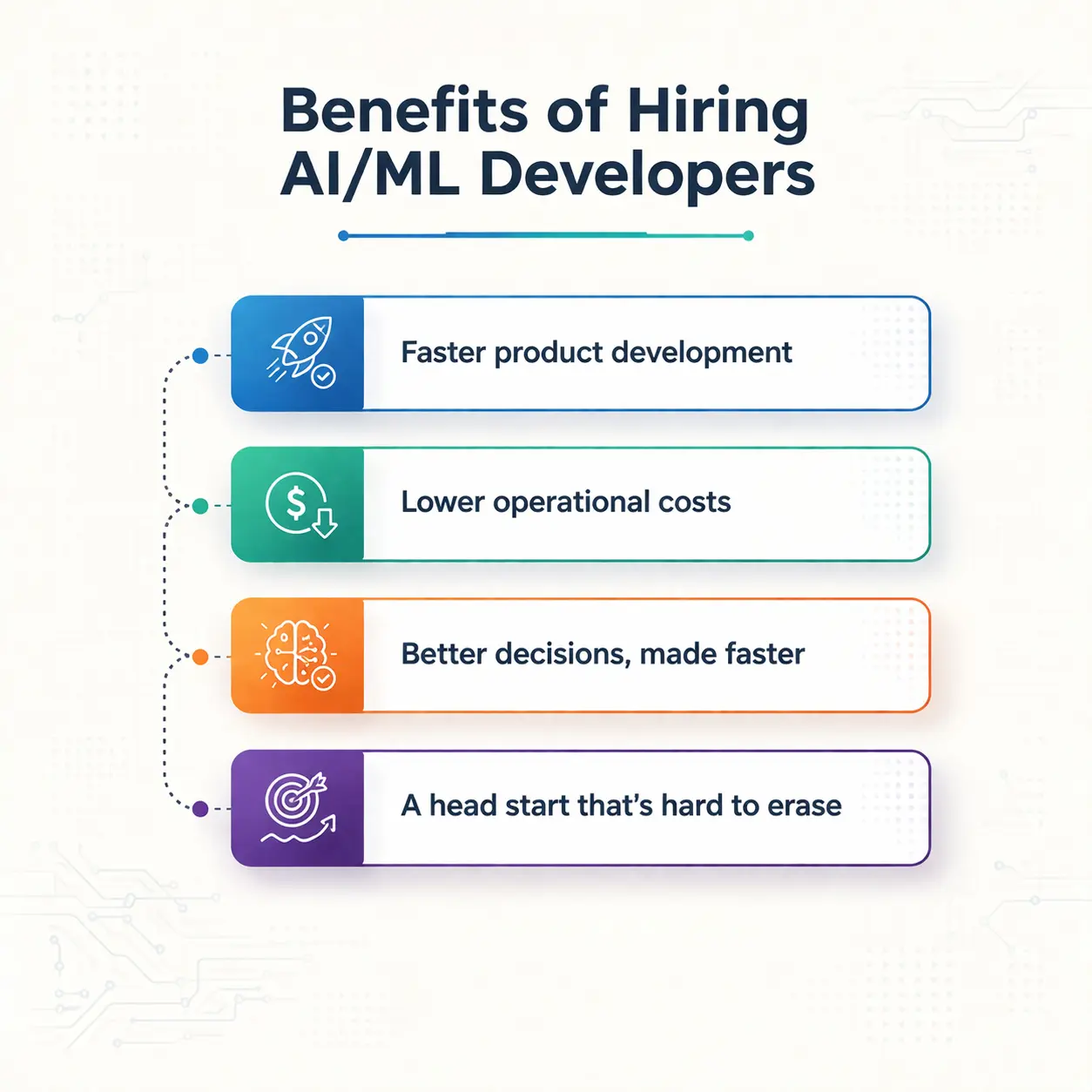
Let’s talk about what actually changes in your business when you hire well. Not what the technology can do in theory, but what it does in practice.
Faster product development
When you bring on experienced AI/ML engineers, features that would take an internal team months to research can be scoped and shipped in weeks. A SaaS company we worked with cut their release timeline from 14 weeks to 6 by handing the ML components to a dedicated AI development agency while their own engineers focused on the product layer.
Lower operational costs
This isn’t about replacing people. It’s about stopping smart people from doing repetitive work. A logistics company using route optimization AI typically sees 15 to 25% lower fuel costs. A financial services firm that automates document processing can reassign three or four people to work that actually requires their brain.
Better decisions, made faster
When AI surfaces insights from live data, you stop relying on monthly reports and gut calls. According to a 2023 IBM report, companies using AI for decision support reported 25% faster decision cycles. That speed compounds in ways that are hard to see quarter by quarter but obvious over two years.
A head start that’s hard to erase
Every month your AI system runs, it improves. Your recommendation engine gets sharper. Fraud detection gets more accurate. Forecasting tightens. A competitor who starts 18 months later doesn’t just need to match your system. They need to match your system plus 18 months of model improvement baked into it. That’s a gap most companies never close.
For more on how AI Consulting Services can accelerate this for smaller teams, that link breaks down the approach for businesses under 200 employees.
Red Flags to Watch for When Hiring an AI Development Partner
These are patterns we see repeatedly. Each one has cost someone real money and real time. Treat these as red flags, not minor concerns.
They show demos but no deployed products.
Demos are rehearsed. They run on clean data in controlled conditions. Ask to see something that’s live, serving real users, with real traffic. If the best they can show you is a demo environment, you should be cautious.
Data ownership isn’t discussed upfront.
Who owns the trained model? Who owns the training data? What happens to your data if you end the contract? These questions feel awkward to ask in the honeymoon phase. They become very expensive to litigate later. Get it in the contract.
They’re the cheapest bid on a system that matters.
If you’re building an AI system that touches revenue, customer data, or regulatory compliance, the cheapest bid is the most expensive mistake you’ll make. Budget teams exist at every price point, but a $30K quote for a project that realistically takes $120K of work means corners are getting cut. Your job is to figure out which ones.
The pitch team disappears after kickoff.
We mentioned this in the tips section because it matters that much. Some firms present a senior team during the pitch and then offshore 80% of the development to a subcontractor. Ask for the org chart of the people who will touch your project.
No post launch case study exists.
This is the one that separates real partners from project shops. Ask every potential vendor to show you a case study where they supported a client six months or more after go live. Not just a completed project — an ongoing relationship. If they can’t produce one, they build and walk away.
Cultural and communication styles don’t align.
Technical ability matters, but so does working style. If your team operates in two week sprints with daily standups and your vendor sends monthly email updates, you’ll be frustrated within a month. Align on how you work before you align on what you build.
They can’t name specific tools or frameworks for your project.
If you ask what stack they plan to use and the answer is vague, that’s a red flag. A real team knows whether they’ll use PyTorch or TensorFlow, whether deployment goes through SageMaker or a custom pipeline, and why. Vague tooling answers mean the team assigned to your project probably hasn’t been chosen yet.
They promise results before seeing your data.
Any company that guarantees accuracy numbers, ROI percentages, or delivery timelines before they’ve looked at your data is telling you what you want to hear, not what’s true. Responsible teams give ranges and caveats. The ones who promise 95% accuracy in the first meeting are the ones who disappear when the model delivers 60%.
Cost of Hiring an AI & ML Development Company
Real numbers. No “contact us for a quote” runaround.
Small projects ($25K–$75K): A focused ML model for one use case. Think a recommendation engine for a product catalog, a chatbot trained on your support docs, or a classification model for internal data. Usually 6 to 12 weeks of work with a small team.
Mid-scale projects ($75K–$250K): Multiple models, custom integrations, data pipeline work, and a production deployment. This is where most mid-size companies land. Expect 3 to 6 months of development with a dedicated team of 3 to 5 people.
Enterprise projects ($250K–$500K+): Full platform builds, multi-model architectures, compliance requirements, large scale data processing, and ongoing support contracts. These projects often run 6 to 12 months with larger teams and phased delivery.
Hourly rates vary by geography. US based senior AI/ML engineers typically bill $150 to $300 per hour. Nearshore teams (Latin America, Eastern Europe) run $75 to $150. Offshore teams (South Asia, Southeast Asia) range from $30 to $80. The rate doesn’t tell you the cost, though. A $50/hour team that takes three times longer isn’t cheaper.
What drives cost up: messy data that needs heavy cleaning, integration with legacy systems, regulatory compliance (healthcare, finance), and the need for explainable AI models. What’s usually extra in most contracts: cloud infrastructure, model retraining after launch, ongoing monitoring dashboards, and dedicated support hours.
Here’s the reframe: a $150K investment in AI that automates 200 hours of manual work per month pays for itself in 8 to 10 months. After that, the math only gets better. Cost is the wrong lens. Return is the right one.
Why Choose AppZoro
We at AppZoro built this company around a simple idea: US based companies deserve an AI ML development company for business that actually ships, not one that delivers decks and disappears.
Two projects that show how this works in practice:
The ADR Boost case study is a good example. A hospitality client needed a pricing engine that could adjust room rates based on demand, competitor pricing, and seasonal patterns. We built a predictive pricing model that helped them increase average daily revenue without losing occupancy. The system was live within 10 weeks and still running with our support.
The CreditDIY case study involved a fintech company that wanted to give users personalized credit improvement recommendations. We built the ML pipeline that analyzed credit data and generated action plans tailored to each user’s profile. The result was higher engagement and measurably better credit outcomes for their user base.
If you’re looking for an AI App Development Company that treats your project like a product, not a ticket, that’s us.
What to Do Next
The decision in front of you isn’t “should we use AI.” That ship has sailed. The decision is who you trust to build it right, and whether you start now or six months from now when your competitors have moved further ahead.
You now know what the process looks like, what it costs, what to ask, and what to avoid. The next step is small.
If you want to see how AppZoro has approached projects similar to yours, start with a free 30-minute technical consultation. No pitch, no pressure — just clarity on what’s actually possible for your business.
Leave a Comment