
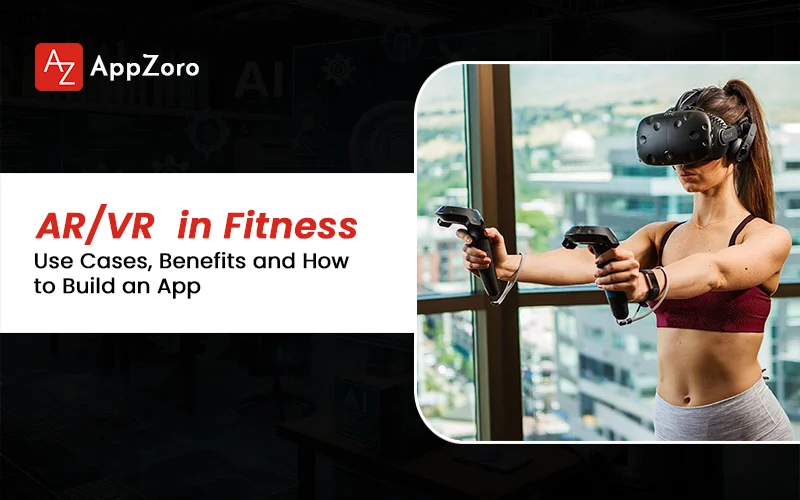
Take a rainy January evening. Priya has a gym membership she hasn’t used in three weeks, a living room with a coffee table pushed to the wall and a headset her brother left behind. Twenty minutes later she’s slicing glowing blocks to a beat, soaked in sweat, and honestly surprised she didn’t check the clock once. Nobody lectured her about discipline. The workout just stopped feeling like one, and that’s a hard thing to design.That small shift is what AR/VR in fitness is selling, and it’s why product teams keep asking us about it. Below, we’ll cover what the technology is, where it works, the benefits, features, tech stack, risks and the steps for AR/VR fitness app development. If you’re new to the wider process, our guide on how to develop a fitness app covers the base layer that AR and VR sit on top of.
What Is AR/VR Fitness Technology?
AR/VR fitness technology covers any app or device that uses extended reality to guide, track or motivate physical activity. The two halves behave quite differently, and a third, mixed reality, blends them.
| Augmented Reality (AR) | Virtual Reality (VR) | Mixed Reality (MR) | |
| What the user sees | Real world plus digital overlays | A fully virtual world | Virtual objects that interact with the real room |
| Typical device | Smartphone, smart glasses | Headset (Meta Quest, Pico and similar) | Headsets with colour passthrough, Apple Vision Pro |
| Best fit | Form feedback, outdoor games, quick sessions | Immersive classes, boxing, dance, rhythm workouts | Home workouts that respect furniture and space |
| Barrier to entry | Low, most people own a phone | Higher, needs a headset | Highest |
Augmented Reality in Fitness: Where It Works
Augmented reality in fitness shines when the user’s real environment matters. Picture a phone camera that tracks your squat depth and flags a rounded back, or a running app that draws a pacing ghost on the road ahead. You don’t need a headset for either.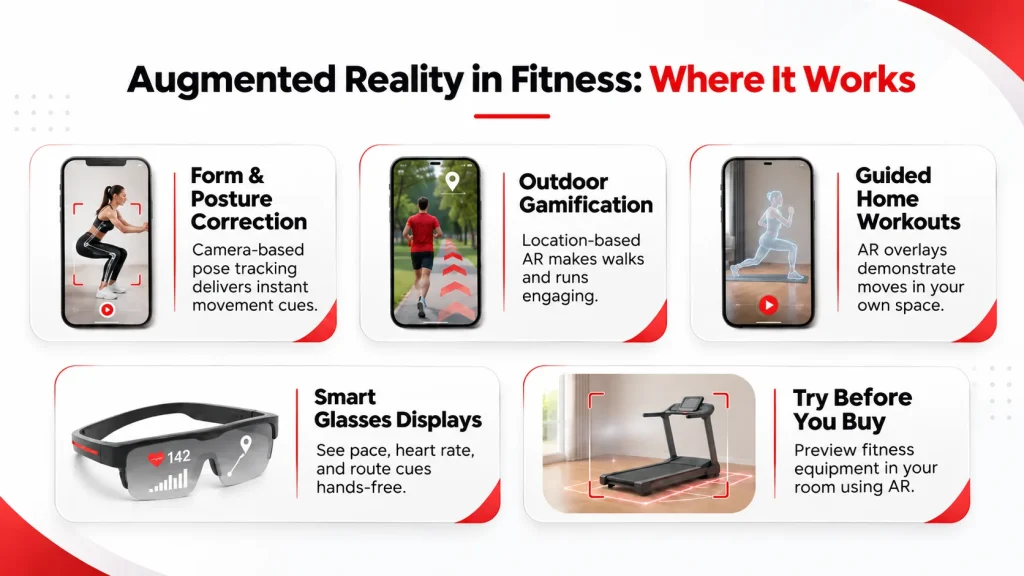
- Form and posture correction. Pose estimation reads joint positions through the camera and gives instant cues. It’s the closest an app gets to a trainer standing next to you, and users notice when it’s wrong.
- Outdoor gamification. Location-based AR, the Pokémon GO model, pushes people to walk and run farther without framing it as exercise.
- Guided home workouts. An overlay shows the movement in your own room, scaled to your height and space.
- Smart glasses displays. Pace, heart rate and route cues sit in the corner of your vision, so you’re not glancing at a wrist.
- Try-before-you-buy. Retailers and equipment brands use AR to place a treadmill or rack in your home before you’ve paid for it.
Virtual Reality in Fitness: Where It Works
Virtual reality in fitness replaces the room entirely, which is why it suits people who find gyms boring or a bit intimidating. If that’s your audience, VR deserves a serious look.
- Rhythm and combat workouts. Beat Saber and FitXR made it normal to burn serious calories in a headset.
- Virtual studios and classes. Live or recorded sessions with an instructor avatar and other participants, minus the commute.
- Scenic cardio. Cycling or rowing through a mountain pass or a coastline, which makes a 40-minute session pass faster.
- Rehabilitation and physiotherapy. Controlled, trackable exercises with progress data a clinician can review. Anything clinical needs proper validation and regulatory attention.
- Mindfulness and recovery. Breathing, stretching and guided relaxation in calming environments.
Benefits of AR/VR in Fitness
The benefits of AR/VR in fitness show up on two sides: for users, and for the business running the app.For users
- Higher motivation and longer sessions, since the activity feels like play.
- Better form, with real-time corrections that lower injury risk.
- Access without a gym, from home, a hotel room or a park.
- A sense of presence and community, even when everyone’s in different cities.
- Workouts shaped around ability, space and goals.
For businesses
- Stronger retention and daily active use.
- Differentiation in a crowded app-store category.
- Richer data on movement quality and engagement, which feeds personalisation.
- New revenue lines such as premium classes, hardware bundles and corporate wellness.
Features Worth Building: AR/VR Integration in Fitness Apps
AR/VR integration in fitness apps works best when the immersive layer plugs into things users already expect. Don’t rebuild the basics, because users won’t forgive an AR app that can’t even sync their steps. Our list of 15 features that could make your fitness app popular like Fitbit covers those foundations, and the table below shows the AR/VR additions.
| Feature | AR or VR | Why It Matters |
| Real-time pose tracking and form alerts | AR | Safety and perceived coaching quality |
| Virtual instructor or avatar | VR | Makes solo sessions feel guided |
| Gamified goals, streaks and leaderboards | Both | Drives repeat sessions |
| Wearable sync (heart rate, calories, sleep) | Both | Keeps workouts adaptive and measurable |
| Adaptive difficulty | Both | Stops beginners quitting and experts getting bored |
| Multiplayer and social rooms | VR | Accountability and community |
| Spatial safety boundaries | VR, MR | Prevents collisions with real furniture |
| Progress dashboards | Both | Shows results beyond the headset |
Inclusive design matters here too. Body-tracking models and avatar options can behave differently across body types, ages and abilities, and the UX needs of specific audiences vary. Our piece on building a fitness app for women is a good reference for that thinking.
Tech Stack for AR/VR Fitness App Development
Your stack depends on the device you’re targeting, so settle that before anyone opens Unity.
| Layer | Common Choices |
| Engine | Unity (most common), Unreal Engine |
| AR frameworks | ARKit (iOS), ARCore (Android), WebXR for browser experiences |
| VR platforms | Meta Quest SDK, OpenXR, Pico, visionOS |
| Pose and motion tracking | MediaPipe, ML Kit, device hand and body tracking |
| Backend | Cloud APIs for user profiles, workouts, leaderboards and analytics |
| Integrations | Apple Health, Google Health Connect, Bluetooth heart-rate sensors, wearables |
| AI layer | Personalisation, form scoring, workout recommendations |
Cross-platform engines save time, though performance-sensitive VR scenes often need careful optimisation. Frame rate is not a nice-to-have in a headset, because dropped frames are one of the quickest routes to nausea.
How to Approach AR/VR Fitness App Development?
Here’s the sequence we’d follow if you asked us. It’s lean on purpose.
- Pick one problem. Form correction, immersive cardio or rehab exercises. Don’t try all three at once, we’ve seen that stall projects.
- Choose the device. Phone-based AR reaches the most people. Headset VR gives richer immersion to a smaller audience.
- Prototype the core loop. Build one workout, test it with real users and watch where they wobble, lose interest or feel sick.
- Build the supporting app. Accounts, onboarding, progress tracking, wearable sync and payments.
- Test for comfort and accuracy. Check session length, motion comfort, tracking quality in different lighting and rooms.
- Launch small, then iterate. Use engagement data to decide the next feature.
For a deeper walk-through of the surrounding process, see our step-by-step fitness app development guide.
Challenges and Risks to Plan For
- Hardware access. Headsets are still a purchase many people haven’t made, so work out early whether your launch audience already owns one.
- Motion sickness. Smooth locomotion, steady frame rates and short first sessions help, and comfort settings should be easy to find.
- Tracking accuracy. Pose models struggle with poor lighting, loose clothing and cluttered rooms. Tell users plainly what the app can’t detect, they’ll trust it more.
- Content cost. Immersive environments and classes take real production effort, and your users will expect fresh content every month.
- Safety. Players can’t see their surroundings in VR, and that’s a real hazard. Boundary setup and clear warnings are essential.
- Privacy and data protection. Camera feeds, body movement and heart-rate data can be sensitive personal data, and in some cases health data. Depending on your users, GDPR, HIPAA or state privacy laws may apply, so don’t leave legal review until the end. Collect only what the feature needs, and be clear about storage and sharing.
- Medical claims. Wellness and clinical rehab are different territories. Don’t promise treatment outcomes you can’t validate.
What Does It Cost?
Cost swings widely, and it’s hard to quote without scope, because an AR form-checker on a phone and a multi-user VR studio are very different builds. The main drivers are the platform count, 3D asset and environment quality, tracking complexity, backend and integrations, content volume and compliance work. Our fitness app development cost guide breaks down the base app budget, and AR or VR is added on top of that, mostly through 3D content and specialist engineering.
Where AR/VR in Fitness Is Heading
Three trends look likely to matter, in our view. AI is making form feedback and workout plans more personal, and our write-up on how AI is redefining the fitness industry goes through real examples. Lighter headsets and smart glasses should lower the hardware barrier over time. And mixed reality is making home workouts feel more natural, since the digital coach can share your actual room.
Conclusion
AR/VR in fitness isn’t a gimmick when it solves a real problem, whether that’s keeping a beginner motivated, catching a bad squat or making rehab less tedious. The strongest products we’ve seen pick one clear use case, build the comfort and privacy basics properly and let what users actually do decide what you build next.If you’re considering an AR or VR fitness product and want a realistic view of scope, stack and cost, the AppZoro team can help you map it out before you commit to a build.
Frequently Asked Questions
What Is AR/VR in Fitness?
It’s the use of augmented and virtual reality to guide, track and motivate workouts, from phone-based form feedback to fully immersive headset classes.
What Is Augmented Reality in Fitness?
Augmented reality in fitness overlays digital information, like pose guides, pace markers or game elements, onto the user’s real surroundings through a phone or smart glasses.
What Is Virtual Reality in Fitness?
Virtual reality in fitness places the user inside a simulated environment through a headset, usually for boxing, dance, cycling or guided classes.
What Are the Benefits of AR/VR in Fitness?
Better motivation, improved form, flexible access and richer personalisation for users, plus stronger retention and product differentiation for businesses.
How Does AR/VR Fitness App Development Work?
You choose a use case and device, prototype the core workout, build the supporting app and integrations, test for comfort and accuracy, then launch and iterate.
How Should AR/VR Be Integrated Into Fitness Apps?
Add it as a focused layer on top of core features like tracking, wearables sync and progress dashboards, rather than as a replacement for them.
 Profile of Sam Agarwal