Women Health Tracking App Development: Features, Market, Process and Costs

It’s 11 p.m., and a woman opens her cycle app to log a late period. The app tells her ovulation happened last Tuesday, so the week she’s spent worrying must be nothing. Then the period arrives eight days late anyway. She doesn’t blame the app. She starts wondering what’s wrong with her body, and that’s a lot to put on a user.
That reaction isn’t far-fetched, and you’ve probably seen it yourself. The University of Sydney, summarising research on period trackers in October 2024, noted that one study found cycle length varied by five or more days for more than half of women, while many calendar-based apps still predict ovulation as exactly 14 days before the expected period. When a prediction is wrong, the same summary warns, users may doubt their own body rather than the app.
Moments like these decide whether a product lives or dies, and they’re where plenty of women health tracking app development projects lose users and trust. The idea sounds simple, but you’ll find the decisions underneath it, like prediction logic, privacy and medical claims, really aren’t. If your product leans closer to fitness than to cycles, AppZoro’s fitness app development guide shows you the wider build picture first.
So what should you plan before a single screen is designed? A clear audience, predictions that are honest about their limits, data practices that survive scrutiny, and a clear line on what the app claims, so let’s take a look at each of those.
What Is Women Health Tracking App Development?
Put simply, it’s the work of building software that lets women record cycles, symptoms, moods and health milestones, understand the patterns and plan around them. Under the broader label of FemTech app development, it covers several quite different products:
| App Type | Core Job | Product Consideration |
| Cycle and period tracker | Log periods and symptoms, predict the next cycle | Daily habit is easy to build, but trust depends on honest predictions |
| Fertility and conception app | Identify likely fertile days | Prediction accuracy and claims carry the most risk |
| Pregnancy and postpartum app | Track weeks, symptoms and appointments | Long engagement, with clinic and employer partnership potential |
| Menopause and perimenopause app | Track symptoms and treatment choices | An audience many consumer apps have overlooked |
| Condition-specific app (PCOS, pelvic health) | Support ongoing management | More clinical evidence and regulatory work |
What sets the category apart from general fitness tracking is the data, and you can’t treat it the same way. Cycle dates, pregnancy intent and symptoms are personal in a way step counts never are, so you’ll handle them differently, and that one difference changes almost every design and legal decision that follows. Many teams also place cycle tracking inside a bigger product, which is where AppZoro’s guide to building a wellness app helps with the wider planning. But how big is the opportunity, really? Let’s look at the numbers.
The Women Health App Market: Size, Growth and Funding
Ask five research firms for the size of the women’s health app market and you won’t get matching answers, because each one draws the category’s edges differently. Three recent estimates show the spread:
| Research Firm | Base Figure | Forecast | Growth Rate |
| Fortune Business Insights | $2.96 billion (2025) | $12.96 billion by 2034 | 17.71% a year |
| Coherent Market Insights | $4.73 billion (2026) | $12.34 billion by 2033 | 14.7% a year |
| 360iResearch | $6.16 billion (2026) | Adds $17.28 billion by 2032 | 18.66% a year |
Fortune Business Insights, Coherent Market Insights and 360iResearch each publish their own figures, so treat the exact number as soft. The direction isn’t: every serious forecast points up, with growth rates between roughly 15% and 25% a year.
Funding tells a more uneven story. Galen Growth reported a record $2.2 billion in femtech funding in 2024. Deloitte’s narrower health-tech analysis then showed women’s health investment falling 56% in 2025, to $478 million, while overall health-tech funding rose, and the World Economic Forum and BCG reported in January 2026 that women’s health attracts only about 6% of private healthcare investment. Investors are selective, and capital’s concentrating in proven players such as Flo, which passed a $1 billion valuation in 2024. If you’re launching a new product, that means a clear niche and real retention matter more than a broad feature list.
Women Health App Features: What Belongs in the First Release
At the heart of any cycle app sits a small loop: someone logs a day, sees what it means, and comes back tomorrow. Every other feature exists to keep that loop turning, so don’t lose sight of it. This is how the core women health app features line up against what users need:
| Feature | User Need | Product Consideration |
| Fast cycle and symptom logging | Record a day in a few taps | Entry speed decides whether the habit survives |
| Predictions with ranges | Know roughly what’s coming | Show confidence and let users correct the model |
| Reminders and notifications | Stay consistent without nagging | Discreet wording that doesn’t reveal the app’s purpose on a lock screen |
| Insights and trend reports | Spot patterns over months | Trends beat single-day numbers, and exports help clinician visits |
| Privacy controls | Trust the app with sensitive data | Plain-language consent, easy export and real deletion |
| Mode switching | Track a period, conception, pregnancy or menopause | Needs flexible data models, not separate apps |
Wearable input, AI insights, telehealth and community features aren’t in that table on purpose. They’re optional, and each one brings integration, privacy and testing work that your first release rarely needs, which is why you should settle the core loop first. And since predictions are the most visible promise any cycle app makes, let’s look at how to handle them honestly.
Predictions, AI and the Accuracy Problem
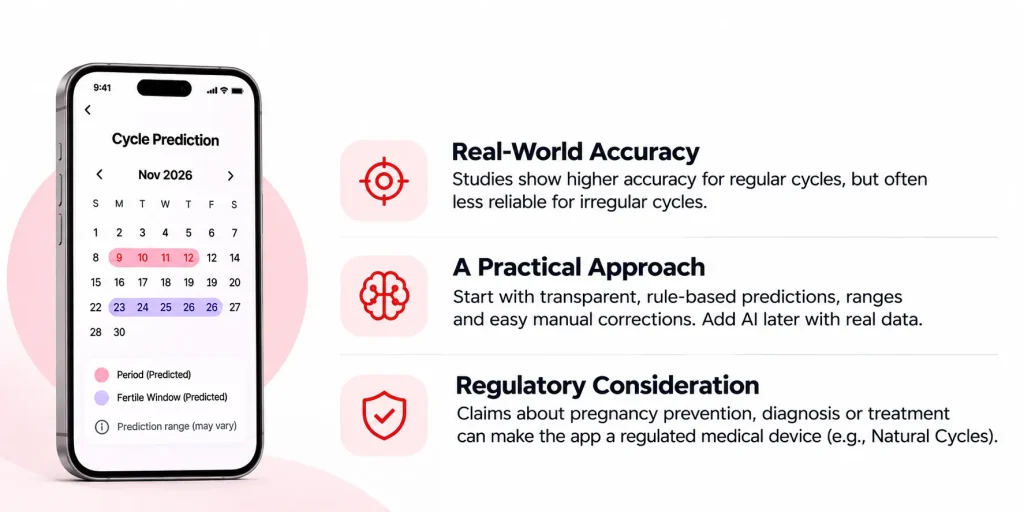
A University of Washington study from 2017, drawing on 2,000 app reviews, a survey of 687 people and interviews, found that period trackers were most accurate for people with very regular cycles, and that the people who most need an app are often those whose cycles aren’t regular. Many apps, the researchers noted, rarely let users correct wrong predictions, and users preferred designs that showed prediction ranges and stayed discreet. A peer-reviewed comparison of ten popular apps, fed the same cycle profiles, found conflicting answers on period dates, ovulation day and the fertile window. Those studies are a few years old, so newer apps may do better, but you should still treat them as a fair warning.
For your first release, the sensible route is usually rules rather than machine learning: transparent calculations, prediction windows instead of single dates, easy manual corrections, and a note on what the app can’t know. AI can improve predictions as data accumulates, but you’ll need to validate it against real cycles and have clinicians review it before anyone relies on it. This also explains where regulation starts. Claims about preventing pregnancy, diagnosing a condition or guiding treatment can make software a regulated medical device, and Natural Cycles is the well-known example of a cycle app described as FDA-cleared for birth control. For personalised programmes inside a wider health product, AppZoro’s wellness app development services page shows how it describes that work.
How to Develop a Women Health Tracking App
Women health tracking app development goes smoothly when the stages follow the user’s problem and the data, not a generic software checklist, and in practice that means:
- Defining who’s tracking and why, because someone trying to conceive, someone managing perimenopause and someone avoiding pregnancy need very different language and guardrails.
- Settling the claim early. Decide whether the app tracks and educates, or makes contraceptive, diagnostic or treatment claims, before design hardens.
- Designing for sensitivity: inclusive language, no assumptions about relationships or gender identity, and notifications and icons that don’t reveal what the app is.
- Building predictions with clinical input and testing them against irregular cycles, not only textbook ones.
- Setting up consent, privacy controls and a maintenance plan before launch, not after.
The fourth point deserves the most attention. If your app only works for regular cycles, it fails the people who need it most, so testing with irregular profiles early is far cheaper than fixing trust later. With the stages clear, let’s look at what drives the budget.
Women Health Tracking App Development Cost
There isn’t one price, and you shouldn’t trust anyone who quotes one, because cost follows scope, platforms, integrations, privacy engineering and whether the product edges into regulated territory. AppZoro’s fitness app development cost guide publishes the base ranges below for fitness products, and you should expect a cycle app with sensitive data to sit toward the upper part of the range for its scope.
| Tier | Typical Scope | Typical Cost | Typical Timeline |
| Lean MVP | One platform, 3 to 5 core features, secure accounts | $25,000 to $60,000 | 3 to 4 months |
| Full first version | iOS and Android, reports, subscriptions, richer insights | $80,000 to $200,000 | 6 to 9 months |
| Wearable-integrated app | Real-time sync and a defined device list | $120,000 to $250,000 | Varies with the device list |
Several cost drivers sit on top of those tiers:
| Cost Factor | What Affects It | Budget Consideration |
| Scope | Cycle logging only, or fertility, pregnancy and menopause modes | Fix a first-release scope before asking for quotes |
| Privacy and security | Consent flows, encryption, access controls, testing | Plan from day one, since retrofitting typically costs more |
| Clinical input | Medical review of content and prediction logic | Budget for reviewer time, not only engineering |
| Integrations | Apple Health, Health Connect, wearables | Each needs building, testing and upkeep |
| Maintenance | OS updates, security patches, content upkeep | AppZoro’s guide puts year-one maintenance at 15% to 25% of the build |
Each wearable integration typically adds $5,000 to $20,000, and you’ll pay cloud, API and store fees every month on top. Women health tracking app development cost is also easier to compare when every quote states its assumptions on scope, platforms and support in writing. And speaking of integrations, let’s see what they can and can’t do.
Integrations, Wearables and Data Privacy
Wearables can add temperature, heart rate and sleep context to cycle predictions, which is why you’ll see so many teams put them on the roadmap early. Garmin, for instance, offers a Women’s Health API covering menstrual cycle tracking and pregnancy information. The catch is access. Reporting from September 2026 says Garmin appears to have stopped processing new developer applications in spring, with no date for reopening, although Garmin hasn’t publicly confirmed it. Plan fallbacks such as HealthKit and Health Connect, and keep your integration estimates flexible. AppZoro’s wearable app development guide covers the trade-offs of each route.
Privacy needs the same honesty. On August 1, 2025, a federal jury in San Francisco found that Meta violated California privacy law by recording sensitive menstrual health data through an SDK embedded in the Flo app, an app described at trial as having 60 million active users. In late September 2026, plaintiffs asked the court for a $1.1 billion judgment covering about 222,000 California residents, and Meta opposed it. Washington’s My Health My Data Act lets consumers sue directly over consumer health data outside HIPAA, and its first class action, filed in February 2025, targeted an SDK embedded in third-party apps. What applies depends on where your app operates and who it serves, so consent, minimisation and legal review belong in your plan from the start, and none of this is a compliance guarantee.
In practice, that means you keep third-party advertising and analytics code out of screens that handle reproductive health data, ask for consent at the moment of collection, and make deletion complete.
How to Choose the Right Features to Build First
Start with one measurable problem, such as logging a day in under thirty seconds or helping someone with irregular cycles get a useful prediction range, and build only what supports it. You’ll thank yourself later. Track outcomes like weekly active users, completed logs and prediction corrections, and add features only when those numbers are moving. If you’re adding cycle tracking to a training or wellness product, you’ll find broader planning in AppZoro’s guide on how to develop a fitness app.
Conclusion
So when it all comes together, women health tracking app development is really about a handful of decisions made in the right order: who the app is for, how honest its predictions are, how carefully you handle data, and how far your claims go. These choices matter because they shape both cost and trust, and you won’t easily win trust back once it’s lost.
If a women’s health or cycle tracking feature is part of a fitness or wellness product you’re planning, AppZoro’s fitness app development team can help you turn the scope into a quote that compares cleanly with others.
Frequently Asked Questions
How much does women’s health tracking app development cost?
A lean MVP typically runs $25,000 to $60,000 and a full first version $80,000 to $200,000, based on AppZoro’s published ranges. Privacy engineering, clinical review and integrations push a build toward the upper end, and maintenance adds 15% to 25% of the build cost each year.
What are the must-have women health app features?
Fast cycle and symptom logging, predictions shown as ranges, discreet reminders, trend reports and export, and clear privacy controls with real deletion. Wearables, AI and telehealth can follow once users keep returning.
How big is the women health app market?
Estimates range from about $3 billion to over $6 billion for 2025 to 2026 depending on the research firm, with forecast growth of roughly 15% to 25% a year.
What is FemTech app development?
FemTech app development is the building of software for women’s health needs, such as menstrual cycles, fertility, pregnancy, postpartum care and menopause. It pairs mobile engineering with sensitive-data privacy and, sometimes, medical regulation.
How do you develop a women's health tracking app?
Define the audience, settle the health claim, design for sensitivity, build and test predictions with irregular cycles in mind, and put consent, privacy and a maintenance plan in place before launch.
 Profile of Sam Agarwal