
Remember downloading a gym tracker, logging bench press on Monday with full enthusiasm, and then quietly going back to the notes app on your phone by Thursday because adding a drop set was taking four taps too many? That friction is exactly why Hevy got popular, and it is also why the fitness app like Hevy cost conversation is usually starting in the wrong place.Most founders/entrepreneurs are opening this conversation with a feature list, when the thing they are really buying is a logging loop that somebody is repeating three or four times a week for a year. Hevy is making that trade extremely visible, since its App Store listing is free with in-app purchases and the Pro upgrade is sitting at $2.99 monthly, $23.99 yearly or $74.99 lifetime on the US store (Apple App Store listing, accessed October 22, 2026), which is telling you that the product is only working if people are staying.So what should you actually be pricing before a single screen is getting designed? Well, the logging loop, the platforms, the data model sitting behind the charts, and the integrations you are genuinely needing on day one, all of which sit inside the wider planning covered in AppZoro’s guide on how to develop a fitness app, so let’s break it down.
How Much Does It Cost to Build a Fitness App Like Hevy?
The honest answer is that the fitness app like Hevy cost is a range and not a price, and the Hevy app development cost you are eventually signing off is moving with six things, namely how many platforms you are shipping, how deep the workout data model is going, whether there is a social layer, whether a watch app is in scope, how much custom design the product is needing, and how much backend and sync work is sitting underneath all of it.A plain workout logger on one platform, with an exercise library, routines, sets/reps, weights, a rest timer and a history screen, is a genuinely small build, and it is landing near the lower MVP tier above. The moment a second platform, a social feed, full analytics and a smartwatch companion are joining the scope, you are moving through the mid-level tier and towards the advanced one, and the reasons are not hard to see, because every one of those is a separate surface to build, test and maintain.The store side is the cheap part, and the exact numbers are worth knowing before they are becoming guesses in a spreadsheet. Apple is charging $99 a year for the Apple Developer Program and Google a one-time $25 for a Play Console account, while the commission is the real line item, since Apple is taking 30 percent as standard and 15 percent under the App Store Small Business Program for developers with up to $1 million in prior-year proceeds, and Google is applying 15 percent to auto-renewing subscriptions, which on a $23.99 yearly plan like Hevy’s is quietly deciding how many subscribers your build has to pay for.
What Features Affect the Cost of a Hevy-Style Fitness App?
The workout tracker app features that are shaping the budget are rarely the ones founders/gym owners are worrying about. An exercise library with names, muscle groups and demo media is mostly content work, whereas the expensive part is the data model underneath it, because sets, reps, weights, RPE, warmup and drop sets, supersets and rest timers all have to be stored in a way that is still queryable two years later when somebody is asking for a one-rep-max chart.Hevy’s public listing is a fair guide to where that complexity is sitting, since Apple’s store page is describing routines synced to Apple Watch, live sync with the phone, heart rate tracking, set types marked as warmup, normal, drop or failure, one-rep-max calculation, full-screen graphs of volume, best weight and total reps, and the option of copying a friend’s workout, with Pro adding unlimited routines, unlimited graph history and unlimited custom exercises (Apple App Store listing, accessed October 22, 2026). Each and every one of those is a real engineering line item rather than a checkbox.For a first release the core is staying small, resulting in:Accounts, profiles and a straightforward onboarding. The exercise library and routine building. The logging screen with sets, reps, weights and rest timers. Workout history and one clear progress chart.Everything else, meaning the social feed, the detailed statistics, the watch app, body measurements and subscriptions, is sitting in the optional column until the logging loop is proving itself with real users/lifters. If you are wanting the wider planning view around that decision, AppZoro’s fitness app development guide is covering feature selection and development stages in more depth. So how do those features translate into a quote? Let’s break it down.
Hevy Clone App Development Cost by Feature and Scope
Rather than inventing a dollar figure per feature, this table is showing relative implementation complexity and the reason sitting behind it, and that last column is where the quiet budget decisions are hiding:
| Feature or scope | Implementation complexity | Why it affects cost |
| Exercise library and workout logging | Low to medium | Content plus a clean data model, and the data model is what is costing you later |
| Sets, reps, weights, rest timers, history | Medium | Edge cases like supersets, set types and mid-workout edits are multiplying the test matrix |
| Routines and progression | Medium | Templates, reordering and progression rules are needing real UX work, not just screens |
| Personal records, charts, statistics | Medium to high | Aggregation queries, caching and chart performance across years of data |
| Social feed, profiles, likes, comments | High | A second product really, with moderation, notifications, privacy controls and abuse handling |
| Subscriptions and paywall | Medium | Store billing, receipt validation, entitlements, restore flows and failed-payment handling |
| Apple Watch or Wear OS companion | High | A separate app with its own UI, offline logging and live sync back to the phone |
| Web app or cross-platform parity | High | Another surface with its own QA cycle and release process |
So a basic tracker is one build, whereas a Hevy-style product with social, analytics, subscriptions and a watch app is really three or four builds sharing one backend, and this is the single biggest reason two quotes for “an app like Hevy” are landing miles apart. And speaking of the things outside the feature list, let’s see what else is moving the budget.
What Influences Fitness Tracker App Development Costs?
And that is not all, because the line items outside the feature list are moving the budget just as much. Platform choice is the first of them, since native iOS and Android are costing more than a cross-platform build but are behaving better where background tracking and watch integration are concerned, and UI/UX design is the second, because in fitness tracker app development most of that design time is going into the logging screen, which is the one screen somebody is touching dozens of times per session.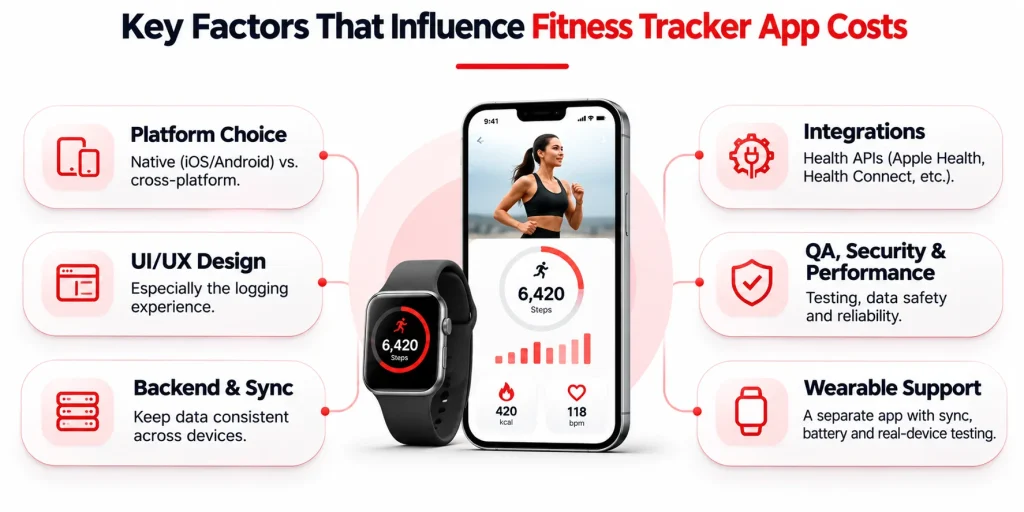 Then there is everything users/lifters are never seeing, resulting in:The backend and the account and sync layer keeping a workout consistent across phone, watch and web. Analytics, push notifications and the subscription plumbing. Third-party APIs such as Apple Health and Health Connect. QA, security, performance work and maintenance continuing long after launch.These don’t just add cost at the start, they also decide how expensive year two is, and for a broader cost context across all of them, with scope, team structure, integrations and upkeep laid out properly, AppZoro’s fitness app development cost breakdown is the better reference, and it is worth saying that it is covering fitness products generally rather than pricing a Hevy clone app specifically.Wearables are deserving their own warning here. A watch companion is definitely not a toggle, it is a second application with its own lifecycle, and sync, battery and reconnection behaviour are all needing testing on real hardware, which is exactly what AppZoro’s wearable app development guide is covering. Hevy is shipping Apple Watch and Wear OS apps today, so it is a fair benchmark, though your first release is rarely needing to match that on day one. But how long is all of this taking? Let’s take a look.
How Long Does It Take to Build an App Like Hevy?
Timelines are following the same scope logic, and AppZoro’s fitness page is stating that an MVP is typically running 3 to 4 months, while a mid-level platform with subscriptions and wearable integrations is usually running 5 to 7 months, with a full connected ecosystem taking longer (AppZoro, fitness app development services page, accessed October 22, 2026). Those are one company’s delivery norms rather than an industry standard, and your own timeline is also depending on how quickly decisions are coming back from your side.The stages themselves are fairly predictable, meaning discovery and scope, UX and UI with the logging flow designed first, development in sprints, integration work, testing on real devices, and store submission with the review cycle built into the plan. The part teams are underestimating every time is the testing of the logging loop across interruptions, phone calls, lost connectivity and a watch drifting out of range, because that is where a tracker is either feeling solid or feeling broken. And once it is live, how is it earning? Let’s break it down.
How Can You Make Money From a Fitness App Like Hevy?
If you are planning to make money from a fitness app in this category, the pricing reality is set already, since Hevy is free with Pro at $2.99 a month, $23.99 a year or $74.99 lifetime on the US App Store (Apple App Store listing, accessed October 22, 2026), and your model is going to be read against that whether you like it or not.
| Monetization model | How it works | Product consideration |
| Freemium | Core logging free, with limits on routines, history or custom exercises | The free tier has to be genuinely usable, or nobody is staying long enough to upgrade |
| Subscription | Monthly and annual tiers, often with a lifetime option | Annual and lifetime pricing is trading long-term revenue for cash now |
| Paid programs and plans | Structured training content sold separately | Needs qualified programming and ongoing content upkeep |
| Coach and trainer tools | Client rosters, plan assignment, check-ins | A different buyer and a different support load altogether |
| Partnerships and marketplace | Gyms, brands or providers inside the app | Only working once your audience is big and engaged enough to matter |
Revenue is following retention, willingness to pay, acquisition cost and the real value somebody is getting out of the app, so none of these models is a guarantee, and no public figures are confirming what Hevy is earning. If your product is widening beyond lifting into habits, recovery or nutrition, the broader planning in AppZoro’s guide to building a wellness app is a sensible next read before that scope is getting locked in. So who should be building it? Let’s take a look.
How to Choose a Fitness App Development Company
Choosing a fitness app development company for this kind of product is less about portfolio size and more about whether the team is really understanding the logging loop, so ask to see a product where somebody is entering data repeatedly, ask how they are handling offline sessions and sync conflicts, and ask who is owning the data model at the end of it.A reasonable checklist is looking like this, resulting in:Relevant mobile and fitness product experience. A real discovery stage before any estimate. Feature-level estimates instead of one lump sum. Hands-on integration experience with Apple Health or Health Connect. Documented testing, privacy and security practice. Clear terms on source-code ownership, documentation and handover.And that is not all, because the maintenance conversation is extremely crucial here, since store policies and wearable APIs are changing regularly and somebody has to be budgeted to keep up with each and every one of them. If your roadmap is pointing towards habits, recovery or mental wellbeing alongside training, AppZoro’s wellness app development page is showing how that wider scope is described.
Conclusion
So when it is all coming together, the fitness app like Hevy cost is really being set by a handful of choices made in the right order, namely how small the first release is staying, how many platforms it is covering, whether the social and analytics layers are in or out, how far the wearable work is going, and how much testing and maintenance you are budgeting after launch, and these choices are extremely crucial because they are shaping both the quote and the product people are keeping on their phone.Write that scope down first and the quotes are finally becoming comparable, which is really the whole point of the exercise. And if you are planning a workout tracker or a wider training product and you are wanting a scope and estimate against your own feature list, AppZoro’s fitness app development services page is a reasonable place to start the conversation.
Frequently Asked Questions
How much does it cost to build an app like Hevy?
There is no verified figure for copying Hevy specifically. As a planning frame, AppZoro is publishing general fitness ranges of $15,000 to $25,000 for an MVP, $25,000 to $35,000 for a mid-level platform and $35,000 to $50,000 for an advanced one, and a Hevy-style product is usually sitting in the second or third band once social features, analytics and a watch app are joining the scope.
What affects Hevy app development cost the most?
Platform count, the depth of the workout data model, the social layer, the smartwatch companion and the amount of custom design, with testing and maintenance adding ongoing cost long after launch.
What features should a Hevy clone app include at launch?
Accounts, an exercise library, routine building, the logging screen with sets, reps, weights and rest timers, workout history and one clear progress chart, with social, deep statistics and subscriptions being held back for later.
How long does it take to build a workout tracker app?
AppZoro is quoting 3 to 4 months for an MVP and 5 to 7 months for a mid-level platform with subscriptions and wearables, though timelines are varying by team, scope and how fast decisions are coming back.
Can a workout tracker integrate with Apple Watch and Wear OS?
Yes, and Hevy is doing both, but each companion app is a separate build with its own sync and battery testing, so it is adding real cost rather than being a settings toggle.
 Profile of Sam Agarwal