
Every patient today generates an extraordinary amount of health data. Doctors and nurses are expected to do more with less. More patients. More data. More documentation. But time hasn’t expanded to match. Here’s something many people don’t realize. Physicians spend up to 40–50% of their time on administrative work.
The global shortage of healthcare workers is projected to reach 10 million by 2030. At the same time, patient demand keeps rising, driven by aging populations, chronic diseases, and higher expectations for care.
Traditional software can store it. Predictive models can find patterns in it. But neither can take that insight and do something with it autonomously, across systems, at scale. That gap is exactly where agentic ai in healthcare examples are starting to emerge as genuinely transformative, not just promising.
This is where AI agents in healthcare industry conversations become more than just hype.
Beyond Automation: What Makes AI Agents Actually "Agentic"?
This is where a lot of the confusion starts. People hear AI agents and assume it means smarter automation. Better chatbots. Faster rule-based workflows. That's not wrong exactly, but it's not the full picture either.
Fully agentic systems are different in a fundamental way. They don't just generate outputs. They reason, plan, and act. They pursue a defined goal using a combination of memory, contextual judgment, and tool access. And they adapt when circumstances change.
Here's what that looks like in practice across four core components:
Memory- An AI agent doesn't treat every patient interaction as a blank slate. It retains longitudinal context: past diagnoses, medication history, behavioral patterns, prior care touchpoints. That continuity is what allows it to make genuinely relevant decisions rather than generic ones.
Reasoning- Clinical reasoning is complex. So is operational reasoning inside a health system. Agentic systems are built to navigate that complexity, weighing variables, applying logic, and making judgment calls within defined parameters.
Tool use- An agent that can't interact with existing systems isn't very useful in healthcare. The best implementations connect directly to EHRs, scheduling platforms, diagnostic APIs, insurance systems, and communication tools. This is what allows them to act, not just advise.
Multi-agent collaboration- Some of the most sophisticated implementations use multiple agents working in parallel. One handles clinical data, another manages scheduling, a third handles billing, and they coordinate in real time to manage a patient's entire care journey. This is where implementing agentic ai in healthcare gets genuinely complex, and genuinely powerful.
The Strategic Advantage: Core Benefits of AI Agents in Healthcare
Let's get specific. Because the case for agentic AI isn't theoretical. There are real, documented benefits playing out in health systems right now.
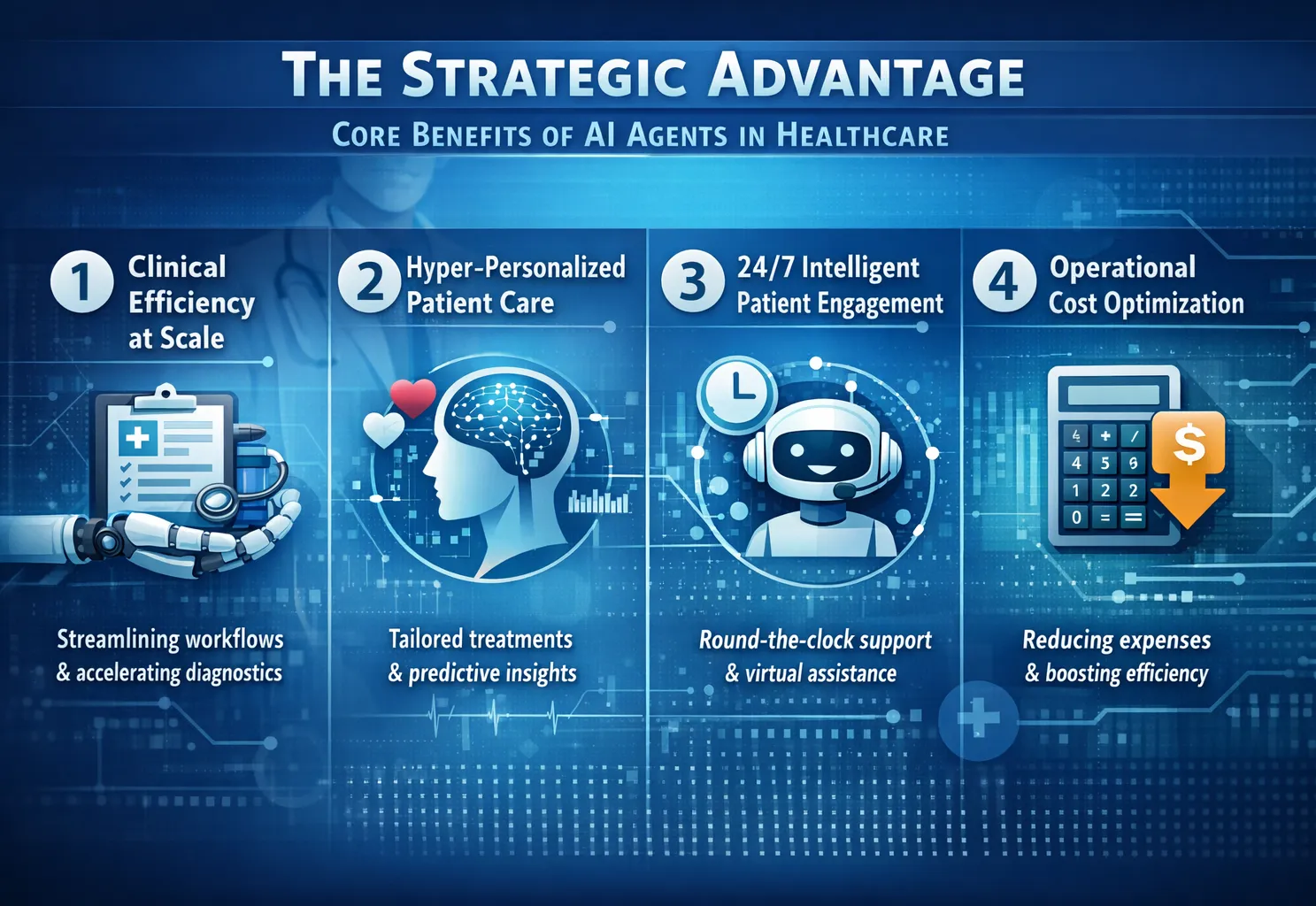
1. Clinical Efficiency at Scale
Physicians should be doing physician things. Diagnosing. Treating. Building relationships with patients. Not chasing down authorizations or manually documenting every interaction.
AI agents tackle the administrative layer aggressively. One large health system piloting AI-assisted documentation reported saving physicians an average of 2 hours per day. That's not a rounding error. At scale, across a hospital network, that's the equivalent of adding hundreds of clinical hours back into the system without hiring a single new physician.
2. Hyper-Personalized Patient Care
Generic care protocols are a product of limitation, not preference. Clinicians know that every patient is different. The problem has always been the bandwidth to actually treat them that way.
Agentic ai in healthcare use cases around personalization are particularly compelling. Adaptive chronic disease management that evolves as patient behavior and health data changes.
This is the kind of individualized care that used to require significant manual effort and is now becoming possible at population scale.
3. 24/7 Intelligent Patient Engagement
One of the most immediate agentic ai in healthcare use cases is simply being available when humans aren't.
AI care navigators can handle patient questions at 2am. They can walk someone through symptom assessment, help them understand whether they need to go to the ER or wait for a morning appointment, refill prescription requests, and send pre-procedure instructions. Not with a static FAQ, but with genuinely intelligent, context-aware responses.
The downstream impact on emergency department utilization is significant. Studies on AI-based symptom checkers show reductions in unnecessary ER visits in the range of 15 to 20%. That's meaningful both for hospital costs and for patient experience.
4. Operational Cost Optimization
Healthcare administration costs in the US account for roughly 35% of total healthcare spending. That's somewhere around 1 trillion dollars annually. A huge portion of that goes toward billing, coding, claims processing, and the back-and-forth with insurance companies.
Health systems that have implemented AI-driven revenue cycle tools are reporting claim denial rates dropping by 30 to 40%. For a large hospital, that can mean tens of millions of dollars recovered annually.
This is one area where AI Agent Development Services are seeing intense demand, because the ROI is fast, measurable, and doesn't require clinical workflow changes to capture.
What Implementing Agentic AI in Healthcare Actually Looks Like?
Implementing agentic ai in healthcare isn't a plug-and-play situation. Anyone telling you otherwise is selling you something.
The systems that work well share a few things in common:
They're built with deep integration into existing clinical workflows, not bolted on top of them
They have strong data governance and privacy architecture from day one, not as an afterthought
They include clinician involvement in the design process, because agents that don't fit how care teams actually work get abandoned
They're deployed incrementally, starting with lower-stakes administrative tasks before expanding into clinical decision support
They have clear human oversight mechanisms, because autonomy doesn't mean unsupervised
The organizations seeing the best results aren't the ones that moved fastest. They're the ones that moved most thoughtfully, partnering with experienced AI Agent Development Services to navigate the clinical, technical, and regulatory complexity that comes with this territory.
Where This Is All Heading
Healthcare doesn't have the luxury of moving slowly forever. The pressure is too real, the workforce gaps too wide, the data too vast to manage manually.
Agentic AI isn't a future-state technology. It's being deployed today, in real health systems, with measurable results. The early adopters are pulling ahead on efficiency, on patient experience, and on the ability to scale without proportional increases in headcount.
The inflection point isn't coming. For many health systems, it's already here.
The organizations that treat AI agents as a strategic priority now, rather than a wait-and-see experiment, are the ones that will define what high-performance healthcare looks like in the next decade.
Where AI Agents Deliver Immediate ROI: High-Impact Use Cases
This is where things get practical.
A lot of discussions around AI feel abstract. But when you look at how an ai agent in healthcare actually works inside hospitals, clinics, or even pharma companies, the value becomes very clear, very quickly.
Let’s walk through the areas where organizations are already seeing real returns.
Intelligent Patient Intake & Triage
Patient intake is usually the first bottleneck. Long forms. Repetitive questions. Delays before a doctor even sees the case.
AI agents simplify this process.
Patients interact with conversational agents that collect symptoms
The system asks follow-up questions based on responses It builds a structured patient profile before the visit But it doesn’t stop there.
These agents can also:
Assess urgency
Categorize risk levels
Route patients to the right department
So by the time a clinician steps in, they already have context. It saves time and improves accuracy.
Clinical Decision Support Agents
Doctors don’t need more data. They need better clarity.
AI agents can assist by:
Suggesting possible diagnoses
Recommending treatment pathways
Highlighting risks based on patient history
What makes this powerful is the combination of:
Clinical guidelines
Real-time patient data
Historical records
This is one of the more advanced agentic ai use cases in healthcare, where AI doesn’t replace decisions but strengthens them.
Remote Patient Monitoring Agents
This is becoming one of the fastest-growing areas in the ai agents in healthcare market. Patients don’t always need to be in hospitals to be monitored.
With wearables and connected devices, AI agents can:
Track vitals continuously
Detect unusual patterns
Send real-time alerts
For chronic conditions like:
Diabetes
Heart disease
This kind of monitoring is incredibly valuable.
Instead of reacting to emergencies, care teams can step in early. It’s more efficient and much safer for patients.
Administrative Workflow Automation
Let’s talk about the less glamorous side of healthcare. Operations.
A huge amount of time and money is lost in:
Medical coding errors
Claim rejections
Poor scheduling
AI agents can handle:
Automated coding and billing
Claims processing with fewer errors
Smart appointment scheduling
Many organizations start here when exploring agentic ai applications in healthcare because the ROI is quick and measurable.
Drug Discovery & Clinical Trial Acceleration
This is where things get really interesting. Drug discovery is expensive and time-consuming. AI agents are starting to change that.
They can:
Analyze massive datasets to identify patterns
Generate research hypotheses
Suggest potential drug candidates
In clinical trials, they help with:
Matching patients to trials faster
Identifying suitable candidates based on medical history
This reduces delays and improves trial success rates.
Hospital Operations & Resource Optimization
Hospitals are complex systems.
Managing them efficiently is a challenge on its own.
AI agents can support:
Bed allocation based on real-time demand
Staffing predictions
Supply chain management
For example:
If patient inflow increases suddenly, the system can suggest reallocating resources before things get overwhelmed.
These kinds of agentic ai applications in healthcare often work quietly in the background, but their impact is significant.
Building AI Agents in Healthcare: A Practical Implementation Framework
Knowing the use cases is one thing. Actually building and deploying systems that work in a regulated, high-stakes clinical environment is another challenge entirely. Organizations that partner with an experienced AI development company will tell you the same thing: the technology is often the easier part. The process, governance, and integration work is where most implementations succeed or fail.
Here's a framework that reflects what actually works.
Identify High-Impact, Low-Risk Entry Points
The instinct to start with the most exciting use case is understandable but usually wrong. Clinical decision support agents and diagnostic AI are compelling. They're also among the most complex to validate, govern, and integrate safely.
The smarter approach is to start where the impact is high and the clinical risk is low. Administrative workflows are the obvious starting point. Prior authorization, scheduling optimization, billing and coding, these applications deliver measurable ROI quickly and don't require the same level of clinical validation as patient-facing or diagnostic systems.
Data Readiness and Integration
Healthcare data is messy. EHR systems from different vendors don't talk to each other cleanly. Clinical notes are a mix of structured and unstructured text. Imaging data lives in PACS systems. Genomic data is in yet another silo. Building AI agents that can actually reason across this landscape requires serious data integration work upfront.
FHIR-based interoperability standards have improved the picture, but they haven't solved it. Health systems serious about agentic AI need to invest in their data infrastructure as a prerequisite, not an afterthought. That means data pipelines that normalize inputs from multiple sources, and it means thinking carefully about how unstructured clinical text gets processed and surfaced to AI systems.
Model Selection and Architecture
Not every agentic ai application in healthcare requires a frontier LLM. And using one where a simpler architecture would work is both expensive and introduces unnecessary complexity.
For many administrative applications, hybrid systems work well. A combination of deterministic rule-based logic for standard cases and LLM-powered reasoning for edge cases often outperforms a fully generative approach on both cost and reliability.
For clinical reasoning applications, retrieval-augmented generation (RAG) is increasingly preferred over full fine-tuning. Rather than baking clinical knowledge into model weights, RAG systems retrieve relevant guidelines, literature, and patient data at inference time. This means the knowledge base can be updated without retraining, which matters in a field where evidence evolves constantly.
The architecture decision should be driven by the use case requirements, not by what's most technically impressive.
Compliance, Security, and Governance
HIPAA isn't optional. Neither is GDPR for organizations operating in or handling data from European patients. Any AI system touching protected health information needs to be built with compliance as a structural requirement, not a layer applied at the end.
That means data encryption in transit and at rest, access controls, audit logging, and clear data retention policies. It also means thinking carefully about where model inference happens. Cloud-based LLM APIs introduce data residency questions that need explicit answers before deployment.
Beyond regulatory compliance, explainability is increasingly important both for clinical trust and for risk management. If an AI agent recommends a course of action, the clinical team needs to be able to understand why. Black-box recommendations in healthcare don't hold up to scrutiny, and they shouldn't.
Human-in-the-Loop Design
Autonomy in AI agents is a spectrum, and in healthcare, where exactly a system sits on that spectrum matters enormously.
For administrative tasks, higher autonomy is generally appropriate. An agent that handles claims submission without requiring human sign-off on every transaction is reasonable and efficient.
What's Slowing Down AI Agents in Healthcare
The momentum is real. The use cases are proven. The ROI data is compelling. And yet, full-scale adoption of ai agents in healthcare industry remains uneven. Some health systems are running sophisticated multi-agent deployments while others are still debating whether to move beyond basic automation.
The gap isn't usually about technology. The obstacles are more human, more organizational, and in some cases more structural than most implementation discussions acknowledge. Understanding what's actually slowing things down is essential for any organization serious about implementing agentic ai in healthcare the right way.
Data Privacy and Regulatory Constraints
Healthcare data is among the most sensitive information that exists. The regulations protecting it, HIPAA in the US, GDPR in Europe, and an increasingly complex patchwork of state-level and international frameworks, are not going away. If anything, they're getting stricter as AI capabilities expand.
The challenge isn't that compliance is impossible. It's that it's genuinely difficult to navigate when you're working with large language models, cloud infrastructure, and third-party AI tools that weren't originally designed with healthcare-specific privacy requirements in mind.
Questions that every implementation team eventually runs into include: Where does patient data go when it's sent to an external model API? Who has access to it? How long is it retained? What happens if a model trained on aggregated data inadvertently surfaces identifiable patterns?
These aren't hypothetical concerns. They're the kinds of questions that have paused deployments and triggered legal reviews at major health systems. Organizations working with an experienced AI/ML Development Company that understands healthcare compliance from the start avoid a lot of this friction. Teams that treat regulatory requirements as something to figure out later tend to get stuck.
Trust and Clinical Validation
Physicians and nurses didn't go through years of rigorous training to hand decisions over to a system they don't understand and can't interrogate. That skepticism isn't resistance to change. It's a reasonable professional standard.
For ai in healthcare industry to reach its potential, the systems need to earn clinical trust. That means transparent reasoning. It means validation against real patient populations, not just benchmark datasets. It means demonstrating that the agent performs consistently across diverse patient demographics, not just the groups most represented in training data.
The FDA's evolving framework for AI-based software as a medical device is moving in the right direction, but the regulatory pathway for clinical AI agents is still maturing. For many health systems, the absence of clear approval standards for certain types of clinical AI creates genuine uncertainty about liability. That uncertainty slows decisions even when the clinical team is otherwise enthusiastic.
Validation takes time and resources. Agentic ai in healthcare use cases that have moved successfully into clinical settings have typically gone through extensive prospective testing, peer-reviewed publication, and phased rollout with close monitoring. Shortcuts in this process tend to create the exact incidents that set adoption back industry-wide.
Integration with Legacy Systems
This deserves to be said plainly: a significant portion of healthcare IT infrastructure is old. Not slightly outdated, but genuinely aged in ways that create real integration barriers.
Many hospitals still run core clinical systems built in the 1990s. EHRs from different vendors don't communicate cleanly. Data lives in formats that weren't designed with interoperability in mind. Getting an intelligent AI agent to access the right patient data, in real time, across the systems where that data actually lives, requires serious technical lift.
FHIR standards have helped. HL7 integrations have helped. But implementation is still highly variable across institutions, and the engineering work required to build reliable data pipelines into legacy environments is often underestimated in planning conversations.
The practical implication is that integration timelines and costs tend to be larger than anticipated. Organizations that budget generously for this layer of the work and staff it with teams that have actual healthcare IT integration experience fare significantly better.
Bias, Hallucination, and Safety Risks
Large language models can be confidently wrong. In most contexts, that's inconvenient. In a clinical context, it can be dangerous.
Hallucination, where an AI system generates plausible-sounding but factually incorrect information, is a known limitation of current LLM architectures. In administrative workflows, the consequences of an error are usually recoverable. In clinical decision support, they can contribute to patient harm.
Bias is a related but distinct concern. AI models trained on historical healthcare data inherit the biases embedded in that data. If certain populations were systematically undertreated or underrepresented in training data, the model's outputs will reflect those patterns. Several published studies have documented racial and gender disparities in clinical AI performance, and the field is still working through how to address this rigorously.
Safety frameworks, red-teaming practices, and bias auditing are not optional for responsible deployment of agentic ai in healthcare examples. The AI/ML Development Company you partner with needs to treat these as core engineering requirements, not checkbox exercises.
The Competitive Edge: Why Healthcare Organizations Must Act Now
There's a version of this conversation where acting now feels optional. Where the sensible response is to let the technology mature a bit more, watch what peers are doing, and avoid being an early adopter in a high-stakes environment.
That logic made sense in earlier stages of the ai in healthcare industry evolution. It makes considerably less sense today.
Early adopters vs. laggards
Organizations that adopt early gain:
Operational efficiency
Better patient outcomes
Stronger competitive positioning
Those who delay may find themselves trying to catch up later, which is always harder.
Cost vs. quality is no longer a trade-off
Traditionally, improving care quality meant higher costs.
AI agents are changing that.
They allow organizations to:
Reduce inefficiencies
Improve accuracy
Deliver better patient experiences
All at the same time.
Digitalization of healthcare services
Healthcare is slowly moving toward platform-based models.
This means:
Integrated services
Seamless data flow
Connected patient experiences
AI agents play a key role in enabling this shift within the AI in healthcare industry.
The strategic risk of inaction
Not adopting AI agents isn’t a neutral decision.
It can lead to:
Higher operational costs
Slower service delivery
Reduced patient satisfaction
The organizations that act now, that partner with capable AI Agent Development Services, invest in their data foundations, and build implementation competency before it becomes urgent, are the ones that will define what excellent healthcare delivery looks like in the next era.
The technology is ready. The use cases are proven. The only remaining variable is organizational will.
The Next Decade: Future Trends in Agentic AI for Healthcare
The current generation of AI agent deployments represents an early chapter. The next ten years point toward something far more integrated, autonomous, and personalized than what most health systems are running today.
Multi-Agent Ecosystems
Most health systems today run single-agent deployments handling discrete tasks. That's changing. The future is coordinated networks of specialized agents, each owning a defined domain, sharing patient context fluidly, and informing human clinical decisions in real time. Think documentation, monitoring, care coordination, and patient engagement agents all working from a unified patient view. Early versions exist today. Scaled deployment is years away, not decades.
Fully Autonomous Care Pathways
As validation methods mature and regulatory frameworks catch up, higher-autonomy care management will expand. Routine prescription renewals, chronic disease monitoring, post-discharge follow-ups. These high-volume, lower-acuity scenarios are natural fits. Human oversight stays in place. Routine execution becomes largely automated.
Smart Hospitals
Facilities being designed today are being built around AI-driven operational intelligence. Sensor networks, real-time location systems, dynamic staffing and patient flow management. The hospital of 2030 will be operationally unrecognizable compared to the hospital of 2020.
IoT, Wearables, and Digital Twins
Agentic AI will extend well beyond the clinic. Digital twins, virtual patient models built from health data, genomics, and behavioral patterns, will let AI agents simulate intervention outcomes before applying them in the real world. Precision medicine and chronic disease management stand to benefit most.
Voice-First Healthcare Interfaces
Natural voice interaction is reducing the friction of clinical data entry and making AI tools accessible to staff whose hands are occupied during care. The shift from screen-based to voice-first interfaces is already underway in documentation and care management. It will become standard.
Personalized AI Health Companions
Perhaps the most consumer-facing trend. Persistent AI agents that know your full health history, track your behaviors, surface relevant insights, and help you navigate care decisions. Wearable data plus EHR integration plus conversational AI makes this realistic at meaningful scale within five to seven years.
Why Choose AppZoro for AI Agents in Healthcare
Building AI agents in healthcare is not a generic software project. It sits at the intersection of clinical workflows, data compliance, systems integration, and machine learning architecture. Getting any one of those wrong creates real problems. Getting all of them right requires a team that has done it before.
AppZoro brings that experience together under one roof.
Deep Expertise Across AI and Healthcare Workflows
Understanding how to build an AI model is one skill. Understanding how care teams actually work, how clinical decisions get made, how administrative workflows create downstream problems, that's a different skill entirely. AppZoro operates at both levels.
Our team includes AI and ML engineers alongside professionals with direct experience in healthcare operations. That combination shapes how we design agents, what we prioritize in architecture, and where we anticipate failure points before they become production issues.
When you are implementing agentic ai in healthcare, that domain depth is not optional. It's the difference between a system clinicians actually use and one that gets abandoned after three months.
Custom Agent Development Built Around Your Workflows
Off-the-shelf AI tools have their place. But the most impactful agentic ai applications in healthcare are purpose-built for the specific workflows, patient populations, and system environments of the organization deploying them.
AppZoro builds custom. That means agents designed around your EHR environment, your care protocols, your compliance requirements, and your operational goals. Not a generic product configured to approximate what you need, but a system engineered specifically for your context.
Whether the priority is clinical decision support, revenue cycle automation, remote patient monitoring, or care coordination, the architecture reflects the actual problem, not a template.
Secure and Compliant by Design
HIPAA compliance, data encryption, access controls, audit logging, these are not features we add at the end of a project. They are built into our development process from day one.
As a healthcare application development company working in a regulated environment, AppZoro structures every engagement around data governance requirements. We design for auditability, explainability, and security before writing a single line of application code. That approach protects our clients from the compliance gaps that commonly surface when security is treated as an afterthought.
End-to-End Implementation from Strategy to Deployment
A lot of AI development company relationships end at delivery. AppZoro operates differently. We work with healthcare organizations from initial use case identification through architecture design, integration, validation, deployment, and ongoing performance monitoring.
That end-to-end model matters because the hardest parts of implementing agentic ai in healthcare are not always the technical build. They are the integration with legacy systems, the change management with clinical staff, the validation work required before go-live, and the feedback loops needed after launch. We stay engaged through all of it.
Outcomes-Focused Delivery
AppZoro has worked across healthcare domains including clinical operations, revenue cycle management, patient engagement, and remote monitoring. Our implementations have helped clients reduce administrative overhead, improve claim acceptance rates, and build infrastructure that scales as their AI agent capabilities expand.
Case Study: Improving Medication Adherence with an AI-Powered Healthcare App
One of the healthcare-focused solutions developed by AppZoro is a medication adherence application designed to address a very common problem patients not taking their medications consistently.
It may sound simple, but it has serious consequences.
Missed doses often lead to:
Worsening health conditions
Increased hospital visits
Higher healthcare costs
This is exactly where an ai agent in healthcare can make a meaningful difference.
The challenge
Medication adherence is not just about reminders.
Patients forget for many reasons:
Busy schedules
Lack of understanding
No real-time follow-up or support
The solution
AppZoro developed a smart mobile application that focuses on improving adherence through intelligent, patient-centric features.
At its core, the solution functions like a lightweight AI-driven assistant.
Key capabilities include:
Automated medication reminders
Educational content for better awareness
Continuous engagement to keep patients on track
Where AI agents fit in
While the app itself may seem straightforward, the underlying concept reflects broader agentic ai applications in healthcare.
Instead of a static reminder system, an AI-driven approach can:
Adapt reminder timing based on patient habits
Escalate alerts if doses are missed repeatedly
Provide contextual nudges based on patient history
That’s the difference between basic automation and intelligent assistance.
Final Note
The opportunity is here. The technology is ready.
What makes this moment different from previous AI cycles in healthcare is specificity. The ai agents in healthcare market is no longer trading in abstractions. Health systems are running production deployments. Clinicians are using AI-assisted tools in daily practice.
The organizations that move early will shape how agentic ai applications in healthcare evolve over the next decade. If you’re looking to build scalable, secure, and impactful solutions, working with a team that understands both AI and healthcare can make all the difference.
AppZoro is the partner for that journey. Not because we sell AI products, but because we build systems that work inside the operational and clinical reality of healthcare, and we stay engaged until they deliver.
Leave a Comment