
Walk into any busy hospital and you’ll notice something interesting. It’s not just the patients that are overwhelmed, the system itself often is. Doctors rushing between appointments, nurses juggling multiple responsibilities, and administrative staff buried under endless paperwork.
Telemedicine, remote monitoring, and app-based consultations are no longer “new.” They’ve quietly become part of everyday healthcare. Behind many of these systems, you’ll find some form of AI in healthcare automation working in the background.
But technology adoption is rarely driven by curiosity alone. It usually comes from friction.
Doctors today spend a surprising amount of time on non-clinical tasks. Studies often point out that documentation alone can take up nearly half their working hours. That’s time taken away from actual patient care. Burnout follows naturally.
This is where AI automation in healthcare starts to make real sense.
The numbers reflect that shift. The global AI healthcare market is growing at a pace that’s hard to overlook, with projections crossing the $180 billion mark within the next decade. More importantly, it’s not just large hospitals investing anymore. Mid-sized clinics and digital health startups are also adopting automation to stay competitive.
What is AI Automation in Healthcare?
AI automation in healthcare means using intelligent systems to handle tasks that usually require human effort. These systems don’t just follow instructions, they learn from data and improve over time.
The AI system analyzes medical data to automate healthcare processes according to its fundamental method. The present-day Enterprise AI Solutions which healthcare organizations use today depend on these components as their main operational base.
Machine Learning
This technology enables systems to acquire knowledge through their previous experiences. The system can estimate a patient s likelihood of developing a medical condition based on their past medical information.
Natural Language Processing
This technology enables machines to comprehend human linguistic communication. The technology converts medical notes from doctors into organized data while it supports chatbot functions.
Robotic Process Automation
This system performs constant tasks which include handling billing procedures and managing claims. The system operates at high speed without experiencing fatigue.
Computer Vision
The technology applies its capabilities to medical imaging analysis. The AI system examines X-rays and MRIs to detect possible medical conditions.
Predictive Analytics
This tool assists hospitals with their future planning activities. The system forecasts patient admissions while it helps detect high-risk patients at an early stage.
How Does It Differs from Traditional Automation?
Traditional automation is pretty basic. It follows fixed rules. For example, if a patient books an appointment, the system assigns a slot based on availability. Simple, but rigid.
AI takes it a step further. It learns patterns. It adapts. It can adjust schedules based on urgency, patient behavior, or even past cancellations.
So instead of just doing tasks, it starts making smarter decisions.
That’s the real difference between old systems and modern AI in healthcare solutions.
Key Areas of Application
Clinical workflows: Doctors use AI tools to assist with diagnosis and treatment decisions.
Administrative processes: Things like billing, scheduling, and record management are increasingly automated.
Patient engagement: Chatbots and virtual assistants help patients with queries, reminders, and follow-ups.
Diagnostics: AI helps detect diseases earlier, especially through imaging and data analysis.
Top Benefits of AI Automation in Healthcare
Let’s break down the key benefits in a practical way.
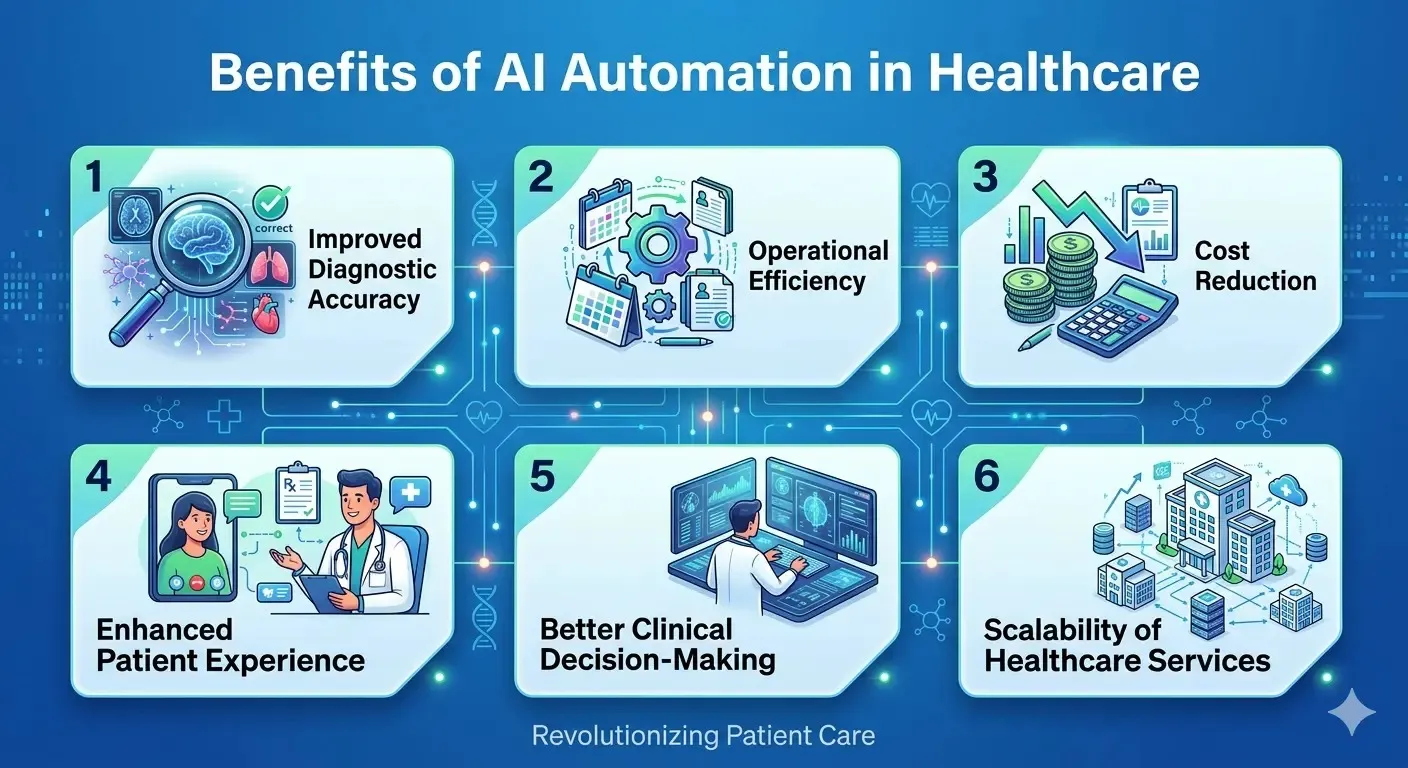
1 Improved Diagnostic Accuracy
Doctors make critical decisions every day, often under time pressure. AI supports them by processing large volumes of medical data quickly and consistently.
In imaging, for example, AI scans X-rays, MRIs, and CT images and highlights even the smallest irregularities. It does this without fatigue, which makes a big difference during long review cycles.
Here’s what improves with AI:
Early detection of diseases, especially in subtle cases
More consistent analysis across different cases
Reduced chances of oversight due to workload
2 Operational Efficiency
Hospitals run on processes, and many of those processes are repetitive.
Staff spend hours on scheduling, documentation, billing, and follow-ups. These tasks slow down operations when handled manually.
With AI for automation in healthcare, systems handle these tasks automatically.
Appointment scheduling runs without constant coordination
Billing and claims processing move faster
Patient records update in real time
3 Cost Reduction
Healthcare systems deal with constant financial pressure. A large portion of costs comes from inefficiencies like missed appointments, repeated tests, and delayed processes. AI helps reduce these gaps.
It improves cost management by:
Minimizing manual errors that lead to rework
Identifying high-risk patients early to prevent readmissions
Optimizing resource allocation across departments
4 Enhanced Patient Experience
Patients notice how smoothly a system works. Long waits, unclear processes, and delays create frustration. An important part of this is the benefits of AI-driven patient logistics automation in healthcare.
This includes:
Better patient flow within hospitals
Reduced waiting times
More organized scheduling systems
5 Better Clinical Decision-Making
Doctors deal with complex information every day. They need to analyze patient history, lab results, and current symptoms in a limited time. AI helps by organizing this data and turning it into actionable insights.
It supports decision-making by:
Highlighting potential risks based on patient data
Suggesting possible diagnoses using pattern recognition
Recommending treatment options based on similar cases
6 Scalability of Healthcare Services
Healthcare demand continues to grow, especially in high-density regions. Hiring more staff or expanding infrastructure doesn’t always solve the problem. AI provides a more flexible way to scale.
With automation:
Chatbots handle thousands of patient queries at once
Remote monitoring systems track multiple patients in real time
Digital platforms manage high volumes without slowing down
Also Read: Top Benefits of AI in Healthcare for Hospitals and Healthcare Providers
Real-World Use Cases of AI Automation in Healthcare
Many people still think of AI as something experimental. In reality, hospitals already use AI automation in healthcare in very practical ways. These applications don’t always stand out, but they quietly improve efficiency and accuracy across the system.
Let’s look at where it’s actively making a difference.
1 Medical Imaging and Diagnostics
Radiology leads the way in AI adoption. AI systems analyze X-rays, CT scans, and MRIs within seconds. They highlight abnormalities and assist doctors in identifying potential issues early. This shows how AI technologies in healthcare support clinicians without replacing their expertise.
Key advantages include:
Faster scan analysis
Consistent results across large volumes
Early detection of conditions like tumors
Also Read: Why AI-Powered Medical Imaging Software Development Is a Game-Changer for Radiology Centers
2 Virtual Health Assistants and Chatbots
Healthcare apps now rely heavily on AI-driven assistants. This is where AI Workflow Automation directly improves accessibility for patients and efficiency for providers. These systems handle routine interactions, which reduces pressure on hospital staff.
They help by:
Checking basic symptoms
Booking and managing appointments
Answering frequently asked questions
3 Predictive Analytics for Patient Outcomes
AI allows healthcare providers to move from reactive care to proactive care. By analyzing patient data, systems can predict risks before they turn into serious issues. This shift is one of the strongest advantages of AI and automation in healthcare.
For example, AI can:
Identify patients likely to need ICU care
Predict disease progression
Flag high-risk cases for early intervention
4 Robotic Surgery Assistance
AI enhances surgical procedures by improving precision. AI-assisted systems provide real-time guidance during operations. They help surgeons make more accurate movements and reduce risks.
Key contributions include:
Improved surgical precision
Real-time data support
Reduced chances of complications
5 Administrative Workflow Automation
Administrative work often consumes a large portion of hospital resources. Tasks like billing, claims processing, and record management require time and accuracy. The benefits of AI in healthcare workflow automation become very visible here.
With AI Workflow Automation, hospitals streamline these processes.
Systems process claims automatically
Records update without manual input
Workflows run faster across departments
6 Drug Discovery and Development
AI is also transforming pharmaceutical research. It speeds up drug discovery by analyzing large datasets and identifying potential compounds faster than traditional methods.
It helps by:
Reducing time needed for research
Improving clinical trial selection
Predicting drug effectiveness
7 Remote Patient Monitoring
Remote care is becoming more common, especially for chronic conditions. Wearable devices collect continuous data, and AI analyzes it in real time. This approach makes care more continuous and accessible, which is a key strength of AI automation in healthcare.
This allows healthcare providers to:
Monitor patients without frequent hospital visits
Detect unusual patterns early
Provide timely interventions when needed
Examples of AI Automation in Healthcare
Real-world examples provide better understanding than use cases because they show actual implementation.
Let’s look at how healthcare organizations are actually applying these solutions.
Hospital-Level Implementations
Hospitals currently operate artificial intelligence-based triage systems.
The systems use patient symptom assessment to establish case urgency order. The system decreases waiting periods while it guarantees essential patients receive immediate medical assistance.
Automated ICU monitoring serves as another example.
The system uses artificial intelligence to monitor patient vital signs while it notifies medical personnel about potential health deteriorations. This type of system provides essential critical care hospitals because it helps doctors identify vital patient information early.
Industry Tools and Platforms
Multiple healthcare facilities already utilize existing medical tools.
AI-powered radiology platforms assist in interpreting scans. Clinical decision support systems help doctors make more informed choices.
Healthcare providers work with AI & ML Development Company to create these tools which maintain high accuracy and reliability standards.
Startup Innovations
Startups introduce their innovative concepts to the industry.
AI-driven telehealth platforms now handle all three essential functions of medical care which include initial patient consultations and subsequent patient follow-up visits and ongoing patient communication.
The industry offers dedicated platforms which handle complete automation to conduct all processes from patient registration through to payment processing.
The Healthcare Application Development Company builds many healthcare solutions which operate according to actual healthcare requirements.
Real Case Snapshots
A simple before-and-after comparison helps put things into perspective.
Insurance claims required manual processing which took several hours before AI introduction and this method increased the chances of making mistakes.
The existing process requires two hours to perform but automation now enables its execution within six minutes while achieving superior precision.
Another example is diagnostics.
Scans need to go through manual review which different professionals handle in different ways. The inclusion of AI technology results in a process that becomes quicker and more reliable.
The process implements gradual improvements until it achieves its intended results. The organization achieves increased operational efficiency through decreased worktime and reduced expenses and improved patient care results.
The actual worth of AI automation in healthcare arises from its ability to transform daily medical operations. The system delivers value through its fundamental functions which enhance the way things work during normal business operations.
Challenges of Implementing AI Automation in Healthcare
While the benefits are clear, implementation is not always straightforward. There are a few challenges that organizations need to navigate carefully.
Data Privacy and Security
Healthcare data is highly sensitive.
Any system handling patient information must comply with strict regulations like HIPAA or GDPR. Data breaches are not just technical issues, they can damage trust.
This is why working with an experienced AI consultant for automation in healthcare becomes important, especially when dealing with compliance requirements.
Integration with Legacy Systems
Many hospitals still rely on older systems.
Integrating modern AI solutions with these legacy systems can be complex. Data formats may not match, and interoperability becomes a challenge.
This often slows down adoption more than the technology itself.
High Implementation Costs
AI systems require investment.
Infrastructure, skilled talent, and ongoing maintenance all add to the cost. For smaller healthcare providers, this can be a barrier.
However, it’s worth noting that long-term savings often outweigh the initial investment.
Regulatory and Ethical Concerns
AI decisions are not always easy to explain.
If a system recommends a diagnosis or treatment, clinicians need to understand why. This is where explainability becomes important.
There’s also the issue of bias. If the training data is not diverse, the AI model may produce skewed results.
Resistance to Change
Technology adoption is not just about systems, it’s about people.
Staff may be hesitant to trust or use new tools. Training becomes essential, but so does cultural acceptance.
Without that, even the best systems can fail to deliver results.
Data Quality and Availability
AI is only as good as the data it learns from.
Incomplete or inconsistent datasets can lead to inaccurate predictions. Many healthcare organizations still struggle with data standardization.
Improving data quality is often the first step before implementing AI and automation in healthcare effectively.
How to Implement AI and Automation in Healthcare
Implementing AI is not about jumping straight into technology. It’s more of a step-by-step process.
Identify Business and Clinical Objectives
Start with clarity.
What problem are you trying to solve? Is it reducing waiting time, improving diagnosis, or cutting operational costs? Define clear KPIs so you can measure success.
Assess Data Readiness
Before anything else, look at your data.
Is it clean, structured, and accessible? If not, you’ll need to invest time in data preparation.
Without good data, even the best AI models won’t perform well.
Choose the Right Use Case
Don’t try to automate everything at once. Start with a high-impact, low-risk area. Administrative automation is often a good starting point because it’s easier to implement and shows quick results.
Select the Right Technology Stack
Choose tools and platforms that fit your needs. This includes AI models, cloud infrastructure, and APIs. Working with an experienced AI & ML Development Company can help you make better decisions here.
Build vs Buy Decision
You can either build a custom solution or use existing software. Custom solutions offer flexibility but take time and resources. Off-the-shelf tools are faster to deploy but may not fit perfectly.
The right choice depends on your goals and scale.
Pilot Program
Start small. Run a pilot project to test the system in a controlled environment. Measure performance and identify any issues before scaling.
Integration with Existing Systems
Make sure the new system works smoothly with your current setup. This includes EHR systems, hospital management software, and other tools already in use.
Ensure Compliance and Security
Security should never be an afterthought. Ensure your system meets all regulatory requirements and uses proper encryption to protect data.
Train Staff and Stakeholders
Even the best system won’t work if people don’t know how to use it.Provide proper training and support to ensure smooth adoption.
Monitor, Optimize and Scale
Implementation doesn’t end after deployment. Continuously monitor performance, gather feedback, and make improvements. Once the system proves its value, you can scale it across the organization.
Why Choose AppZoro As Your Trusted Tech Partner?
Choosing the right technology partner is often where most healthcare organizations hesitate. Not because of lack of options, but because the stakes are high. You’re not just building software, you’re shaping systems that directly impact patient care.
This is where a company like AppZoro positions itself differently.
Healthcare Domain Expertise
Healthcare is not like other industries. It comes with strict regulations, complex workflows, and zero margin for critical errors.
AppZoro brings hands-on experience in building solutions around AI automation in healthcare, which means they understand both the technical side and the operational realities of hospitals and clinics.
This reduces the learning curve and helps avoid common implementation mistakes.
End-to-End Development
One common challenge is managing multiple vendors across different stages of development.
AppZoro simplifies this by offering complete, end-to-end services. From initial consultation and strategy to design, development, and deployment, everything is handled under one roof.
This approach works particularly well for organizations looking to adopt AI and automation in healthcare without juggling multiple teams.
Custom AI Solutions
No two healthcare organizations operate the same way.
Pre-built tools often fall short because they don’t align with specific workflows. AppZoro focuses on building tailored systems that fit into your existing processes rather than forcing you to adapt.
Whether it’s patient management, diagnostics, or AI Workflow Automation, solutions are designed to match real operational needs.
Compliance-Ready Development
Data privacy is not optional in healthcare.
AppZoro ensures that all solutions are built with compliance in mind, including HIPAA and GDPR standards. This is critical when dealing with sensitive patient information.
Working with an experienced AI consultant for automation in healthcare helps reduce risks and ensures your systems meet regulatory expectations from day one.
Scalable and Secure Architecture
Healthcare systems need to grow over time.
AppZoro focuses on building scalable architectures that can handle increasing data and patient loads. At the same time, security is built into every layer, not added later.
This balance between scalability and security is essential for long-term success in AI technologies in healthcare.
Proven Track Record
Experience matters, but results matter more.
AppZoro has worked on multiple healthcare projects, delivering measurable improvements in efficiency, accuracy, and user experience. Real-world case studies and client success stories provide a clearer picture of what they can achieve.
Case Study: Building Reliable AI-Driven Healthcare Systems with AppZoro
Background
Healthcare organizations face a critical challenge when adopting new technologies: balancing innovation with patient safety, regulatory compliance, and operational continuity. Unlike other industries, even minor system failures can directly affect patient outcomes.
A mid-sized healthcare provider (client anonymized) sought to implement AI-driven automation across patient workflows, diagnostics support, and internal operations.
They required a trusted, end-to-end technology partner capable of delivering a secure, scalable, and customized solution.
Challenge
They needed a solution that would integrate seamlessly, reduce operational friction, and remain compliant with strict healthcare regulations. The client’s key challenges included:
Disconnected systems across departments
Inefficient manual workflows increasing staff workload
Limited interoperability between patient management and diagnostic tools
High risk associated with handling sensitive patient data
Lack of internal expertise in AI automation in healthcare
Solution
AppZoro approached the project with strong healthcare domain expertise, focusing on understanding clinical workflows, identifying automation opportunities without disrupting care delivery, and minimizing implementation risks through industry familiarity. This helped reduce onboarding time and avoid common system design issues. To address vendor fragmentation, they delivered a fully integrated, end-to-end development model covering consultation, requirement analysis, UX/UI design tailored for medical staff, AI development, system integration, and compliant deployment—ensuring consistency and accountability throughout.
Instead of relying on generic tools, AppZoro built custom AI solutions aligned with the organization’s existing processes, including intelligent patient management, AI-assisted diagnostics, and automated administrative workflows, enabling smooth adoption with minimal disruption. Compliance was embedded from the start, with HIPAA-compliant data handling, GDPR-aligned privacy measures, and secure data storage and transmission, reducing regulatory risks. Additionally, the platform was designed with a scalable and secure architecture, featuring modular components, cloud-based infrastructure, and multi-layered security, ensuring long-term growth without compromising performance or data protection.
Results
Following implementation, the healthcare provider experienced measurable improvements:
Operational efficiency increased through workflow automation
Reduction in manual errors in patient data handling
Improved diagnostic support accuracy using AI tools
Enhanced user experience for both staff and administrators
Stronger compliance posture with reduced regulatory risk
Conclusion
Healthcare is going through a quiet transformation. AI automation in healthcare is playing a central role in this shift, making systems faster, more accurate, and more patient-focused.
From reducing administrative burden to improving diagnosis and enabling personalized care, the impact is already visible.
For healthcare providers, this is not just an opportunity, it’s a competitive advantage. Those who adopt early and implement thoughtfully will be better positioned to handle future demands.
If you’re considering integrating AI and automation in healthcare, the key is to start with a clear strategy and the right partner. Connect with us today!
Leave a Comment