
Hospitals face their greatest operational difficulties because they must treat an increasing number of patients while managing a growing volume of medical data to meet the rising needs of their patients. Medical professionals must complete their diagnostic work within shorter time frames while hospitals need to operate at maximum productivity and patients request customized healthcare solutions that exceed their standard treatments.
Global health reports predict that the world will experience a shortage of around 10 million healthcare workers by 2030. This is where AI technologies in healthcare are starting to make a real difference.
Artificial intelligence in medicine used to exist as a futuristic concept. Medical facilities and laboratories and outpatient treatment centers now use the technology for their operations. The AI system enables medical staff to analyze medical images and assess patient information while it predicts health outcomes and performs remote patient monitoring.
Understanding AI in Healthcare: Definition and Core Technologies
Before exploring actual uses of AI technology in healthcare it is necessary to know the definition of AI technology in healthcare.
Hospitals currently operate digital systems which include electronic health record systems and hospital management software. These systems provide patient data storage solutions while they assist with hospital operation management.
AI technology operates through distinct mechanisms.
AI systems perform data analysis functions and they use the information to improve their performance and assist physicians in their decision-making process.
What AI Means in Healthcare
Healthcare professionals use AI to describe computer systems which analyze medical data and produce valuable insights for doctors and healthcare providers.
These systems acquire knowledge by processing extensive datasets. As the system progresses, it becomes more proficient at recognizing patterns and determining future results.
An AI system which learns from thousands of X-ray images achieves the ability to identify beginning stages of medical conditions. This process allows doctors to detect medical issues with increased speed.
Core AI Technologies Used in Healthcare Today
Machine Learning
Machine learning is one of the most common AI technologies used in healthcare. It allows systems to learn from data and improve over time.
Healthcare uses machine learning for:
- predicting disease risks
- identifying high-risk patients
- analyzing medical images
- studying patient outcomes
Natural Language Processing
Doctors write a lot of notes during patient care. Hospitals also store huge amounts of medical documents. Natural Language Processing helps AI understand human language.
With this technology, AI can:
- read doctor notes
- summarize medical reports
- extract key information from records
- help automate documentation
Computer Vision
Computer vision helps AI understand images. AI can study these images and highlight possible abnormalities. Doctors can then review them more quickly. In healthcare, it is widely used for medical imaging such as:
- X-rays
- CT scans
- MRI scans
- ultrasound images
Predictive Analytics
Predictive analytics helps doctors understand what might happen in the future based on past data.
Hospitals use predictive models to:
- identify patients at risk of complications
- predict disease outbreaks
- reduce hospital readmissions
- improve patient care planning
Generative AI
Generative AI is a newer development in healthcare technology. Instead of just analyzing data, it can also generate content such as reports and summaries.
Some examples include:
- automatic clinical documentation
- AI-generated medical summaries
- support for medical research
Many experts believe this is one of the most promising new AI technology in healthcare developments.
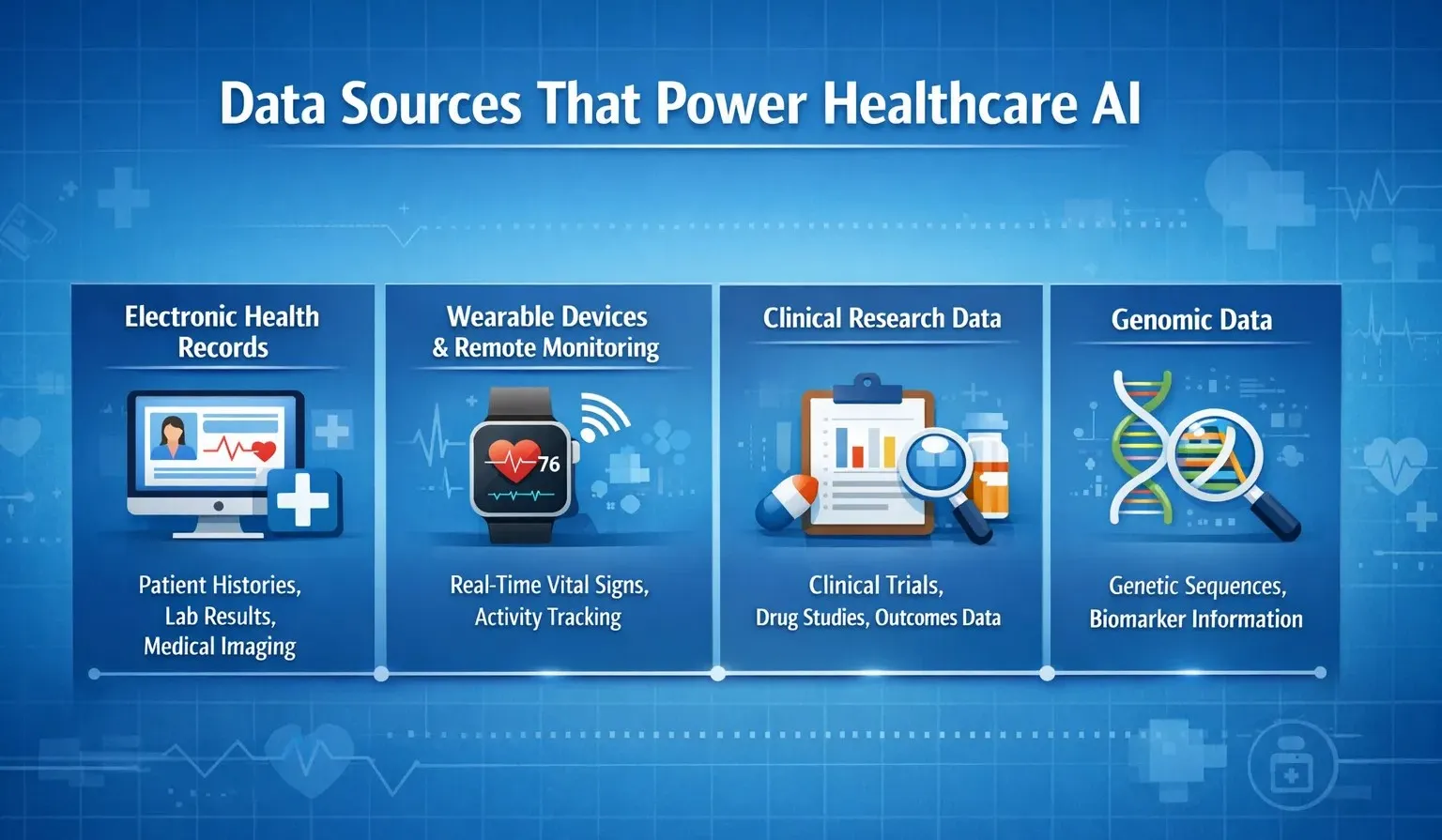
Data Sources That Power Healthcare AI
AI systems depend on large amounts of data. Healthcare provides many valuable data sources.
Electronic Health Records
Electronic Health Records contain important patient information such as medical history, prescriptions, and lab results.
AI systems analyze these records to find patterns and support clinical decisions.
Medical Imaging
Medical imaging provides large datasets for training AI models.
These include:
- X-rays
- MRI scans
- CT scans
- ultrasound images
Wearable Devices and Remote Monitoring
Wearables are becoming a powerful data source in healthcare.
Through AI and wearable technology in healthcare, devices like smartwatches and health trackers collect continuous health data.
They can track:
- heart rate
- sleep patterns
- activity levels
- oxygen levels
Clinical Research Data
Medical research and clinical trials produce a large amount of data. AI tools help researchers analyze this information faster and find useful insights.
Genomic Data
Genomic data contains information about a person’s genes.
AI systems can analyze genetic data to help doctors understand disease risks and design more personalized treatments.
Why Is Healthcare Turning to AI?
There are several reasons why healthcare organizations are adopting AI faster than before. The current healthcare system is facing some serious challenges.
Let’s look at a few of them.
1. Shortage of Doctors and Healthcare Staff
When medical staff are overloaded, it becomes difficult to deliver quick and accurate care.
AI helps by supporting doctors in tasks such as:
- analyzing medical scans
- organizing patient records
- helping with diagnosis
- automating paperwork
2. Massive Amounts of Healthcare Data
The problem is that humans cannot analyze all this information quickly. That is why AI technology used in healthcare is becoming so valuable. AI systems can study thousands of records and identify patterns that may not be obvious to doctors.
3. Rising Healthcare Costs
Healthcare is expensive for both hospitals and patients. Hospitals are always trying to improve efficiency while keeping costs under control. Many healthcare organizations are already using AI to improve operations and reduce unnecessary expenses.
AI tools can help reduce costs by:
- automating routine tasks
- reducing diagnostic errors
- improving hospital resource planning
- predicting patient risks earlier
4. AI Is Becoming Part of Modern Healthcare
As healthcare systems continue to evolve, AI will play an even bigger role in improving patient care and hospital efficiency. To understand how all this works, it is important to first understand what AI actually means in the healthcare world.
Today, AI technology software use cases in healthcare include:
- analyzing medical images
- predicting diseases
- improving hospital operations
- supporting patient communication
- helping researchers develop new drugs
Step by Step Guide to Implementing AI in Healthcare Organizations
Below is a practical step-by-step approach many healthcare organizations use.
Step 1. Define Clear Clinical or Operational Objectives
The first step to solving an AI problem requires researchers to determine the exact need which needs to be addressed through artificial intelligence technology. Hospitals need to determine whether they want to improve diagnostics, automate administrative work, enhance patient monitoring, or optimize hospital operations. The AI project establishes clear goals which enable the project team to achieve measurable outcomes.
Step 2. Build the Right Data Infrastructure
AI systems need high-quality data which serves as their main operating component. Healthcare organizations must ensure that patient data from different sources can be collected, organized, and integrated properly. This process requires the establishment of connections between electronic health records and imaging systems and other medical databases.
Step 3. Choose the Right AI Technologies and Tools
Some hospitals prefer building custom software development solutions, while others adopt ready-made AI platforms. Organizations base their decisions on this matter according to three important aspects which include expenses and system scalability and their available technical know-how. Organizations need to select appropriate infrastructure solutions between cloud-based systems and on-premise systems because this decision impacts their future capacity to execute artificial intelligence projects.
Step 4. Develop and Train AI Models
The current stage establishes and develops artificial intelligence systems through the utilization of medical data. The developers need to make training data for their models which they will then develop before conducting tests to check their accuracy. The healthcare sector needs technology partnerships at this stage because they help develop AI applications while validating model performance through actual clinical testing. The AI system needs to undergo testing procedures which will validate its ability to deliver trustworthy information.
Step 5. Integrate AI into Existing Healthcare Systems
AI technology requires complete integration with existing hospital systems to deliver its benefits. The process of integration establishes connections between AI systems and three main hospital systems which include electronic health records and medical imaging systems and hospital management software. The system design enables doctors and staff members to obtain AI insights through their main work activities which eliminates the need to operate different systems.
Step 6. Ensure Compliance and Security
AI systems must adhere to strict regulatory requirements because healthcare data contains highly sensitive information. Hospitals must establish effective security systems which will safeguard patient data while meeting healthcare compliance requirements. Responsible AI execution in the healthcare sector requires three fundamental elements which include protecting data privacy and maintaining secure data systems and conducting risk assessments.
Step 7. Train Healthcare Staff
The complete success of advanced technology depends on its user acceptance. Healthcare professionals need to understand how AI systems work and how to use them effectively. Training programs help doctors and hospital staff become comfortable with new tools and workflows. The research establishes trust in AI healthcare systems which motivates more people to use the technology throughout the organization.
Step 8. Monitor Performance and Continuously Improve
The system needs continuous assessment and enhancement because the system needs ongoing developer support. Hospitals need to assess system performance at regular intervals while they should update their models whenever new data becomes accessible. The process of continuous monitoring enables organizations to discover faults which leads to better system performance and trustworthiness. Healthcare organizations can use emerging AI technologies to enhance their systems through new data and innovations.
How Conversational AI is Transforming Patient Engagement
Hospitals receive thousands of patient calls every day for appointment bookings, basic health questions, prescription refills, and follow-ups. Staff experience increased workload because they must manually handle all patient calls. Systems that enable patients to interact through natural language their their need for information about their medical needs make up conversational AI.
Hospitals currently implement these tools as standard components of their healthcare AI technology software applications to enhance patient engagement.
Conversational AI offers several advantages for hospitals and healthcare organizations. It helps reduce pressure on staff while improving communication with patients.
Some of the biggest benefits include:
Reduced administrative workload
Patient calls, appointment scheduling, and basic inquiries can take up a lot of staff time. AI chatbots can handle many of these tasks automatically, allowing healthcare staff to focus on more critical work.
Faster patient communication
Patients no longer need to wait on long phone calls. AI systems can respond instantly to patient questions through chat or messaging platforms.
24/7 patient support
Unlike human support teams, AI tools can operate around the clock. Patients can receive assistance at any time, even outside hospital working hours.
Healthcare websites and mobile applications make extensive use of chatbots to assist their users. The system allows patients to submit inquiries, assess their medical conditions, schedule appointments, and access information about hospital services.
Voice assistants
Patients can use voice commands to access healthcare services through voice-enabled AI systems. Patients can inquire about medication instructions, verify their appointment times, and receive reminders through voice-based systems.
These advanced AI systems function as patient navigation tools that assist users in accessing various healthcare services.
Major AI Use Cases Transforming Healthcare
Artificial intelligence is no longer limited to one specific area of healthcare. It is now used across diagnosis, hospital operations, research, and patient monitoring.
In fact, many of the most impactful AI technology software use cases in healthcare are already improving medical outcomes and operational efficiency.
Let’s look at some of the most important applications.
AI in Medical Imaging and Diagnostics
Medical imaging is one of the earliest and most successful uses of AI in healthcare.
AI systems can analyze thousands of medical images in a short time and identify patterns that may indicate disease. This helps doctors detect problems earlier and improve diagnostic accuracy. This makes it one of the fastest growing areas of AI technology used in healthcare.
Common applications include:
- radiology automation for faster image analysis
- early detection of conditions such as pneumonia or stroke
- AI-assisted cancer screening for breast, lung, and skin cancers
Predictive Analytics for Disease Prevention
Preventing diseases before they become serious is one of the biggest goals of modern healthcare.
With AI predictive analytics, healthcare providers can analyze patient history, lifestyle data, and medical records to identify people who are at risk of certain conditions.
Examples include:
- predicting risk of heart disease or diabetes
- identifying patients likely to be readmitted to the hospital
- supporting population health management programs
Drug Discovery and Clinical Research
Developing new medicines is a long and expensive process. AI is helping pharmaceutical companies and research institutions accelerate drug discovery.
AI systems can analyze massive biological datasets to identify potential drug molecules and predict how they might interact with the human body. Many pharmaceutical organizations now rely on Enterprise AI solutions to support drug development and research processes.
Key benefits include:
- faster identification of promising drug candidates
- improved design of clinical trials
- better analysis of research data
Personalized Treatment and Precision Medicine
Every patient is different. AI helps doctors create treatment plans that match the specific needs of each individual. This is one of the most promising areas of new AI technology in healthcare, especially as genetic data becomes more accessible.
By analyzing medical history, lifestyle data, and genetic information, AI systems can suggest treatment strategies tailored to each patient.
Important applications include:
- AI-based treatment recommendations
- personalized therapy planning
- genomic medicine and genetic risk analysis
AI Powered Hospital Operations
Hospitals are large and complex organizations. Managing patient flow, staff schedules, equipment, and supply chains can be difficult without the right technology.
AI systems help hospitals improve efficiency by automating operational processes. Many healthcare providers work with an AI & ML development company to implement advanced operational systems that improve efficiency and reduce operational costs.
Some examples include:
- hospital workflow automation
- patient admission forecasting
- supply chain and inventory management
Remote Patient Monitoring
Remote monitoring is becoming an important part of modern healthcare. Patients can now be monitored outside hospitals using connected devices and wearable technology.
Through AI and wearable technology in healthcare, devices such as smartwatches and biosensors can track important health indicators including heart rate, oxygen levels, sleep patterns, and physical activity.
Many healthcare organizations are integrating these tools into their digital platforms through Healthcare application development services.
Benefits include:
- early detection of health problems
- better management of chronic diseases
- reduced hospital visits
- continuous patient monitoring at home
Emerging AI Technologies Shaping the Future of Healthcare
Below are some of the most promising technologies that are transforming the future of AI in healthcare technology.
Generative AI in Healthcare
Generative AI is one of the fastest growing innovations in healthcare. Unlike traditional AI systems that only analyze data, generative AI can create new content such as summaries, reports, or documentation.
Hospitals are already using this technology to automate routine documentation tasks. Doctors often spend a significant portion of their time writing patient notes and preparing reports. Generative AI can automatically summarize clinical conversations and generate structured medical documentation.
This technology helps reduce administrative work and allows doctors to focus more on patient care. Many hospitals are investing in AI application development projects to build customized generative AI tools for their workflows.
Digital Twins for Personalized Care
Digital twin technology is another exciting development in healthcare AI. A digital twin is a virtual model of a real patient that is built using health data, medical history, and physiological information.
Using these digital models, doctors can simulate different treatment scenarios before applying them in real life.
This technology has strong potential for personalized medicine because it helps doctors understand how different treatments might affect each patient.
AI Powered Robotics
Robotics combined with AI is transforming how certain medical procedures are performed. AI powered robots are now assisting surgeons during complex procedures and improving precision in operating rooms.
One of the most common examples is robotic assisted surgery. These systems allow surgeons to perform delicate procedures with greater accuracy and control.
AI driven robotics is also being used in hospital operations. Robots can assist with tasks such as transporting medical supplies, delivering medications, and managing logistics within hospitals.
These innovations show how AI and technology in healthcare are working together to improve both patient care and hospital efficiency.
Federated Learning for Secure Data Collaboration
Healthcare organizations often face challenges when sharing medical data due to privacy concerns. Federated learning offers a new approach that allows multiple organizations to train AI models without directly sharing patient data.
This helps healthcare providers collaborate on research while protecting patient privacy. Federated learning is expected to play an important role in large scale medical research and future AI predictive analytics models.
Edge AI for Real Time Monitoring
Edge AI is another technology gaining attention in healthcare. Instead of sending data to centralized cloud systems, edge AI processes data directly on devices such as medical equipment or wearable sensors.
As remote healthcare grows, edge computing will become an important part of AI technologies in healthcare, especially for real time patient monitoring.
Ethical, Regulatory, and Security Challenges in Healthcare AI
While AI offers many benefits, it also raises important ethical and regulatory concerns. Healthcare data is extremely sensitive, and the use of AI must be handled carefully to maintain patient trust.
As AI in healthcare industry adoption increases, organizations must address several key challenges related to privacy, fairness, and transparency.
Data Privacy and Security Risks
Healthcare systems store large amounts of personal and medical information. When AI systems process this data, strong security measures are essential to prevent unauthorized access.
To reduce these risks, healthcare organizations must build secure AI pipelines and follow strict data protection policies. Strong cybersecurity practices are essential when implementing AI technologies in healthcare.
Algorithm Bias and Fairness
AI systems learn from historical data. If that data contains biases, the AI model may produce unfair or inaccurate results.
For example, if a training dataset mainly includes data from one population group, the AI system might not perform well for other groups.
This can create healthcare disparities and affect the quality of care.
Developers must carefully evaluate training data and continuously monitor models to ensure fairness. Addressing bias is an important responsibility for organizations building AI in healthcare technology solutions.
Transparency and Explainability
Another challenge is understanding how AI systems make decisions. Some advanced AI models operate as complex systems where the decision process is not always easy to explain.
This is often called the “black box” problem.
Doctors need to trust AI recommendations before using them in clinical decisions. That is why explainable AI techniques are becoming more important.
Explainable systems allow healthcare professionals to understand why a certain prediction or recommendation was made.
Improving transparency helps build trust in AI and technology in healthcare applications.
Regulatory Compliance
Healthcare is one of the most regulated industries. Any technology used in medical settings must comply with strict regulatory standards.
Many countries are also developing specific frameworks for AI governance in healthcare.
Following these regulations ensures that AI technologies in healthcare are implemented safely and responsibly while protecting patient rights.
Best Practices for Successful AI Implementation in Healthcare
Implementing AI in healthcare is not only about adopting new tools. It requires proper planning, strong data systems, and collaboration between technology experts and healthcare professionals. When organizations approach it strategically, AI technologies in healthcare can deliver real value in terms of better patient outcomes, improved efficiency, and reduced operational costs.
Below are some best practices that healthcare organizations should follow when implementing AI solutions.
Start with Pilot Projects
Instead of launching large scale AI systems immediately, hospitals should begin with smaller pilot projects. Pilot programs allow organizations to test AI technology used in healthcare in a controlled environment before expanding it across departments.
This approach helps teams understand how the technology performs in real clinical settings. It also allows hospitals to identify potential challenges early and refine the system before full deployment.
Focus on High Impact Use Cases
Healthcare organizations should prioritize AI projects that solve real problems. Not every hospital process requires artificial intelligence, so selecting the right use cases is important.
Many organizations begin with areas where AI technology software use cases in healthcare already show strong results. Examples include medical imaging analysis, patient engagement platforms, predictive disease detection, and hospital workflow optimization.
Focusing on high impact areas helps demonstrate the value of AI in healthcare industry applications and encourages wider adoption within the organization.
Ensure Strong Data Governance
AI systems rely heavily on high quality data. Without proper data management, AI models may produce inaccurate results. Healthcare organizations must establish strong data governance practices to ensure data accuracy, security, and compliance.
This includes maintaining standardized patient records, protecting sensitive health information, and ensuring that datasets are reliable. Proper data governance is essential when developing large scale Enterprise AI solutions for healthcare organizations.
Maintain Clinician Involvement
Doctors, nurses, and healthcare professionals should be actively involved in AI projects. Their experience and clinical expertise help ensure that AI systems are practical and useful in real medical workflows.
When clinicians participate in the development process, they can guide how the system should work and provide feedback on how AI insights should be presented. This collaboration improves trust and encourages adoption of AI in healthcare technology solutions.
Establish AI Governance Teams
Healthcare organizations should also create dedicated AI governance teams. These teams are responsible for overseeing how AI systems are developed, deployed, and monitored.
Governance teams ensure that AI technologies in healthcare follow ethical standards, regulatory guidelines, and internal policies. They also help monitor model performance and ensure that AI systems continue to deliver reliable outcomes.
Invest in Interoperability Standards
Hospitals typically use many different digital systems such as electronic health records, diagnostic platforms, and hospital management software. AI tools must be able to communicate with these systems to work effectively.
Investing in interoperability standards ensures that AI solutions integrate smoothly with existing infrastructure. This is particularly important when developing new platforms through Healthcare application development services.
When all systems work together, healthcare providers can take full advantage of AI and wearable technology in healthcare and other emerging digital health innovations.
Why Choose AppZoro for Healthcare AI Solutions
As healthcare organizations explore artificial intelligence, choosing the right technology partner becomes critical. Implementing AI requires deep expertise in both healthcare systems and advanced technologies.
AppZoro provides specialized Healthcare application development services designed to help hospitals, healthcare providers, and digital health companies successfully adopt AI solutions.
Expertise in Healthcare AI Development
AppZoro works as an experienced AI & ML development company with a strong focus on healthcare innovation. The team builds intelligent systems that support diagnostics, patient engagement, predictive analytics, and hospital operations.
From building machine learning models to integrating AI into existing healthcare platforms, AppZoro helps organizations unlock the full potential of AI technologies in healthcare.
Compliance First Development Approach
Healthcare technology must follow strict security and privacy standards. AppZoro follows a compliance first approach to ensure that all AI solutions meet regulatory requirements.
This includes designing HIPAA compliant architectures, implementing strong data protection measures, and building secure AI pipelines. These practices ensure that AI technology used in healthcare remains safe, reliable, and compliant with industry standards.
Custom AI Solutions for Hospitals and Health Systems
Every healthcare organization has unique needs. AppZoro develops custom solutions that align with specific clinical workflows and operational goals.
The team supports a wide range of AI technology software use cases in healthcare, including:
- AI powered diagnostic tools
- conversational patient engagement platforms
- predictive healthcare analytics
- intelligent hospital workflow systems
End to End Implementation Support
Successful AI adoption requires more than just software development. It involves planning, integration, and continuous improvement.
AppZoro provides complete support throughout the AI journey, including consulting, system development, deployment, and ongoing maintenance. By combining technical expertise with healthcare knowledge, the company helps organizations build scalable Enterprise AI solutions that support long term innovation.
With the right strategy and technology partner, healthcare providers can confidently adopt new AI technology in healthcare and transform how care is delivered in the modern healthcare ecosystem.
Conclusion
Healthcare is entering a new era where technology plays a bigger role in improving patient care and hospital efficiency. Over the past few years, AI technologies in healthcare have moved from research labs into real hospital environments. Doctors are using AI tools for diagnostics, hospitals are improving workflows with intelligent systems, and patients are experiencing faster and more convenient care.
As adoption grows, AI in healthcare technology will continue transforming how medical services are delivered. From advanced diagnostics to remote monitoring and personalized treatment plans, AI will help healthcare providers make smarter decisions based on real data.
Healthcare organizations that adopt emerging AI technologies in healthcare strategically can achieve several long-term benefits.
Our team specializes in building advanced healthcare platforms powered by AI. From intelligent diagnostics to conversational systems and predictive healthcare tools, we help healthcare organizations design and implement scalable AI solutions.
If you want to explore how AI in healthcare technology can transform your healthcare services, connect with our team today. We can help you plan, build, and deploy solutions that match your organization’s goals and long-term vision.
Frequently Asked Questions
What is AI technology in healthcare?
AI technology in healthcare refers to computer systems that analyze medical data and assist doctors in diagnosis, treatment planning, and hospital operations. These systems use technologies such as machine learning, predictive analytics, and automation to improve healthcare efficiency and accuracy.
What are the three AI technology categories in healthcare?
The three main categories include clinical AI, operational AI, and patient engagement AI. Clinical AI supports diagnosis and treatment decisions, operational AI improves hospital workflows, and patient engagement AI focuses on communication and patient interaction.
How are AI technologies used in healthcare today?
Hospitals use AI technologies in healthcare for many purposes such as medical imaging analysis, disease prediction, patient monitoring, clinical research, and hospital workflow automation.
What are some emerging AI technologies in healthcare?
Some important emerging AI technologies in healthcare include generative AI for medical documentation, AI-powered robotics for surgery, digital twin technology for personalized treatment, and predictive analytics for disease prevention.
How does conversational AI help healthcare providers?
Conversational AI technology in healthcare allows hospitals to automate patient communication through chatbots and virtual assistants. These systems can answer questions, schedule appointments, and provide basic health information.
How can we start implementing AI in our healthcare organization?
You can start by consulting with an experienced technology partner who understands healthcare systems and AI development. Our team can guide you through planning, development, integration, and deployment of AI solutions tailored to your organization.