
Remember heading out for a Sunday ride, getting home genuinely pleased with yourself, and then realising your phone had quietly stopped recording somewhere around the second hill, so the whole thing is now a flat line on a map? That single failure is telling you exactly why a Strava-style product is a different animal from a gym logger, and it is also the reason the cost to develop an app like Strava is sitting higher than most founders are expecting.
A workout tracker is mostly storing what somebody is typing in, whereas an activity tracker is recording continuously in the background, writing location points every second, drawing them on a map, calculating pace, distance and elevation from them, and then showing all of it to people who are liking and commenting on it. This is why the budget conversation is really about reliability and infrastructure rather than screens, and AppZoro’s guide on how to develop a fitness app is covering the wider process end to end.
So what should you actually be pricing before a single screen is getting designed? Well, the tracking engine, the mapping provider, the data model behind every activity, the social layer and the monthly bills that are arriving after launch, so let’s take a look.
How Much Does It Cost to Develop an App Like Strava?
The Strava app development cost is moving with six variables, namely how many platforms you are shipping, how accurate and battery-friendly the tracking has to be, which mapping provider you are choosing, how much of the social layer is in the first release, how much analytics is sitting behind each activity, and how much testing you are doing on real devices in real conditions.
| Development scope | Typical features | Estimated cost | Main cost drivers |
| MVP | Accounts, GPS activity recording, route map, basic stats, activity history | $15,000 to $25,000 | Tracking reliability, one platform, light backend |
| Mid-level | Following, activity feed, likes and comments, performance analytics, notifications, subscriptions | $25,000 to $35,000 | Social backend, feed performance, billing, second platform |
| Advanced | Segments, challenges, leaderboards, wearable sync, richer analytics, moderation tools | $35,000 to $50,000 and upward | Scale, real-time processing, integrations, heavier QA |
Those ranges are AppZoro’s published general fitness figures rather than verified Strava-style quotes, and they are assuming design, mobile development, backend work, integrations, testing and deployment inside the number, with mapping fees, hosting and app store costs sitting outside it. A genuinely community-scale product is going above the top band, and the reasons are not hard to see, because an activity feed serving thousands of people is an infrastructure problem before it is a feature. So which features are really driving that? Let’s break it down.
Which Strava App Features Have the Biggest Impact on Development Cost?
The Strava app features that are shaping the budget are rarely the ones sitting at the top of a wireframe. Registration, profiles and history are straightforward, whereas the tracking engine underneath them is where the engineering hours are really going, since it has to keep recording while the screen is off, survive a phone call, handle a tunnel with no signal, and still produce a route matching what somebody actually ran.
Mapping and route visualisation are adding their own weight, because rendering a long route smoothly and showing elevation alongside it is both a performance problem and a recurring cost, while analytics such as pace, splits and personal bests are needing a data model that is still fast when an account is holding four years of activities. And that is not all, because the social layer is effectively a second product, resulting in:
- Feeds, followers, likes and comments, each needing permissions, pagination and performance work.
- Segments and leaderboards, which are needing comparison logic and are inviting cheating, so moderation is arriving with them.
- Challenges and achievements, with the rules engine and the notifications that are keeping them alive.
- Privacy controls, since people are sharing routes that are starting at their front door.
That last point is extremely crucial and it is definitely not optional, since hiding start and end points, setting activity visibility and controlling who is seeing a profile are safety features rather than nice-to-haves. So how are these splitting across releases? Let’s take a look.
Strava App Development Cost by Project Scope
The honest way to plan this is deciding what is proving the product and what is waiting for evidence that people are coming back.
| Project scope | Feature inclusions | Complexity | Budget consideration |
| MVP with essential tracking | Recording, route map, distance, pace, elevation, history, privacy settings | Medium | Most of the budget is going into tracking reliability, not screens |
| Mid-level with community | Following, feed, kudos and comments, performance insights, push notifications | Medium to high | Backend and feed performance are becoming the main spend |
| Advanced platform | Segments, leaderboards, challenges, wearable sync, admin and moderation dashboards | High | Scale, abuse handling and integration upkeep are continuing costs |
A first release is genuinely fine with recording, a map, the core numbers and privacy controls, while segments and leaderboards are waiting until there is a community worth comparing. For a broader view of how scope, team structure, integrations and maintenance are shaping a fitness budget generally, AppZoro’s fitness app development cost breakdown is the better reference, though it is covering fitness products as a category rather than pricing a GPS tracking product specifically. And speaking of what is sitting under the hood, let’s see what the tracking engine is really costing.
How GPS Tracking, Maps, and Backend Infrastructure Affect Cost
Background location is the most demanding part of this build, since both platforms are treating it as sensitive, so you are handling permission flows, “while using” versus “always” states, foreground services on Android and background modes on iOS, and doing all of it without flattening the battery on a four-hour ride. This is only testable on real hardware in real conditions, which is why device testing is a line item rather than an afterthought.
Mapping is where a one-time build is turning into a monthly bill. Google removed the flat $200 monthly credit from Google Maps Platform on 1 March 2025 and replaced it with per-SKU free caps, with Essentials SKUs such as Dynamic Maps including 10,000 free events a month and overage charged per thousand calls, while Mapbox is offering 50,000 free web map loads a month and then charging per thousand after that. The practical point is that providers are pricing differently per product and per unit, so the mapping choice is affecting both the build and the running cost, and it is worth modelling at your expected activity volume before anything is getting locked in.
Behind that, the backend is storing a lot of small points, syncing across devices, handling an upload arriving hours later from a watch, and staying responsive while a feed is read far more often than it is written. So how is the platform choice moving this? Let’s break it down.
How Platform Choice and Technology Affect Strava App Development Cost
Platform choice is affecting testing even more than development, since shipping both platforms from day one is roughly doubling the device matrix for a feature set that is depending on hardware behaviour. Native development is usually behaving better for continuous location, background services and watch companions, while cross-platform is working well for feeds, profiles, analytics screens and settings, and plenty of teams are sensibly mixing the two by keeping the tracking layer native.
Underneath that, the technology decisions are following the same logic, resulting in:
- A database that is handling time-series location data without slowing down as accounts are growing.
- Cloud infrastructure that is scaling with activity uploads rather than with signups.
- Monitoring and crash reporting, because a tracking failure is invisible until somebody is complaining.
- Analytics that are telling you whether people are recording a second activity at all.
None of these is glamorous, and each and every one of them is affecting the maintenance bill more than the launch bill. So what about the devices people are actually wearing? Let’s take a look.
Wearable Integrations, Advanced Analytics, and Other Cost Factors
Wearables are where scope is expanding quietly. Connecting to Apple Health or Health Connect is giving you activity and heart-rate context without manual entry, but each connection is bringing its own permissions model, data formats and sync edge cases, and a watch companion is a separate build with its own interface and release cycle. This is why integrations are affecting every future release rather than just the one they ship in, and the limits around battery, phone-to-watch sync and hardware testing are covered in AppZoro’s wearable app development guide.
Accuracy is deserving the same honesty. A 2017 Stanford study in the Journal of Personalized Medicine tested seven wrist-worn devices and found that none of them estimated energy expenditure with an error below 20 percent, so wearable readings are working best as context rather than as a number somebody’s training is being judged on. If your roadmap is extending into recovery, sleep or habit tracking, that is a broader product with different requirements, and AppZoro’s wellness application development page is showing how that wider scope is usually described. So how long is all of this taking? Let’s break it down.
How Long Does It Take to Build an App Like Strava?
AppZoro’s fitness page is stating that an MVP is typically running 3 to 4 months, while a mid-level platform with subscriptions and wearable integrations is usually running 5 to 7 months, and a GPS-heavy product is sitting at the longer end of both because of the testing involved. Those are one company’s delivery norms rather than an industry standard, and your own timeline is depending on scope, team size, integrations and how quickly decisions are coming back from your side.
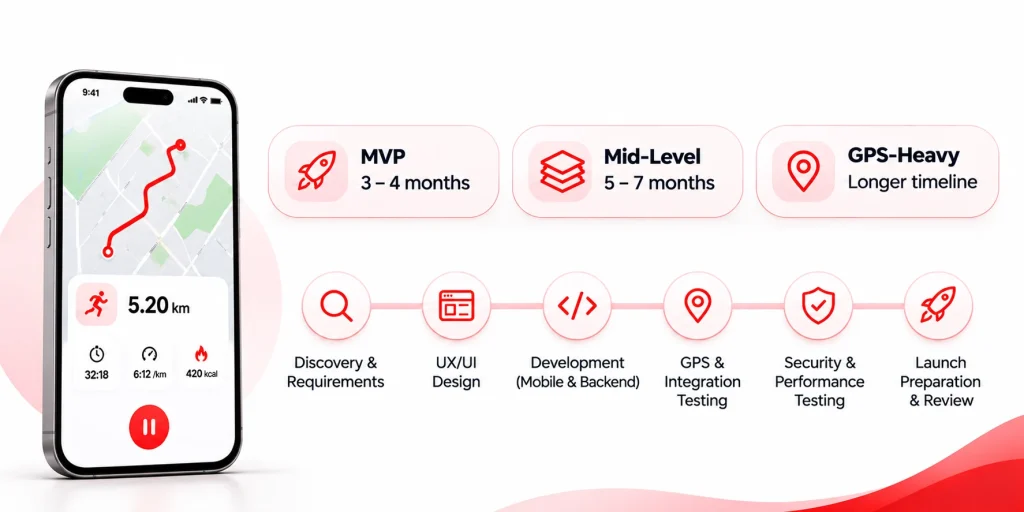
The stages are predictable enough, meaning discovery and requirements, UX and UI with the recording flow first, mobile and backend development running together, GPS and integration testing in real conditions, security and performance testing, and launch preparation with the store review built in. This is where testing is behaving differently from a normal app, since a tracking engine cannot be validated from a desk. So what is arriving after launch? Let’s take a look.
What Are the Ongoing Costs of Running a Strava-Style App?
The running costs are the part that is surprising founders most, because a tracking product is consuming infrastructure continuously rather than when somebody is opening a screen, resulting in:
- Cloud hosting, databases and storage, all growing with every activity recorded.
- Mapping API calls, billed per thousand once the free monthly caps are gone.
- Data transfer, monitoring, crash reporting and analytics.
- Store costs, with Apple charging $99 a year and Google a one-time $25, and commission on subscriptions at 15 percent for most smaller sellers.
- Bug fixes, security updates and yearly OS compatibility work.
- Support and moderation, which are arriving with leaderboards and public feeds.
These are operating expenses rather than development costs, and they are needing their own line in the plan, since a product that is working beautifully at a thousand users is quietly costing real money at fifty thousand. So how is the number coming down sensibly? Let’s take a look.
How Can You Reduce the Cost of Building an App Like Strava?
The cheapest version of this product is not the one with fewest features, it is the one with the clearest definition, since ambiguity is what is really costing money once development is running, so start by proving that people are recording a second and third activity, because without that, segments and challenges are decoration.
A sensible plan is looking like this, resulting in:
- Shipping one platform first, with recording, maps, core stats and privacy controls.
- Testing GPS accuracy and battery drain on real devices in week one, not at the end.
- Delaying feeds, segments and leaderboards until retention is justifying them.
- Choosing integrations that users are asking for, rather than matching a competitor’s list.
- Modelling mapping costs at your expected volume before committing to a provider.
- Reusing proven components for auth, billing and notifications instead of customising everything.
What is not belonging on that list is cutting privacy controls, security work or tracking reliability, since those are the three things people are judging the product on. If you are planning to widen into habits or recovery later, the planning considerations in AppZoro’s guide to building a wellness app are worth reading before that scope is getting locked in. So who should be building it? Let’s take a look.
How to Choose a Fitness App Development Company for a Strava-Like Product
Fitness app development cost is only meaning something when the team quoting it has built something tracking people outdoors, so ask to see a location-based product, ask how background permissions and dropped signal are handled, and ask who is owning the data model when the engagement is ending.
A reasonable checklist is looking like this, resulting in:
- Real location-based and mobile experience, with products still live.
- Backend engineering that is comfortable with time-series data and feeds.
- Documented privacy and security practice, including route privacy and consent.
- Integration testing on actual devices and wearables.
- Feature-level estimates with milestones instead of one lump sum.
- Clear terms on source-code ownership, documentation and post-launch support.
And that is not all, because the way a partner is handling the first awkward scope question is telling you more than any case study, since somebody pushing back early is the one protecting your budget later. So what is all of this adding up to? Let’s take a look.
Conclusion
So when it is all coming together, the cost to develop an app like Strava is being set by a handful of choices made in the right order, namely how reliable the tracking has to be, which mapping provider you are choosing, how much of the community layer is in the first release, which integrations are earning their place, and how much you are budgeting for the hosting, mapping and support bills continuing every month after launch. These choices are extremely crucial because they are shaping both the quote and the product people are keeping on their phone.
And if you are planning a GPS tracking product and you are wanting a scope and estimate built around your own users rather than around a competitor’s feature list, AppZoro’s fitness technology solutions team is a reasonable place to start the conversation.
Frequently Asked Questions
How much does it cost to develop an app like Strava?
It is a range rather than one figure, and as a planning frame AppZoro is publishing general fitness ranges of $15,000 to $25,000 for an MVP, $25,000 to $35,000 for a mid-level platform and $35,000 to $50,000 for an advanced one, with GPS accuracy, mapping, social features and integrations deciding where a Strava-style build is landing.
What is the Strava app development cost for an MVP?
An MVP is sitting at the lower end when it is limited to accounts, activity recording, a route map, core stats, history and privacy settings on one platform, with the tracking engine taking most of that budget rather than the interface.
How long is it taking to build an app like Strava?
AppZoro is quoting 3 to 4 months for an MVP and 5 to 7 months for a mid-level platform, with a GPS-heavy product sitting at the longer end because tracking and integration testing are happening on real devices.
What are the most important Strava app features?
Reliable background recording, an accurate route map, distance, pace and elevation, activity history and privacy controls, with feeds, segments and leaderboards becoming important only once there is a community using them.
Can you build a fitness app like Strava on a limited budget?
Yes, if the first release is staying narrow, meaning one platform, recording, maps and core stats, while the social layer is waiting, though cutting privacy, security or tracking reliability is costing far more later than it is saving now.
What affects the ongoing cost of a Strava-style app?
Hosting, databases and storage growing with activity volume, mapping API calls once free caps are gone, store fees and commission, monitoring, yearly OS updates, support and moderation.
 Profile of Sam Agarwal